
By Steven Sheffield — The Giro d’Italia is the most Italian thing in sport — and that is saying something. Founded in 1909 by La Gazzetta dello Sport, a sports newspaper that was struggling to survive and gambled its future on staging a race around the entire country, the Corsa Rosa has grown across more than a century into one of the most celebrated and dramatic events in cycling. Inspired by the success of the Tour de France, which had launched six years earlier in 1903, the Giro quickly developed an identity entirely its own — one shaped by the landscapes of Italy, the passions of its tifosi, and a gift for producing racing that defies rational explanation. Today it stands as the second of cycling’s three Grand Tours in terms of age, and for many devotees of the sport, first in terms of drama and beauty.
The race takes its character from Italy itself — chaotic, emotional, unpredictable, and capable of sudden and extreme shifts in fortune. Its mountain stages in the Dolomites and the Alps have provided the backdrop for some of cycling’s most legendary performances, and its long history is populated by figures whose names still carry the full weight of the sport’s mythology. The Giro has a particular genius for producing races that cannot be explained by form guides or pre-race logic — moments of courage, betrayal, and improbable triumph that linger in the memory long after the peloton has left Italy.
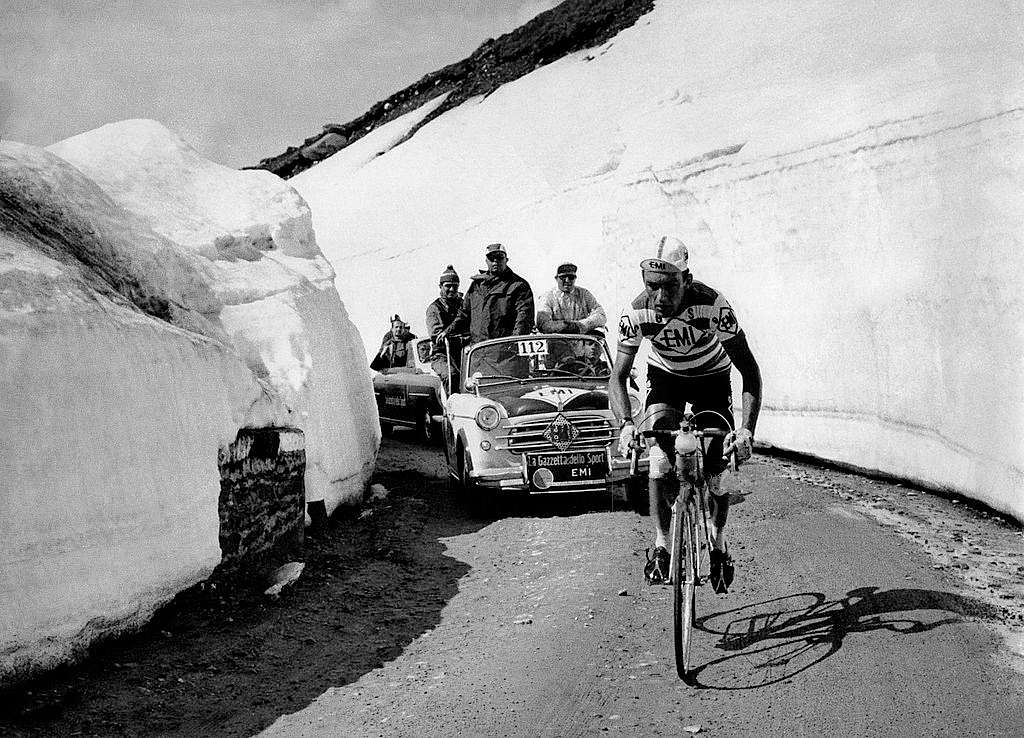
The 109th edition of the Giro d’Italia begins on 8 May 2026 with a Grande Partenza in Bulgaria — the first time in the race’s history that it has started there — before transferring to Italy for three weeks of racing through the peninsula’s most spectacular terrain, finishing in Rome. The questions that follow draw on the full sweep of the Giro’s history, from its earliest editions to the 2026 race itself.
Q1. Three riders stand alone atop the all-time Giro d’Italia winners list, each having won the race five times — a total no one has since matched or surpassed. Who are the three riders tied for the most Giro d’Italia victories, and what do all three have in common beyond the number of wins?
Q2. Today the pink leader’s jersey is inseparable from the identity of the Giro. Yet the race’s first two decades were run without any distinctive jersey for the overall leader. Who was the first rider to wear the maglia rosa, and why was pink chosen as the jersey’s color?
Q3. Each edition of the Giro d’Italia designates a stage as the Tappa Bartali in honor of Gino Bartali. His legacy extends well beyond his racing palmarès, however. During World War II, he undertook a series of long solo rides through German-occupied Tuscany under the cover of training, the true nature of which was not widely known until after his death in 2000. What was Bartali actually doing on those wartime rides, and what recognition did he receive posthumously?
Q4. During the 1949 Tour de France, Fausto Coppi crashed early in the race, lost more than eighteen minutes on a single stage, and came within a conversation of abandoning. His teammate was Gino Bartali — the defending Tour champion and his great rival. What historic achievement did Coppi accomplish at the 1949 Tour, and what does the episode reveal about the relationship between the two men?
Q5. For more than forty years after the race began, every Giro winner was Italian. The race had been contested since 1909 before a foreign champion finally claimed the maglia rosa. Who was the first non-Italian rider to win the Giro d’Italia, and in what year did he do so?
Q6. The 1956 Giro d’Italia produced one of the most remarkable displays of physical courage in the history of the race. Fiorenzo Magni, the Tuscan champion known as “The Lion of Flanders” for his three Tour of Flanders victories, suffered a severe injury during the race yet refused to abandon. With a broken collarbone and unable to grip the handlebar with his damaged arm, Magni improvised a solution — he bit down on an inner tube looped around his bars and used it as a brace to hold his position on the bike. Despite this extraordinary effort, Magni did not win the 1956 Giro. Who did, and where did Magni finish?
Q7. Franco Balmamion won the Giro d’Italia in back-to-back years, 1962 and 1963, making him the last Italian rider to win consecutive editions of the race. He was not a flashy champion — no barnstorming mountain attacks, no dominant time trial performances. Contemporary journalists noted that he had a habit of winning the Giro without many people noticing. He started the race eleven times across his career. What is it about Balmamion’s Giro record that makes it genuinely unique in the race’s history — and which other rider shares a version of it, albeit with an asterisk attached?
Q8. Eddy Merckx’s record at the Giro d’Italia stands apart from every other rider in the race’s history. His five victories span an extraordinary period of dominance, but his achievement in combining the Giro with Tour de France victories in the same season is equally remarkable. How many times did Eddy Merckx win both the Giro d’Italia and the Tour de France in the same calendar year, and in which years did he accomplish this?
Q9. Felice Gimondi remains one of the most complete champions in Giro d’Italia history, a figure whose legacy is sometimes underappreciated because his career overlapped almost entirely with that of Eddy Merckx. How many times did Gimondi win the Giro d’Italia, in which years, and what single accomplishment in the broader palmarès of professional cycling placed him in the rarest company of all-time Grand Tour champions?
Q10. The 1987 Giro d’Italia remains one of the most controversial editions in the race’s history. A rider who had previously worn the maglia rosa found himself ordered to ride in support of a teammate who had overtaken him in the general classification. He chose not to. Which rider defied his Carrera team orders on a mountain stage of the 1987 Giro to attack the rider who had taken the pink jersey from him?
Q11. One of the most legendary days in Giro history occurred during the 1988 crossing of the Passo di Gavia, when riders faced a full alpine blizzard with temperatures well below freezing and snow so deep that the road itself disappeared. Which rider emerged from that stage with the race lead, what team did he ride for, and what was the historical significance of his eventual overall victory?
Q12. The 1989 Giro d’Italia concluded in Florence with an individual time trial of 53.8 kilometers. Laurent Fignon entered that final stage already wearing the maglia rosa, holding a lead of 1 minute and 31 seconds over second-placed Flavio Giupponi. He would defend it successfully and win the Giro overall. But the most revealing subplot of that Florence time trial involved a rider who placed second in the stage — more than a minute faster than Giupponi — while appearing to have little bearing on the race’s outcome. Who was this rider, and why does his performance in Florence matter enormously when you consider what happened eight weeks later?
Q13. Unlike most trophies in professional sport, the Giro’s prize takes the form of a striking spiral design — a shape that has no conventional base, no cup, no plaque. What is the trophy awarded to the winner of the Giro d’Italia called, and what does its name mean in English?
Click to next page to see answers.
(Visited 14 times, 14 visits today)