
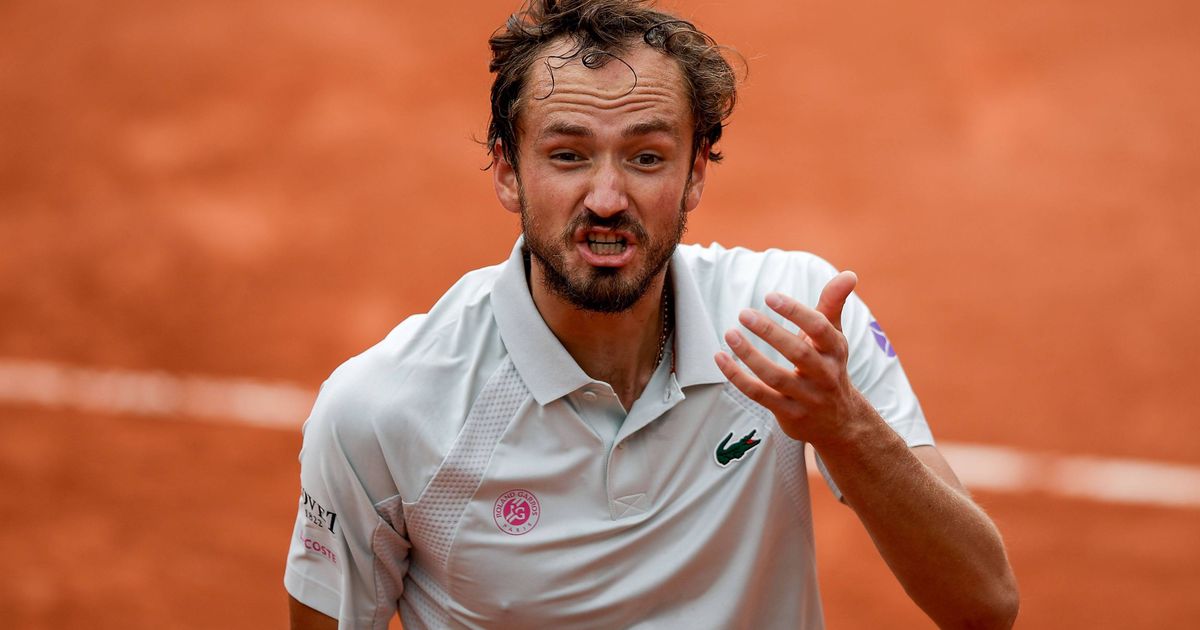
In assessing both the defeat and his clay performance more broadly, Medvedev provided a structured breakdown: first isolating the Berrettini loss as an abnormal performance driven by specific factors, and then expanding into a wider critique of clay as a surface defined by unpredictability and reduced control compared to hard courts.
“Losing 6-0, 6-0 is humiliation”: Medvedev reflects on Berrettini defeat
Medvedev was clear in rejecting the idea that a double bagel result can be explained purely through technical deficiencies. Instead, he pointed to underlying causes, suggesting that extreme scorelines at this level are typically linked to factors beyond standard match dynamics. His assessment framed the loss as something to analyse rather than overgeneralise.
The emotional dimension of the defeat remained significant, particularly given the rarity of such a result at elite level. Medvedev acknowledged the psychological weight of the scoreline, describing it in direct terms while placing it within the broader context of professional sport.
“It’s painful at least because of the humiliation, because losing 6-0, 6-0 is humiliation. But that’s life, that’s sport. I’m not the first, I won’t be the last.”
Despite the initial impact, Medvedev indicated that recovery followed a predictable timeline. The focus shifted from reaction to recalibration, using the gap between tournaments to rebuild rhythm and restore competitive clarity ahead of Madrid. “Of course, for a few days it was tough. I’d say about a week it was hard just to get back into rhythm and understand what to do next.”
“Clay is like FIFA”: Medvedev explains unpredictability on the surface
Beyond the specific defeat, Medvedev expanded on his long-standing difficulties on clay, offering a detailed explanation centred on the role of randomness. Rather than highlighting physical demands or rally tolerance, he focused on the variability of bounces and outcomes, which he sees as a defining limitation compared to hard courts.
“For me, clay is like FIFA. You can do everything right, but there’s still a big element of luck. Sometimes it’s the easiest ball, and it bounces badly, and you lose the point.”
This perspective contrasts sharply with his approach on faster surfaces, where he relies on structure, anticipation and incremental control. Medvedev identified this ability — consistently having the correct response under pressure — as a key trait shared by the leading players on tour.
“Almost no matter what the opponent does, you always have an answer — and usually the right one. You start to know where they’ll hit, where they’ll serve. That’s when it becomes very hard for them.”
On clay, however, he acknowledged that replicating this control requires significantly greater effort, while still being subject to external variables. The margin for error increases, and even well-constructed points can break down due to factors outside direct control. “I can do it on clay too, but it takes much more effort and a bit more luck than on hard. Sometimes one bad bounce, and everything you built is gone.”