
Is Victoria Mboko a pusher? I was tagged in a Twitter exchange the other day debating that exact question. From watching her play, I would hardly compare her to Ostapenko, but the p-word wouldn’t have come to mind.
Rally Aggression Score puts her at +6, on a scale designed to run from -100 to +100. Based on 27 charted matches from the last 52 weeks, that makes her about neutral, tactically similar (at least along this dimension) to the likes of Belinda Bencic and Karolina Muchova. Counterpunchers, maybe, not pushers.
On the other hand, “neutral” overstates it. Lowell West devised the metric about a decade ago, and the game has changed since then. The way I initially scaled it, Petra Kvitova flirted with triple digits, and that was about it. Now, Dayana Yastremska gets close to 200. Elena Rybakina, at exactly 100 in the last year, ranks only fifth among players with at least five charted matches. There’s nothing so extreme at the other end: Emma Navarro has averaged -68, while the most passive top-tenners are Coco Gauff and Mirra Andreeva at -20 and -30, respectively.
Mboko’s +6, while hardly vintage Wilander, is indeed more passive than the average WTA player in 2026.
Aggressive growth
Will the Canadian change tactics with age? These days, it seems like nearly everyone at least tries to take more chances and hit more winners. (If you don’t, your opponent will!)
I can’t tell Mboko’s future, but I can load up a database and run queries on it.
So, different question: Do players in general change tactics with age? It’s easy to think of examples: Serena Williams got more aggressive over the years. Ostapenko (remarkably) has done the same. I’m not sure there are equally prominent players who have moved in the other direction, but it does seem like some teenagers show up bashing balls, then settle for a more measured game in their 20s.
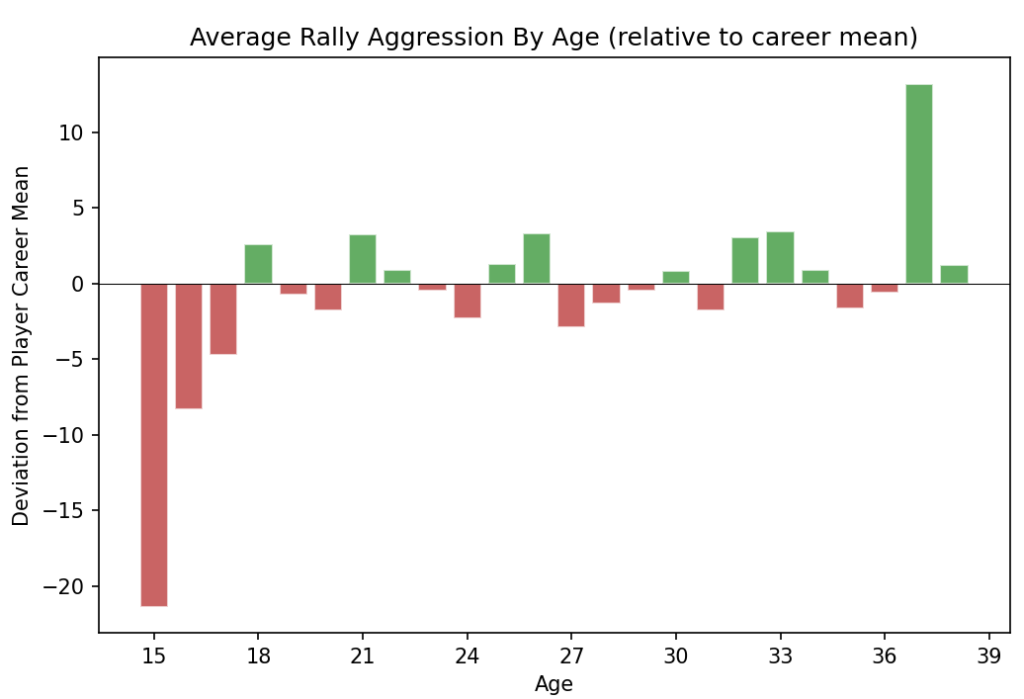
I took all women with at least 20 charted matches, grouped their rally scores by year, and figured out how much each year’s score differed from their career norms. Average those deviations across all players, and this is what you get:
From age 18 to 36–the entirety of most players’ careers–there’s nothing to see here. Plus or minus five points of rally aggression score is a rounding error, especially since these are non-random samples based on what Match Charting Project contributors wanted to chart and could find on video.
The spike at age 37 is also not very instructive: It’s basically Serena Williams, and we already knew that as she aged, she took increasingly few prisoners. From 2007 to 2009, her average aggression score was about +20. In 2019, when she was 37, it was +109.
Still, that climb at the left end of the graph is suggestive. It doesn’t literally apply to Mboko, who is already 19. But it supports a plausible narrative. When young women–especially the youngest prospects–arrive on tour, they aren’t as strong, or perhaps even as tall, as they will soon become. (Even Lilli Tagger recently gained a centimeter.) Their experience is disproportionately against juniors, who are even less physically imposing, relative to adult pros. The typical 16-year-old, no matter how talented, isn’t going to show up on tour and play like Sabalenka.
There are exceptions, of course. Maria Sharapova’s highest single-season aggression score was in 2004, when she was 17. Madison Keys arrived on the circuit playing essentially the same game she would play for the next decade. Iga Swiatek was more aggressive at age 18 than she has been since.
On average, though, the youngest players are more conservative–fewer winners, fewer errors–than they will become as they graduate from their teens. The mechanism could well apply to a 19-year-old, too.
The trend is null
We’re always talking about how players could develop and improve, or what their new coach brings to the table. Yet the undefeated champion of tennis forecasting is the null hypothesis. The null hypothesis, of course, means that you should’ve skipped this entire post and watched a Friends rerun instead.
It is boring, but the best way to predict how a player will look next year is to point at their current results and say, “yeah, just like that.” You can fiddle around the edges and maybe find players on the cusp of something or other, but … no, usually you can’t even do that.
Here are the year-to-year aggression trends of the women with the most matches in the MCP database:
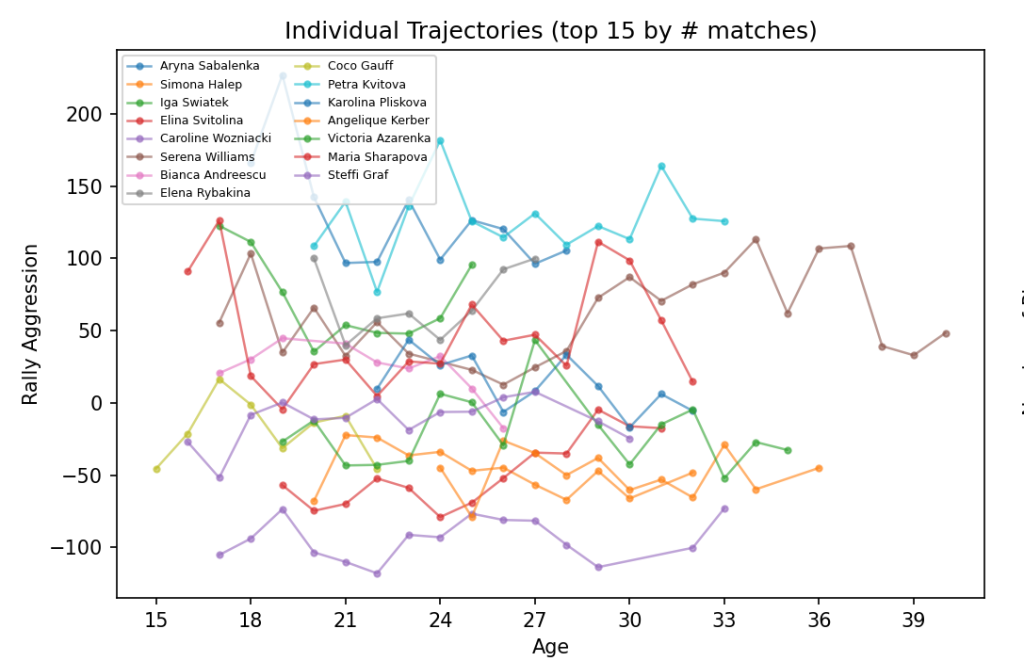
See that trendline that goes from the lower-left corner up to the upper-right? No, you don’t, because it’s not there. The closest is Serena, who dipped to +12 in her late 20s before getting hyper-aggressive in her 30s.
To answer the question posed by my headline, then: No, pushers don’t grow out of it. The style of play you see today is a good predictor of the style of play you’ll see a decade from now.
Lucky for Mboko, then, that she isn’t a pusher. Throughout her career, I’ll bet she tries a lot of new things and incorporates plenty of fresh ideas from a handful of high-profile coaches. The end result may well take her to the top of the rankings: A 19-year-old ranked 6th on the Elo table has a bright future ahead. If she finds a game that takes her all the way to the top, odds are it will look a lot like what we’ve seen so far.