
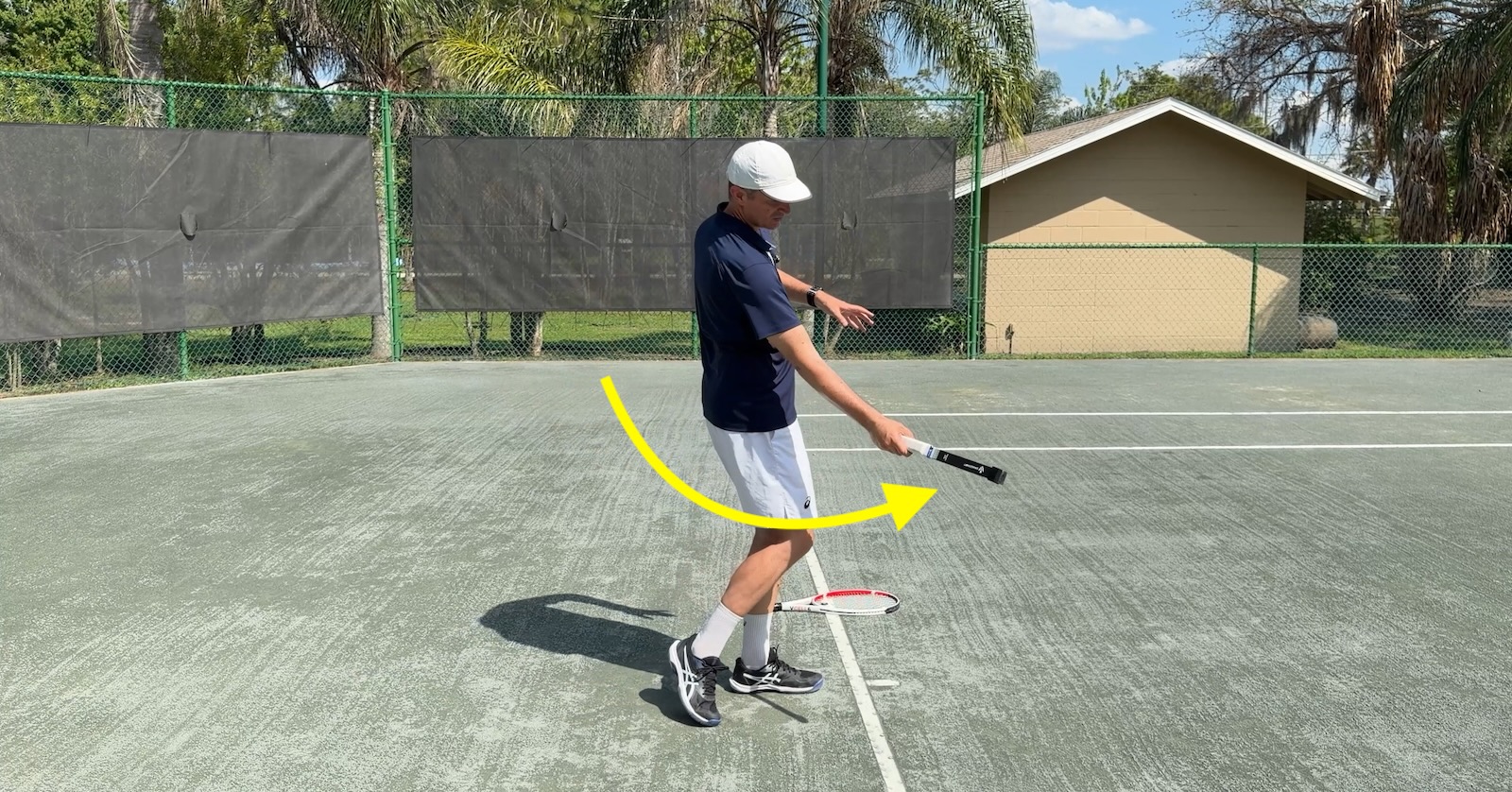
In this Dragonet Swing review, I want to share my honest thoughts on a tennis training device that, in my opinion, can genuinely help certain adult recreational players — if they use it with the right expectations.
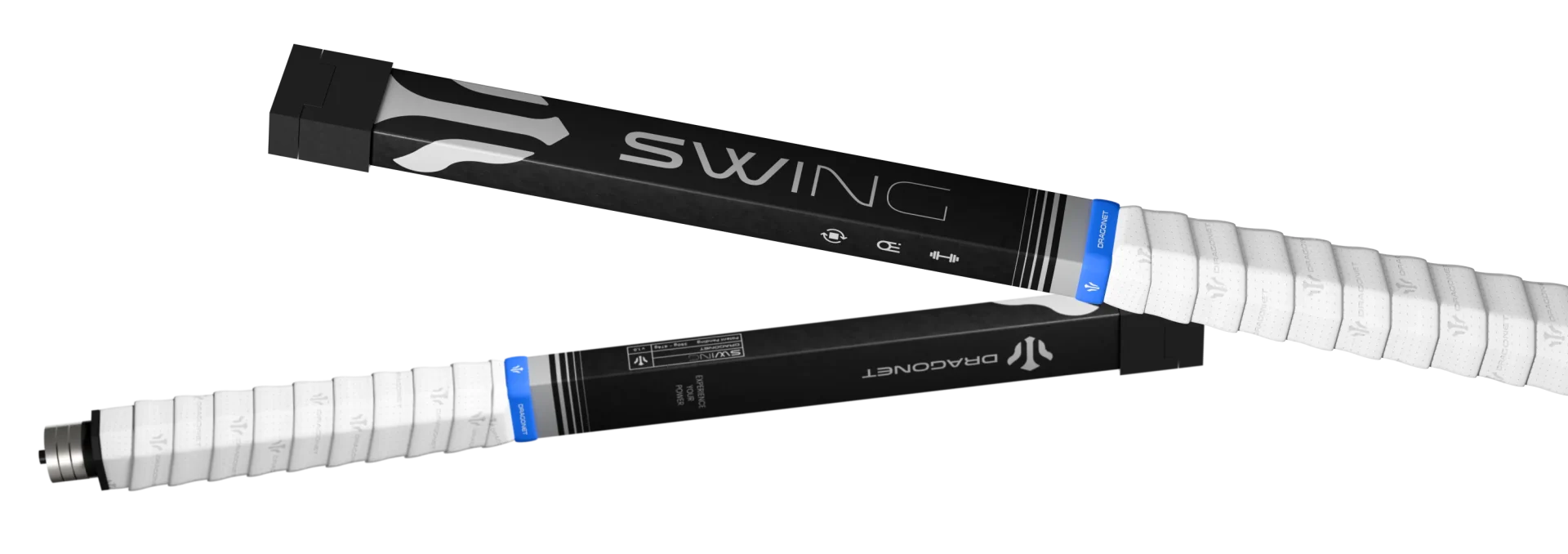
Interested in the Dragonet Swing?
You can check the current price and subscriber discount here:
Disclosure: I received one Dragonet Swing device free of charge for review. I am not being paid for this review, but I may receive a small commission if you purchase through my link, at no extra cost to you.
Over the years, I have seen many tennis training devices come and go.
Some are gimmicky. Some are mildly useful. And a few actually help players feel something important that is otherwise quite difficult to teach.
The Dragonet Swing falls, in my opinion, into that last category — but only if we understand clearly what it does and what it does not do.

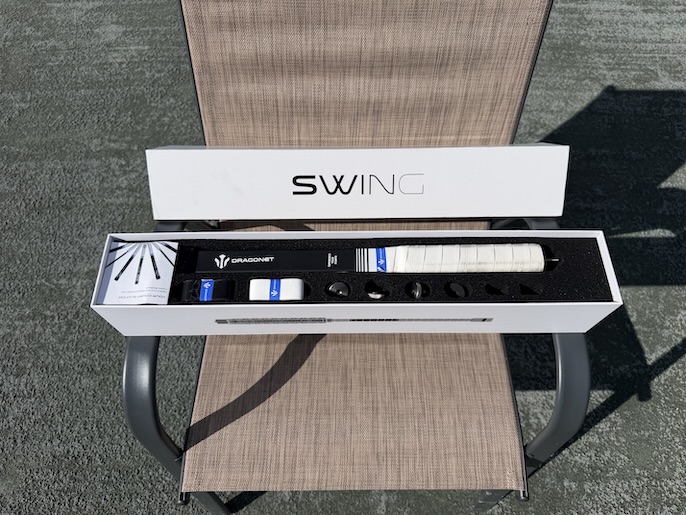
Dragonet Swing is one of the most innovative tennis tools I have tested
Based on my own testing and also using it with students, I found that its real value is not that it magically teaches the whole stroke.
Its real value is that it can help certain adult recreational tennis players warm up better, swing more freely, create better wrist lag, and learn how to focus energy more efficiently into the shot.
That distinction matters, because many players buy tennis training aids hoping they will fix everything.
This one will not. But it can still be very useful.
What Is the Dragonet Swing?
The Dragonet Swing is a tennis training tool that is heavier than a normal racket and has a moving internal mass that creates a click when you accelerate it correctly.
It also allows you to adjust weight, balance, and airflow resistance, so you can make it easier for technical work or more demanding for physical work.

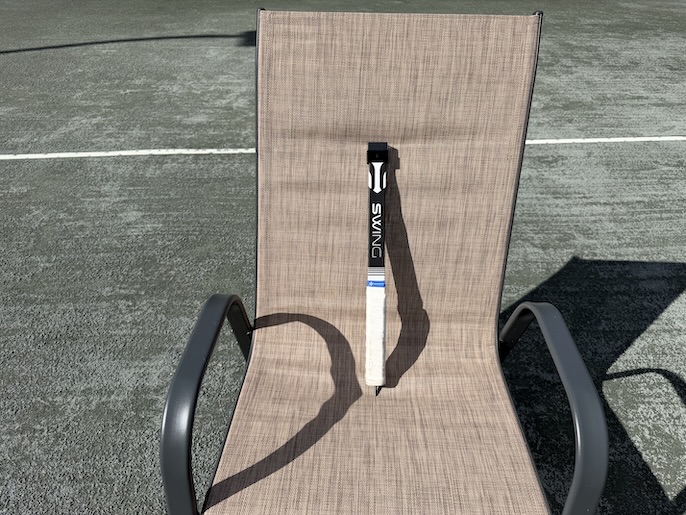
The Swing is a high-quality product made in Italy
That makes it more versatile than a simple weighted racket trainer.
Still, for me, the key is not the features themselves.
The key is what the device helps the player feel.
The Biggest Benefit: It Helps You Focus Energy Better
The best way I can explain the biggest benefit of this device is with a magnifying glass.
The sun gives off a huge amount of energy, but a leaf or a piece of paper only starts to burn when that energy is focused into a very small area. Tennis strokes work in a very similar way.

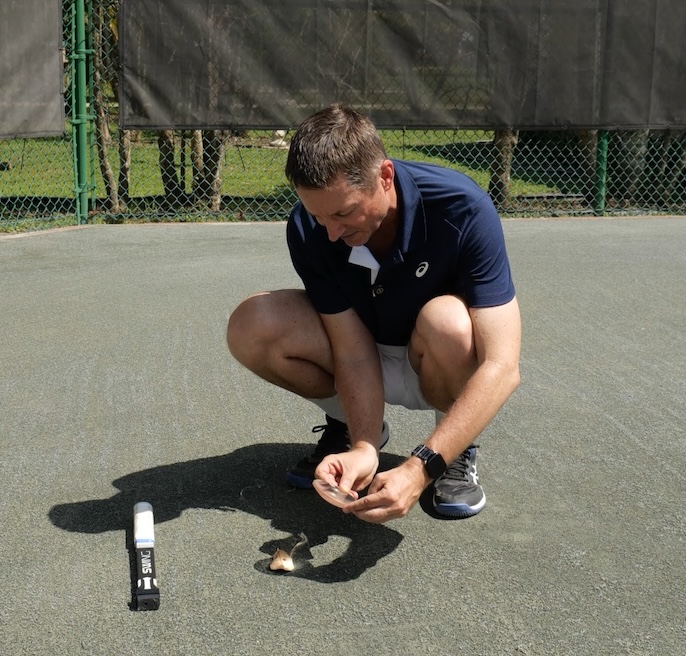
Focused energy is extremely powerful
Many adult recreational players use plenty of effort, but they do not focus that effort well. They leak energy through the stroke.
They over-rotate, push too much, or stay too tense in the arm and wrist. As a result, they work hard but do not get an efficient ball.
What makes the Swing interesting is that it can help the player feel where acceleration should happen and how energy should be concentrated more efficiently.
That, to me, is the most innovative part of the device.
Benefit #1 – A Very Good Warm-Up Tool
The first clear benefit is warm-up.
Even without adding extra weight, the Swing is already heavier than a typical racket. So if you use it before practice or before a match, it activates the muscles in the arm and body more strongly.

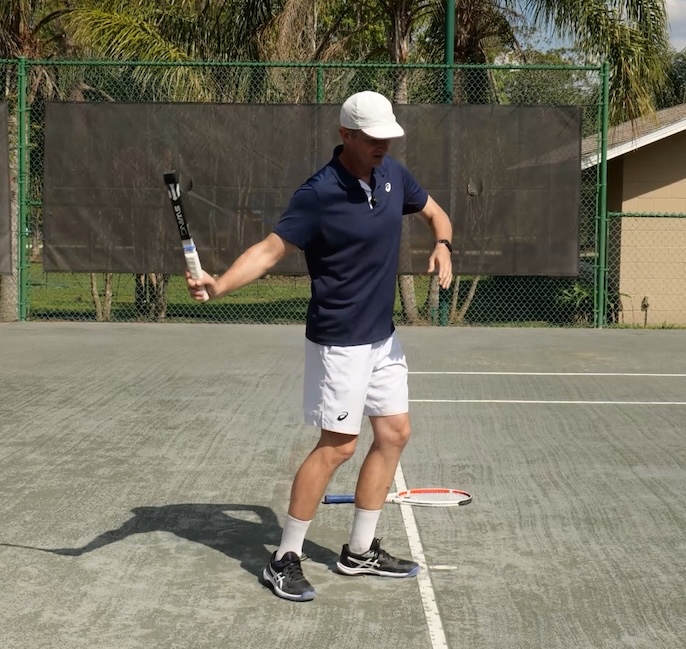
If you want to activate your arms before a tennis session, the Swings works really well for that.
Then when you pick up your normal racket, the racket feels lighter and easier to maneuver.
This is a very practical use.
Many adult players begin hitting while their body is still not fully awake. A slightly heavier object can help switch the body on more effectively.
So purely as a tennis warm-up tool, I think the Swing already has value.
Benefit #2 – It Encourages a Freer Swing
The second benefit is hidden in the name itself.
It is called the Swing. And that is actually a very accurate name.
One of the most common problems I see in adult recreational players is that they do not really swing the arm enough. They are too tense.
They push the racket forward instead of allowing it to swing and accelerate more naturally. This is one reason why strokes often feel forced and why players struggle to create effortless power.
I already use heavier objects in lessons for exactly this reason. Sometimes I use a pickup tube. Sometimes I have the player hold two rackets.

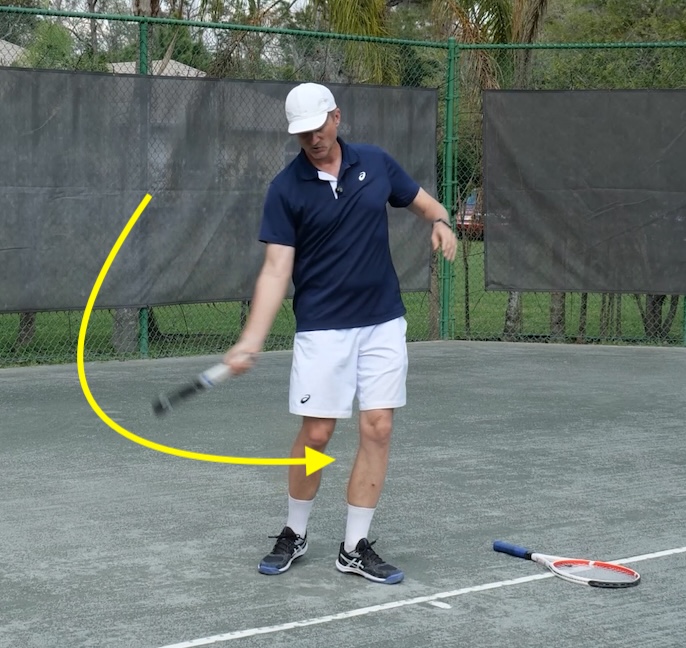
A downward swing with some gravity assist creates a lot of effortless power.
The principle is always the same: a bit of extra mass helps the player feel the swing better. That is exactly what the Swing can do.
Because it is heavier, it encourages the arm to move more freely and gives a better feeling of downward acceleration into the shot.
For players who are too stiff and arm-dominant, that is a real benefit.
Benefit #3 – It Can Improve Wrist Lag
This is actually one of my favorite uses of the device, even though it is not emphasized much in the product’s marketing.
Adult players are often too stiff in the wrist and forearm. They hold the racket too tightly, do not allow the wrist to respond naturally, and then lose one of the key contributors to efficient acceleration into the ball.
The extra weight of the Swing can help here. If you use the device in the right way, it encourages a softer, more natural wrist lag.


The Swing helps you gently soften the wrist tension on forehands and backhands.
I find this especially useful in small figure-eight style drills, where the player can feel the weight helping the wrist respond instead of locking up.
This can be useful on the forehand, one-handed backhand, and even on the two-handed backhand, where many adults are far too rigid.
So for me, this is not only a swing trainer. It is also a very good wrist lag trainer.
What the Click Is Really Teaching
The click is what makes the device different.
The moving mass inside the Swing clicks when you accelerate the device correctly.
If your motion is inefficient, mistimed, or too slow in the wrong part of the swing, it will not click properly.
This is why I see it as a biofeedback tool.
It gives the player a signal — both audible and physical — about where and when efficient acceleration is happening. That is hard to explain in words.

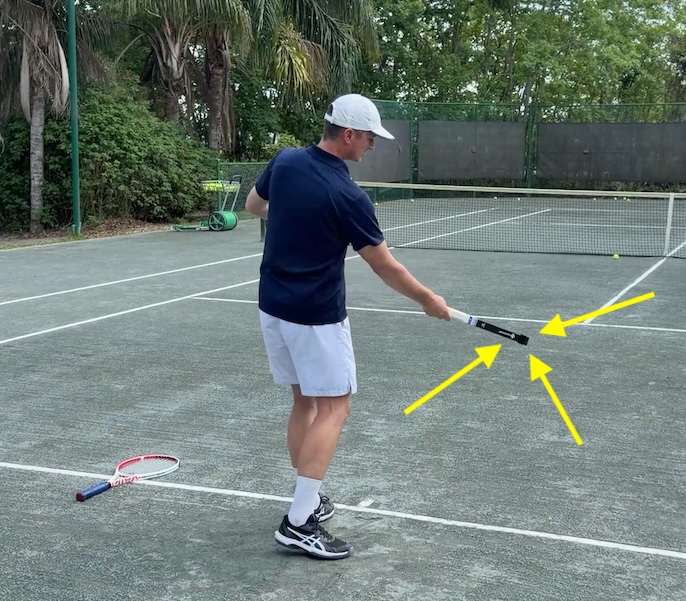
The Swing gives you an audible signal and biofeedback when you swing the right way.
I can tell a player to “focus energy,” but that phrase is vague until they actually feel it. The Swing makes that feeling much clearer.
In this sense, it teaches something very valuable:
- not just effort
- but directed effort
Not swinging harder everywhere. Not working more for the sake of working more.
But learning to create a more concentrated burst of acceleration in the right area of the swing.
Can the Swing Help Timing?
Yes — but only if we define timing carefully.
The Swing can help the player become more aware of where the contact point should be in space.
Because the click happens only when acceleration is timed correctly, the player begins to sense where that efficient zone is. Over time, this can create better awareness of where the ball should be intercepted.

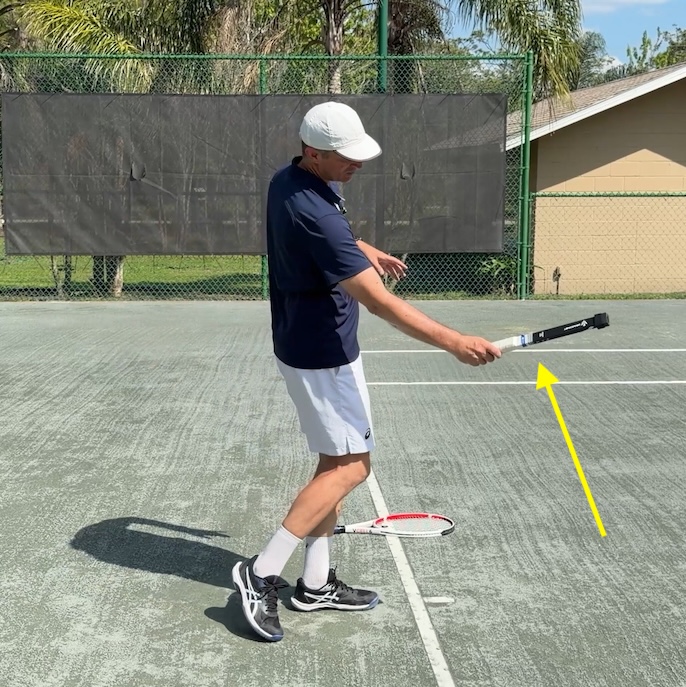
The sound and feel help you establish ideal contact point in space.
But I would not say it teaches timing in the full sense.
It does not teach reading the ball, spacing, movement, or adjustment steps. It helps more with the internal feel of where the stroke should release and where acceleration should peak.
That is an important distinction.
What the Swing Does Not Do
This is where expectations need to stay realistic.
The device is called the Swing, not “Complete Biomechanical Transformation of the Player”. 😉
In a way, the name tells the truth very well. It helps the swing. It does not build the entire stroke from the ground up.
If a player’s fundamentals are poor — if they do not know how to organize the body, coil and uncoil correctly, stabilize well, and create the stroke from the body first — then this device cannot teach all of that for them.
In fact, if you give it too early to a player who already arms the ball too much, it may simply reinforce that habit.
So I would not position this as a beginner’s device for forehands and backhands.
I would position it as a refinement tool.
One Warning About Resistance Settings
There is also one practical warning here.
If you set the airflow resistance too high and make the device too difficult to click, then the player may start trying too hard.

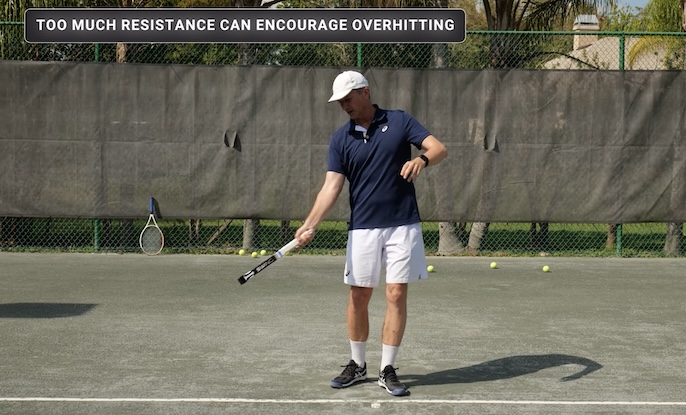
I recommend you use the Swing on the full airflow setting for the easiest way to making it “Click”.
Instead of learning smooth, efficient acceleration, the player may start muscling the device simply to force the click.
Then, when they switch back to the racket, they may become over-aggressive and miscalibrated.
So for most technical work, especially for non-elite players, I would keep the airflow in the easier setting.
That allows the player to learn the feel without turning the exercise into a brute-force task.
Who I Think This Device Is Best For
In my opinion, this device is not for beginners.
If you are below about the 3.0 NTRP level, especially on forehands and backhands, you probably need to build better general stroke organization first.
You need stability, body rotation, and a clearer basic movement pattern before a device like this becomes truly helpful.

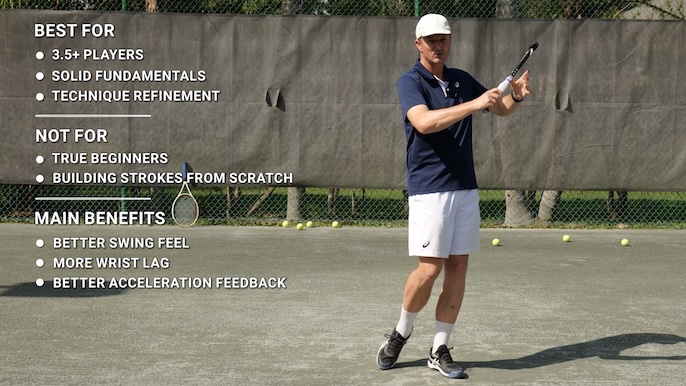
Where I think the Swing becomes useful is for players around 3.5 and above who already have some basic fundamentals in place and now want to refine the quality of the swing itself.
These players can benefit from:
- better warm-up and activation
- freer swinging
- improved wrist lag
- clearer feel for focused acceleration
- more efficient contact
Higher-level players can also use it as an activation tool before practice or matches, especially with additional weight.
Final Verdict
Overall, I think the Dragonet Swing is a useful tennis training device for the right type of player.
Its biggest value is not that it teaches the whole stroke.
Its biggest value is that it helps certain players refine the stroke technique.
And that includes some very useful things:
- warming up the body
- encouraging freer arm movement
- improving wrist lag
- teaching a clearer sense of where and how to focus energy into the shot
So if you are an adult recreational player with decent fundamentals already in place, and you want a training aid that helps you refine swing quality and acceleration feel, I think the Swing is worth considering.
If you are looking for something that will teach the entire stroke from scratch, I would not expect that from this device.
That is not really what it is for. In, fact, as far as I know, no such training tool exists and it never will. The game of tennis is just too complex to be solved by one training aid.
Closing Note
If you are the kind of player who already has the basics in place and now wants to improve the quality of your swing, the Dragonet Swing can be a useful tool.
Just make sure you use it with the right expectations: not as a miracle solution, but as a refinement aid.
Interested in the Dragonet Swing?
You can check the current price and subscriber discount here: