
Summary
Solo training is a small but essential part of every serious Muay Thai athlete’s routine, and it’s also the part most likely to go wrong without the right approach. This article covers everything you need to know about self-directed Muay Thai training: why it can be dangerous to get it wrong, how to avoid cementing bad habits when no coach is watching, and which drills are worth your time when training alone. You’ll find step-by-step breakdowns of balance drills on the heavy bag, cardio and conditioning work, shadowboxing, and the key technical cues that separate productive solo sessions from wasted ones. As Muay Thai World Champion and Evolve MMA instructor Chaowalit Jocky Gym puts it, “Solo training is where your discipline is truly tested. When there’s no coach in the room, the fighters who improve are the ones who hold themselves to the same standard they would in front of their trainer.” Whether you’re supplementing your sessions at a gym like Evolve MMA in Singapore or filling in gaps between classes, this guide will help you make every solo session count.
Key Takeaways
- Solo training is high-risk if approached without structure. Without a coach to correct you in real time, even small technical errors can become ingrained habits that take far longer to undo than they did to develop.
- Simplicity and specificity are the foundations of effective solo training. Picking one clear focus per session and starting slowly before adding intensity is the surest way to build good technique rather than reinforce bad ones.
- Your phone camera is one of the most underused tools in solo training. Recording yourself gives you a coach’s-eye view of your technique and lets you catch errors before they become muscle memory.
- Balance drills on the heavy bag build the foundation for effective striking. The ability to stay composed and upright after landing a kick is a technical skill that must be trained deliberately — it doesn’t develop by accident.
- Shadowboxing is only useful when it’s intentional. Moving around and throwing shots randomly feels productive, but isn’t. Effective shadowboxing requires visualisation, realistic ranges, and a specific technical focus.
- Conditioning drills on the bag are technique drills first, cardio drills second. Completing reps quickly with poor form builds endurance and bad habits simultaneously — always prioritise technique before intensity.
The Issue With Self-Directed Training
The common issue with solo training is revealed in its name. It’s solo. There is no one there to correct you. So, if you happen to throw something with bad technique without realizing it then you could wire in bad habits that can be extremely difficult to break, especially if you do a lot of solo training without a chance for someone to correct it. If this happens, then you will be slowing your development as it takes more time to unlearn bad habits than it does to learn a new one from scratch.
How To Avoid Reinforcing Errors
The simple way to avoid ingraining bad technique when training solo is to make sure that you keep your drills simple. Doing too much too fast is a definite way to make little mistakes; eventually, these mistakes become big problems.
When training to improve technique on your own, it’s vital to be specific in your goals for the session. It’s going to be difficult to maintain impeccable form and composure if you are working on too many things at once. Once you have picked a particular focus for the session, begin by starting slow and make sure to focus on the key points of performance in every technique you throw before you add intensity.
For example, if you are kicking, don’t throw your shots as hard and as fast as you can right away. Start slow, work on starting and finishing in the correct position, rotating your hips, and coming up onto the ball of your feet. Once you’re able to do them perfectly at a slow and relaxed tempo, gradually increase the power and speed whilst maintaining your commitment to form.
Your phone camera can be a great asset when training solo. You can use your camera to record yourself as you undertake solo training. This gives you the ability to gain a ‘coach’s eye view’ of your technique between rounds. You’ll get a clearer picture of your technique and what you need to improve on, whilst informing you of any errors you could potentially be making before they become muscle memory.
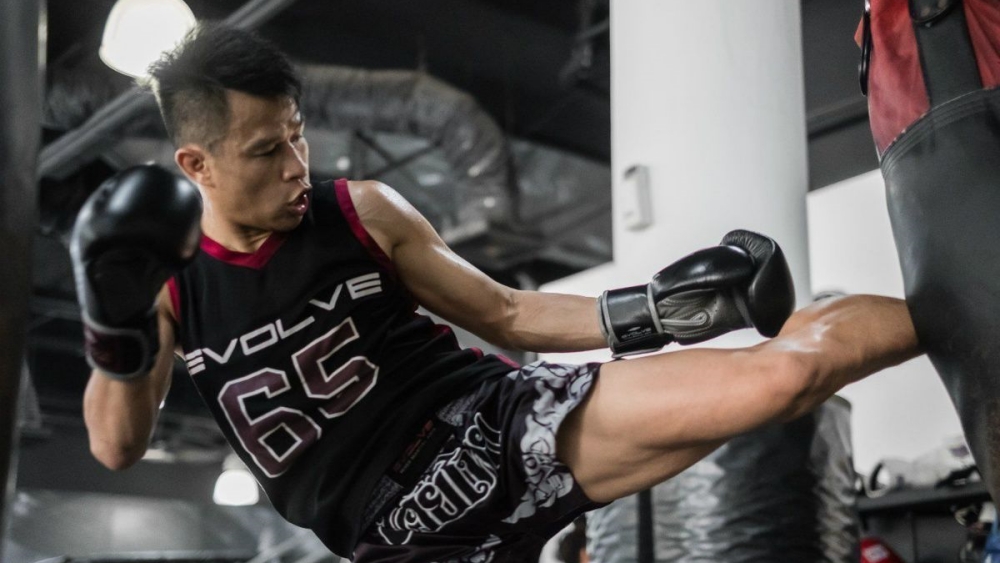
Balance is a vital skill in Muay Thai. Without it, you can’t land effective kicks and are an easy target for any opponent looking to sweep you. Luckily, it is very easy to improve your balance by working on your own with three very simple heavy bag drills. All of these drills increase in difficulty as you add power and speed to the movement, so make sure you begin slow.
1) Kick Into Knee Guard
In this drill, you are mimicking the technique that you would use if a fighter has caught your body kick, and you are trying to stop them from sweeping you. Simply throw a kick to the body and as the kick connects continue turning your hip over so that your shin is braced horizontally across the bag.
2) Kick Into Block
This technique, shown by Muay Thai World Champion Kiewpayak Jitmuangnon can easily be modified for solo work on a heavy bag. Being able to land a body kick and reverse your momentum into a perfect Muay Thai block requires excellent balance and technique. After landing a body kick to the bag, return your leg to a strong Muay Thai block without letting your foot touch the floor. Once you can do this perfectly, begin to repeat the movement, going directly from your block into another kick and block without pause.
3) Kick And Transition Into A Teep (Push Kick)
In this drill, you begin with a kick, followed by a second kick. The second kick transitions into a teep. Once you’ve mastered your balance and ensured your teep accuracy is precise, you can elevate the difficulty by integrating it with preceding balance drills. This involves transitioning seamlessly from a kick to a block, and ultimately to a teep, without any pauses.
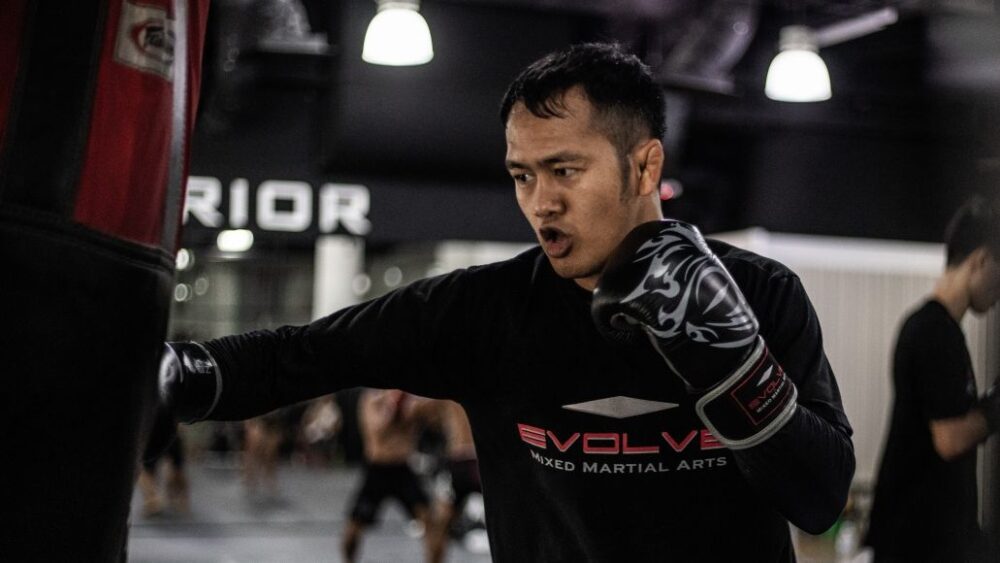
The following drills are staples in self-directed Muay Thai training. They can be used to build cardio and endurance when you are training alone. That being said, you will be doing yourself a disservice if you approach them with the mindset of completing them as fast as possible without focusing on technique. As with all of the other self-directed training drills, it is important to start slow and make sure that you are hitting all of your points of performance before you increase the intensity of your training.
1) Teeping The Heavy Bag
It’s not uncommon to see fighters throwing anywhere from 200-300 teeps on a heavy bag as a way to condition their legs and improve their teeps. Whether you are doing all of your teeps on one leg or alternating between the two there are some key points of performance to focus on to ensure that you are developing great technique through this drill. These include the following:
- Be Accurate: Teep the same spot on the bag every time. A great way to make sure you are working on your accuracy is to make sure that the bag doesn’t spin after your teep it. Many people will place a sticker or mark the bag with tape to give them a clear idea of where to aim their teep.
- Use Your Hips: Teeping isn’t just the art of lifting your leg and pressing it into your opponent’s stomach; most of your power comes from your hips. So, make sure to press your hips into every teep.
- Lean Back: As you extend your leg, make sure to lean your head back so you are out of range of any imaginary punches coming your way. Doing this also counterbalances your teep, so that if you miss you don’t fall forward into an awaiting counter.
2) Kneeing The Heavy Bag
Once again, it is incredibly easy to ingrain bad habits if you don’t approach this tried and tested solo training drill correctly. So, whether you are doing a marathon run of 500+ knees unbroken or you are doing intervals of 20 power knees at a sprint, make sure that you are focusing on the following:
- Knee To The Body: It is natural for your knees to start to drift south of the border when you get tired, so you must be aiming for a spot on the bag in line with your belly button. Once again, using some tape to mark the correct height on the bag can be useful to make sure you are kneeing high enough.
- Kick Your Legs Back: Remember, in Muay Thai, it is only effective strikes that make an impact on the scorecards. If you are just tapping the bag with your knee, then you aren’t training good technique. Make sure to create power by kicking your leg behind you before driving your knee forward.
- Use Your Arms: You need to strengthen your arms if you want to be successful in the clinch and using your knees on the bag is a great opportunity to do this. Make sure you grab the sides of the bag around head height and make sure that you are pushing the bag away as you extend your leg behind you. Then pull it back into you as you deliver your knees.
3) Shadowboxing
Anyone who has been bitten by the Muay Thai bug won’t be able to help but break into a round of shadowboxing at random times when they are alone at home. While it is easy to get lost in the joy of moving around and throwing techniques for the fun of it, it’s important to keep technique and ringcraft in mind when you start sparring with an invisible opponent. So, next time you are shadowboxing alone, keep the following things in mind.
- Visualise: Whenever you are shadowboxing, try to imagine yourself pulling off the specific techniques and drills that you have practiced in training on an invisible opponent. Imagine how they are going to move and what signs your adversary will give to prompt you to pull off the techniques that you plan on using in the ring.
- Keep It Realistic: Don’t fall into the trap of throwing shots for the sake of it. Remember the ranges for your different weapons and only ingrain the combinations that you will use in the ring.
- Be Specific: You don’t need to shadowbox all eight of your weapons at once. You can break things down and only shadowbox your weaknesses. So, if your trainer has told you that you need to work on your footwork, don’t distract yourself with massive hand and elbow combinations, just imagine how you need to move when you are in the ring with your opponent.
Frequently Asked Questions About Solo Muay Thai Training
Q: How Often Should I Train Muay Thai On My Own?
A: Solo training works best as a supplement to your regular coached sessions, not a replacement for them. Most practitioners find that one to two dedicated solo sessions per week is enough to reinforce technique, build conditioning, and work on specific weaknesses — without risking the development of uncorrected bad habits. The more solo training you do relative to coached training, the more disciplined you need to be about keeping your technique clean.
Q: What Equipment Do I Need For Solo Muay Thai Training At Home?
A: At minimum, a heavy bag and a pair of gloves will cover the majority of the drills in this guide. A timer or interval app is useful for structuring your rounds. If you don’t have access to a heavy bag, shadowboxing is an effective alternative for technique and footwork work, though you lose the tactile feedback the bag provides. A full-length mirror or a phone mount for recording yourself can be extremely useful for self-correction.
Q: Is Shadowboxing Alone Enough To Improve My Technique?
A: Shadowboxing is a valuable tool, but it has limitations. Because there is no resistance or feedback, it is easy to develop unrealistic habits — throwing techniques at ranges that wouldn’t work in a real fight, or moving in ways that feel fluid but aren’t functionally sound. Shadowboxing is most effective when used with a clear technical focus and an honest visualisation of a real opponent. Use it to reinforce what you’ve already been taught in class, not to explore new techniques on your own.
Q: How Do I Know If I’m Building Bad Habits During Solo Training?
A: The most reliable way to catch errors early is to film yourself regularly and review the footage honestly. Compare what you see to the technique demonstrated by your coaches or by high-level fighters on film. If something looks off — a dropped hand, a lazy hip rotation, an inconsistent stance — address it before it becomes automatic. Bringing specific questions from your solo sessions back to your next coached class is also a good habit: it means your solo training and your coached training are actively informing each other.
Q: Can Beginners Do Solo Muay Thai Training?
A: Beginners should approach solo training with extra caution. Without a baseline of correctly learned technique, solo drilling carries a higher risk of cementing poor movement patterns that will take significant time to correct later. If you’re new to Muay Thai, focus your early months on coached sessions — at a structured gym like Evolve MMA in Singapore, for example, you’ll have experienced World Champion instructors watching your form and correcting errors in real time. Once your foundational techniques are solid and your coach confirms they are, you can begin incorporating solo drills to supplement your training.
Q: What’s The Best Solo Drill For Improving Balance In Muay Thai?
A: The kick-into-block drill is one of the most effective balance drills you can do alone. The ability to land a body kick and immediately recover into a strong defensive position — without letting your foot touch the ground — requires genuine balance, hip control, and body awareness. It is also directly applicable to real sparring situations. Start slowly, prioritise control over speed, and only increase the intensity once the movement is consistently clean.
Q: How Should I Structure A Solo Training Session?
A: A well-structured solo session should have a clear warm-up, a defined technical focus, and a conditioning component. For example: five minutes of light shadowboxing to warm up, followed by three rounds of a specific balance or technique drill on the bag, followed by two to three rounds of a conditioning drill such as teeps or knees. Finish with a round of intentional shadowboxing focused on the same technical theme. Keeping sessions focused around one or two goals — rather than trying to cover everything — will produce better results over time.
Q: How Do I Stay Motivated When Training Alone Without A Coach Or Training Partners?
A: Structure is your best tool for motivation. Set a specific goal for each session before you start — whether that’s 200 clean teeps, three rounds of kick-into-block, or focused shadowboxing on your footwork — and hold yourself to it. Recording your sessions and reviewing them objectively can also help maintain a sense of accountability and progress. Many practitioners find it useful to think of solo training as time they are investing in the version of themselves that shows up to the next coached session ready to improve.
Final Thoughts
It doesn’t matter what skill level you possess; the above drills can help you improve your Muay Thai game. There are tonnes of benefits to training alone and there are many other solo training drills that you can practice. Just remember, you will only improve through self-directed training if you remember to start slow and remain focused on technique.
You may also like:
What Is The Southpaw Stance? The Ultimate Guide for Boxing, Muay Thai, And MMA