
I’ve always been fascinated by big ships–not because they carry tons of oil or guns or drunk Midwesterners, but because they carry engines the size of apartment buildings, with doors on the crankcase large enough for mechanics to walk around inside.
But the scale isn’t what fascinates me. Instead, it’s the ruthless environment and economics they operate within, which dictates that there is no breakdown too big to fix at sea. You can’t exactly drop your oil tanker off at the shop, especially not when it’s drifting 1000 miles offshore. Instead, they diagnose and repair everything on the fly.
That means ships don’t just have engines the size of buildings; they also have spares, tools, mechanics and even machinists riding around full time, all making sure there is no such thing as an unfixable problem. It’s the first thing I think about whenever I step foot on one.
Maybe I’m just a dork, or maybe I’m fascinated by this because I’ve spent so much time broken down on the side of the road. Commuting to high school in a 40-year-old Triumph Spitfire, racing 30-year-old beaters and logging tens of thousands of miles in cross-country road trips driving all manner of worn-out road and race cars has taught me a thing or two about roadside repairs.
I’m usually the chase mechanic on our Classic Motorsports Road Tours, where I’ll spend a week keeping dozens of 30-year-old sports cars happily motoring along for 1000 miles. With spring ahead of us and plenty of summer round trips on the horizon, here’s how to keep your project car driving more like a container ship.
[Checklist: How to best remove a classic from winter storage]
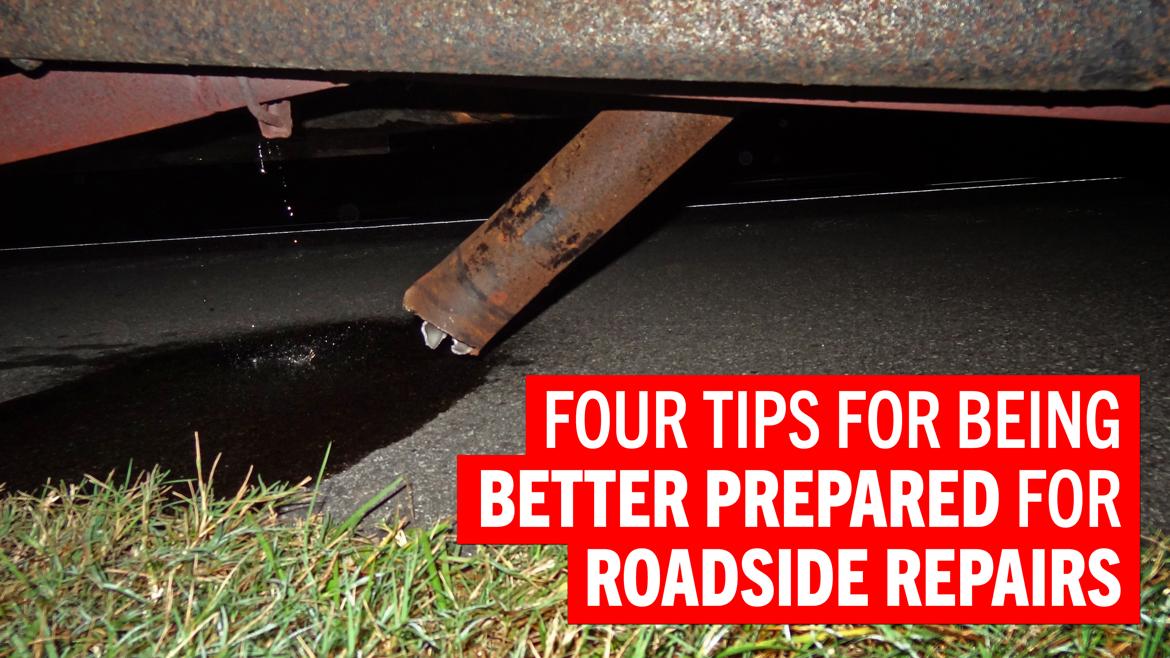
1. Recognize the problem before it’s a disaster. Stop and check that new vibration. Fill that leaky radiator before it’s empty. Make sure that new exhaust leak isn’t melting wiring. And when you run out of gas, don’t keep cranking the starter until you’ve got a dead battery, too.
2. Learn to triage. I hate to break it to you, but if you’re road-tripping a project car, odds are it wasn’t showroom fresh when it left the garage.
I find the easiest way to triage, at least at first, is to force yourself to write down the problem, the likely causes and the problems you’ve found. Then, write out your hypothesis–or, if you’ve got a friend, just tell them the story.
Before you do anything else, ask yourself or your friend: “Is this a credible explanation?” This takes a few minutes, but it could save you hours chasing the wrong problem. And because you go into every repair with a plan, you’ll avoid getting too deep into the car before realizing you don’t have the tools or parts you need. Those are intricately connected to your triage process, too: Have two prime suspects for a failure, but not sure where to start? Fix whatever you have the tools and parts for first. Then, if it doesn’t work, it’s time to go hunting for more resources (or a tow).
3. Carry the tools and parts you’ll need to fix your car. This seems obvious, but too many people throw a generic little tool kit in their car and assume they’ll be covered when something goes wrong.
It’s not realistic to fix every problem on the side of the road (you’re no container ship), but you’ll have a far more pleasurable breakdown if you put a little thought into it. For example: If you carry a spare wheel bearing, do you have the giant socket you’ll need to unbolt it from the spindle? Do you have the right assortment of extensions and swivels to install that spare motor mount? And do you have the clip tool you’ll need to get to that leaking radiator?
The answer to any or all of these questions can be no, but at least you’ve thought about it. Don’t forget the consumables, like zip ties, duct tape and crimp connectors, too.
4. Carry the knowledge you’ll need to fix your car. Service literature is invaluable, but it isn’t going to do you any good if it’s sitting on your bookshelf. Put your manuals into a waterproof bag in your trunk and leave them there. Or, if you’ve got digital manuals, make sure they’re downloaded to your phone and quickly accessible.
[Sorting a project: The final step between good enough and perfect]
Above all else, though, remember one key thing: You’re not in a hurry, you don’t have to start fixing anything instantly and the old adage “slow is fast” holds just as true under the hood as behind the wheel. Take your time, triage the problem and carry the resources you’ll need. And focus on the bright side: At least you’re not drifting in the ocean when you’re under the hood.
Comments
This is one of the most helpful “tools” I’ve bought over the last few years.


In reply to Coniglio Rampante :
Decent lighting is definitely easy to overlook.

In reply to Colin Wood :
Yeah, that thing has freed up both hands to work under a car (and under a sink) and it’s kept me from having to repeatedly tell/ask someone where to shine a flashlight.
Displaying 1-3 of 3 commentsView all comments on the GRM forums
You’ll need to log in to post.