
Jump into the elevator.
Stické tennis was invented in the 1870s in England. It’s a hodge-podge of tennis, squash, and real tennis. Brits built about 50 courts around the world, mostly in England. The game disappeared after the First World War. Just two courts are still playable.
Ding. Yes, stické is the world’s most obscure racquet sport.
× × ×
Biltong and fireplaces are the strongest memories of the first time I played stické.
High stone walls and hedgerows sheltered Hartham Park, a Georgian manor house and estate in Wiltshire, when we drove in on a March day a few years ago. The owner, Jeff Thomas, brought us into a drawing room in the main house and gave us tea. Thomas loved history. He told us that the house, built in 1795, boasted 168 rooms and an absurd amount of fireplaces—142 in total. “We have the best collection of Victorian and Georgian fireplaces in the country,” Thomas said. “The Victoria and Albert Museum has been in to look at them all and catalog them. It is the only sort of complete collection.” In 1997 Thomas bought Hartham Park and remodeled the outbuildings, turning them into flexible offices, co-working spaces, and a conference center; more than 40 firms were based there.
After tea, Thomas took us up to the stické court. Standing alone in the park-like grounds to the west of the house, the building was made from timber and had a distinctive larch split-log cladding and a half-hip roof. It was built in 1904. “That was the balcony that Winston Churchill gave a speech,” Thomas said, “his first one to raise funds for the Liberal Party. He addressed 150 people out there on the cricket pitch.” Thomas told us that during the Second World War the court was used as a corn silo. Inside, being Hartham Park, there were three fireplaces.
As we fetched our tennis clothes, a car pulled up. It was Nigel à Brassard. He was the pied piper for stické at Hartham and the president of the Stické Tennis Association. As we talked, he reached his hand into his jacket pocket and nibbled on some dried brown bits. “Are any of you interested in some of my homemade biltong?” he said with a smile. “It really is home made.”
Soon a couple of other people arrived: Allan Bosley, a longtime player and secretary of the Stické Tennis Association, and Adrian Chivers. Along with Hugh Richman, Chivers, we were told, captured the 2015 World Championship. A world championship? It was the second one, after an inaugural in 2004. Bosley told us about the 2015 event: a one-day affair, doubles, complete with prize-giving and a champagne reception at the end.
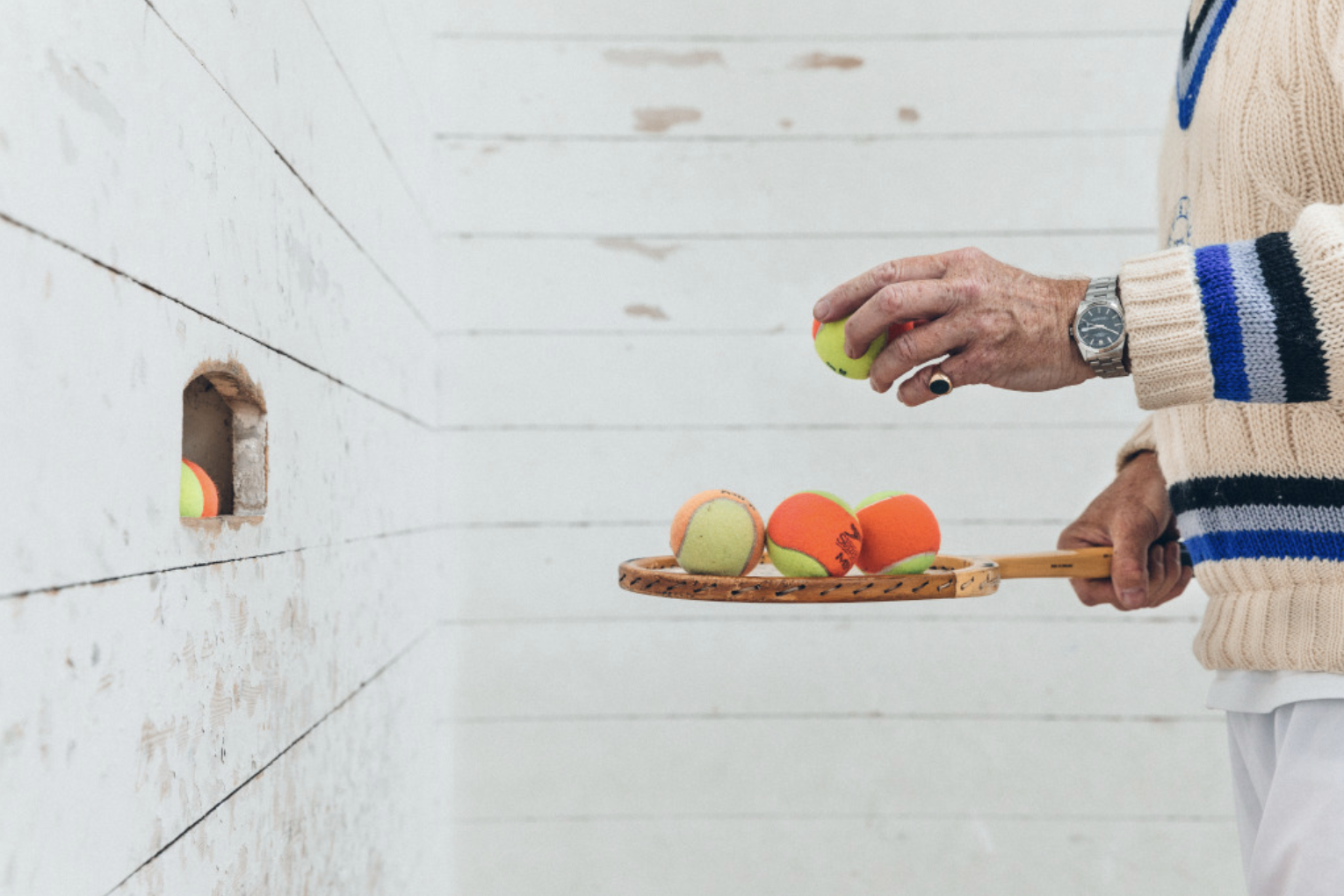
We got on the court and banged around. Bosley and Chivers showed us the slogging line, the mark past which if a ball coming off the back wall bounced a second time, the striker lost the point. We switched sides after every two games. The game was a challenge. The racquets were regular tennis racquets, but we used low-compression red-and-yellow-striped tennis balls, similar to those for children. (After Thomas bought the estate and revived the court, they tried leather-covered ones made by a pelota player in the Basque area of Spain. Graham Tomkinson, in a 2004 pamphlet on stické tennis, wrote that they pierced regular tennis balls “to reduce the excessive bounce.”) If it was cold, they used low-pressure balls made by Price of Bath, a century-old local ball manufacturer; if it was warm, they used the low-compression balls.
When we finished, we gathered in the balcony above the back wall. “It’s a complete and utter joy to have the court,” said Thomas, even though he’s had to replace the roof not once but twice (once to repair it; a second time when it blew off in a gale). “We get interesting people. It brings a lot of fun and happiness to peoples’ lives. It is a great workout for those who wouldn’t normally work out.”
Brassard spoke about stické’s history (he wrote a master’s thesis on the game) and also its future. Perhaps we might build a court in the U.S.? As we departed, Brassard presented a personalized oversize certificate pronouncing us as ranked in the top 100 in the world in stické tennis.
x x x
In looking for the history of stické, I started with a letter to the editor of the Times.
This wasn’t the first time that the venerable London newspaper had provided the raw data on the origins of a racquet sport. Back in the late 1990s, I was hunting down the beginnings of squash. I spent a week in the archives at Harrow School but couldn’t come up with a fully satisfying explanation for how exactly the game emerged there in the 1860s. One day while researching in the British Library, I came upon a reference to a 1920s letter to the Times about squash. I paged and scrolled and after an hour found out, yes, a flurry of letters ran in the Times in December 1923. Day after day, old Harrovians deliciously dilated on how the game began, culminating with a detailed report from Sir William Hart-Dyke, Lullingstone Castle, Kent, the man who paid for the very first squash courts at Harrow in1865. Bingo.
With stické, the story was similar. On 11 April 1910 the Times reported on the formal opening of a stické tennis court at Queen’s Club in London1. Three days later came a letter from Major-General Desmond O’Callaghan of Iverna Court, Kensington. From 1871 to 1876 O’Callaghan had been a superintendent of experiments at the Royal Artillery School of Gunnery in Shoeburyness. He was there in 1874 when Major Walter Wingfield officially patented a new, outdoor version of real tennis and began selling sets for £6. Wingfield called his game sphairistike, which was ancient Greek, more or less, for the art or skill of playing ball. Or, play ball. Wingfield’s creation, with careful promotion, catalyzed a sudden boom.
When sphairistike arrived in Shoeburyness, O’Callaghan spun tales about his childhood in Yorkshire in the 1850s, where he and his half-brother Julian Marshall had created their own backyard version of tennis at their home, using paving stones, pig-sties, and chicken coops2. In his 1910 letter to the Times, O’Callaghan recalled that he immediately tinkered with Wingfield’s game: “with fresh memories of the old paved yard, and strongly reminiscent of the added value to such a game of back and side walls, I took counsel with some of my brother officers.” They collected two dozen damaged 9′-by-9′ wooden artillery targets and hammered them together to create walls and floor. The court was eight targets long (with a six-foot channel at the net) and three targets wide: thus 78 feet long and 27 feet wide. They painted the walls black and added a wire above the nine-foot walls to keep balls from flying all over the base. Above the net was a tape stretching the width of the court: The server had to lob the ball over the tape or it was a fault. “Its height was only settled after much discussion and trial,” O’Callaghan wrote. Originally O’Callaghan intended the game to have chases like real tennis, but they abandoned that idea. They also decided to score like racquets (first to 15 points). O’Callaghan said that the game was good: “It is, in my opinion, a better game than squash rackets, in that four people can play and that a single [match] is not too exhausting in a hot climate.”
They called their game Shoeburyness-tické. “Obviously clumsy,” as O’Callaghan wrote, it “was soon shortened to stické.” For some reason, the diacritical accent mark, which Wingfield sometimes had attached to his game, hung on, an infinitesimal scratch that symbolized the quirky origins of a quirky sport.
× × ×
Shoeburyness incubated the game. The postmaster in the village, a Mr. Coupe, started producing racquets and balls, particularly stické balls that were lighter and smaller than a tennis ball. It was relatively cheap to erect an outdoor court—as little as £100 (about $15,000 today) for a wooden court, perhaps £400 for one with stone walls. Soon outdoor stické courts appeared at British army and navy barracks around England (Chatham, Dover, Isle of Wight, Lydd, and Portsmouth) and around the world (Bermuda, Halifax, India, Ireland, Malta, and Pretoria, South Africa). The 1910 Queen’s Club court was one of the rare occasions when an outdoor stické court sprung up away from the military.
But the weather was iffy in England, and stické moved indoors. In the 40 years before the First World War, about 30 covered courts were built: A half dozen appeared in India, one in Ottawa, and one in Northern Ireland; the rest were at country houses in England and Wales, installed by landed gentry.
An early advocate for stické was Lord Dufferin. In the winter of 1875–76, when he was the governor-general of Canada, Dufferin put up a court in Ottawa. A decade later, when he had moved on to be viceroy of India, he erected one in both Calcutta and Shimla. And when he retired to his ancestral home, Clandeboye in Northern Ireland, he converted a barn into a stické court.3 Just two years ago, a former stické court was discovered at the Himalaya Club (now Hotel Himalaya Castle) in Mussoorie, adding to a list of almost a dozen Indian courts, nearly all originally built by Dufferin. One of Dufferin’s India courts is still somewhat extant. In April 1887, when he constructed a new Viceregal Lodge in Shimla, he included a stické court. Dufferin, in true colonial style, dressed his Shimla ball boys in scarlet uniforms. The Shimla court is still there, situated in the Indian Institute of Advance Study and used as a badminton court.
Lord Dufferin built; Lord Desborough proselytized. In 1893 Desborough put up a stand-alone court at his country estate, Taplow Court, using wood from central Siberia. Indoor stické was different from the original outdoor version: Scoring was like lawn tennis; the court, made out of wood, was larger by a few feet of width and length; and indoor stické adopted one particular aspect of real tennis, a five-foot-wide sloping penthouse running along the left-hand side wall. You served the ball off the roof of this penthouse. To add spice, some courts in India hung a gong on the wall at both ends—you could end a point with a bang. In England, instead of gongs, they dangled tea trays.
Desborough’s friends built their own courts. The Astors had an active court at Cliveden, their notorious estate in Berkshire4. In 1913 King Edward VI converted a conservatory at Buckingham Palace into a stické court5. Edward VI loved stické. In an April 1911 letter that Brassard dug up, Desborough’s son Julian mentioned that the King and Queen and their children came to Taplow Court. The King went to play stické: “The King’s little boys went up to the gallery of the tennis court, with tennis balls, and threw them down on him as hard as they possibly could.”
The First World War was a disaster for the game. In France in May 1915, Desmond O’Callaghan’s only son, Gerard, died due to gas poisoning. That same month, Lord Desborough’s eldest son, Julian, also died in France; two and a half months later, his middle son, Billy, was killed just a mile away. A couple of new courts went up after the war, most notably Howard Gould’s at Mongewall Park (Gould was the brother of Jay Gould, the world champion in real tennis), but society had irrevocably changed, and the two cohorts that supported the game—military officers and aristocratic families—were devastated by the war. Critically, after the war the sole court not at a private home, Queen’s, was demolished.
Many of the people who built stické courts were members of an informal, late-19th-century assortment of British politicians, intellectuals, and artists dubbed the Souls. Women led the group—the Souls were decidedly egalitarian. The indoor version of stické was their special plaything. Stické was specifically designed to be coed. Almost all play was doubles. It was social and balanced. The receiver of a serve could decline any serve and ask for another. All net cords were a let. Most courts had a slogging line. The game was simple and approachable: It took no time for the neophyte to pick it up.6
Last summer I saw that firsthand at Knightshayes, the other extant court in England. On a warm and humid afternoon, I came into the bar at Hartnoll Hotel in Devon and met John Bayfield, Jamie Lawson Johnston, and Marcus Frankpitt. They were middle-aged, friendly, and happy to show an American visitor the game. We had a beer. They told me how stické tennis worked at Knightshayes. Sir Ian Amory ran the court. The nephew of the last couple to own and live at Knightshayes before it was handed to the National Trust in 1972, Sir Ian managed the operation. Long ago, Sir Ian had organized groups of friends to play on a weekly basis, each with their own evening. On the weekends Sir Ian and his family played. “We here find it a great game,” Sir Ian wrote to me, “easily picked up by anyone who has played a court game before and therefore understands angles from walls.” The court, built in 1907, was so well-made that since it passed to the National Trust nearly a half century ago, it had never needed any major repairs.
I joined the Monday group. “It started about 30 years ago,” Bayfield told me. “My wife got a job with the National Trust. We met Sir Ian at a function. He said that he had heard I played tennis and asked if I’d like to try stické.” The evening groups didn’t mix. There was no club championship or annual dinner. Bayfield and Frankpitt had been in the Monday group for years; Lawson Johnston was the newcomer, having joined them only 18 years ago. “We don’t really know the people who play on the other evenings,” Bayfield said. “We are all stické addicts to some extent,” Lawson Johnston added. “But it is something we do on our own.”
I heard him say “sticky,” so I asked about the pronunciation. “We pronounce it ‘sticky,’” Bayfield said. “People are putting on airs when they pronounce it ‘stické.’”
We then headed up the hill to the estate. The court was sort of hidden. There were no signs for it, and the Knightshayes map discretely labeled it “tennis court.” In the 64-page official Knightshayes history, it received a total of a half-dozen sentences that started: “Situated near the Stables, this timber-clad building is not accessible to visitors.” The court was nondescript compared with Hartham. A sign near the door indicated a maximum of 12 spectators. I asked Lawson Johnston about it. “Oh,” he said, as he grabbed his racquets from his boot, “I’ve never had a single spectator. Ever.”
Hartham Park had one side penthouse; Knightshayes had a side penthouse and one at both ends. Knightshayes was a bit narrower. There was a tiny balcony at Knightshayes, nothing like the giant fireplace-bedecked one at Hartham. And sunlight. At Hartham, most of the roof was covered, while at Knightshayes much of the roof was comprised of large skylights. We warmed up, with Bayfield and Frankpitt standing in deep sunlight. It was like an oven on the court. “It gets quite cold in the winter,” Frankpitt said. I could only imagine.
We used dark red balls. They were standard tennis balls but, for a peculiarity of history, red not yellow. An Amory family textile factory in Tiverton had always dyed the stické balls red. “They help with visibility,”Frankpitt said. The cream-white walls would have hidden a regular yellow felt ball. We played with four balls. In between points, Lawson Johnston was determined to clear each ball near the net. It was necessary because you constantly lurched forward, taking balls off the back wall. Bayfield had a habit, reminiscent of 10-year-olds, to put an extra ball right against the back wall rather than in his pocket.
Lawson Johnston and I lost the first set 6–3. I was pretty useless. I kept on volleying rather than hurrying forward to play it on the rebound off the back wall. I misread spin. I boasted too much. Unlike Hartham, the balls flew fast at Knightshayes. “The cardinal rule is to not get stuck in the corners,” Lawson Johnston kindly told me after I was again out of position. More than once my groundstrokes were too aggressive: The court had no slogging line, but a rule was that if the ball coming off the back wall hit the net before bouncing twice, you lost the point. Diabolically, serving proved harder than it looked. The side penthouse was so narrow that I often hit too hard and missed it completely for a fault. Like racquetball, everything was in play. If the ball hit the ceiling and then was playable, the point continued; if it was a winner, then you played a let. “The point,” Lawson Johnston said as we switched sides after the first set, “is to have fun.”
Switching sides was a rite of passage. There was no space to go around; instead you delicately ducked under the net, near a sign forbidding you to jump over it. Strangely, in the second set, playing the sun, we romped easily. Frankpitt tired a bit and Bayfield made some unforced errors. When Lawson Johnston was receiving serve, I learned to get out of the way—the returner had to play the serve no matter where it bounded off the penthouse.
In the third set, back in the shade, we hopped to a 5–3 lead and I was anticipating a welcome return to the hotel bar. Somehow we lost 10 straight match points, in all possible ways, and eventually, Bayfield and Frankpitt clinched the game. 5–4.
My serve. We went down 40–30 and I double-faulted again. 5–5. This was echt stické: Nearly two hours of play and there we were, very sweaty and very tied. We dashed to 40–0 and then took, finally, our first match ball.
As we walked out, I told them the story of Brassard handing me the certificate at Hartham authenticating my position in the world top hundred. It was exceedingly kind of him and a good laugh, playing on the joke that you often hear after taking up other obscure sports like real tennis or racquets, that if you own a racquet you must be nationally ranked. Yet there was something utterly delectable to play a sport as we had at Knightshayes, entirely for fun, for exercise, and for friendship, and not for anything else at all. Stické was free from measurement. There were no ratings, leagues, websites, social media pages, recorded results. Normally, if you put a racquet in one hand, you quickly find some sort of measuring stick in the other hand. Twenty-first-century sports are the bastard son of Fitbit married to FOMO: What am I doing and how does it compare to everyone else? Stické was zen tennis.
We repaired down the hill to the hotel. It was one of those impeccable British summer evenings, a lilac breeze, lingering daylight, laughter. We sat in the garden and marinated in the day before, one of the most extraordinary evenings in sports history, when in the space of 20 minutes in London, Federer blew match points against Djokovic and lost at Wimbledon and England topped New Zealand in an impossibly close Cricket World Cup. We then talked about Brexit, children, Chamonix, Dylan Thomas, and dovecotes.
Near us, a group of women and men played some game on the grass. They used wooden sticks and blocks. None of us had seen this before. Even though this stické cohort had come to the hotel every Monday for years, they had no idea what they were playing. We asked our waiter. He didn’t know either.
Well, I thought, this was something. I had just played one of the most obscure games possible, and yet minutes later I was in a garden watching people play another sport no one knows? That put me, nicely, in my place.
Endnotes
1 Eustace Miles and Tip Foster led the Queen’s Club exhibition on opening day, playing a single game of stické for a half hour, with Miles winning 15–14. In 1901 Miles wrote the first book about squash and in 1908 earned a silver medal in real tennis at the London Olympics. Foster, formally known as R.E., gets two solid footnotes in sporting history. He was the only man to have captained England in both cricket and football, and in the first innings of his Test debut against Australia in 1903 in Sydney, he scored 287, still the highest Test debut in history and at the time the highest Test score ever.
2 O’Callaghan grew up at Headingley Manor, his family’s estate outside Leeds. “The roof of a line of low sheds,” wrote O’Callaghan, “served for a penthouse, the paving-stones, as in monastic times, marked our chases, the upper portion of a door was our grille, three pigsties the dedans, there was a superfluity of tambours, and ‘chase the poultry-yard door,’ ‘worse than the second pigsty’ (the winning gallery was the last pigsty on the hazard side) gave local colour to the marking. It made a good game and taught me to cut the ball.”
3 The Clandeboye court is now an art gallery. Dufferin’s great-granddaughter, the author Caroline Blackwood, was raised at Clandeboye, which she described in gothic horror in Great Granny Webster.
4 Cliveden was a key site in the scandalous Profumo Affair in the early 1960s. Cliveden was the home of the American-born Nancy Astor, the first woman t osit as a Member of Parliament. She was keen on not just stické: In 1930 she donated two squash courts to the University of Virginia.
5 In 1939 the stické court at Buckingham Palace was turned into a squash court and a swimming pool; there is, according to Nigel à Brassard, still evidence of the stické court in the rafters. In November 1948 the Duke of Edinburgh played squash there with his private secretary while Queen Elizabeth II gave birth to their first child, Prince Charles.
6 “The Souls played as dolphins play,” wrote a biographer of the group, Angela Lambert, “not indolently, casually, half-heartedly, but with the supreme grace and confidence of creatures in their element, reveling in their mastery of it. They sparkled and shimmered, tossing aside crystalline drops of laughter playing according to obscure rules of their own devising, rules that changed and were broken and were anyway never quite what they seemed and always baffling to outsiders.”
James Zug is the author of six books, including Squash: A History of the Game. He is ranked in the world’s top one hundred in many obscure racquet sports.
Tom Parker is the 24th-ranked stické player in the world.