
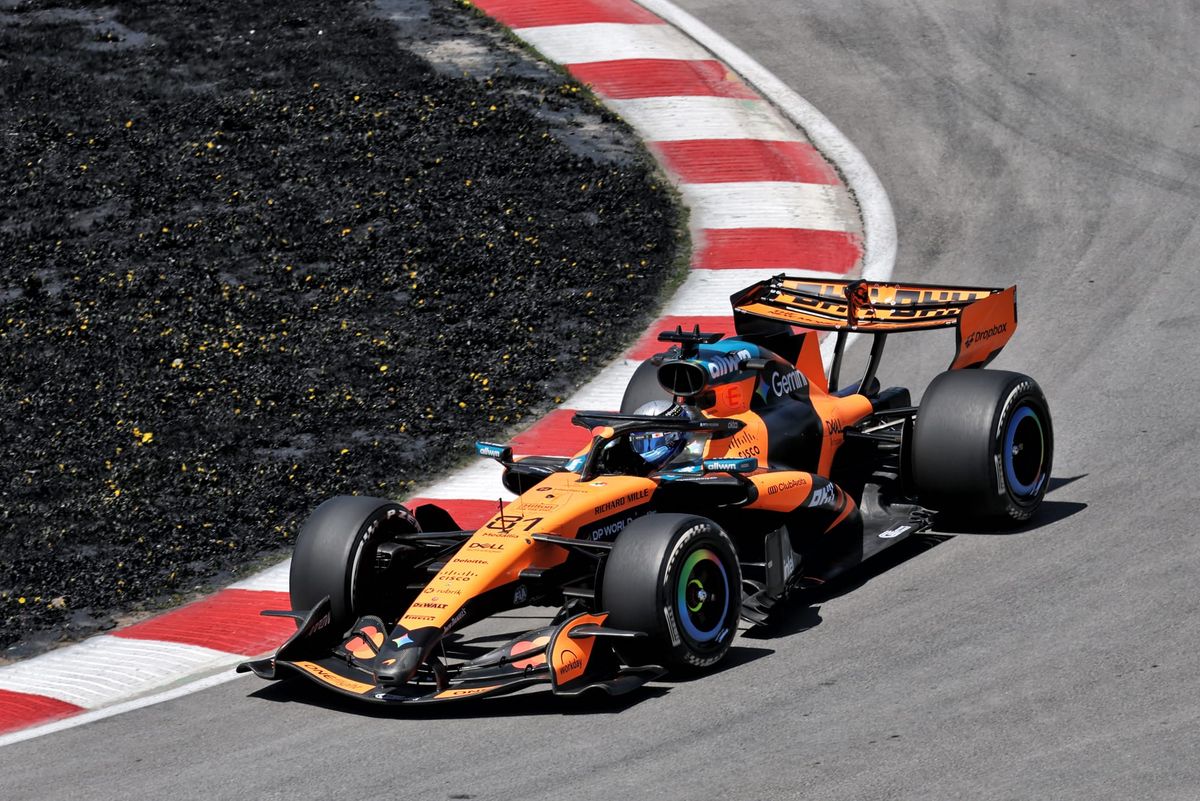
McLaren brought what can only be called a raft of updates to Montreal, it was the final parts to complete the update they introduced in Miami.
(‘Raft’, no pun intended, because of the boating lake and the fact that Jordan, where Gary was technical director, won the last five raft races held on the grand prix weekend across the lake, seen below in 2018).
Back to the front wing, this area is critical to the flow structure the rest of the car has to work with so no surprise to see changes there.
As the comparisons show, it has increased the inboard cord length on the section under the nose, it also looks like the angle of incidence is also more acute but it’s difficult to see in detail as the pictures are at a different angle.
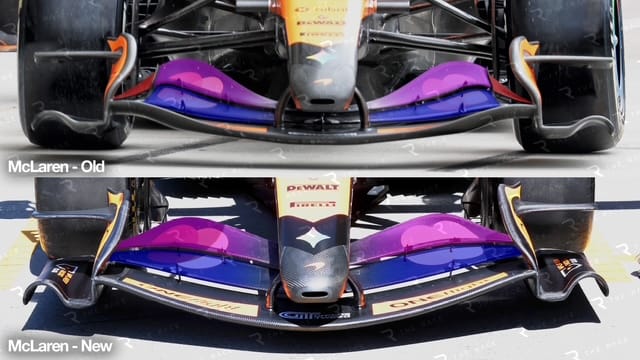
The flaps are also now full-length and run directly into the front wing end plate. This eliminates the need for that small section of flap outboard which is highlighted in red in the ‘McLaren – old’ image above, you can see it between the endplate and flaps (blue/purple).
When you increase the cord length of the flaps, especially in this area which is the section of wing that generates the downforce from what is the lowest part of the wing, the centre section of the main plane becomes critical to flow separation problems. In reality, it can cause you more problems on the circuit than the wind tunnel or CFD show up during your analysis.
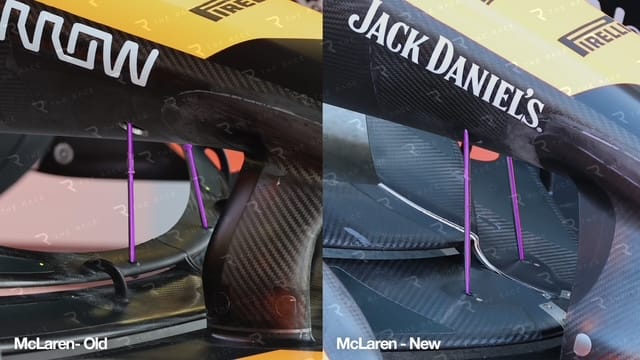
The comparison below also shows it has relocated the active aero links, it has the mechanism within the nose operating these rods which connect them to the flap assembly. You can also see the difference in the flap cord lengths at the centre line from this comparison.
Those problems can also be compounded by the fact that the cars now have active aero where the front and rear wings can be opened or reduced in angle on the straights and closed or increased in angle for the corners.
The regulations require that these actions take no less than 0.4 seconds. That in itself isn’t a problem, it’s making sure that the airflow reattachment takes place in that time span or even faster.
I wasn’t surprised when Oscar Piastri’s engineer told him that his lock-up at the final chicane in practice was because the front wing airflow hadn’t reattached by the time he hit the brake pedal. This meant that he had less front downforce than required, resulting in the lock-up and the inherent tyre flat spots.
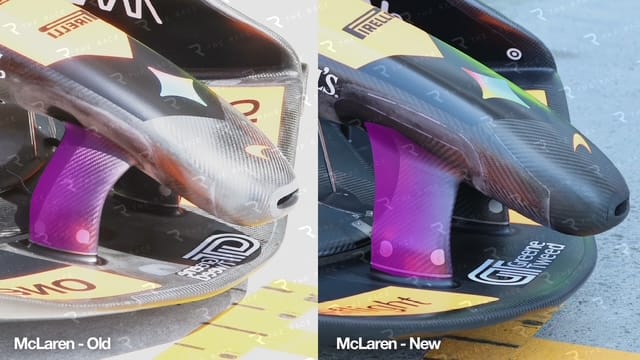
The front wing mounting pillars have also been repositioned and re-profiled (in purple, above). This shouldn’t be a problem as these two components’ primary purpose is to mount the wing assembly.
As a secondary function, they are flow direction vanes that optimise the airflow direction to the central section of the underfloor.
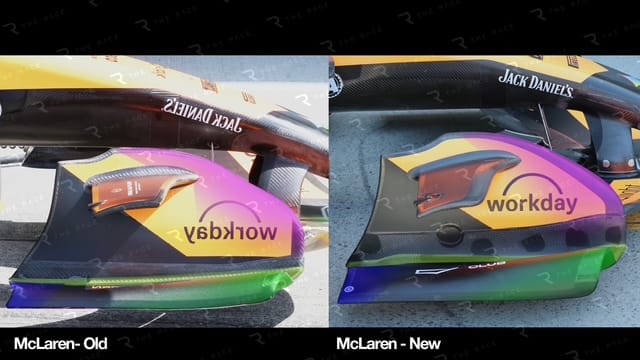
The end plates (seen above) have a slightly different upper profile and what looks like an increased leading edge opening to the footplate tunnel. This opening reduces the sensitivity of the footplate to the track surface when the wing assembly gets closer to the ground, especially when the car rolls in high speed corners.
It also forces some of that airflow under the flat section at the rear of the endplate and forces it out into what is called the front tyre squirt area. This is the displacement of airflow when the front tyre rotates onto the track surface.
If possible, you want this to be forced outboard to reduce its effect on the downforce-producing devices inside of the front tyres.
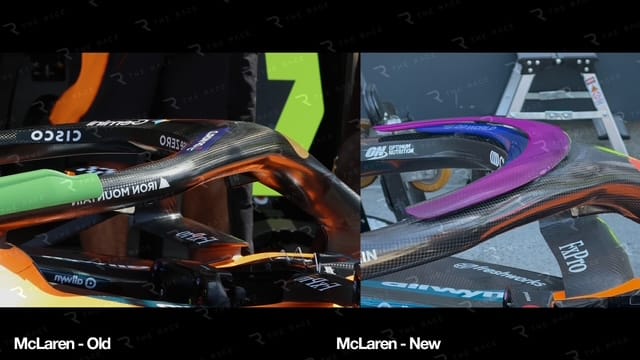
They have also added a boomerang on the top of the halo (in purple, above, right). Piastri, being Australian, probably brought it over with him…
I’m surprised McLaren didn’t have this earlier in the season as managing any airflow that is being displaced by a round-section tube can be beneficial.
This should reduce turbulence on the drivers helmet and also on the airbox/upper cooling intakes, and in turn the actual rear wing itself.
It’s a step backwards to have had to run the older version of the front wing for sprint qualifying but with these new cars, and the active aero, everyone is on a steep learning curve so I don’t suppose it will be the last time we will see it.
However, consistency and balance usually outweighs simply higher downforce levels.