
A correspondent wrote with a question about sand topdressing amounts in relation to the turf GvX.
“I’m hoping you’d be able to point me in the direction of finding something on sand inputs vs. the GvX. I’ve listened to podcasts explaining measuring in depths but can’t recall listening to one on recommendation of sand dependent on your GvX?
The short answer is, you won’t find anything on that, I hope, because I don’t think I’ve made any specific recommendations linking a particular sand rate to a particular GvX.
I can elaborate on this answer with three points that come to mind.
-
The reason I don’t link sand and GvX is because the GvX is the actual growth expressed in relation to the expected growth based on temperature (growth potential). What this means, practically, is that the same GvX at different locations will have different clipping volume. For example, let’s take 15 December in London with an average temperature of 5 °C and in Singapore with an average temperature of 27 °C, with a GvX of 40 at both locations. To get a GvX of 40 in those temperatures, that corresponds to a daily clipping volume of 0.2 mL/m2 in London but 7 mL in Singapore. That is, because the GvX is adjusted based on GP, the identical GvX of 40 in this case has about 35 times more actual clippings in Singapore for this example than in London.
-
For any one site, I imagine that the sand requirement is lower when the GvX is lower, and that the sand requirement is higher when the GvX is higher. But I don’t try to link the amount of sand to the GvX.
-
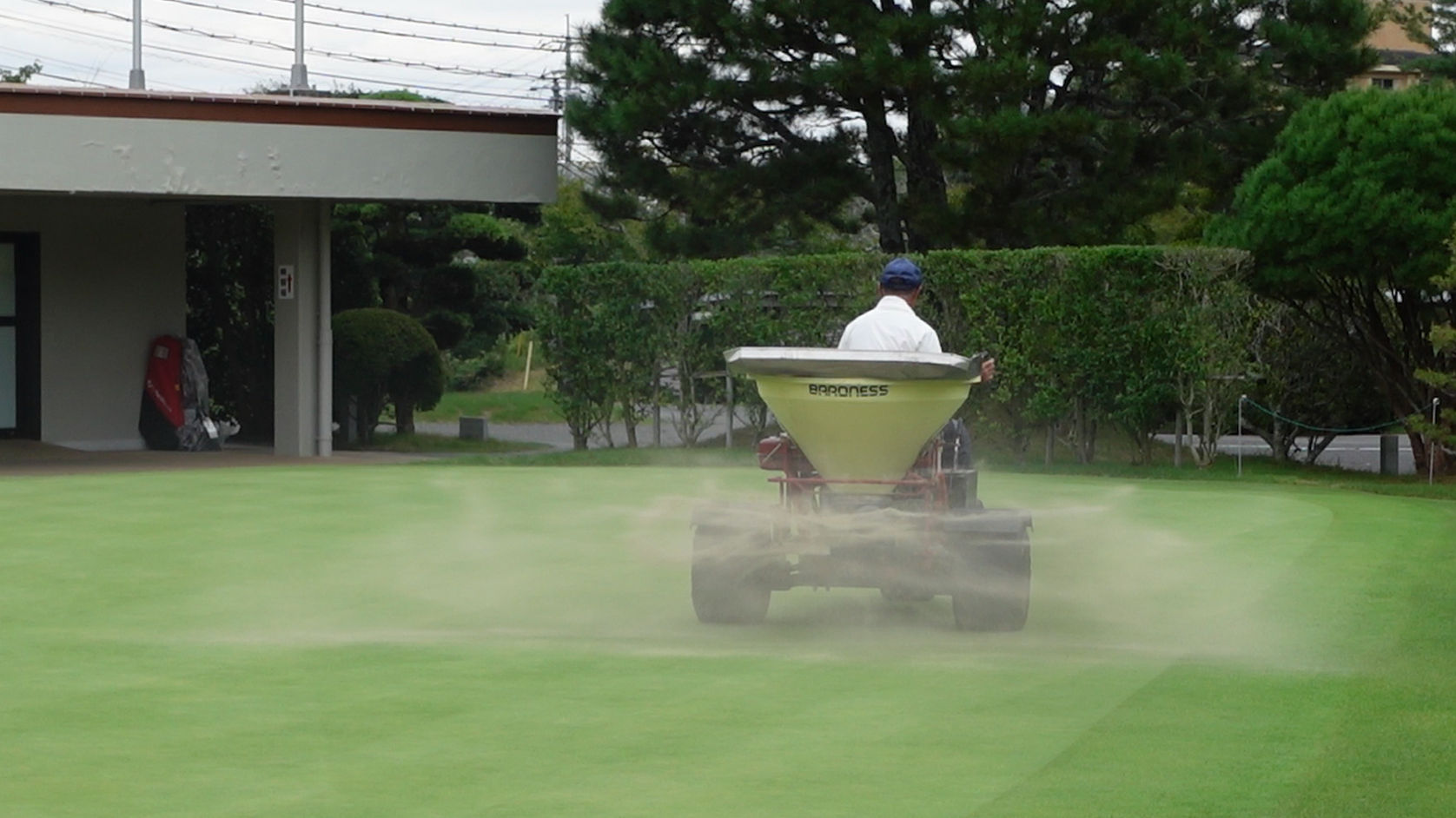
I have proposed that 1 mm of sand topdressing may be a reasonable amount to apply for every 1 L of clipping volume. That is, for every 1 L of clippings per m2, add 1 mm of sand over the time period it takes to collect that many clippings. Doug Soldat has tried this topdressing rate in a research project at the University of Wisconsin, and he’s found that under the conditions of the experiment, that rate of sand produced an intermediate level of soil organic matter. One of the summary points in a project update is this: “While the different topdressing volumes [multiple methods of choosing a topdressing rate were tested] resulted in differences in surface soil organic matter (4.4% vs 6.1% after three years of divergent management), the differences in playing surface performance (speed, firmness, quality, density) were minor across that range.”
Another way to get a site-specific sand topdressing estimate is to use the spreadsheets from PACE Turf.
The way I really like to do this is to measure the total organic material by depth, the OM246, and then to calculate a sand amount based on that.