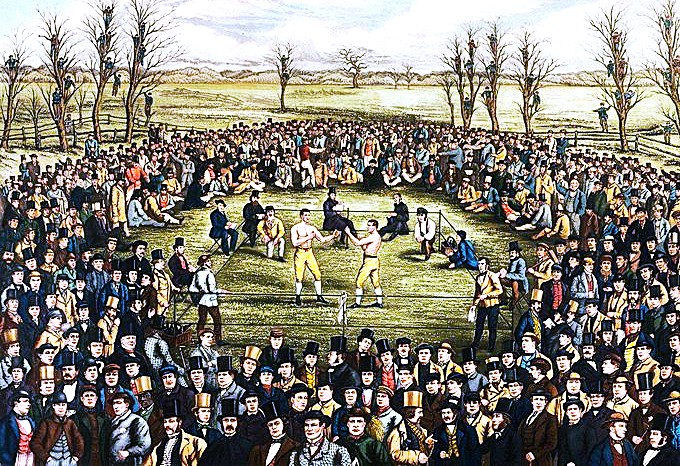
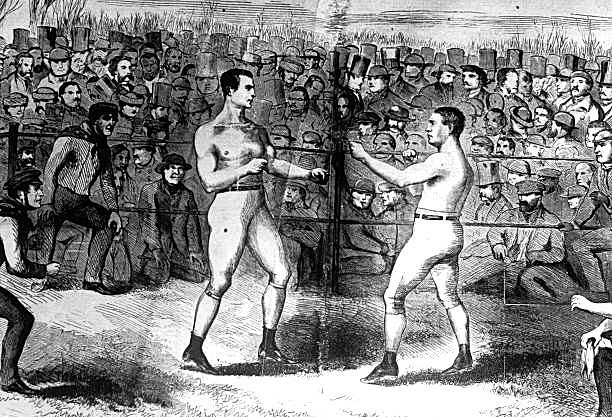
Heenan vs Sayers. It is the most publicized, most eagerly anticipated sporting event on both sides of the Atlantic Ocean. Some at the time regard it as the most written about event, of any kind, ever. An American and an Englishman squaring off for the heavyweight championship of the world. The crowd is massive. Celebrities of all stripes are in attendance. This is “The Fight of the Century.”
Except the Englishman is actually a middleweight. And the American has an 0-1 record. And none of the fans will know until the last minute where the confrontation will actually take place. And that’s because this is the fight of the 19th century. In truth, the first ever “Fight of the Century.” Tom Sayers vs John Heenan on April 17th, 1860, for the inaugural world title of boxing.
As most fight fans know, pugilism in the mid-19th century was so foreign to the boxing we see today that prize-fighting was almost an entirely different sport. No gloves. No bell. Wrestling and throwing an opponent were allowed. Rounds ended not after a set time had elapsed, but when a fighter was knocked down. The designated regulations were the “London Rules.” And every bit of it was illegal.
But some of the similarities are less known. For example, in preparation for the Heenan vs Sayers showdown, both men trained for about three months, not unlike today’s camps. And when they took their shirts off in the ring—a custom known at the time as “peeling”—everyone remarked on the fact that both combatants were in exquisite shape. These were not barroom brawlers; these were professional pugilists.
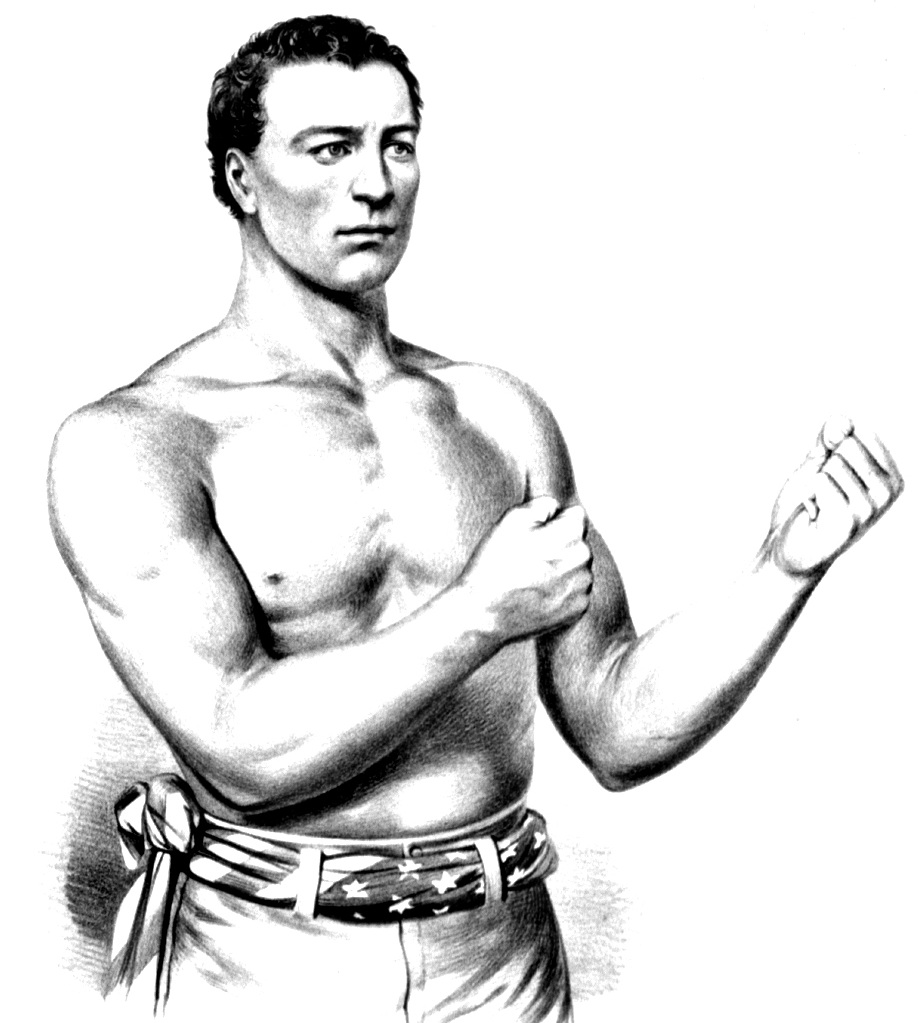
Nonetheless, the differences to the present are most striking to anyone looking back a century-and-a-half. The American John Heenan, who was renowned as a man of violence from his time as an enforcer in the dockyards of San Francisco, had participated in just a single professional fight before meeting Sayers, a match which he had lost. However, he had fought so well in that defeat, a battle against American champion John Morrissey, that the American boxing establishment nominated the 26-year-old to face the English champion Sayers.
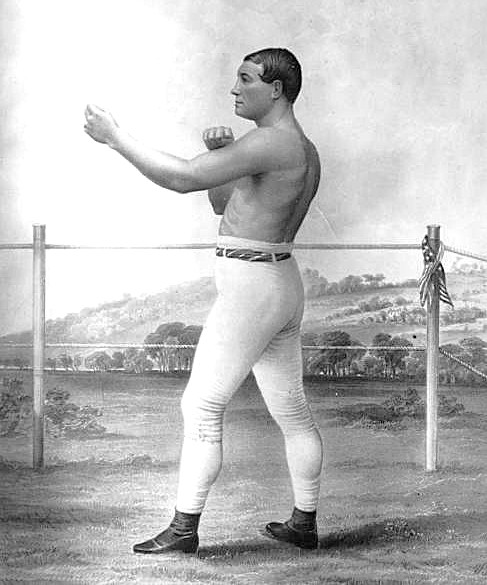
Tom Sayers was quite a different man. He was 34, nearing the end of his career, and stood only 5’ 8”. Today he would likely be a light middleweight. He was a crafty veteran though, with a record of 14-1. Fights at this time were so brutal, and lasted so long, that it was rare for a pug’s record to get into double digits. Despite what we might see now as a modest record, Sayers was experienced and brought the goods.
The start of fight-day back in 1860 was a little like a late 1990s rave. No one knew the location of the contest except the combatants and their small entourages. Swaths of boxing aficionados, known as “the fancy” (from which we get the word “fan”), had bought train tickets from London “To Nowhere.” When word of Waterloo station made the rounds, people packed the platforms and piled onto a fleet of south-bound specials.
The trains took them to Farnborough, where they hiked through the meadows to a prize ring set up in a field. Everyone present was breaking the law, and several were famous and powerful. Charles Dickens, Prime Minister Lord Palmerston, and The Prince of Wales (who’d later become King Edward VII) were all in attendance.
Heenan and Sayers were called to scratch at about 7:30 am, and began a brutal affair that would last over two hours. The larger Heenan dominated the opening rounds, landing big blows and several times throwing Sayers to the ground. After the fifth, Heenan raised his hands in triumph, as if he had already won.
But then Sayers showed why he was the champion. In rounds seven and eight, which lasted thirteen and twenty minutes respectively, Sayers proceeded to land clean, jarring punches to Heenan’s face, blows which resulted in the American’s right eye swelling shut. In today’s vernacular, we might say that Sayers boxed while Heenan brawled, and while the smaller Sayers took punishment even just from blocking the bigger man’s punches, he also inflicted plenty of damage with his more precise offensive efforts.
As the rounds went on, the half-blind Heenan landed all the knockdowns, but Sayers, who was in visible pain, always made it back to scratch. And the Englishman didn’t just survive, he continued to score, eventually causing Heenan’s left eye to swell shut as well. After more than two hours, with Sayers barely able to stand and Heenan almost completely blind, the two faced off for round 37. And then the police showed up.
While officers worked their way through the spectators, Heenan forced Sayers to the edge of the ring and then grabbed the Englishman’s neck, forcing him down on the rope. Heenan was choking Sayers and someone had to cut the rope to put an end to it.
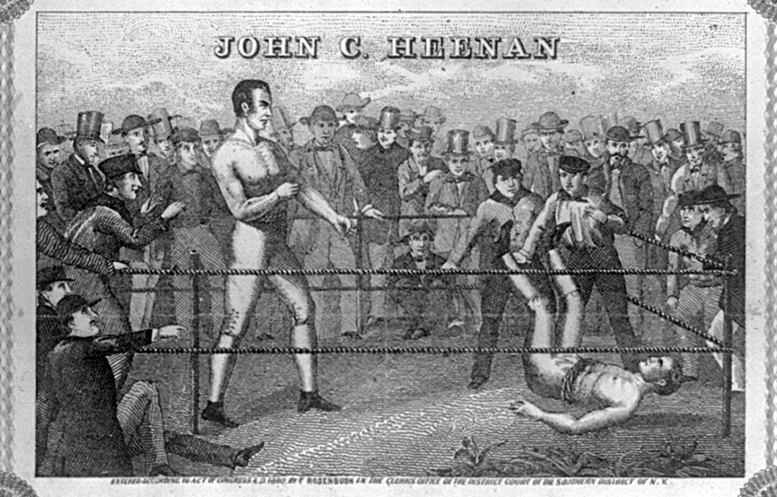
Most reports say that the combatants fought five more rounds and then the referee called it a draw. Whatever the case, we know there was not a clear winner. The police made no arrests but let the fighters and the fancy make their way back to the trains on which they had arrived. Sayers had to be carried, he was so beaten. Heenan sprinted back, showing everyone that he could have continued.
And so the first ever “superfight” ended as so many others would: in controversy. Would Heenan have finished the job had the bout gone on? Could Sayers have pulled off a miracle? Both men did claim victory, but beyond that neither added fuel to the argument. In fact, they became friends, did a UK tour together to earn some money, and later reunited in the ring when Sayers worked Heenan’s corner in the American’s bout against Tom King. Sayers retired after fighting Heenan, while the American only had one more fight, against King, and he lost, leaving the boxing world rated as a great pugilist, but without ever having notched an actual legitimate victory. Both men died at age 39.
The legacy of this historic fight goes beyond making boxing an international sport. Its popularity and brutality led to calls for changes in the rules. The new code called for gloves, three minute rounds, and a ten second count after knockdowns. A certain Marquess of Queensbury sponsored these changes, and the new regulations bear his name to this day.
There’s also a social history to this fight. Professor Robert Colls has said that such contests might be described as the “plebeian version of national history.” For the British in particular, Colls said that a fight like this showed that the English could give a good account of themselves. In the wake of the Napoleonic Wars, where infantry men were so often required to bravely march into enemy fire, a man like Sayers proved that the Britons had the required valor. On the American side, it’s not an accident that Heenan was an enforcer in San Francisco, and ended up dying in Wyoming. He was an outlaw brawler, one of the tough men that would define America’s frontier, the Wild West, and, to an extent, America’s idea of itself.
So if Heenan vs Sayers does not find itself on any lists today of great “superfights,” no one can dispute the fact that few have proved to be as important to the sport’s development. And we should all be grateful that we no longer have to travel to a field in the countryside to see our favorite fighters battle one another.
–Joshua Isard