
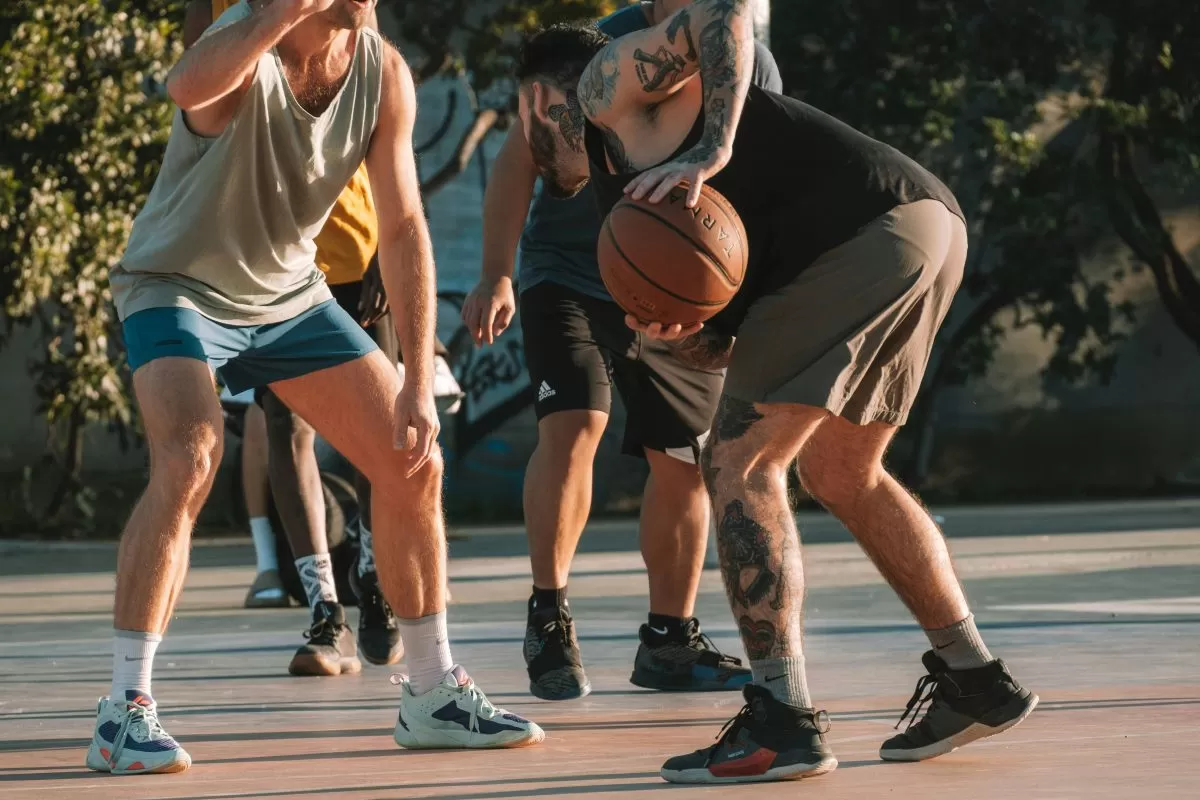
A player who sweats off 2% of body mass shoots a lower percentage, covers the floor slower, and tracks the game with less attention. For a 90 kg guard, 2% is under 2 kg of fluid. A single competitive game can produce that loss. Whole-body sweating rates in basketball average close to 0.95 liters per hour, and players have been measured well above 1.6 liters per hour during games. The deficit builds inside one game, and the drop in play follows it closely. The number worth watching is how far behind his own sweat rate a player falls.
The Two Percent Threshold
Researchers describe a consistent point where measurable decline begins. At 2% body mass loss, combined shooting and timed drills drop to a degree that reaches a measurable level. Below that figure, players often hold steady. Past it, the numbers fall in a predictable pattern that grows with each additional percent.
The 2% mark matters because players reach it without alarm. Thirst lags behind actual fluid loss, sometimes by a full percent of body mass. A player can feel functional while already at a deficit that costs him points and seconds. The body does not send a strong signal until the gap widens further, by which point the performance cost is already present on the floor. This is why coaches who wait for a player to ask for water tend to catch the problem late.
Stamina and the Slower Sprint
Dehydration shows up first in repeated high-speed efforts. In simulated games, players with 2, 3, and 4% body mass loss recorded sprint times that grew longer by 7, 8, and 16%. The pattern is progressive. Each additional percent of fluid loss adds measurable time to the same sprint.
Basketball depends on repeated short accelerations rather than steady running. A defender closing out, a guard beating his man off the dribble, and a forward crashing the boards all demand quick bursts. When blood volume drops and core temperature climbs, the heart works harder to move oxygen to working muscles, and those bursts slow. The effect compounds across four quarters. By the closing minutes, a dehydrated player is slower at the exact point when possessions decide the result, and the slowdown reaches the legs he needs for both defense and the offensive rebound.
Choices for Replacing Lost Fluid
Players replace fluid with more than plain water. Water handles the volume, but heavy sweaters also lose sodium and other salts that water alone does not return. Many programs rotate through several options across a game: water for general intake, milk or whole food after the final buzzer, and hydration drinks for sessions where sweat loss runs high. The aim is to match the drink to the demand. A heavy-sweat session in a hot gym and a light shootaround call for different intake.
Timing matters as much as content. Drinking a large volume in the final minutes does little for a player already behind. Steady intake during stoppages and timeouts keeps the deficit from reaching the range where skill drops.
Focus, Attention, and Decision Speed
The cognitive cost is harder to see from the stands and easier to feel on the floor. Even mild dehydration lowers attention and short-term memory once a player passes 2% body mass loss. A meta-analysis of hypohydration found that deficits beyond 2% compromise attention, executive function, and motor coordination. Reaction time results vary across studies, but the higher-order skills a player needs to read a defense hold up worse than the simple ones.
Basketball rewards fast reading. A point guard tracks five defenders, a shot clock, the spacing of his own team, and a called set at once. That load depends on working memory and attention, the exact functions fluid loss erodes first. The same loss brings on moodiness and fatigue before a player notices either, which dulls the patience a long game demands. A dry, tired player still runs the play. He reads it a beat late, and a beat is the gap between an open look and a turnover. The cost is invisible in a box score, which lists the missed shot but not the half-second of slow recognition that produced it.
Shooting Accuracy Under Fluid Loss
Shooting is the most documented casualty. In one controlled comparison, players at 2% dehydration made 45% of shots against 53% when properly hydrated. Across progressive dehydration from 1 to 4%, players made 5, 6, 8, and 10 fewer shots as the deficit grew. The decline scales with the percent of fluid lost.
Three-point shooting suffers most because it asks for the finest motor control. Fatigue in the legs shortens the shot. Lapses in attention disrupt the timing of the release. The combination of physical and cognitive decline is heaviest on the skill that depends on both, which is the long jump shot taken late in a close game when a player is already several quarters into his fluid deficit.
Recovery Between Games
The deficit does not reset on its own between games. A player who finishes one game 2% down and does not replace the fluid brings the gap into the next session. Full fluid replacement takes more than the deficit itself, because some of what a player drinks passes through as urine. A common guideline is roughly 1.5 liters of fluid for every kilogram of body mass lost, paired with sodium to help the body hold it.
Back-to-back schedules expose players who skip this. The second game of two nights in a row starts with a player who never closed the previous deficit, which front-loads the decline into the opening quarter rather than the fourth. A weigh-in after each game turns an invisible problem into a number a trainer can act on.
Building Intake Around the Game
The fix is plain and well understood. Players who weigh in before and after sessions learn their own sweat rate, then drink on a schedule that holds losses under 2%. Thirst alone arrives too late to set the pace. Most lose between 0.5 and 1 liter per hour of play, though heavy sweaters lose far more, so individual measurement beats any generic rule printed on a poster.
Sodium supports the effort. Salt helps the body hold the fluid a player drinks. For a guard who sweats heavily across a long game, water alone can leave him drinking steadily and still falling behind. Pairing fluid with sodium keeps the intake from passing straight through and leaving the deficit in place.
The Two Percent Rule in Practice
The research points to a single working figure. Hold fluid loss under 2% of body mass, and most of the measured decline in shooting, sprinting, and attention does not appear. Cross it, and the costs arrive together and grow with every additional percent. A player cannot feel the 2% line, which is why a weigh-in and a drinking schedule matter more than thirst. Ignore it, and what shows up in the minutes that decide the game is a version of the same player who is a step slower to every ball and a beat slower to read it.