
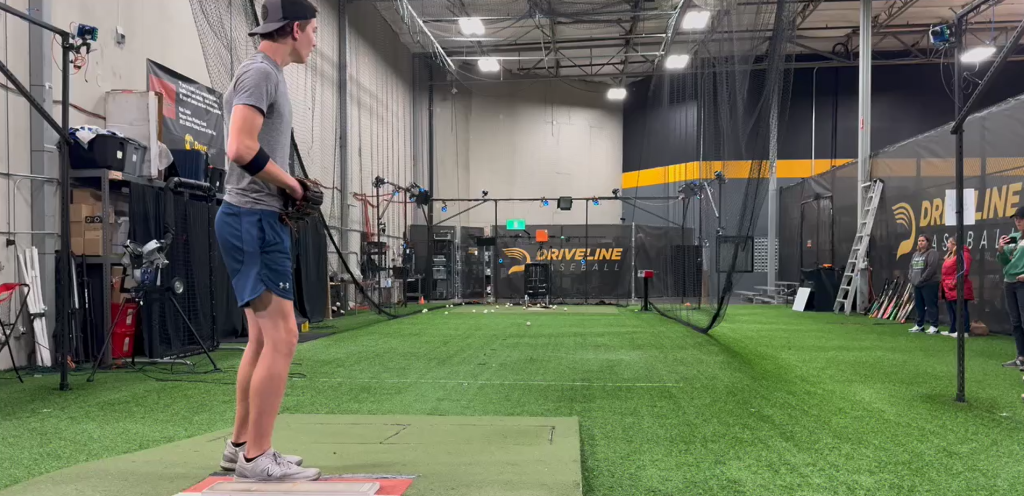
PULSE gives Coury the confidence to know when he should throw, how much, and at what intensity.
“I would tell (younger guys) to make sure you stick to the workload because elbow injuries suck. They’re not fun,” Coury said. “And an extremely easy way to get them is doing more than you are supposed to, especially on those recovery days when your body is supposed to be actively recovering.”
Ferguson has seen the power of PULSE in working with Coury and other athletes.
“The biggest thing right now with him is our recovery days because his mechanics are so good, it’s really easy for him to get up above that threshold that we want him working at,” Ferguson explained. “PULSE gives us a really effortless way to monitor that workload on a day-to-day basis, especially on those lower-intent days.
“He knows on what days, what ranges he needs to be in.”
Ferguson notes PULSE can measure the stress of every type of throw, including those not made on the mound during recovery days.
Like many high school athletes, Coury pitches and plays a position on the field, usually first base.
PULSE allows for all his throwing work to be measured, not just pitching-related training.
“On those recovery days, when I don’t want him throwing out of his wind up, or his stretch position but we’re trying to keep him athletic, PULSE allows us to monitor the workload,” Ferguson said. “We can get a gauge on that and be like, ‘OK, he is doing some shortstop throws, or he’s doing some catcher throws. How does that impact his workload today compared to normal throwing?’ Monitoring that acute-to-chronic ratio and making sure we are staying in a good spot especially for a guy coming off elbow problems … building that workload slowly.”
Recently, Coury returned to the mound for a motion capture and his first high-intensity throwing since he was injured. He was elated to see 90.4 mph light up on the velocity board after one of his first four-seam offerings.
“It honestly wasn’t even the number that made me excited,” Coury said, “It was honestly just being off the mound again. That was my first time being off the mound in a full year, like at 100% and. … I more so wanted to make sure that I felt good after that mocap, and I didn’t feel like my arm was in pain, that kind of stuff. And I felt great after.
“I’ll retest in two weeks and hopefully I can put up like 94 (mph) or something like that and that would be awesome.”
That would certainly open some eyes among college coaches. Coury’s goal is to pitch at Division I level.
He has not had as much game action as he would have liked due to his fluke injury, but he enters his senior year with his best days ahead of him as a pitcher. Coury is a classic Driveline development success story, with plenty of chapters yet to be written.