
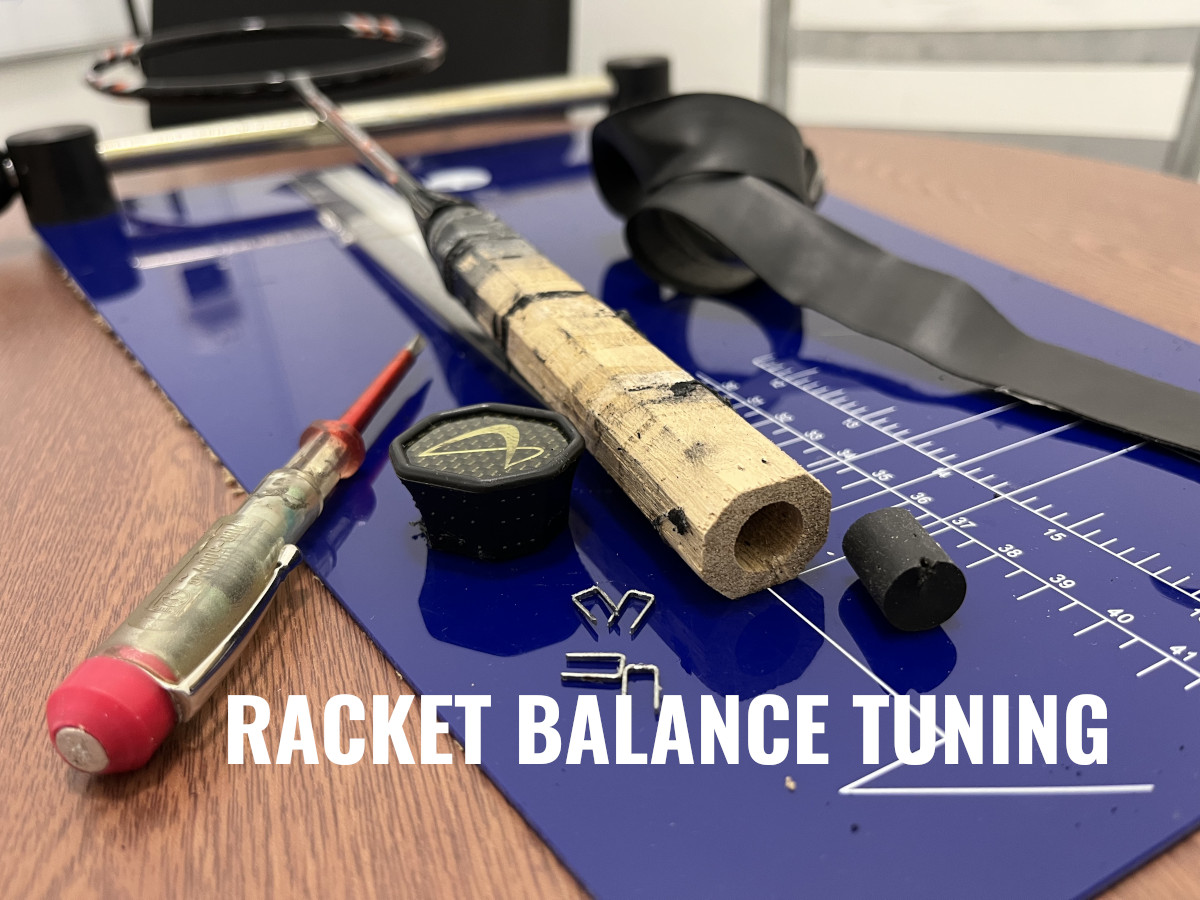
A practical guide to making your racket feel faster, more powerful, or easier to handle
One of the most overlooked aspects of badminton racket customization is balance point tuning. Many players focus only on total weight, but two rackets with the same weight can feel completely different depending on how that weight is distributed.
The good news is that you can modify a racket’s balance point without significantly changing its overall weight. With the right adjustments, you can make a racket feel more head-heavy for extra power, or more head-light for faster defense and drives, while keeping the total weight nearly identical.
Understanding Balance Point
The balance point (BP) is the point where the racket balances horizontally on a finger or rod. It is usually measured in millimeters (mm) from the base of the handle.
Typical ranges:
- Head-light: below 285 mm
- Even balance: around 285 to 295 mm
- Head-heavy: above 295 mm
A higher balance point generally provides:
- More momentum and power
- Heavier smashes
- Slower maneuverability
A lower balance point generally provides:
- Faster racket handling
- Quicker defense
- Easier flat exchanges and drives
The Key Principle: Weight Redistribution
To change balance point without changing total weight, you must redistribute mass from one area of the racket to another.
In simple terms:
- Add weight to the head while removing a similar amount from the handle
- Or add weight to the handle while removing a similar amount from the head
The total weight stays almost the same, but the racket’s feel changes dramatically.
This is the most common customization for players seeking more attacking power.
Step 1: Reduce Handle Weight
You can reduce handle weight by:
- Replacing the original grip with a thinner grip
- Removing an overgrip
- Using a lighter replacement grip
For example:
- Original grip setup: 10 g
- New grip setup: 6 g
- Weight reduced from handle: 4 g
Step 2: Add Weight to the Head
Now transfer similar weight to the frame using:
- Lead tape
- Tungsten tape
- Weighted strips
Common placement areas:
- 12 o’clock for maximum power increase
- 10 and 2 o’clock for a more balanced feel
Example:
- Add 4 g of tape to the racket head
- Net overall weight change: approximately 0 g
Result:
- Same total weight
- Higher balance point
- More powerful swing feel
What You Will Notice
Advantages:
- Stronger smashes
- More momentum
- Heavier shuttle penetration
Disadvantages:
- Slower reactions
- More demanding on wrist and forearm
- Reduced defensive speed
Advanced Method: Adjusting Weight Inside the Handle
Another way to modify the balance point is by adjusting the hidden weight inside the handle itself.
Some badminton rackets contain:
- rubber weights
- silicone filling
- foam or putty material
inside the hollow wooden handle beneath the end cap.
By partially or fully removing this material, you can reduce handle weight and shift the balance point slightly toward the head without adding external weight.
How to Access the Handle Weight
Step 1: Remove the Grip
Unwrap the grip until the wooden handle and end cap are exposed.
Step 2: Remove the End Cap
Using a small flat screwdriver, carefully pry out the metal staples or clips holding the end cap in place.
Be careful not to damage:
- the wooden handle
- the plastic cap
- the staples
Keep the metal clips safely, as they will be reused during reassembly.
Step 3: Inspect the Inside
Once the cap is removed, check whether the handle contains:
- rubber inserts
- silicone
- foam filling
- weighted material
Not all rackets have internal weighting, but many factory head-light or even-balance rackets do.
Step 4: Remove Weight Gradually
Remove small amounts at a time and recheck the balance point frequently.
Even tiny changes inside the handle can noticeably affect racket feel.
Step 5: Reassemble the Handle
After adjustment:
- reinstall the end cap
- push the metal clips back into place
- rewrap the grip
Important Warning
This modification should be done carefully.
Improper removal or reassembly may:
- loosen the handle
- create vibration issues
- damage the wooden shaft handle
If unsure, it is better to start with grip modifications first before attempting internal handle adjustments.
In reality, this is extremely difficult.
For rackets that are naturally head-heavy by design, most of the weight comes from the frame construction itself. Unlike grips or lead tape, structural frame weight cannot be safely removed.
This means there is usually very little removable mass available at the racket head.
Because of this limitation:
- You can slightly reduce the head-heavy feel
- But fully converting a head-heavy racket into a truly head-light racket without increasing total weight is often impractical
What Players Usually Do Instead
Most players use one of these approaches:
1. Add Weight to the Handle
This is the most common method:
- Extra overgrips
- Heavier replacement grips
- Silicone or tungsten putty inside the handle
This lowers the balance point and makes the racket feel faster.
However, total racket weight will increase.
2. Use Lighter Strings
Using thinner or lighter strings can slightly reduce head weight, but the effect is usually small.
3. Choose a Different Racket Model
If a player wants a dramatically more head-light feel, switching to a racket designed with that balance profile is usually the better solution.
Many players are surprised that just 2 to 4 grams can significantly affect racket feel.
This happens because weight added farther from your hand creates much greater rotational effect.
For example:
- 3 g added at the racket head feels far more significant than 3 g added near the grip
- Weight at 12 o’clock changes swing feel dramatically
That is why professional racket customization often uses very small weight adjustments.
Useful items include:
- Lead tape
- Tungsten tape
- Precision weighing scale
- Balance board or ruler
- Thin replacement grips
- Overgrips of different thicknesses
Make Small Adjustments First
Start with:
- 1 to 2 g changes
- Test before adding more
Large balance changes can make a racket uncomfortable very quickly.
Measure Everything
Track:
- Total racket weight
- Balance point
- Grip setup
This helps you reproduce setups consistently.
Consider Swing Weight
Even if overall weight stays the same, swing weight changes when mass moves farther from your hand. This is why the racket may feel heavier or lighter during actual play despite identical static weight.
Modifying a badminton racket’s balance point without changing total weight is one of the most effective ways to fine-tune racket performance.
By redistributing weight between the handle and the head, players can customize:
- Power
- Speed
- Maneuverability
- Overall feel
The best setup ultimately depends on your playing style, strength, and preferences. Small, careful adjustments are usually more effective than extreme modifications.
In many cases, a properly customized racket can feel better than buying a completely new model.
Want us to make a video on badminton racket balance tuning and handle weight adjustment? Comment below 👇