
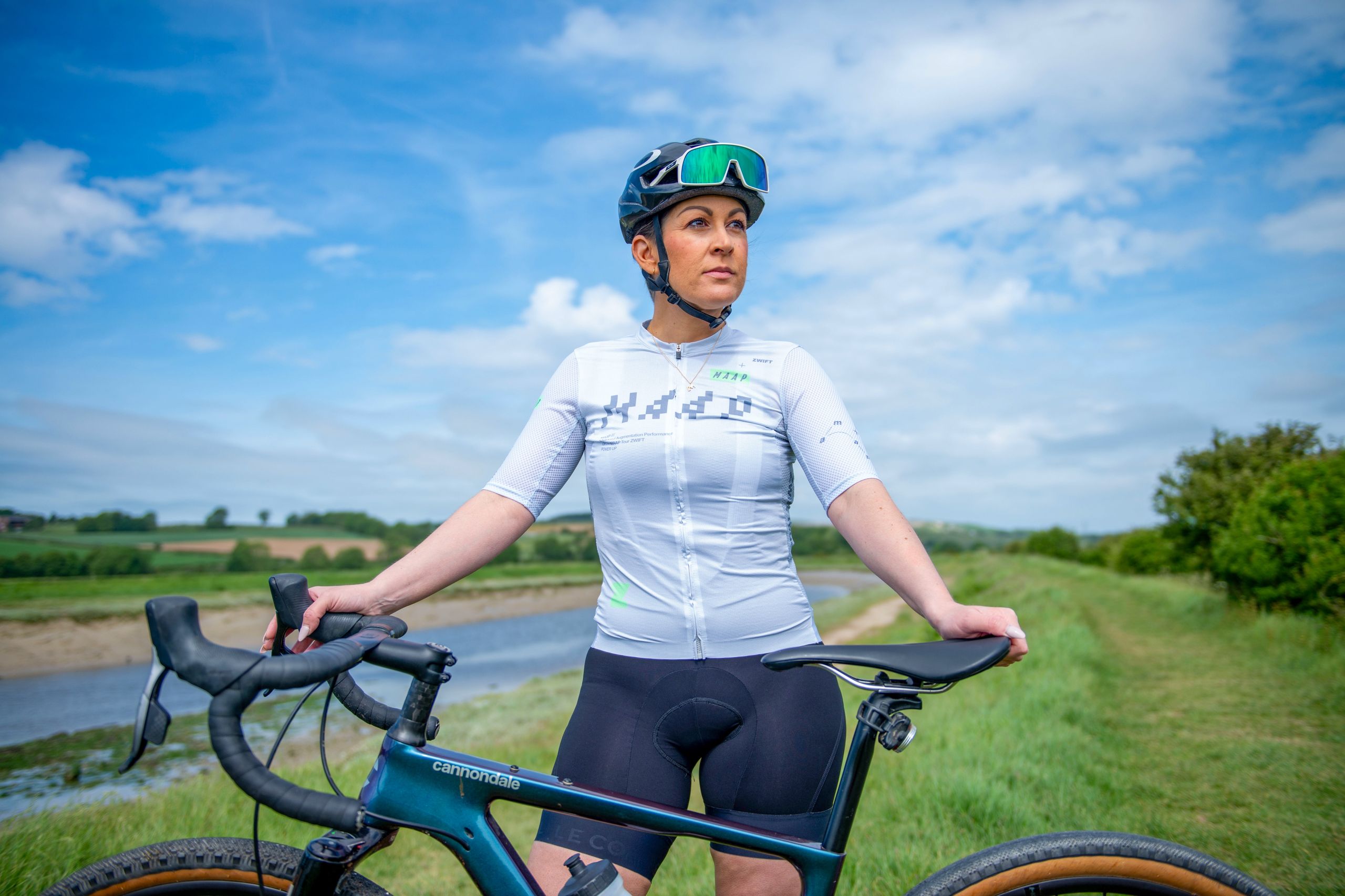
A “blur” and an “influx of words” is how Rebecca Charlton describes receiving her cancer diagnosis to me. “It was just knocking me sideways. It was a string of chemotherapy, cancer, spread… it was the biggest shock of my life.”
The cycling journalist and commentator had arrived for what she expected to be a “routine” appointment, resulting in perhaps a “course of antibiotics”. Instead, she heard the words: “I’m really sorry, it’s cancer.”
The former Cycling Weekly writer and author had given birth to her second daughter just a few months prior, and now faced a fight against an aggressive form of breast cancer. Hours after that appointment, she was live on TV, enthusiastically guiding fans through a chaotic sprint finish on day three of the Tour de France Femme Avec Zwift, eventually won by Lorena Wiebes (Team SD Worx–Protime).

“That world of bike racing became my escape. I couldn’t control what was happening with the cancer. I could control focusing on doing my job well; I could focus on Pauline Ferrand-Prévot getting up that mountain first, and it helped me immensely,” she recalls. “That initial period of time was really dark. Cycling is such a constant in my life, and once again, it came to the rescue.”

Keeping her focus on the job helped Charlton to process her diagnosis
(Image credit: Rebecca Charlton)
Being the face and voice of live TV coverage requires laser focus, “there isn’t time to let intrusive thoughts in,” says Charlton, “I love the adrenaline of live TV, and once that countdown happens, and you’re into the stage of a race like the Tour, you’re fully immersed in that. You’re trying to constantly think one step ahead the whole time, you can’t think about cancer.”
Charlton has kept her diagnosis private for the best part of a year, eventually opting to commentate off-screen. “As my lashes and brows and things all fell out, and I suddenly looked like a cancer patient, I suddenly looked very unwell,” she recalls. “So I wanted to hide that, but what the joy of commentary brought was that no one could see me, and I still got to just be me and talk about what I love.”
With active treatment now concluded, Charlton will be presenting highlights of the Tour de France and Vuelta a España this summer on Channel 5. “From the darkest low to the brightest high, this is a dream come true,” she told me. “I’ve watched the Tour religiously since the 90s and this is a true pinch me moment.”
No warning signs
Before her diagnosis, the only alarm bell Charlton had had that something might be amiss was a lump under her armpit. In the sleep-deprived haze of the newborn bubble, the lump was initially put down to breastfeeding and the huge changes that take place postpartum. A nurse told Charlton, “‘we’re dotting the i’s, crossing the t’s, everything’s going be fine.” Her mammogram was clear, as was her ultrasound; Charlton didn’t expect bad news at her follow-up appointment, but a biopsy showed up cancer cells.
What followed was months of waiting; by the time Charlton finally arrived at the first of two surgeries – which would leave her unable to pick up her newborn baby – she was eager for the treatment to begin. “It’s a very bizarre thing to say, like you want to get under the knife, you want to get into chemotherapy. These are things that you know are going to be hideous. But I was excited to get started. I wanted to fight it. I wanted to be proactive, I wanted to get back some control.”
Next, Charlton endured a course of ‘dose dense’ chemotherapy and weeks of daily radiotherapy. Having spent a decade working as a fitness editor at Cycling Weekly, her go-to response was to square up to treatment like it was a very, very tough bike ride.

(Image credit: Rebecca Charlton)
“I really likened the whole process of recovering for each [chemo] session to interval training. If you’re doing a VO2max test or a ramp test, you’re just focusing on ‘how long can I keep going when I’m absolutely depleted on the floor, and I’ve given it everything, how can I get back up again?’ – I was seeing chemo like that.
“I had days when I was lying on the bathroom floor, so unwell, I didn’t think I could ever get to the next session. But I started keeping a diary, and I knew that on day seven, I would be quite bad, and then things would start to improve and, all being well, I could get back up again. And that’s absolutely how I viewed it: ‘this is interval training, and I’ve just got to get myself well enough again, so in two weeks’ time, [I can] get bashed, knocked to the floor, and get back up again’.”

(Image credit: Rebecca Charlton)
Get up again she did, using cycling as and when possible to limit symptoms. Finding a research paper that suggested that short, targeted bursts of exercise could reduce the chance of developing peripheral neuropathy – which Charlton describes as “crippling nerve pain” – she combined this with wearing compression garments, finding relief from previously “excruciating” pain.
“All the pain – having been on morphine to control it – started to subside. I’m not saying that this is a miracle cure for everybody. But by doing that research and treating it like I would have done if I was training for a bike ride or a bike race really helped me. It also kept my mind calm, thinking, ‘what can I do? How can I help myself?”.
Of course, Charlton cautions that balance is key. Looking at the broader cycling landscape, and the trend towards riders taking a more holistic approach to training – something she did herself when using Zwift to stay fit through two pregnancies – she says: “I think we’re – in so many ways – starting to realise that actually just going harder and faster all the time isn’t necessarily the best route to longevity, to getting fitter, to keeping your health topped up. And that’s something again that cancer has taught me: pushing through that pain barrier isn’t always the answer; if it feels like too much, you have to rein it in and listen to that.”

Cycling – carefully balanced with recovery – helped control Charlton’s symptoms
(Image credit: Future)
Though riding outdoors was rarely possible, the indoor community on offer via Zwift was a lifeline, Charlton remarks that jumping on, “even if it’s not for a long ride, just fills me with joy and positivity.”

(Image credit: Rebecca Charlton)
The support of the cycling community is a topic Charlton returns to repeatedly in our conversation. From the anaesthesia team who recognised her – and sent her to sleep before both surgeries with a mind full of bike racing – to Jo Rowsell, who comforted her in the commentary box immediately after her diagnosis, and Dani Rowe MBE who “held” her and “stocked the fridge” with healthy meal replacements when food was just too much. But the influence of Sir Chris Hoy – who was himself diagnosed with incurable cancer in 2023 – has been a lifeline.
Having read his book All that Matters before her own diagnosis, she notes “it might sound like a cliche, but I am able to appreciate everything. The sun comes out, that’s brilliant. If I have a moment with my children, reading them a lovely book that they enjoy, everything is heightened, and I’m just so grateful for everything.”
Charlton’s has now finished active treatment. “There is more to come for me,” she acknowledges, adding that she will be sharing her journey through any future treatment. She observes “there’s no guarantees in this situation”, but adds “I am just so grateful for everything now.”

(Image credit: Rebecca Charlton)
Sir Chris’ charity ride, the Tour de 4, takes place in September, having last year raised over £3 million for cancer charities. “Research matters so much,” Charlton says, “I am not only looking for hope for myself with advancements in treatment, but for everybody affected now, affected in the future, who’s already been affected in the past,” she says.
“[Cancer] is becoming more prevalent in younger people below screening ages,” Charlton adds, noting that her young age “added to the shock…I thought ‘it’s a risk in my lifetime, and honestly, that’s something I have to worry about later along the road, that’s not a now problem’, but it did happen now, and I think that’s why it’s so important for people to check themselves.
“I didn’t, unfortunately, have any warning signs until it had spread [to my lymph nodes], but I’m so glad I went to the GP that day, and he took it seriously. So you’ve just got to speak up if you think something might be wrong.”
Charlton’s demeanour throughout our interview is one of immense positivity, and that’s in part a viewpoint she’s learned: “[After my diagnosis] the first thing I wanted to do was find other people that have been in my situation and that were positive and in a happy, good place having come through a diagnosis and treatment.
“I want to be that – if possible – for anybody else hearing those words and going through the darkest time that I could have imagined going through, I would be so heartened to be that person that makes somebody else feel a little bit less alone and a little bit better about it.”
A balancing act like no other

Cycling helped Charlton to stay positive during a dark year
(Image credit: Future)
“There is no good time to get a cancer diagnosis, is there. But to have it postpartum was brutal. Not only was my focus having and feeding and staying up all night with a newborn baby, but I had a toddler as well,” says Charlton. She and her partner opted to tell their now four-year-old that “mummy had a poorly arm”, since the PICC line used to administer drugs was a visual cue, but Charlton notes “it was pretty heartbreaking, not being able to tell her why. I was coming back from the second surgery, trying to read bedtime stories, having just been under general anaesthesia. There was a lot to cope with, but I just had to keep going for the kids,” Charlton recalls.
Thankfully, support is available, in the shape of a specific charity fundraising to support women who are diagnosed during pregnancy or shortly after: Mummy’s Star.
“My partner Paul was absolutely incredible, I cannot put into words how much he has done. I was really lucky to have this brilliant support network, but knowing there is support out there with charities like Mummy’s Star is huge as well,” Charlton says.
Check your breasts once a month
One of Charlton’s many supporters during her treatment was Dr Liz O’Riordan. A former consultant breast surgeon herself, O’Riordan is also a cancer survivor and avid cyclist. She talked us through how and when to check your breasts, and what to do if you’re worried. You can also watch her guide on her YouTube channel.
Ideally, you should check your breasts every month. If you are still having periods, it’s often easier to do it mid-cycle, because that’s when your breasts are less lumpy. If you’re not having periods every month, put a reminder in your phone. And if you’re at the screening age and you’re still having mammograms every three years, you should still check every month, because cancers can appear between scans.
To check, look in the mirror at your breasts: are there any changes, dimpling, lumps, bumps, changes to the nipple that you can see? Then lie down and firmly press your breast tissue, pushing the breast tissue with the flat of your hand against your rib cage, trying to feel a lump. And, the final thing you do is have a feel in your armpits.
Most women we see in the clinic with a breast lump, or breast pain, don’t have breast cancer. But the only way to find out is to be seen in a breast clinic, where we can scan and examine you.
The survival rate of breast cancer is increasing all the time. There are new treatments that have been developed, about 20 new treatments in the last five or six years. Though it’s awful seeing stories when young women are dying, lots and lots of women are surviving and living long, healthy lives after a cancer diagnosis.
I would tell anybody, if you’re worried, don’t wait, get it checked out; it’s probably nothing, but we need to put your mind at ease.
If the issues raised in this story have affected you, you can get help and support now. Contact Breast Cancer Now on 0800 448 0822, or visit breastcancernow.org.