
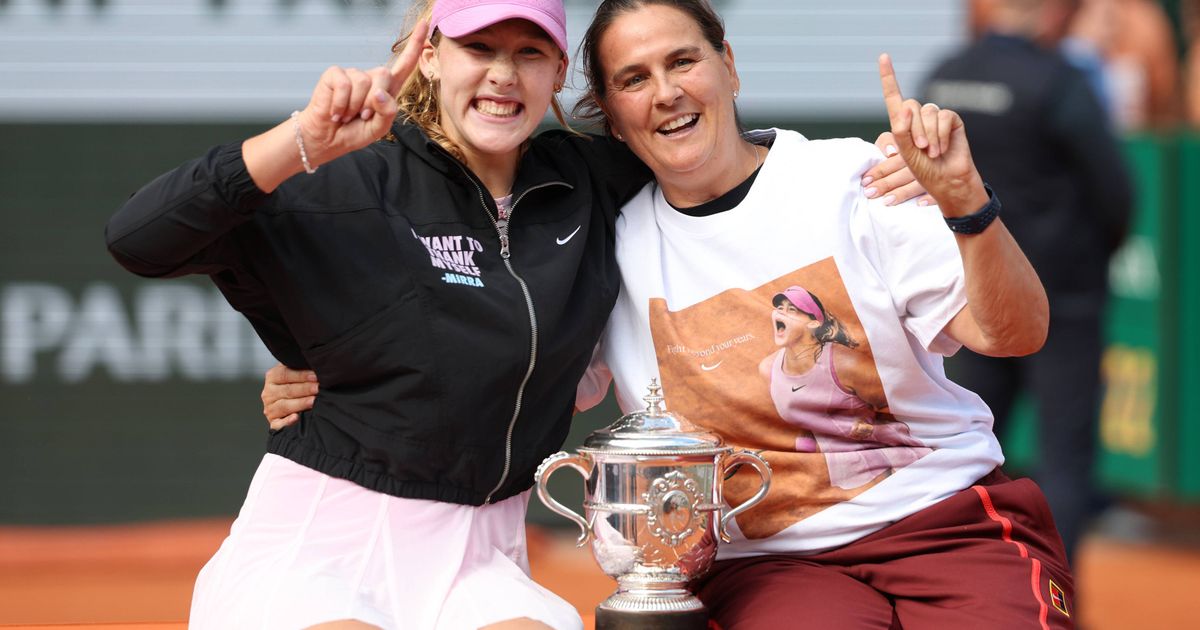
Martinez explained that while much attention is placed on technical improvements and tournament scheduling, she identified another area that required immediate attention during Andreeva’s first full season working with her. The Spaniard pointed to a difficult period following Wimbledon in 2024, describing it as the moment that convinced her additional support was needed away from the court.
“I saw a lot of anxiety in her”
Martinez revealed that the decision emerged after Andreeva suffered an early defeat at Wimbledon 2024. Just weeks earlier, she had reached her first Grand Slam semifinal at Roland Garros, but her Wimbledon campaign ended in a disappointing first-round loss.
While results alone were not the concern, the former world No. 2 noticed signs that she believed were unusual for a player still in her teenage years. That observation led to a direct conversation between coach and player about the importance of mental preparation alongside tennis development.
“After Wimbledon that same year, she suffered a difficult first-round loss,” Martinez explained. “I saw a lot of anxiety and other things that shouldn’t be there. When you’re 17 or 18 years old, you should be enjoying the game and focusing on how to improve. I saw areas that needed work mentally. We had a conversation the next day. She asked me about my own experience because I had worked with a psychologist during my playing career.”
The conversation soon evolved into a concrete recommendation. Martinez commented that Andreeva was already searching for answers and wanted to understand whether professional mental support could make a difference.
“I told her about my experience and said that I thought she would benefit greatly from working with a psychologist. It took a little longer than expected to find the right person, but eventually we did.
“She has now been working with a psychologist for about a year and a half. We work very closely together. I speak with the psychologist often about what they’re working on because I’m around Mirra almost all the time. I think it’s extremely important.”
Why Martinez believed Andreeva was different
Although Andreeva’s rise has often been attributed to her talent, Martinez suggested that mentality and willingness to learn have been equally important factors. The coach rejected the idea that success comes from coaching alone, instead highlighting the attitude the teenager brought into the partnership from the beginning.
According to Martinez, the quality she values most in any player is openness to change. She explained that many athletes know improvements are necessary but are unwilling to fully commit to the process, something she has never viewed as a problem with Andreeva. “I always want to see whether they have the desire to work,” the former world No. 2 said. “For me, that’s the most important thing.”

“If a player doesn’t want to work or isn’t open to change, then forget it. Sometimes players hire you because they know changes need to be made, but deep down they have no intention of making those changes. The desire to improve, get better, and put in the work is the most important thing for me.”
Martinez also revealed that she never viewed Andreeva as a guaranteed future world No. 1 when they first started working together. Instead, she focused on identifying strengths, weaknesses and areas for growth. Among those was a forehand she believed could eventually become one of the Russian’s biggest weapons.
“I saw a very talented girl. I saw an incredible desire to win. She had beautiful strokes, an excellent backhand, and an excellent serve. Her smash impressed me a lot. Regarding her forehand, I told her during our second tournament together: believe it or not, your forehand is going to become as dangerous a weapon as your backhand. It’s fantastic that she won her first Grand Slam. I think she still has a lot of room for improvement, which is a very good thing. I believe she can win more Grand Slams.”
The foundation behind Grand Slam success
Martinez was also careful to downplay her own role in the team’s achievements, insisting that coaches can only guide players who are willing to embrace difficult changes. In her view, Andreeva’s progress has come from consistently accepting new ideas and trusting the process rather than searching for immediate results.
That trust has extended beyond technical work and into other areas of performance. Martinez revealed that the team also added a nutritionist during 2024 as part of a broader effort for long-term development.
“Recovery after difficult matches depends heavily on nutrition and understanding what you’re doing,” she said. “It was important for me to educate Mirra about these things. Sometimes it’s not easy because there can be restrictions and challenges.”
Reflecting on her Grand Slam success as a coach — having previously guided Garbiñe Muguruza to major titles — Martinez credited the players rather than any special formula.
“The secret is that the players are very good. Winning a Grand Slam with them makes me very proud of them and of the work they put in on court.
“Coaches can help, but if the player doesn’t cooperate, it is impossible to win tournaments. Mirra’s willingness to be open, try new things, listen to me, and work hard is what produces results. They’re really good players. That’s why I’ve won Grand Slams with them—not because I’m some kind of super coach.”