
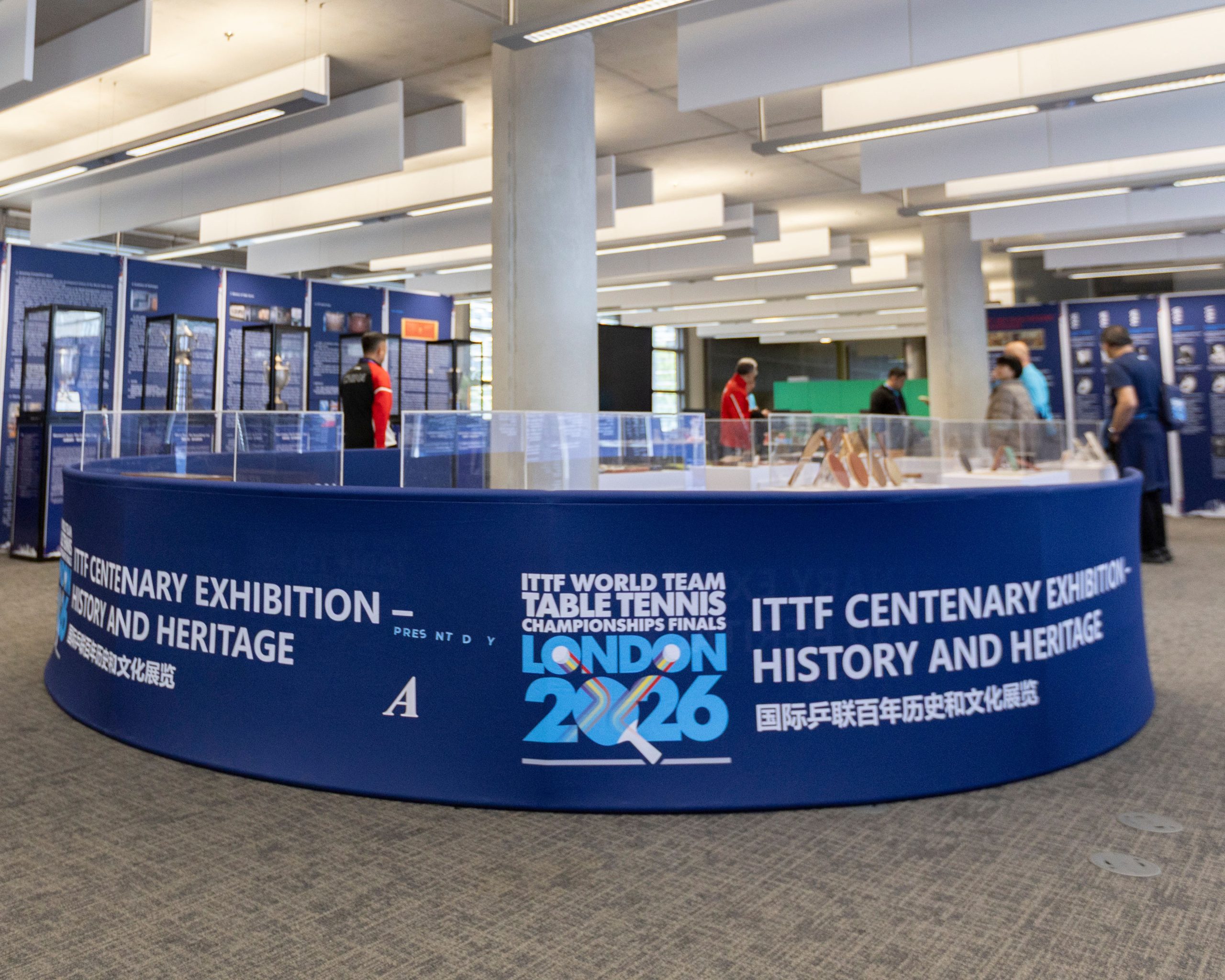
As well as history being made on the field of play, it was also on display at the centenary ITTF World Team Table Tennis Championships Finals London 2026 Presented by ACN.
At Brent Civic Centre, next door to OVO Arena Wembley, the ITTF Museum set up a special exhibition charting the first 100 years of the World Championships.
Packed with information about the great champions down the ages, it also featured a host of artefacts from a century (and more) of table tennis, ranging from bats, balls and nets to photographs, programmes and other documents.
Further display panels charted the history of the ITTF Museum and honoured Founding Curator Chuck Hoey, who died last year, and his successor Shi Zhihao.
Replicas of all seven trophies awarded at the ITTF World Championships featured prominently, while Table Tennis England loaned Fred Perry’s bat, with which he won the 1929 Men’s Singles title.
A book charting every player to have represented England at the World Championships, compiled by Diane Webb, Chair of Table Tennis England’s Archives, Museum & Records Committee, was donated to the Museum and was also on display.
Members of the curator team at the ITTF Museum, including Zhang Dingding, guided visitors through the exhibitions.
Zhang Dingding said: “We have two sets of copies of the trophies. One is here and will travel together with us for every World Championships for the exhibition, and another set is in Shanghai, back in our museum.
“The Iran Cup is our favourite because it’s the most good-looking one, and this is the most difficult one to copy because all the decorations are handmade.”
She said the Museum, which moved from Lausanne in Switzerland to Shanghai in China in 2018 initially had around 10,000 artefacts, many donated by Chuck Hoey, but has since grown to more than 30,000.
A mere 141 were brought to London, but they offered a fascinating insight into the evolution of the sport.
One display showed different bats and balls through the ages, along with a device for picking up balls.
Dingding explained: “First it was string balls, then paper balls and wood balls and then rubber balls. We read from the document that the inventor complained that the string balls bounce too much and were difficult to play, so they decided to modify the materials to paper to wood to rubber ones.
“Also at that time, table tennis was for rich people, so the ladies with very big dresses found it difficult to bend down to pick up the balls, so they invented the ball picker.
“You can see the development of rackets from the beginning. The very first rackets look similar to tennis racket and then there is one is made of animal skins. And then a wood one, then a sponge racket, and then a rubber racket.”
Dingding said the ITTF Museum has six galleries dedicated to different areas of the sport – the creation of the sport; the history of performance competitions; table tennis at the Olympic Games; the evolution of equipment and techniques; the glamour and international relations of table tennis, including Ping Pong Diplomacy; and the ITTF Hall of Fame.