
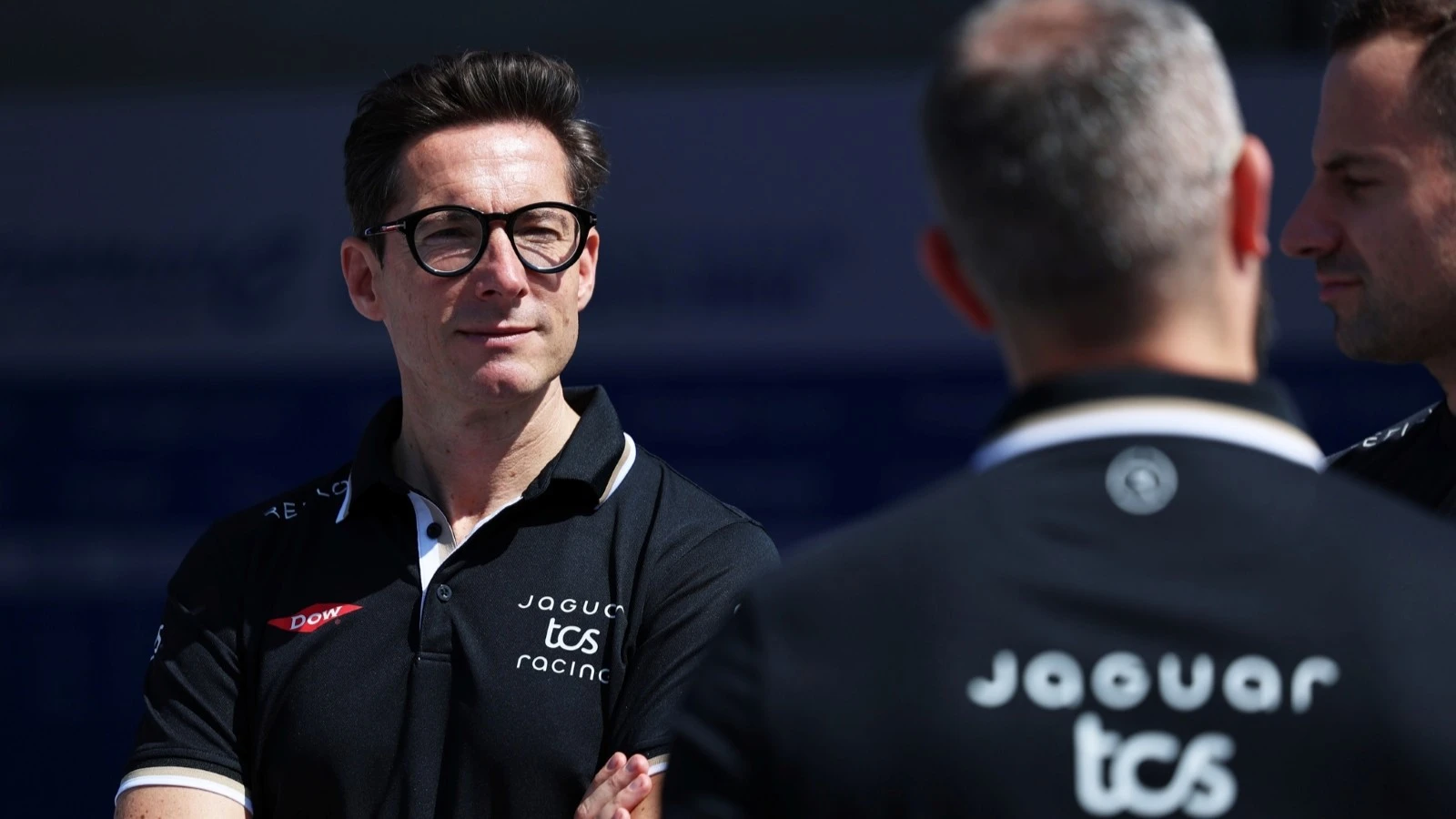
As Formula E’s competitive margins tighten, Jaguar team principal Ian James highlights how success is increasingly defined by adaptability and the ability to respond to constantly changing conditions—factors that come sharply into focus at the Berlin E-Prix this weekend.
For Jaguar Team Principal Ian James, success in Berlin is less about predicting outcomes and more about reacting to change.
In an exclusive interview with Motorsport Week, James said: “I think as a team principal–I mean, I’ve come to Berlin many times now, so on one hand we know what to expect.
“We also know what we can expect is that things will change over the course of the weekend.
“What we’ve often seen here is the race on Saturday, and the results from that race don’t necessarily mean that we’re going to see the same results on the Sunday.
“So, I think from a team principal perspective, it’s very much just making sure that the team is focused and regardless of what results we have on Saturday, good or bad, that we’re able to hit the reset button, refocus, and then go again on the Sunday.
“I think that’s absolutely crucial, but I’m very lucky I’ve got a team of men and women here who are brilliant at what they do. So, actually, the event takes a very light touch from my side.
“So, I’m looking forward almost just to observing the race as it unfolds and being there to support as and when required.”
That ability to reset quickly has often defined Berlin E-Prix weekends, where overnight changes in grip levels and strategy can completely reshuffle the order.
Beyond the immediate demands of the weekend, Formula E’s competitive landscape continues to tighten. Margins at the front are now razor-thin, shifting the focus away from pure hardware gains.
What makes the difference now
James sees that evolution clearly.
“I think that, obviously, software and energy strategy is very much part of that car performance.
“I think if we’re looking at the difference between the hardware in the cars and then the software element, we’ve definitely seen a convergence of performance on hardware.
“The power units or the power trains themselves have become incredibly efficient. And I think that the differences in that efficiency and ultimately the performance that’s connected with that between the manufacturers and the teams is very very small indeed.
“And, obviously, we’re in a two-year homologation cycle. So there’s not actually anything that we can do really to impact the performance of the hardware per se.”
The team principal added: “So, to your point, a lot of the focus therefore is on the software, the way that we’re managing the energy, and the strategy that we therefore deploy over the course of the weekend as well.
“So, that’s where a lot of the focus lies at the moment. And it’s going to be interesting this weekend to see how that all plays out.”
In a championship defined by efficiency and precision, the Berlin E-Prix could once again prove that the smallest decisions make the difference.