
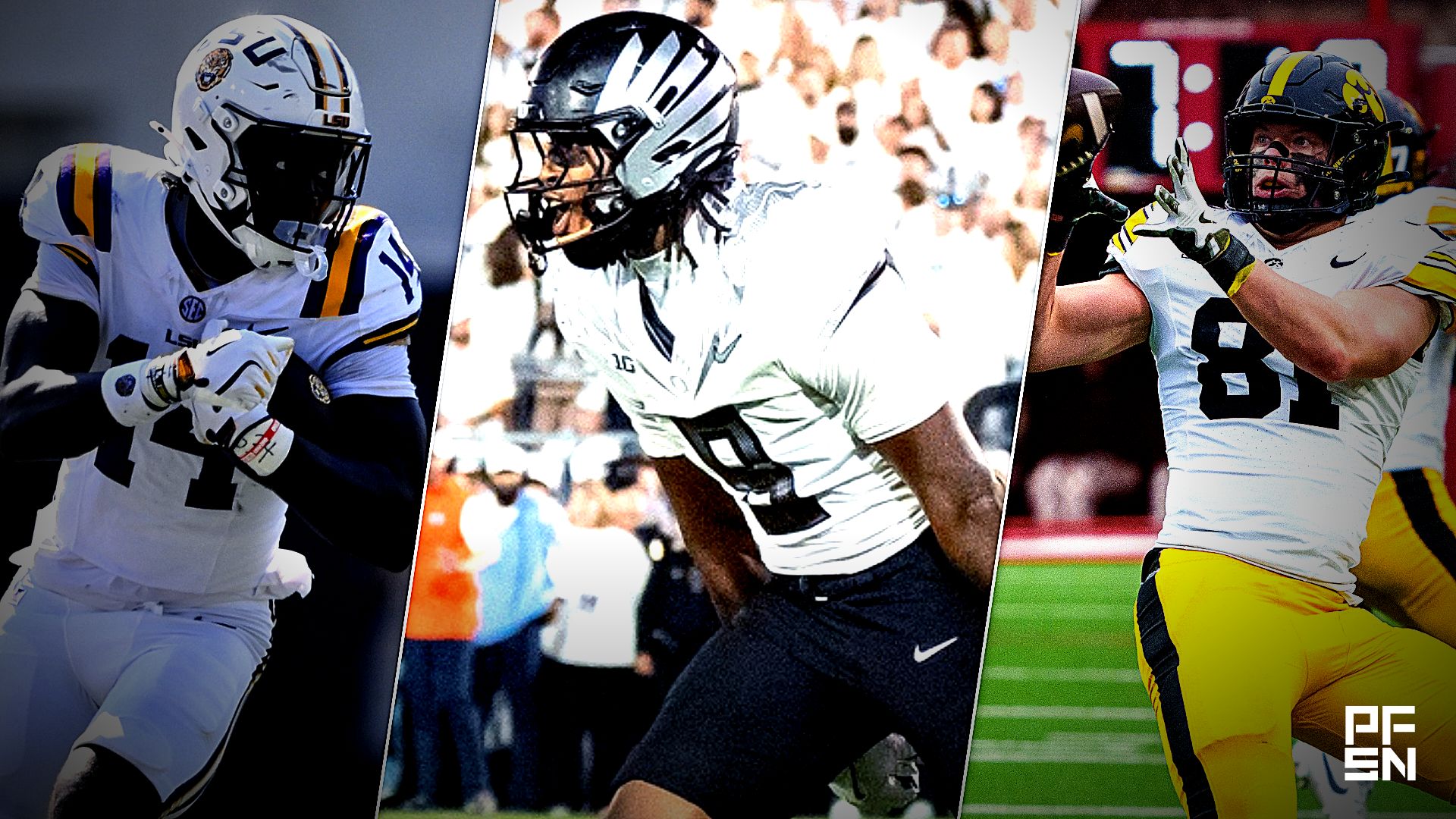
As the NFL evolves more and more toward heavy personnel, the 2027 NFL Draft TEs group should only gain more interest in the eyes of the scouting community. The 2026 NFL Draft, as it so happens, provided a strong indicator for this shift.
The 2026 NFL Draft saw the most TEs selected since the 2002 NFL Draft (22), and is tied with the 2023 NFL Draft for having the most TEs selected in the first three rounds this century.
Selections of TE prospects like Nate Boerkircher, Marlin Klein, Sam Roush, and Will Kacmarek far above consensus values drew confusion in the moment, but those early TE selections will become the norm sooner rather than later, and for an understandable reason.
Having good TEs matters for NFL offenses; it always has, but now it matters more than ever.
But the perfect TEs blend the line perfectly between receiver and blocker, and this is something that not all of the early selections in the 2026 class did. The 2027 class may offer even more upside in this lens, however, and that’s an exciting proposition.
Below, you’ll find my way-too-early Top 10 TE rankings for the 2027 NFL Draft as it stands, with favorites Jamari Johnson and Trey’Dez Green battling under-the-radar names for Top 5 real estate.
10) Luke Reynolds, Virginia Tech
Luke Reynolds is a former five-star recruit who has distant but very real early-round upside if he can improve in several key areas.
A highly-touted 2024 signee, Reynolds played in all 16 games as a true freshman and started in four, picking up 9 receptions for 11 yards and a score. As a true sophomore in 2025, Reynolds took on a greater rotational role, and amassed 26 catches for 257 yards.
In the offseason, Reynolds transferred to Virginia Tech, following former Penn State head coach James Franklin, where he’ll presumably have a premier role once again.
At 6’4″, 250 pounds, Reynolds has a unique build with a blend of lean, compact mass and proportional length. His athleticism routinely pops off the film; he’s exceedingly explosive, with elite long-strider burst and speed working to the second and third levels, and he also has snappy short-area mobility and fluid hips.
That recalibration of athleticism helps him on RAC transitions as well as in the blocking phase, where he can reposition to maintain angles and seal off gaps.
As a 9.1% drop rate signifies, Reynolds’ hands can be inconsistent, and in truth, much of his evaluation is still based on projection. While willing, he’s not strong or balanced as a blocker, and struggles to maintain pad level and leverage later in reps.
BE THE GM OF YOUR FAVORITE TEAM: PFN’s FREE NFL Mock Draft Simulator
As a pass-catcher, he operates best with space, yet doesn’t have an expansive route tree, and is largely confined to designed RAC plays on screens, drags, and crossers. As a RAC threat, he demands respect with quick transitions, explosive climbing ability, and urgent leg churn that yields a degree of forward-pressing contact balance.
Having said all this, Reynolds is a work-in-progress as a catch-point operator, blocker, and route salesman, and needs to keep refining his game as well as add more strength.
With two years of eligibility remaining, the 2028 cycle could be his time, but a leap in 2026 could quicken his NFL Draft ascent.
9) Benjamin Brahmer, Penn State
Benjamin Brahmer is a mid-round TE prospect in the 2027 NFL Draft with an intriguing blend of size and production.
Brahmer spent the first three seasons of his career with the Iowa State Cyclones, first joining the program as a three-star recruit in 2023. As a true freshman, Brahmer played in all 13 games and started two, racking up 28 catches for 352 yards and 2 touchdowns over that span.
He earned honorable mention All-Big 12 recognition in his inaugural campaign, and after an injury-impacted 2024 season, he returned to the forefront as an offensive asset in 2025, registering 37 catches for 446 yards and 6 scores, as well as a PFSN TE Impact score of 78.4.
Along the way, Brahmer secured a drop rate of just 3.9%, and a catch rate over expectation of almost 10%.
In the 2026 offseason, Brahmer followed head coach Matt Campbell to Penn State, where a featured role is in the cards once again. Brahmer’s build and temperament are two elements of his game that enabled him to acclimate early at the collegiate level, and those same elements are at the crux of his 2027 NFL Draft evaluation.
At around 6’7″, 255 pounds, with good proportional length, Brahmer has an ideal size and mass profile, and is a solid functional athlete at that size.
He has a degree of usage and alignment versatility that he’s built up over his time in college football, with the size profile to project long-term as an in-line capable TE, but also the mobility and length to block off motions and out in space.
Brahmer’s most prevalent skill, however, is his catch-point prowess. With his sheer height, he can box out defensive backs and play catch-point positioning, and he flashes cool composure and smooth body control in high-difficulty situations, as well as great hand strength working through contact.
REDRAFT THE ENTIRE NFL: PFN’s FREE NFL Ultimate Redraft Simulator
As his 27.3% target percentage in the red zone shows, Brahmer is built to be a scoring threat. However, he’s still somewhat one-dimensional outside of seam and red-zone roles.
Despite his size, he’s extremely inconsistent as a blocker, with room to get stronger, and he’s not overly fluid as a separator or explosive as a RAC threat.
Brahmer still has developmental aspects to his game, but he has a respectable outlook as an experienced TE2 or TE3 with seam and red-zone utility.
8) DJ Vonnahme, Iowa
DJ Vonnahme is the next in line on Iowa’s tight end conveyor belt and possesses early-round upside with more development.
Interestingly, Vonnahme joined the Hawkeyes not as a highly-touted recruit, but as a preferred walk-on after playing as a position-diverse quarterback at Carroll High School, on the other side of the state.
Vonnahme redshirted in 2024, then entered the starting rotation as a redshirt freshman. Playing in 12 games and starting five in 2025, Vonnahme accumulated 29 catches for 434 yards and 3 touchdowns, as well as a PFSN TE Impact score of 76.4.
Vonnahme’s five starts came in the final five games of the season, and over that stretch, he accrued all of his TDs and 85% of his yearly yardage output. Vonnahme’s hot finish, combined with Iowa’s ultra-reliable track record at the TE position under Kirk Ferentz, has many intrigued by Vonnahme’s potential.
While the 2028 NFL Draft cycle may ultimately be his time, he’s worth knowing heading into the 2027 NFL Draft cycle.
At around 6’4″, 240 pounds, with average proportional length, Vonnahme’s size profile won’t win over scouts alone. In fact, in addition to being below-average size, he also has room to improve as a blocker.
He’s exceedingly urgent and physical, with great explosiveness, and he flashes excellent torque generation for his size, as well as the versatility to insert into interior gaps and climb upfield.
However, his lighter build makes him easy to dislodge and displace by opposing power, and he also greatly struggles to manage his leveraging and pad level through contact at this stage.
Vonnahme needs to get stronger and keep refining his leverage maintenance, but as a receiver, more contemporary promise is present.
While Vonnahme will need to cut down a 6.5% drop rate from 2025, his explosiveness, seam-threatening ability, angle freedom on in-cuts, and scraping physicality at stems set a strong foundation, and he flashes elite late-hands timing and body control in tight catch-point situations.
PREDICT THE NFL SEASON: PFN’s FREE NFL Playoff Predictor
Moreover, Vonnahme’s RAC efficiency is near-elite; he averaged 7.2 yards of RAC per catch in 2025, over 2.4 more per catch than expected.
Vonnahme is still growing, and his size profile may limit his ceiling as a blocker, but he nonetheless showcases quality TE2 upside, with a dynamic RAC element.
7) Dorian Thomas, California
Dorian Thomas is a mid-round TE prospect who could potentially rise into the early-round conversation after a year with Jaron-Keawe Sagapolutele as his quarterback.
Hailing from Washington, Thomas kicked off his career as a three-star signee with the Arizona Wildcats. But after redshirting in 2023 and only seeing special teams snaps in 2024, Thomas transferred to New Mexico to see more opportunities as a receiving threat.
The bet on himself paid off; Thomas delivered 56 catches for 560 yards and 4 touchdowns in his lone season with the Lobos. His strong PFSN TE Impact score of 80.6 was ranked 22nd in the nation, and encased within that score, he put up a glowing 0% drop rate, 1.97 yards per route run, and 6.2 yards of RAC per reception.
At around 6’4″, 250 pounds, Thomas isn’t overly imposing from a size perspective. He has decent compact mass, but close to average proportional length, and that middling size profile brings natural limitations as an in-line blocker.
While Thomas has shown he can properly acquire leverage, engage his lower body, manage his pad level, and adjust his angle leverage on blocking reps, he can still be more consistent with his hand replacement and upper-lower sync, and he’s not a reliable extra blocker on passing downs.
Either way, Thomas does the most damage as a pass-catcher on those reps, and he distinguishes himself as one of the most nuanced route runners and catch-point operators in the 2027 class.
Thomas’ hands are rock-solid; he’s quick to react, smooth on body control adjustments, and can maintain possession on tight-window throws and with immediate contact threats.
As a route runner, he can operate from in-line, off motions, or as a big-slot weapon, and he shows off the quicks and controlled physicality to beat press, pry through second-level stems, and gain leverage late in reps. And as a RAC threat, his vision and instant transitions enable him to make the most of screens and swings.
Thomas is a good-not-great athlete, which places him in an unenviable “tweener” category as a TE without high-end blocking utility. Still, as a quality pass-game catalyst with willing if limited blocking ability, a respectable TE2 outcome is attainable down the line.
6) Brody Foley, Louisville
Brody Foley is a Group of 5 transfer who could ascend into Top 100 conversations with a strong year at Louisville.
Interestingly, Foley was originally a four-star signee for the Indiana Hoosiers pre-Curt Cignetti. But after Foley redshirted in 2022 and logged no catches through 2023 and 2024, serving mainly as a special teams contributor, he transferred to Tulsa to earn a starting opportunity. In that role, he thrived.
Playing just one season for the Golden Hurricane, Foley accumulated 37 receptions for 528 yards and 7 touchdowns, and added 2 more scores on the ground.
Foley’s PFSN TE Impact score of 80.9 was 16th-best in the entire nation. In addition to that figure, he scored just a 4% drop rate, a 9.39% catch rate over expectation, and an impressive 8.2 yards of RAC per reception.
MORE: Ranking Top-10 QBs in 2026 and 2027 NFL Drafts: Would Arch Manning, Dante Moore Rank Above Fernando Mendoza?
At 6’6″, 260 pounds, Foley’s raw talent is clear. He’s a smooth, fluid, and explosive long-strider with clear seam-splitting capabilities, but also bounding RAC when he has a runway to expand his strides.
He can operate in-line, out wide, or off motions, and has quietly developed a respectable route tree with corner routes, whips, and in-breakers in addition to wheels, seam routes, and drags.
At his best, Foley can box out defenders at the catch and play positioning perfectly with late hands, and he’s relatively sturdy and composed working through contact.
While Foley is well-rounded, however, there are still areas for improvement. His hand technique can feature too much overhand work, which can risk instability. Being a taller blocker, leverage maintenance can naturally be an issue for him, and his hand replacement can improve as well.
Regardless, Foley is a tantalizing TE talent with immediate red-zone and seam-busting utility, visible blocking upside, RAC ability, and alignment versatility.
Already, a high-end TE2 projection is clear, and a quality TE1 outcome is in the cards if he can keep developing.
5) Trey’Dez Green, LSU
Trey’Dez Green is a pass-down TE with dynamic receiving upside but also projection questions to answer.
He was a two-sport star in high school, who averaged 27 points and 11 rebounds on the basketball court as a junior. Football would end up being his primary focus, however, and he signed with the LSU Tigers in 2024 as a four-star recruit.
He played in 11 games as a true freshman and found the end zone 4 times, and compounded the momentum in a 2025 campaign that saw him rack up 33 catches for 433 yards and 7 touchdowns, along with a commendable PFSN TE Impact score of 79.2.
He made a particularly strong impact in the red zone, where he fielded an astounding 34.6% target percentage on routes run.
At a towering 6’7″, 237 pounds, Green is long and lean, with a domineering wingspan and catch radius. At that size, he’s an explosive long-strider with high-level seam-stretching speed at the second and third levels, and he’s also unnaturally twitched-up and fluid when changing direction, both as a separator and a grating RAC threat.
Already, Green boasts an expansive route tree and impressive release work and stem IQ, and he flashes extraordinary reaction speed and body control at the catch point.
Green’s upside as an alignment-diverse receiving threat and mismatch generator is clear, but there are areas of improvement still left to attack.
Despite his catch radius and reactive quickness, he had a negative catch rate over expectation in 2025, as well as a drop rate exceeding 10%, which can largely be sourced back to clap-catches and poor securing technique.
Additionally, Green is predictably a poor in-line blocker and a below-average blocking presence overall, who struggles to acquire leverage with his taller frame and doesn’t have ideal play strength. His flaws will be difficult to counteract in this phase in the long term.
Green has schematic limitations as a largely pass-dominant TE without much in-line capability, but as a big-slot and mismatch weapon with separation and red-zone utility, he can be an impactful presence in the NFL.
4) Andrew Rappleyea, Penn State
Andrew Rappleyea is an under-the-radar TE prospect with little production but enticing talent that projects well over a larger sample size.
Rappleyea joined the Penn State Nittany Lions as a four-star recruit in the 2023 cycle, but didn’t catch a pass through his first two seasons. He redshirted in 2023 and missed all but one game due to a knee injury in 2024.
In 2025, he was part of a deep rotation but received more opportunities later in the year and ended up with 20 catches for 180 yards and 3 touchdowns. For a fourth-year player, the sample size is still extremely small for Rappleyea, but he’s quietly produced inspiring film to this point, as an athlete, a blocker, and a route runner.
At around 6’4″, 251 pounds, Rappleyea is well-built, with good frame density and compact mass, and at that size, he’s a quantifiably elite athlete with propulsive fast-striding explosion, abrupt short-area twitch and corrective quickness, and the hip flexibility to sink and redirect at tight angles on route stems.
Rappleyea is exceedingly physical and excels at bending to acquire leverage and driving his base through blocks in the running game. He’s shown he can win the pad level battle and dislodge defensive ends from in-line positions, insert into interior gaps, or block to the boundary and plow defensive backs off the field.
As a receiver, Rappleyea is more of a projection than a proven commodity. While he flashes excellent catch-point control, he can be inconsistent in maintaining possession through contact, and he’s not a proven RAC threat at this stage.
Still, Rappleyea displays a well-developed route tree already, with actionable alignment and usage versatility and good stem footwork and plant-and-drive efficiency. Sustained production is key, but Rappleyea is young, talented, and a plus blocker, with impact two-phase upside as his ultimate long-term ceiling.
3) Peter Clarke, Temple
Peter Clarke is a potential early-round TE prospect in the 2027 NFL Draft who offers an appealing combination of receiving and blocking utility.
Clarke grew up in London, England, and gained interest through the NFL Academy overseas. Earning a three-star recruit billing, Clarke signed with the Temple Owls, where he combined for just five catches over his first two seasons.
In 2025, however, Clarke broke out as an impactful two-phase playmaker, amassing 30 catches for 483 yards and six touchdowns in 12 games.
His 82.4 TE Impact score was Top 10 in the nation, and pairing together a 2.4% drop rate, an 8.8% catch rate over expectation, and a 42.9% target rate in the red zone, Clarke distinguished himself as a dangerous weapon in scoring territory, while also reaching 2.34 yards per route run overall.
At around 6’6″, 265 pounds, Clarke is thickly built, with excellent mass and frame density, and while his length is below average proportionally, his sheer size and play strength make him a venerable presence in multiple phases.
Clarke’s blocking utility underpins his game, as he has truly elite two-phase authority, with the ability to dislodge DEs in-line, track and displace second-level defenders in space, and insert into interior gaps to wall off defenders, while using power and physicality to finish.
As a receiving threat, Clarke isn’t overly quick or fluid, but he flashes good explosiveness and speed in the RAC phase, to go along with grating tenacity and contact balance.
He can make himself available up seams and box out defenders while high-pointing passes, and he shows glimpses of impressive route running efficiency and stem work at his size.
Clarke’s non-elite mobility profile won’t be for every front office, but he nonetheless has quality starter potential as a three-down, two-phase, and red-zone asset.
2) Chris Corbo, Georgia Tech
Chris Corbo is an FCS-to-FBS transfer who quietly has early-round upside with a strong year at the highest level.
Through 2024 and 2025, Corbo was one of the best tight ends in the FCS after first redshirting at Dartmouth in 2022 and playing a rotational role in 2023. In 2024, Corbo fielded a career-high seven touchdowns, and in 2025, he achieved career-highs in both receptions (45) and receiving yards (516), while finding the end zone four times.
Corbo was one of just four FCS TEs to eclipse 500 yards in 2025, and he came away with the league’s highest PFSN TE Impact grade, with an incredible score of 99. Alongside that glowing grade, he achieved 2.24 yards per route run, a 12.28% catch rate over expectation, a meagre 3.4% drop rate, and an average of 5.2 RAC yards per catch.
Corbo’s transition to the Power 4 level and sustained production will be key, but on film, Corbo’s upside is difficult to ignore. At a listed 6’5″, 250 pounds, Corbo has solid size, with the growth potential to near 260 pounds, and he’s an excellent mover at that size, at a TE position where athleticism is paramount for success.
Corbo is an explosive, fast-striding accelerator with good seam-splicing speed, but even more potent is his short-area mobility. Corbo is quick-footed, twitched-up on recalibration, and unnaturally fluid for his build, with high-level ankle flexion, hip fluidity, hip sink, and deceleration capacity at route breaks.
With his mobility, Corbo runs a full route tree, with designed dishes, drags, and in-breakers interspersed with legitimate double-moves, comebacks, posts, and whips.
A fluid, nuanced, and malleable route operator with alignment versatility, Corbo’s catch-point prowess also shows as a strength, as he can use proactive extensions, smooth body control, and proper technique to secure high-difficulty passes in tight spots, as well as gather short throws for RAC.
As a blocker, Corbo is explosive, well-leveraged, tenacious, and calculated with his footwork, but he can still get stronger and improve his sustain at times. And occasionally, overhand approaches yield catch-point instability.
Nevertheless, the body of work corroborates the conclusion that Corbo is a high-quality two-phase and three-down TE, with impact starter potential and unique usage versatility. At Georgia Tech, he can announce himself to the world.
1) Jamari Johnson, Oregon
Jamari Johnson is a primary contender for the TE1 mantle in the 2027 NFL Draft, carrying Oregon’s TE pipeline into the next cycle.
An incredibly versatile high school player who played quarterback, wide receiver, tight end, and defensive end, Johnson originally signed with the Louisville Cardinals as a four-star recruit.
He redshirted in 2023, then eclipsed 150 yards in a seven-game stretch for the Cardinals in 2024. 2025 marked Johnson’s first season at Oregon, where he served as the TE2 behind eventual first-round pick Kenyon Sadiq.
In that role, Johnson racked up 32 catches for 510 yards and 3 touchdowns, while also putting up encouraging efficiency numbers.
Among other figures, Johnson achieved 2.35 yards per route run, 1.01 EPA per target, a 19.76% catch rate over expectation, and 8.8 yards of RAC per reception, while also boasting a sub-4% drop rate and an in-line usage rate of almost 50%.
At 6’5″, 257 pounds, Johnson has the size and length that Sadiq lacked in the 2026 cycle, and he boasts comparable vertical athleticism, with gliding speed and burst. He’s a twitched-up mover with great corrective quickness and stride recalibration, but also boasts springy, effortless acceleration and long-strider range.
He’s capable of taking reps from any alignment, has real two-phase value in-line as a blocker, interior gap puller, and defensive end dislodger, and in the passing game, he can be schemed RAC opportunities on swings and quick outs, threaten up the seam with his long speed and bend, or separate against man coverage with nuanced stem work.
While Johnson’s route tree is still developing, he flashes exceptional stem IQ, targeted physicality combined with release work, and the deceptive intelligence to bait defenders out of position with upfield presses and head fakes.
Taking on TE1 volume will be Johnson’s next challenge, but he has first-round and impact starter upside, and he’s comfortably the top TE1 candidate entering the 2027 cycle.
Honorable Mentions
- Terrance Carter Jr., Texas Tech
- Lawson Luckie, Georgia
- Brett Norfleet, Missouri
- Garrett Oakley, Kansas State
- Michael Masunas, Texas
- Alex Honig, Northwestern
- Ethan Davis, Tennessee
- Eli Finley, Louisiana Tech