

The docuseries is distributed globally via Prime Video in the United States, with additional rollouts across platforms including Channel 5 in the United Kingdom, SkyShowtime in Europe, and regional broadcasters in Canada and Asia, forming part of a wider ATP media expansion strategy.
The evolution of No. 1: Borg, Sampras, Federer, Djokovic and the modern transition
The core narrative of ACES traces how the requirements for reaching World No. 1 have shifted across generations. Borg’s baseline endurance on clay and grass contrasts with McEnroe’s serve-and-volley precision, a tactical divide that defined early ranking battles in the 1980s.
The 1990s section highlights Pete Sampras, whose 286 weeks at World No. 1 were built on grass-court dominance and serve efficiency, while Andre Agassi’s career is used as a counterpoint, emphasising baseline aggression and hard-court adaptability, culminating in his Career Grand Slam completion.
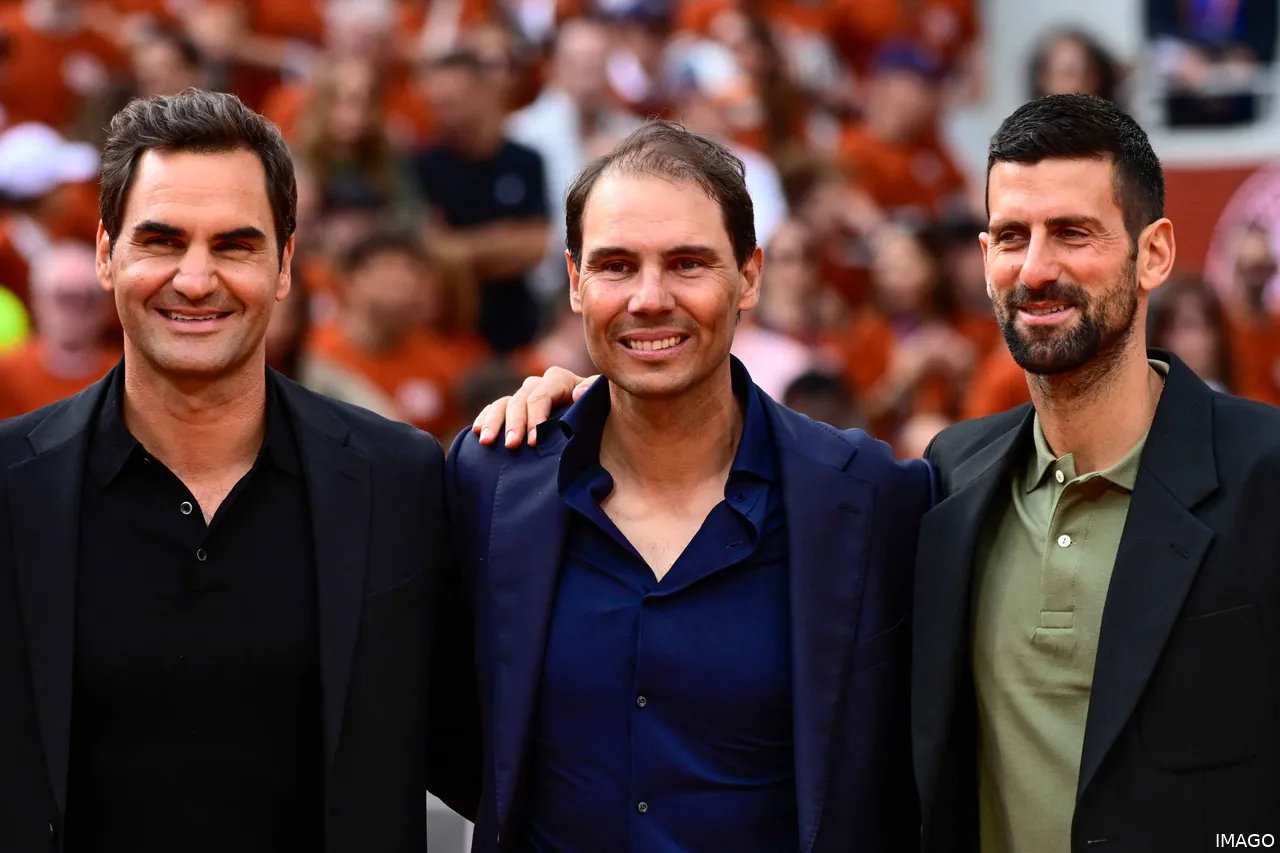
The series then moves into the Federer–Nadal–Djokovic era, where Federer’s 20 Grand Slam titles and multi-surface dominance are contrasted with Nadal’s unmatched Roland Garros record and Djokovic’s sustained No. 1 longevity and head-to-head control over both rivals. This triad is positioned as the defining competitive axis of the modern game.
ATP Chairman Andrea Gaudenzi describes reaching World No. 1 as “the ultimate achievement in our sport”, framing it as a convergence of physical endurance, tactical evolution, and sustained competitive output rather than isolated peak performance.
“ By bringing these stories to a global audience, this series gives fans a deeper understanding of what it takes to reach the top,” the Italian said. “It also helps us showcase the sport at its best, celebrate its greatest champions and connect new fans with the players and moments that have defined the game.”
Rivalries, margins and the Alcaraz–Sinner transition
A key structural layer of the docuseries is its focus on rivalries that shaped ranking transitions. Borg–McEnroe is used to illustrate stylistic contrast under pressure, while Sampras–Agassi reflects the surface-driven split between serve dominance and baseline control in the 1990s.
The Federer–Nadal–Djokovic rivalry receives extended treatment as the longest-running No. 1 cycle in tennis history, where ranking fluctuations were often determined by Grand Slam swing seasons and head-to-head outcomes in finals such as Wimbledon, Roland Garros and the Australian Open.
Director Pat Dimon frames the project as access-driven storytelling, highlighting interviews with multiple generations of champions. “It was a privilege and lifelong dream to meet and chat with so many of the greatest tennis players in the history of the sport to tell the story of how they achieved that honour,” the Director said. “Hearing from these compelling athletes about their fiercest rivalries and historic matches, viewers will get a first-person account of their mental and physical journey to the top and the battle to stay there.”

ATP World No. 1 Players – Historical List
| Player | Total weeks at No. 1 | First reached No. 1 | |
| 1 | Novak Djokovic | 428 | 2011 |
| 2 | Roger Federer | 310 | 2004 |
| 3 | Pete Sampras | 286 | 1993 |
| 4 | Ivan Lendl | 270 | 1983 |
| 5 | Jimmy Connors | 268 | 1974 |
| 6 | Rafael Nadal | 209 | 2008 |
| 7 | John McEnroe | 170 | 1980 |
| 8 | Björn Borg | 109 | 1977 |
| 9 | Andre Agassi | 101 | 1995 |
| 10 | Lleyton Hewitt | 80 | 2001 |
| 11 | Jannik Sinner* | 75 | 2024 |
| 12 | Stefan Edberg | 72 | 1990 |
| 13 | Carlos Alcaraz* | 66 | 2022 |
| 14 | Jim Courier | 58 | 1992 |
| 15 | Gustavo Kuerten | 43 | 2000 |
| 16 | Andy Murray | 41 | 2016 |
| 17 | Ilie Năstase | 40 | 1973 |
| 18 | Mats Wilander | 20 | 1988 |
| 19 | Daniil Medvedev* | 16 | 2022 |
| 20 | Andy Roddick | 13 | 2003 |
| 21 | Boris Becker | 12 | 1991 |
| 22 | Marat Safin | 9 | 2000 |
| 23 | John Newcombe | 8 | 1974 |
| 24 | Juan Carlos Ferrero | 8 | 2003 |
| 25 | Thomas Muster | 6 | 1996 |
| 26 | Marcelo Ríos | 6 | 1998 |
| 27 | Yevgeny Kafelnikov | 6 | 1999 |
| 28 | Carlos Moyá | 2 | 1999 |
| 29 | Patrick Rafter | 1 | 1999 |
*Active players