
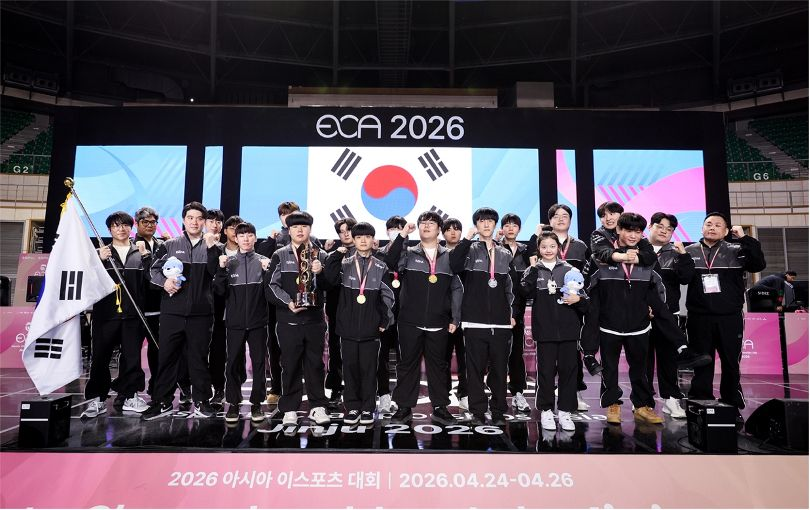
South Korean outlet Sport Naver recently reported that the Korea eSports Association (KeSPA) has confirmed it will not participate in the 2026 Esports Nations Cup (ENC).
The news comes as the organization alleged that the Esports Foundation, the host of the ENC, was indirectly attempting to force certain players onto Korea’s ENC rosters. Given KeSPA’s long history of team selection for the Asian Games and its decades-long management of Korean esports, it violates its internal player selection guidelines.
A quote, translated to English, from KeSPA reads as follows: “Interfering in the composition of the national team has gone beyond itself. Each country has a system, but it is a rude act.”
Why KeSPA withdrew from the ENC
The issue largely boils down to the fact that KeSPA takes a nation’s games event seriously. Especially with the Saudi-backed tournament boasting a high prize pool, a prime location, and serious competition. Yet trying to imply that they want certain players makes it feel like it’s about entertainment and promotion, rather than a serious tournament.
For those reasons, Korea does not seem to be a good fit for the tournament and has withdrawn. South Korea remains on the ENC website, but it has no active partner anymore, where KeSPA would obviously sit.
It also states that any players representing Korea at the event cannot use the phrases “national team,” “Korean national team,” or any similar acronyms.
It marks a huge blow for ENC, which is trying to make the home of esports look more competitive and legitimate. Losing Korea over the fraudulent selection of players is a massive blow, considering that South Korea is indeed the real home of esports, thanks to its long history in the country and its status as the hub of many of the best players across many titles.
It also comes as a blow that KeSPA holds power in Korea. It’s one of the few ways for Korean players to become military-exempt, as the nation has conscription for service-aged men. Winning the Asian Games is one of the reasons men in South Korea can avoid the draft, and that is, by and large, down to KeSPA’s selection process and ethics.
Saudi Arabia’s interference in that process is a major geopolitical problem and a threat to competitive integrity.
In a statement to Sheep, ENC said it still wanted to work with Korean stakeholders to send a team. So, it seems like it will undergo some level of work around. But again, KeSPA still sets the official team standards for the Olympic committee in South Korea, so it will not really be an official team under Korean standards.
China might also be joining Korea in not attending
China is also relatively quiet on the ENC front. Esports journalist Darragh Harbinson reported that the ENC organizers and Chinese management were in negotiations on April 24th.
Given the news of interference in South Korea, it might mean that ENC is trying to negotiate with the Chinese organizers for player selection, too. One has to assume that China, as the largest esports audience, will carry the bulk of viewership, and securing the best Chinese players for the product is certainly on the Saudis’ minds.
It’s speculation, of course, but one has to wonder with the pieces seemingly falling into place.
Players aren’t interested either
We also reported that players themselves are not that interested in the Esports Nations Cup last week. The Spanish high-profile players seem less interested, while the major Slovenian streamers also declined to participate. It seems that some of the biggest streamers, nations, and stars in League of LEgends esports are not interested in the show.
That, of course, is a fairly big sting.
It comes at a time when LIV Golf is likely losing its investments as the Public Investment Fund shifts into a new phase of its 2030 roadmap. The recent report indicated that it’s all about creating value rather than aggressive expansion. If ENC can’t secure the most valuable assets for its esports project, that could pave the way for a rather interesting situation for esports in the coming year(s).