
Patrick Williams, TheAHL.com Features Writer
Manny Malhotra had an extensive hockey résumé long before he ever ended up with the Abbotsford Canucks.
Drafted seventh overall by the New York Rangers in 1998, Malhotra played 16 NHL seasons, totaling 991 regular-season games. He won the Calder Cup with the Hartford Wolf Pack in 2000. Right after retiring as a player, he went directly into coaching and development. First came a development coaching role with the Vancouver Canucks in 2016 before three seasons as an assistant coach. Then it was on to the Toronto Maple Leafs for another four seasons as an assistant coach.
That résumé lacked just one major line on it: head-coaching experience.
That’s where Abbotsford came in two years ago. Malhotra left Toronto to take the Abbotsford head-coaching job on May 24, 2024. Thirteen months later, he had his hands on the Calder Cup again. And a little more than two years after taking that Abbotsford post, he is back in the NHL once again.
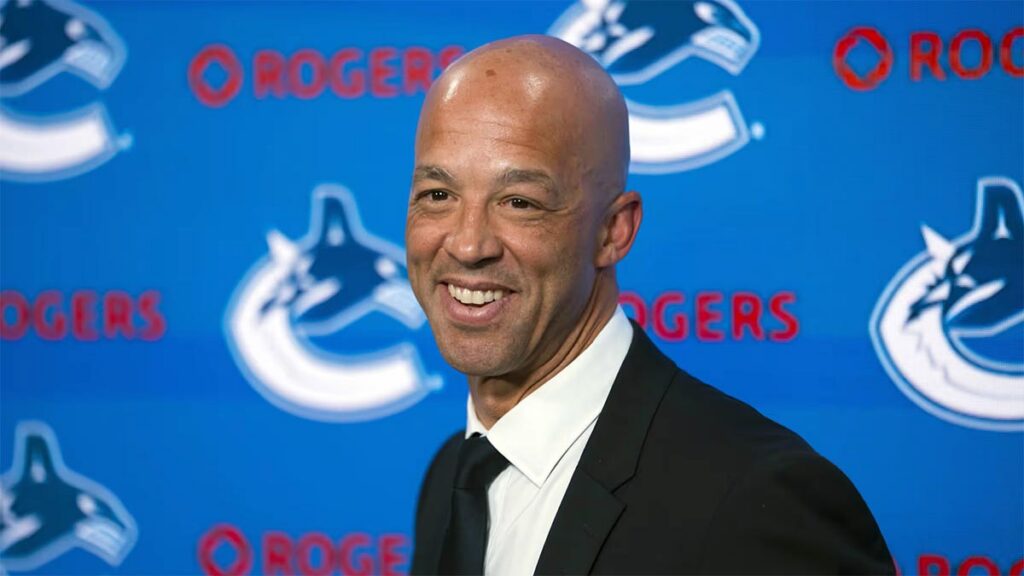
This time it’s as a head coach. Vancouver general manager Ryan Johnson, newly promoted himself from Abbotsford last month, announced Monday that Malhotra was his first NHL head-coaching hire.
Malhotra packed a lot into his two seasons behind an AHL bench, going 72-61-6-5 with Abbotsford. In his first season leading the club, he engineered a midseason turnaround and took a mid-pack team through a torrid second half. From there, Abbotsford pushed through five rounds of the Calder Cup Playoffs and defeated the Charlotte Checkers in six games for Vancouver’s first Calder Cup championship. Along the way he sent defensemen Victor Mancini and Elias Pettersson along with forwards Arshdeep Bains, Linus Karlsson, Aatu Räty and Max Sasson among others on to Vancouver as well.
But it was his second season that provided a much different learning experience. Offseason departures, injuries, and promotions to the Vancouver roster hit Abbotsford hard. With a heavily remade roster, Abbotsford went 3-12-1-2 in the first quarter of this season. Those early setbacks left Abbotsford in deep trouble, standings-wise, and the team never really ever made its way into contention for a return trip to the Calder Cup Playoffs. Dealing with an ever-changing roster, Malhotra eventually used 52 different players, including six goaltenders.
What Abbotsford did manage to do, however, was to stay competitive. After that disastrous first quarter, the team went a solid 25-25-3-1 the rest of the way and caused some Pacific Division havoc in April with a 6-1-1-0 finish.
The Johnson-Malhotra combination succeeded in Abbotsford on both the development and winning fronts. The hope in Vancouver is that success can carry over to the parent team. Vancouver finished last in the NHL this season with a 25-49-8 record, 14 points behind the 31st-place Chicago Blackhawks. That finish led to the ousters of general manager Patrik Allvin along with head coach Adam Foote and assistant coaches Kevin Dean, Brett McLean and Scott Young.
Johnson took over for Allvin on May 14. Franchise legends Daniel and Henrik Sedin are Vancouver’s new co-presidents of hockey operations; the pair have experience working with Abbotsford prospects as well. Jim Rutherford, who had been the team’s president of hockey operations, will move into a senior advisory role. Amid all this change, Malhotra’s promotion means that Vancouver will have had three head coaches in as many seasons.
Malhotra’s playing career featured parts of three seasons with Vancouver, including the team’s run to Game 7 of the Stanley Cup Final in 2011. There is considerable work to do to make Vancouver a winning club again. That work continues later this month at the NHL Draft, where the Canucks have 10 picks, including four of them in the top 41 selections.
“I think one thing that we experienced in Abbotsford was that the commitment to the daily improvements was something that helped our group get to where we did over the course of the year,” Malhotra said at his introductory press conference Thursday in Vancouver. “And I think that is one of the major reasons why this is such a special opportunity.”
Certainly that poor start made it obvious early in the season that Abbotsford’s playoff chances looked dim at best. That did not mean that it had to be a lost season, however. With the turnover that Abbotsford experienced, Malhotra and his coaching staff really dug into the teaching element of the job in year two. He had to rebuild the team’s foundation nearly from scratch, and he did. By the end of the season, Abbotsford had become a team capable of handling opponents chasing Calder Cup Playoff spots.
That same approach will need to continue in Vancouver with a rebuilding NHL team.
“You’ve heard [Johnson] talk about developing and building that foundation of what this group needs to be about and harping on that same messaging every day,” Malhotra continued. “For me and our coaching staff, it’ll be about those daily incremental improvements. Today’s practice needs to look better than yesterday’s practice. The level of execution needs to be better than it was yesterday, and I think by developing that mindset with the guys, you now start to see individual growth. You now see collective growth in the group. and that’s where we’ll start to take strides.
“The opportunity to instill those things from day one is one of the things that really excites me.”
Malhotra stresses the concepts of body language and maintaining positive energy. Even in a second season in Abbotsford that he calls “humbling,” he stuck to those concepts. Bad times in any sphere of life are what someone makes of them. Those struggles can spiral and cause even more problems. A losing team can turn sour and send players off to a variety of personal agendas. Or those rough times can build resilience and serve up lessons to take forward.
Malhotra wanted to take a tough season and make something useful from it. This was not the joy of pushing through the Calder Cup Playoffs and chasing a title. A significantly different challenge tested him this season.
“You have to live it,” he explained of staying true to those concepts even when circumstances test that commitment. “You know, it’s very easy to be in a great mood when things are going well, and you’re winning playoff rounds, and everybody’s on a high. It’s the ability to find that energy and present the right body language when things aren’t going right. And for us as a staff, we knew we were in a much different predicament, but our focus was to maintain that same level of emotion, the same level of preparation, the same level of energy coming to the rink every day.
“I think that messaging got through to the guys.”

On the American Hockey League beat for two decades, TheAHL.com features writer Patrick Williams also currently covers the league for NHL.com and FloSports and is a regular contributor on SiriusXM NHL Network Radio. He was the recipient of the AHL’s James H. Ellery Memorial Award for his outstanding coverage of the league in 2016.