
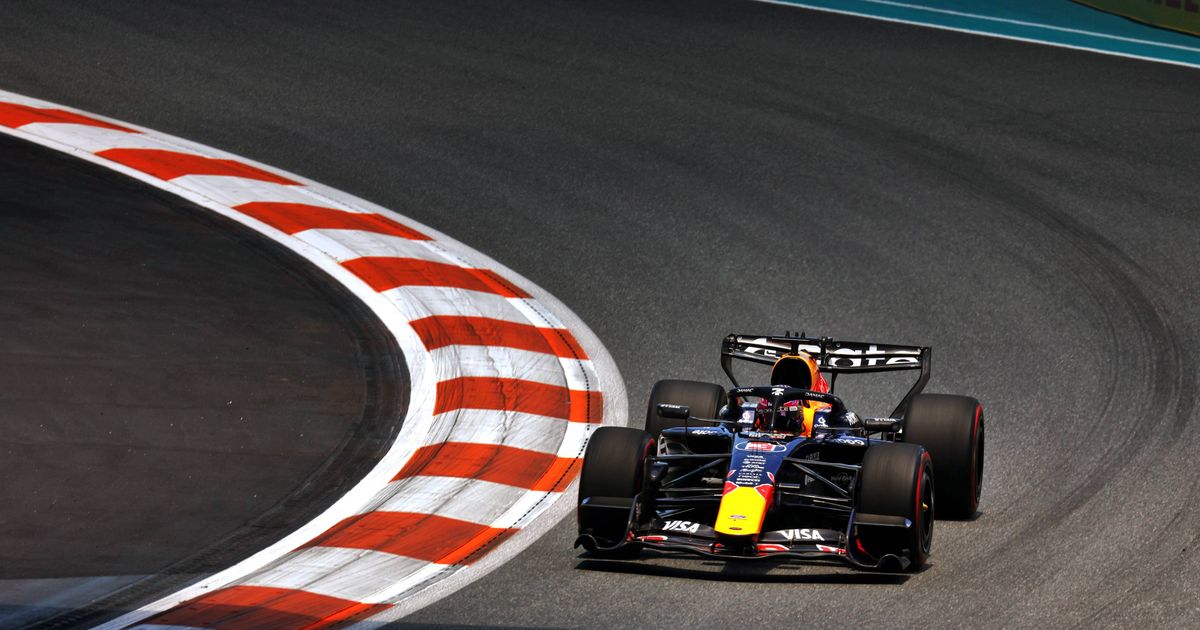
As usual, it is difficult to assess the teams’ true pace based on long runs in a sprint weekend. There were only ninety minutes of practice time available—the session was extended by thirty minutes to give teams more time to get back up to speed after the rule changes—during which multiple run plans for the rest of the weekend had to be tested.
Red Bull no longer the backmarker in the long runs
Russell was a tenth off his teammate. He then struggled in sprint qualifying as well, finishing behind Verstappen. However, on the hard tyre in the long runs, he was seven tenths faster than Verstappen. In Japan, Red Bull was still more than a second off, with even Alpine and Audi quicker. That is no longer the case, as the gap isn’t that big anymore.
| Lap | VER (M) | HAD (M) | ANT (H) | RUS (H) | HAM (H) | LEC (H) | PIA (H) | NOR (H) |
| 1 | 1:33.256 | 1:35.284 | 1:32.829 | 1:32.550 | 1:33.563 | 1:33.631 | 1:33.154 | 1:34.260 |
| 2 | 1:33.189 | 1:34.431 | 1:32.891 | 1:33.199 | 1:33.451 | 1:32.913 | 1:34.790 | 1:34.628 |
| 3 | 1:34.415 | 1:34.317 | 1:32.552 | 1:33.077 | 1:33.330 | 1:33.424 | 1:34.742 | 1:34.900 |
| 4 | 1:33.572 | 1:34.418 | x | 1:32.939 | 1:33.797 | 1:33.903 | 1:35.886 | 1:34.117 |
| 5 | 1:33.648 | 1:34.395 | 1:32.812 | 1:32.824 | 1:33.896 | 1:33.500 | 1:34.120 | 1:34.125 |
| 6 | 1:33.928 | x | 1:33.097 | 1:33.018 | x | 1:33.311 | 1:33.659 | 1:34.397 |
| 7 | 1:33.905 | x | 1:33.320 | 1:32.978 | 1:33.605 | 1:33.175 | 1:33.449 | 1:34.691 |
| 8 | 1:33.836 | 1:35.145 | x | 1:33.265 | 1:33.710 | 1:32.869 | 1:33.121 | |
| 9 | 1:33.748 | 1:34.820 | 1:32.917 | 1:33.506 | 1:33.142 | |||
| 10 | 1:33.564 | 1:35.220 | 1:33.044 | x | ||||
| 11 | x | 1:34.320 | 1:33.058 | 1:33.626 | ||||
| 12 | 1:33.728 | 1:34.707 | ||||||
| 13 | 1:33.983 | 1:34.520 | ||||||
| 14 | 1:33.620 | 1:34.387 | ||||||
| 15 | 1:33.638 | |||||||
| Average | 1:33.716 | 1:34.667 | 1:32.947 | 1:33.098 | 1:33.562 | 1:33.341 | 1:34.115 | 1:34.445 |
Russell will need strong race pace
Although Russell had a strong long run on the medium tyre, he clearly struggled during sprint qualifying. He will have to start the sprint race from P6 and mount a small recovery drive to have a shot at victory. That means he has to pass Verstappen, as well as a Ferrari, two McLarens, and his own teammate. The Italian outfit seems to be Mercedes’ biggest rival, with Charles Leclerc the fastest.
He came closest to Antonelli and Russell with a 1:33.341 average. Lewis Hamilton, however, was only two tenths slower. Red Bull has clearly not closed the gap yet, but a Verstappen who feels good in the car is all the more of a threat. Friday’s sprint race should once again provide a slightly more complete picture of the ‘new’ pecking order.