
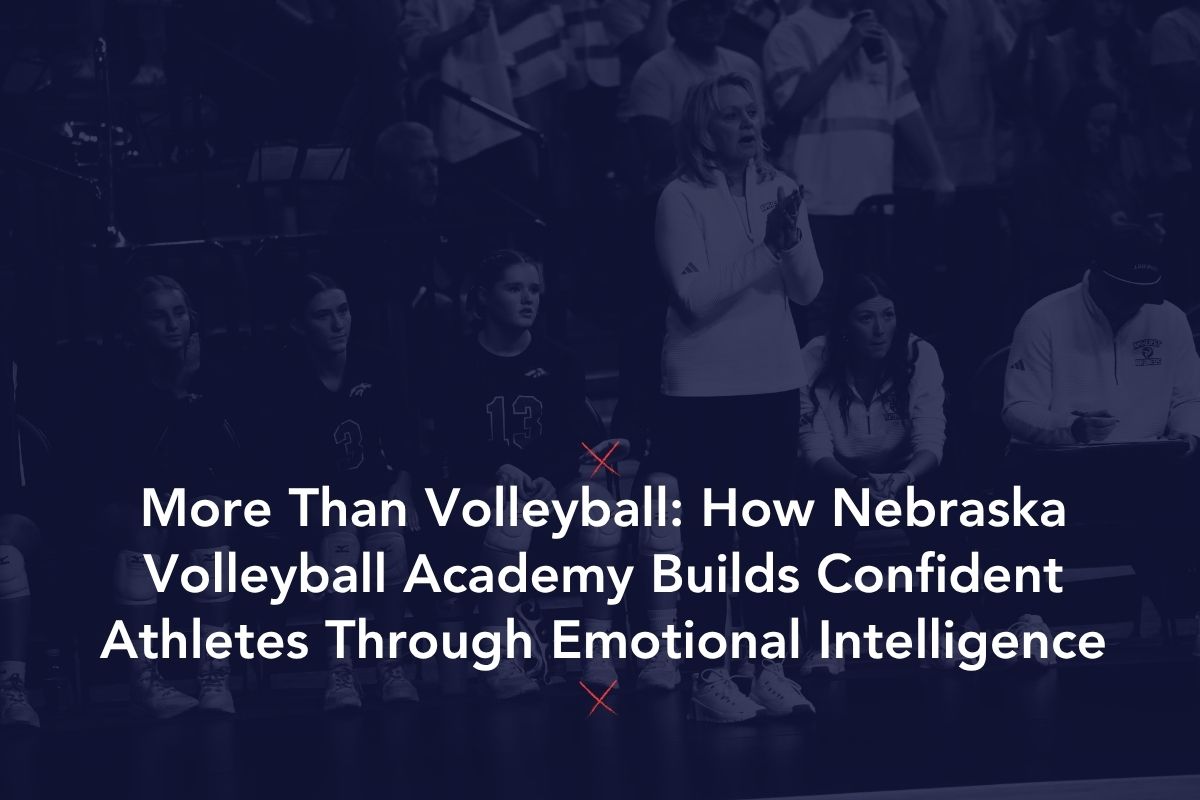
Nebraska Volleyball Academy Club Director Jonie Fader has spent nearly two decades searching for ways to help athletes become more than skilled volleyball players. Her goal has always been to develop confident teammates, resilient competitors and emotionally intelligent young people capable of thriving under pressure both on and off the court.
That search led her to Dignify, a communication and emotional intelligence tool she first implemented while coaching high school volleyball nearly 20 years ago. Today, the system serves as a foundational part of the culture at Nebraska Volleyball Academy, Capital City Volleyball Club and Amherst High School, shaping how coaches communicate, athletes recover from mistakes and teams connect with one another.
“As a coach, I wanted to bring out a player’s full potential not only physically but, more importantly, mentally and emotionally,” Fader said. “I didn’t want my players to just adapt to the coach’s style, and I was tired of guessing how to motivate the athlete.”
Fader, a graduate of the University of Nebraska at Kearney with degrees in teaching, coaching and sports medicine, first discovered her passion for coaching while competing as a college athlete. Her high school coach required players to work with younger athletes, and the experience sparked an interest that extended beyond competition.
“That’s when I fell in love with watching a player improve,” she said.
She later founded Capital City Volleyball Club in Helena, Montana, in 2006 before launching Nebraska Volleyball Academy in 2019. Throughout her coaching career, including her current role entering her eighth season at Amherst High School, Fader has emphasized athlete development beyond volleyball fundamentals.
At the center of that philosophy is emotional intelligence.
“In sport, the consensus has been that 80 to 90 percent of the game is played mentally,” Fader said. “In volleyball, especially with rally scoring, the ability to recover emotionally from mistakes became vital.”
Volleyball is often described as a “game of failures,” where one error immediately results in a point for the opponent. The emotional toll can compound quickly. A missed serve, blocked attack or defensive mistake can linger in a player’s mind long after the next rally begins. Fader believes emotional intelligence allows athletes to recover quickly, maintain confidence and continue leading teammates under pressure.
That is where Dignify enters the picture.
The process begins with a 10-minute survey in which athletes identify the personality traits and driving forces that most strongly motivate them. The program then generates a one-page “Dignify Snapshot” outlining how each athlete prefers to communicate, receive feedback and respond under stress.
For Fader and her staff, the snapshots eliminate guesswork.
“Dignify has been a breath of fresh air because it gives coaches clear direction on how to motivate and communicate with a player the way they want to be communicated with,” she said. “This discovery is done within minutes instead of half the season.”
The impact, she says, has transformed both player development and team culture.
Players and coaches complete the survey together at the start of each season. Coaches keep copies of each athlete’s profile on their clipboards, while players display their snapshots in lockers. Within days, coaches begin understanding how each athlete processes pressure, feedback and motivation.
Rather than forcing athletes into a single coaching style, the program allows coaches to adapt their communication to fit each player.
“This snapshot is the ‘how-to’ guide for communicating with, motivating and creating a culture where a player can function at their full potential,” Fader said.
The results have extended far beyond improved communication. Fader says players now recover from mistakes faster, remain calmer in pressure situations and become more supportive teammates. The club has also experienced stronger retention and a healthier team environment because athletes feel understood and valued.
“We have found that when a player feels dignified and valued for who they are as a person and how that contributes to a team, they relax,” Fader said. “They play more confidently, they are no longer afraid to make mistakes, and they recover from mistakes faster.”
Fader recalled one athlete whose perfectionist tendencies caused her to mentally replay mistakes long after the game had moved on. Through Dignify, coaches learned how to redirect her focus and help her separate mistakes from self-worth. Another player, naturally driven by fun and energy, learned how to embrace discipline and focus in high-pressure moments while still maintaining her personality and joy for the game.
The common thread, Fader says, is teaching athletes to understand themselves while also learning how to support teammates.
“Players learn how to self-dignify as well as how to dignify teammates,” she said. “Therefore producing a confident teammate who can bounce back very quickly after a mistake.”
That emphasis on emotional intelligence has become increasingly important in youth sports, where athletes face growing pressure from competition, expectations and social dynamics. Research across sports psychology consistently shows that emotionally intelligent athletes tend to handle adversity better, communicate more effectively and maintain stronger confidence during competition. Teams with emotionally healthy cultures also often display greater trust, cohesion and resilience during difficult moments.
For Fader, those lessons matter as much as wins and losses.
Her goal is not simply to develop stronger volleyball players, but stronger people: athletes who understand their value, communicate effectively and learn how to thrive under pressure long after their playing careers end.
“Much like traveling to a foreign country, one would want to learn the language and understand the culture in order to function at optimal performance,” Fader said. “We want our players functioning at optimal performance physically, emotionally and mentally, all while being comfortable with who they are.”
For Fader, the long-term impact of Dignify is measured less by trophies and more by the kind of people her athletes become. In a sport defined by pressure, mistakes and constant adjustment, she believes emotional intelligence gives players the ability to compete with confidence while remaining grounded in who they are. By teaching athletes how to communicate, recover and support one another, Nebraska Volleyball Academy is building something that extends well beyond the court — a culture where players leave not only as better volleyball athletes, but as more resilient teammates, leaders and individuals.
Nebraska Volleyball Academy, based in Kearney, Nebraska, is a member of Junior Volleyball Association, the only national association 100 percent focused on junior volleyball and the needs of the club community. JVA’s mission is to improve the junior volleyball experience. Founded in 2006 by Club Directors for Club Directors, JVA supports more than 1,700 member clubs with resources, events, education, and advocacy that help the sport grow in the right direction. With a focus on innovation and inclusivity, JVA empowers clubs to lead with purpose on and off the court while delivering an unmatched event experience at JVA hosted tournaments. Learn more at www.jvavolleyball.org and follow @jvavolleyball on Instagram.