
We’re going to take a little different approach today by focusing on a single story, with another quick note at the end, due to the importance of this issue and the time required to put it together.
Barring anything unexpected, we should be back tomorrow for our usual links and hijinks.
………
Don’t take my word for it.
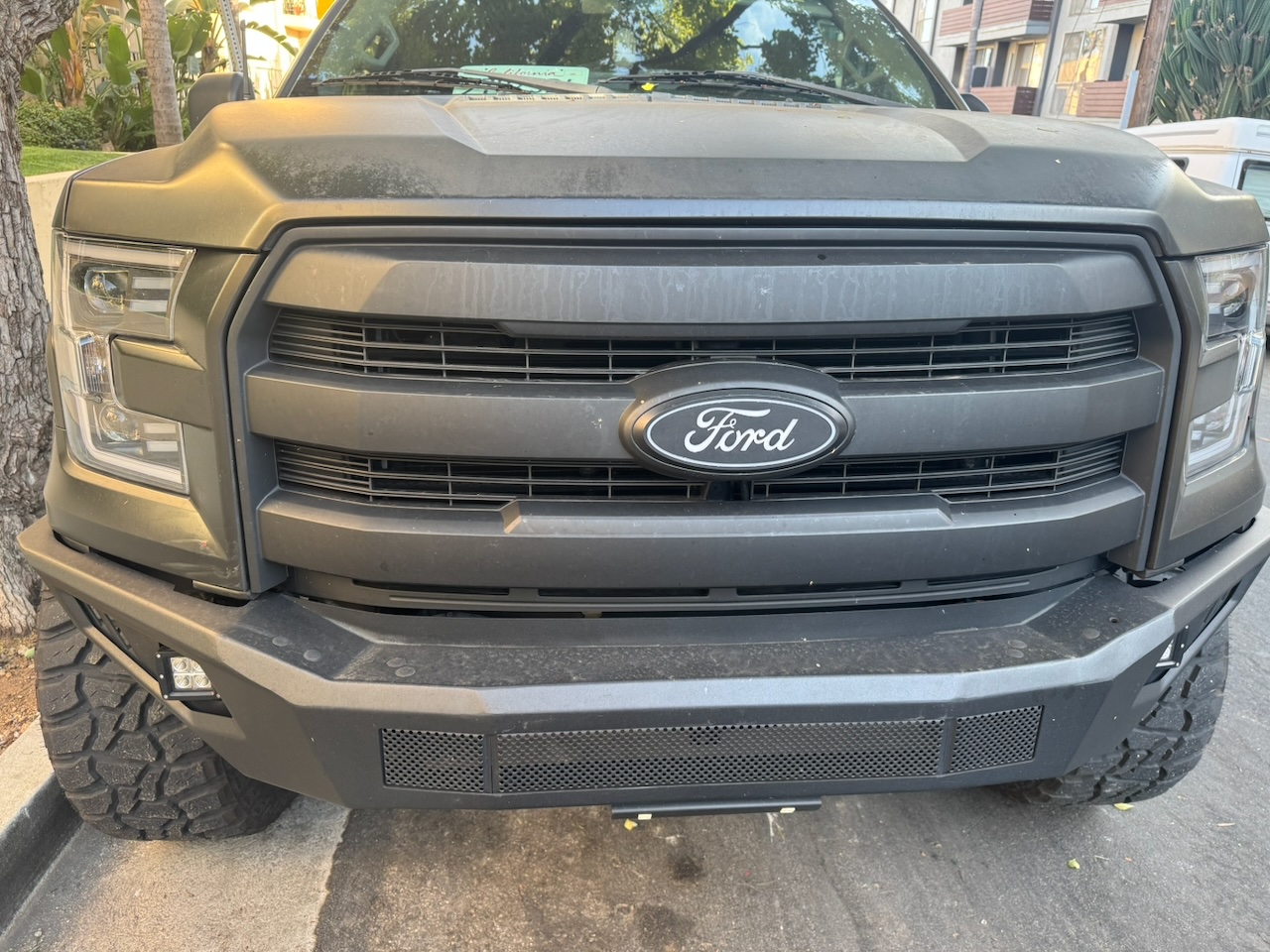
For some time now, I’ve been a voice crying in the wilderness about the dangers of the flat design and ever-increasing height of today’s grills, as pickups and SUVs continue to get bigger, and designs more aggressive.
Make that aggressive, as in dangerous.
I’ve come under a lot of criticism for calling them murder grills, because they are literally designed to kill. Maybe not intentionally, but the design of their grills and extensive blindspots dramatically increase the lethality of these increasingly popular vehicles.
And no one is doing a damn thing about it.
The design of a typical sedan, with a lower hood and a more rounded grill, means pedestrian in a low speed crash is likely to land on the hood, absorbing much of the impact. Although at higher speeds the victim can be thrown into the windshield or even over the car, greatly increasing the risk of serious injury or death.
However, the same crash involving a vehicle with a high, flat grill means the pedestrian will likely be knocked forward on the the roadway, and can easily be run over before the driver has time to react to the crash.
But as I said, don’t take my word for it.
According to a story published by The New York Times over the weekend,
“We see a lot of devastating collisions even at lower speeds because the pedestrian gets punted forward,” said Shawn Harrington, whose company, Forensic Rock, conducted crash tests for us. “Before the driver knows what’s happened, the pedestrian’s head is under the wheel.”
More vehicles than ever have hoods that exceed the average American’s center of gravity, which is generally around the belly button.
The hood of an average passenger vehicle today is about three feet high. Anyone shorter than 5-foot-6 — about half of American adults — would frequently be rammed to the pavement. So would most children.
, who is
, is likely to be knocked down by about 39 percent of vehicles today. In 2002, that number would have been 29 percent.
They even offer an interactive graphic comparing the difference when someone in a smaller passenger vehicle hits a pedestrian compared to a large truck, making the impact crystal clear.
Pun intended.
In fact, researchers for The Times found that approximately 10% of the increase in pedestrian deaths over the past quarter century could be attributed to the sheer size of today’s vehicles, compared to just 25 years ago.
That’s 200 to 400 people each year who might not have had to die, if they hadn’t been sacrificed to the greed of American automakers. Not to mention the vanity of American car buyers, who gladly pay for oversized vehicles with excess capacity most will never use.
Then complain about gas prices.
In fact, The Times cites the excess growth in American vehicles as at least one factor explaining why traffic deaths in the US aren’t declining like they are in most of Europe — particularly for people outside of the vehicle.
Like those of us on bicycles, for instance. And others who just happen to be in the street — or even on the sidewalk — in the wrong place, at the wrong time, for whatever reason.
Then take the increase in blind spots.
Please.
To analyze how these blind zones have changed, we used a three-dimensional scanner to compare sightlines in four of the most common pickups today — the Chevrolet Silverado, Ford F-150, GMC Sierra and Toyota Tacoma — with their counterparts from the 1990s or early 2000s.
The Silverado’s blind zones have nearly doubled.
The Sierra’s and the Tacoma’s grew by about 60 percent.
The smallest increase was the F-150’s. Its blind zones grew by about 25 percent.
Our overall findings match what we found in court records and heard from dozens of experts who reconstruct crashes for police and lawyers.
I have never forgotten about a young Anaheim boy who was killed while riding his bike home from school in 2009.
Nicholas Vela, a 4th grade student at Alexander J. Stoddard Elementary School, did everything he was supposed to do. He waited patiently at the corner for the oncoming truck to stop, then rode his bike out into the crosswalk.
The driver proceeded to roll forward and over the boy and his bicycle, later telling police he never saw the kid on the corner because of his large wing mirror. And didn’t see him riding right in front on him because of the height of his jacked-up truck.
Here is how I described it at the time.
According to the driver, he never saw the boy, and he was not cited by police. Evidently, California drivers are no longer required to be cautious, alert and aware of their surroundings when behind the wheel.
I’m sure the driver is devastated. Lord knows I would be.
But somehow, I don’t think “Oops” should be a universal Get Out Of Jail Free card for someone who kills another human being. Especially not an innocent child who, by all accounts, was riding in a safe and legal manner.
I’ve been haunted by Nicholas’ death for 17 years now.
And how the sheer size and height of a jacked-up truck could hide a boy on a bicycle from the driver’s view. Although I doubt his truck was any larger or higher than some you can drive off the showroom floor today.
Murder grills.
The Times goes on to explain that vehicle design is not the only factor affecting rising pedestrian death, citing road design in particular.
Like America’s wide, straight urban streets and rural highways designed and built with excess capacity that virtually encourages speeding. Along with this country’s many cramped intersections with restricted sightlines, and our penchant for red lights and stop signs instead of roundabouts.
Automatic obstacle detection and braking systems are the miracle that’s supposed to save us.
And they do help. In fact, The Times reports that one study found that GM vehicles with so-called front pedestrian braking reduced the frequency of injuries by 35 percent.
Which ain’t nothing.
But they aren’t always reliable under variable conditions. And relying on them, rather than actually seeing what’s in the roadway in front of and beside you, invites needless collisions, injuries and deaths.
But let’s get back to that question of automakers appealing to the vanity of our fellow Americans.
Again, according to The New York Times,
What used to be utilitarian vehicles for construction workers are now marketed to the American masses, with messages tailored to specific audiences.
One common pitch centers on machismo. Automakers trumpet how some of their trucks have an “aggressive appearance” or a “piercing glare.”
Other approaches emphasize the perceived safety of being the biggest vehicle around. “You’re the king of the road,” said Frank Hanley, a director at the automotive research firm JD Power.
At Ford, Nicole Gayney’s job was to identify specific social and psychological groups to target.
One was men who hoped to be seen as the neighborhood’s hero, keeping everyone safe, said Dr. Gayney, who left Ford in 2022. Another group was women who viewed a roomy S.U.V. as a way to be the community’s caregiver, taking the soccer team out for ice cream.
Yet the problem didn’t go unnoticed.
The ever-growing size of vehicles, and increasing rollover requirements resulting in ever-larger windshield support columns, or A-pillars, reduced visibility to such a degree that researchers at the US Department of Transportation became concerned, meeting with regulators four years ago.
That November, the researchers met with leaders at the department and N.H.T.S.A. They delivered a stark message: Large vehicles, with their big blind zones, were increasingly deadly. They were killing hundreds of pedestrians and cyclists every year and injuring thousands more, the researchers estimated, according to attendees and meeting materials we reviewed.
The researchers hoped that their warning would spur regulators to consider how to address the problem.
But a single senior official disputed the data, and argued that new pedestrian-sensing systems were already solving the problem. So in typical American fashion, the answer was to do nothing.
As you were, boys and girls. Nothing to see here. Pay no attention to that pedestrian or bike rider writhing in pain over there.
Never mind that higher grills — more than 50″ tall for pickups like the Ford F-250 and Chevrolet Silverado 2500, and luxury SUVs like the Lincoln Navigator and Cadillac Escalade — are becoming significantly more common, and more lethal.
Murder grills.
The Times built a complex statistical model to estimate the effects, while noting the inherent difficulties in calculating all the factors, and predicting an alternate reality in which vehicle sizes had remained the same.
But based on the best available data, the model reached a sobering estimate: The shift toward vehicles with higher hoods caused about 3,000 deaths from 2016 to 2024.
The estimate is conservative in many ways…
The Insurance Institute for Highway Safety, for example, found last year that vehicles with larger blind zones were substantially more likely to hit pedestrians when turning left.
And yes, once again, they clearly illustrate it, with side-by-side comparisons of a Chevy ’98 Silverado and the ’22 version of the same make and model.
In one, a pedestrian crossing in a crosswalk to the left of the vehicle is clearly visible as the driver turns. In the other, they’re not. I’ll let you conclude which one is safer.
I strongly encourage you to read the full article, because it’s a remarkable piece of work, and I have only begun to do it justice. (I’ve used a gift link for the article, so you should be able to read it without a subscription.)
And as bicyclists, and humans, our lives are literally on the line.
……….
One other quick note before we go.
A 38-year old Santa Ana man has been arrested for the hit-and-run death of Francois Primeau on Friday.
According to KTLA-5, Edjan Rocha turned himself in to Santa Ana police after they had located the vehicle he had allegedly been driving, and impounded it as evidence. He was booked into the Santa Ana Jail on suspicion of vehicular manslaughter and felony hit-and-run for killing the 60-year old bike rider.
No word yet on whether he has made bail or is still being held.