
It’s also that most of that altitude gain comes in the last 100 km, which gives precious little time for the riders to rest, and it’s the nature of some of the climbs, such as the Côte de Stockeu (1 km @ 12.5%, max. 21%), the Côte de la Redoute (1.6 km @ 9.4%, max. 20%) and the Côte de la Roche-aux-Faucons (1.3 km @ 11%, max. 16%), all three of which are at least as difficult as the Mur de Huy climbed in Wednesday’s La Flèche Wallonne.
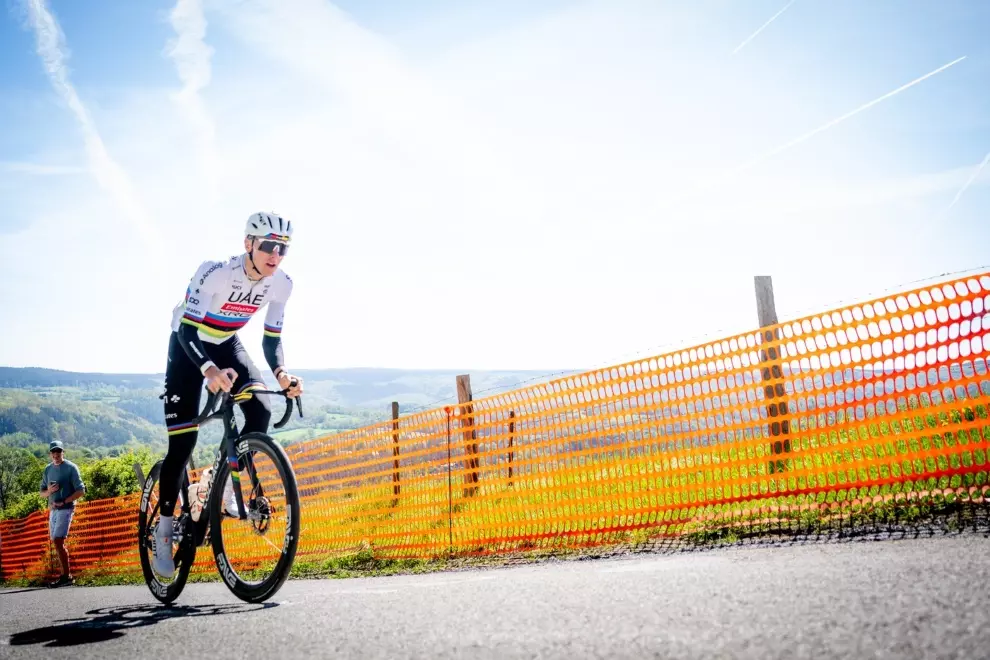
The Redoute and Roche-aux-Faucons climbs come, respectively, 34 km and 13.3 km from the finish line and are very likely to again be decisive in the outcome, as they were in 2024 and last year. In those races, Tadej Pogačar (UAE Team Emirates–XRG) launched his winning moves on Redoute, shook off riders that were following and soloed to victory. As the race is comparable to a difficult mountain stage in the Tour de France, it suits Pogačar down to his toenails.
The Slovenian has won the race three times, also winning in 2021. If he wins on Sunday, as I believe he will, he will be one victory behind Eddy Merckx, who has won Liège five times. It will also make it 13 Monuments won, solidifying his second place behind Merckx’s 19. It seems that every time Pogačar rides in a race, it becomes historical.
This is also true of his teenage rival, Paul Seixas, who on Wednesday became the youngest rider in history to win La Flèche Wallonne. Seixas has raced against Pogačar in two Classics so far, finishing seventh in last year’s Il Lombardia and an impressive and courageous second in this year’s Strade Bianche. And he won the junior version of Liège-Bastogne-Liège two years ago, at the age of 17(!). The 19-year-old is definitely special, but he won’t beat Pogačar on Sunday. Tadej is still more special. When he is at his best, no one can follow him.
It’s true that Wout van Aert (Visma–Lease Bike) beat him in Paris-Roubaix two weeks ago, but that was a special race in which Pogačar had three punctures and rode for far too long on a bike supplied by the race service car. And, of course, van Aert is also a special rider and rode a brilliant race.
Seixas would have to show that he has greatly improved over his Strade Bianche performance, six weeks ago, when Pogačar beat him by a minute. But Pogačar has also gotten stronger and Liège-Bastogne-Liège is a far more demanding race. In Seixas’ favor is that his impressive win in Wednesday’s La Flèche Wallonne didn’t require an enormous effort as the race was largely uneventful until the final climb and he was well protected by his team. But he wasn’t really tested in that race, and he will have to contend on Sunday not only with Pogačar, but also with Remco Evenepoel (Red Bull–BORA–hansgrohe). The key will be if, after more than 220 km of hard racing and climbing, he has the legs to follow Pogačar when he makes his move.
That also goes for Evenepoel, who has won the race twice, in 2022, when Pogačar did not race in it, and in 2023, when the Slovenian crashed out. He did not ride in the 2024 edition, but in 2025 he tried to follow Pogačar on the Redoute, was dropped and then faded badly, finishing 3:11 behind, in 59th.
He looked very strong in winning the Amstel Gold Race, when he outsprinted Mattias Skjelmose (Lidl-Trek). Skjelmose is a terrific rider, but Pogačar lives on a different planet and Liège is a different animal from the Amstel. Add to all that the fact that Pogačar seems to be in the form of his life, any other winner but the world champion on Sunday would be considered an upset – though if Evenepoel won it wouldn’t be a huge upset.
Other potential but highly unlikely winners include Skjelmose, Lenny Martinez (Bahrain-Victorious), Romain Grégoire (Groupama–FDJ United), Kévin Vauquelin (INEOS Grenadiers) and Ion Izagirre (Cofidis). If not for his horrific crash in the Volta a Catalunya, I would have included Tom Pidcock (Pinarello Q36.5). But though he is riding remarkably well in the Tour of the Alps, which ends on Friday, he is probably not yet at full fitness.
Whoever wants to beat Pogačar has to stay on his wheel on the Redoute climb, stay with him on the Côte de la Roche-aux-Faucons and then, after a short descent from its summit, continue to ride with him on the difficult uncategorized 2.3 km (@ 4–6%) drag to the suburb of Boncelles before the final descent toward the finish. I don’t think anyone can do it, but I’d love to see it.