
Most enterprises already own the pieces. A process automation layer. A data integration strategy. An AI initiative. Decisions still run on yesterday’s data. Agents still act without boundaries. Nobody can explain why a workflow did what it did. The technology is there. The architecture that connects it is not.
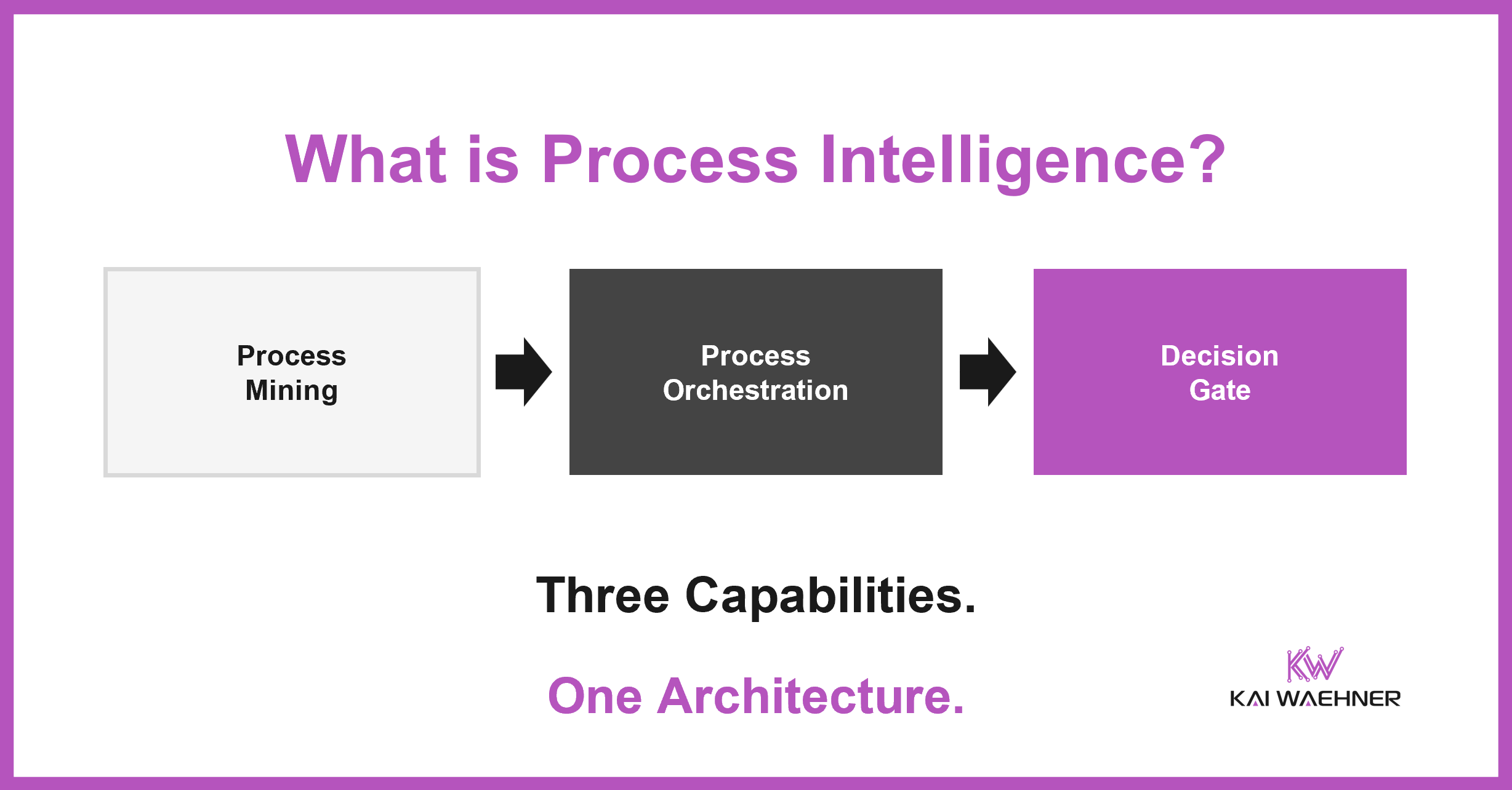
Process intelligence is the discipline that combines process mining, process orchestration, and a decision gate into one enterprise architecture. I made the broader argument in a post on the Trinity of Modern Data Architecture, where process intelligence sits between data integration and trusted agentic AI. This post zooms in on the middle layer. What is process intelligence, and what does it actually include? It includes three things: mining to see how processes really run, orchestration to govern what happens next, and a decision gate to enforce the boundaries on automation and AI.
From BPM to Process Intelligence
Business Process Management (BPM) has been a discipline in enterprise software for more than three decades. It produced tools for modeling, automating, and monitoring workflows. It also produced a generation of disappointments. Processes modeled in idealized diagrams that bore no resemblance to how work actually happened. Automation projects that took years and armies of consultants. Dashboards that showed what the process was supposed to do rather than what it did.
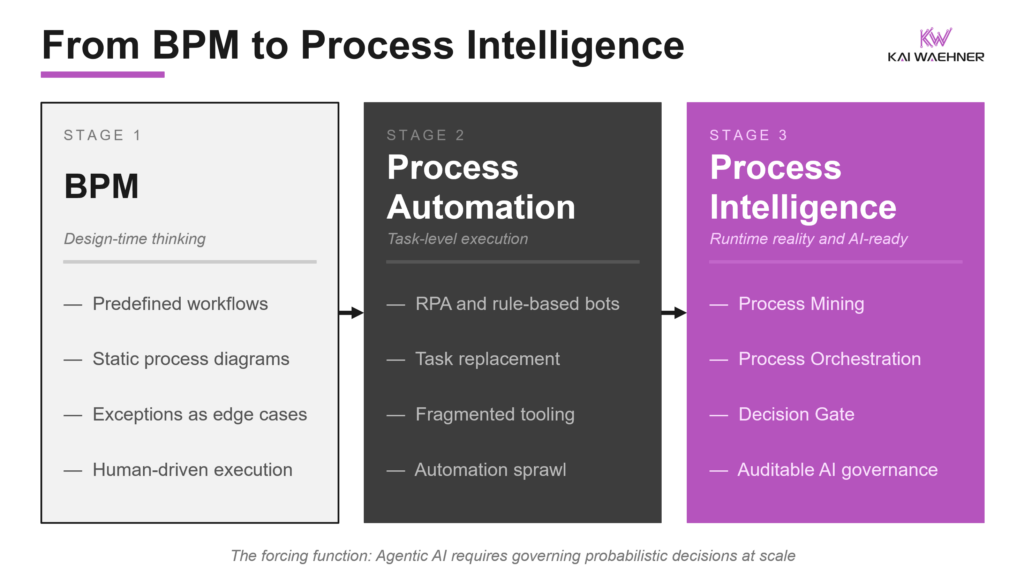
The tools were not wrong. The assumptions behind them were. BPM assumed processes could be fully specified in advance and that exceptions were edge cases. Neither held up in practice.
Process Intelligence is the term that has emerged for the broader discipline. It reflects an expansion of scope. Where BPM focused on designing and automating predefined workflows, process intelligence covers how processes actually run, how they should be governed end to end, and how to keep automation and AI inside auditable boundaries.
The urgency behind all of this is agentic AI. A model does not know whether to approve a loan. It assigns a probability. The process layer decides whether that probability is high enough to act on, whether it triggers a human review, or whether it falls outside the scope the system is authorized to handle at all.
The Three Capabilities of Process Intelligence
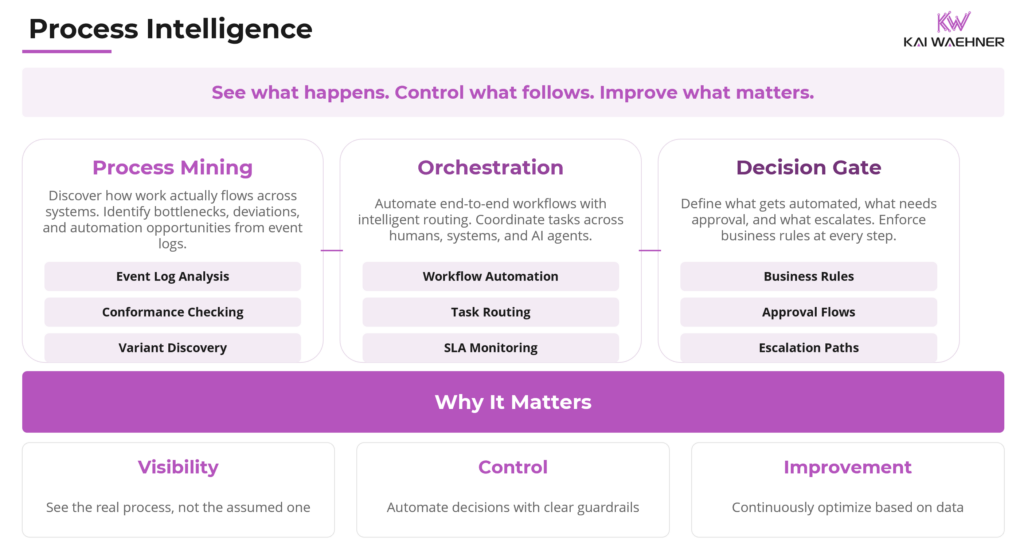
Process intelligence is not a single capability. It is three capabilities that work together. Mining and orchestration are established market categories. The decision gate is the function that ties them together and governs every automated or AI-driven action.
Process Mining: Observe What Actually Happens
Every enterprise has a version of its processes that it believes exists, and a version that actually runs. Process mining closes that gap. It reads the event logs that ERP systems, CRM platforms, and ticketing tools produce as a byproduct of doing their work, and reconstructs the real execution paths. Not the paths in the documentation. The paths in reality.
A purchase-to-pay process designed with four steps and three approvals often turns out to have dozens of variants, some bypassing approvals entirely. Mining does not create that reality. It reveals it. The output is operational truth. It shows where bottlenecks form, where rework costs time, and where the assumed process and the lived one have drifted apart. Newer standards like object-centric process mining (OCPM), formalized by Wil van der Aalst, extend this further by tracing how multiple related objects move through a process together rather than forcing each case into a single rigid path.
Process Orchestration: Govern What Happens Next
Mining is diagnostic. Orchestration is operational. It defines the sequence of steps, routes work between systems and people, enforces timing and dependencies, and coordinates the handoffs that turn individual actions into end-to-end processes. A patient case escalates through it. A supplier disruption gets resolved through it.
Modern orchestration engines are event-driven by design, which means they react to real-time signals from operational systems rather than running on schedules. Open standards like BPMN for process models and DMN for decision logic reduce vendor lock-in and let the same process definition run across compliant engines. Orchestration is the connective tissue between systems, people, and AI agents, not a replacement for human judgment.
The Decision Gate: Enforce the Boundaries
Every automated action and every AI recommendation should hit a decision gate before it has consequences. The gate evaluates the action against business rules, confidence thresholds, and regulatory constraints. What satisfies the criteria proceeds. What does not is routed to a human, escalated, or rejected with a documented reason.
The decision gate is a function, not a fixed product. It can be a rules engine embedded inside an orchestration platform as native DMN support. It can be a standalone decision management product. For organizations running real-time data infrastructure, it can be a context engine fed by data streaming over Apache Kafka, where the gate evaluates the current state of an entity rather than a stale snapshot. The implementation varies. The role does not. Without an explicit, enforceable, auditable boundary, you are not deploying trusted AI. You are deploying capable AI without architectural limits.
How Process Mining, Orchestration, and the Decision Gate Work Together
The three work in sequence. Mining shows where decisions are actually being made and where they need to be governed. Orchestration moves work through the process and coordinates participants. The decision gate enforces what each participant, human or AI, is allowed to do.
Take a credit application. Mining reveals that manual approvals are bottlenecking volume, with high-confidence cases queued alongside the difficult ones. Orchestration routes each new application through scoring, document checks, and review. The decision gate auto-approves applications above a confidence threshold, escalates ambiguous cases to a human, and rejects anything outside the authorized scope. None of the three is sufficient alone. Together, the three are what process intelligence means.
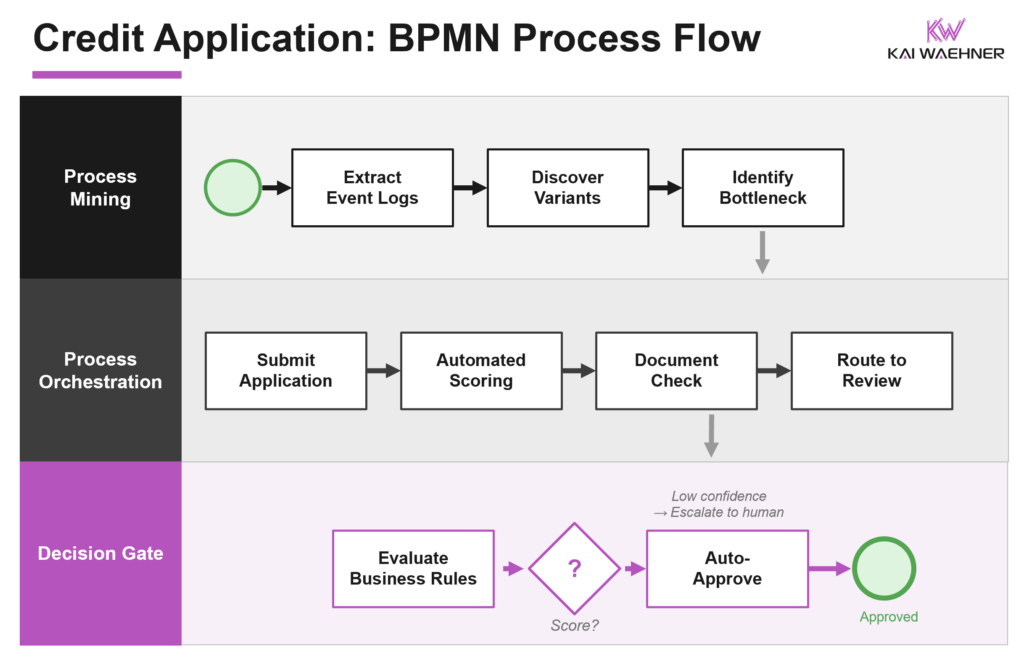
This is not a one-time sequence but a continuous loop. The decisions the gate makes and the paths orchestration runs become the next set of event logs that mining reads, so the process keeps revealing how it actually behaves and where it needs to improve.
Process Intelligence in Gartner and Forrester Research
Both Gartner and Forrester have evolved their coverage of this space, and each firm scopes process intelligence in a way worth understanding before mapping it onto an architectural view.
Gartner published a Magic Quadrant for Process Mining Platforms in April 2025. In May 2026, the same analyst team replaced it with a Magic Quadrant for Process Intelligence, scoped to the mining and task mining market. Orchestration sits in a separate Magic Quadrant for Business Orchestration and Automation Technologies (BOAT) first published in October 2025, covering the convergence of RPA, low-code, iPaaS, and BPA. Two adjacent markets, two sets of vendors.
Forrester follows a similar structure. Its Wave for Process Intelligence Software, published in Q3 2025, scopes the category as the convergence of process mining and task mining. The orchestration side sits in a separate market that Forrester’s Dr. Bernhard Schaffrik defined as Adaptive Process Orchestration, covered in the Forrester Landscape: Adaptive Process Orchestration Software, Q2 2026, which maps 35 vendors.
In that report, Schaffrik describes a market moving toward “AI-first agentic approaches” where reasoning models work alongside deterministic workflows, and fragmented tools are pulled into a single orchestration layer with governance, observability, and a human in the loop. The convergence I described in an earlier post on the Trinity is the same one he points at. We frame it differently. Schaffrik anchors the converged discipline under orchestration. I anchor it under process intelligence, the broader term covering mining, orchestration, and the decision gate together.
These perspectives are not in conflict. Analyst coverage follows how vendors go to market, and buyers benefit from focused evaluations of each adjacent market. The architectural view is what I work with when enterprises plan how the pieces fit together end to end. Buyers shop product by product. Architects design the system those products plug into. Process intelligence as I describe it is the architectural picture, not a competing market category.
Process Intelligence Is Three Things, Not One
BPM gave enterprises the idea that processes could be fully designed in advance. Process intelligence gives them the tools to see what actually runs, govern what happens next, and enforce the boundaries that make automation trustworthy. The discipline has three parts, not one. Organizations that treat it as a single tool, usually a mining tool, will keep getting the results they get today. Organizations that build all three to converge will build something that moves fast, governs well, and earns the trust of the business.
Stay informed about the latest thinking on enterprise architecture, data integration, process intelligence, and trusted agentic AI by subscribing to my newsletter and following me on LinkedIn or X.