
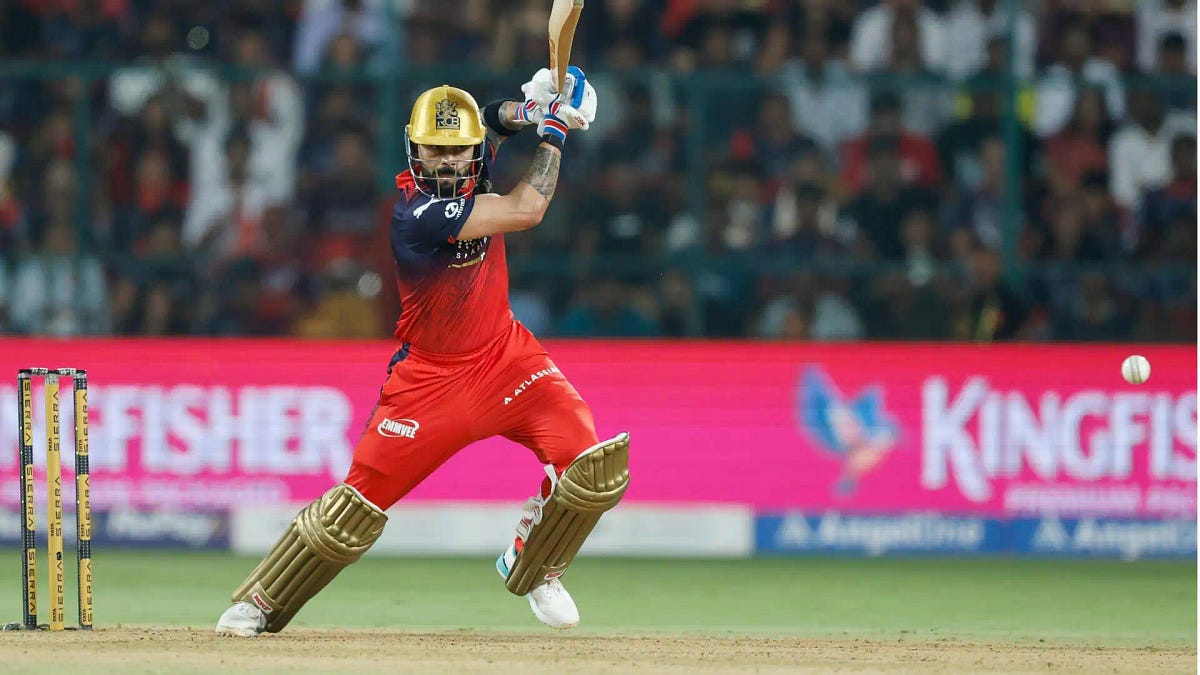
RCB beat GT by 5 wickets, but it could’ve all been very different if not for an inexplicable middle order slowdown from the visitors in the first innings. Well, inexplicable until we explain it in this BtH obviously!
But, what happened beyond the headlines?
-
🪨 GT, Overs 1-6 – RCB’s unstoppable powerplay bowling gets stopped.
-
📉 GT, Overs 16-20 – Why is GT’s middle order so bad in 2026?
-
🏃♂️ RCB, Overs 1-14 – Why couldn’t RCB finish the 205-run chase quicker?
-
🎯 RCB, Over 14 – Virat Kohli’s latest fourth-stump issue.
🚨 If you’re an RCB fan, I’d love if you could fill out this 2-minute survey on how you feel about the franchise this year. I plan to create a graphic story of your answers soon! 🚨
✍️ Written by Tarun Pratap, who runs The Rank Turner. Follow him on X.
Since last year, RCB have had a set bowling plan at home; bowl hard lengths and cramp batters during the powerplay. In 2025, 12 batters got out to this strategy while trying to hook or pull the length deliveries – it’s a strategy that works.
Most importantly, it works against the best openers. The three most feared partnerships in the IPL – SRH’s Abhishek-Head, RR’s Jaiswal-Sooryavanshi, and PBKS’ Arya-Prabhsimran – have all played one game each at Bengaluru since 2025, and none have survived the powerplay. Only Jaiswal got out of the first phase, and scored a total of 49 runs; none of the other 5 made more than 16 at the Chinnaswamy.
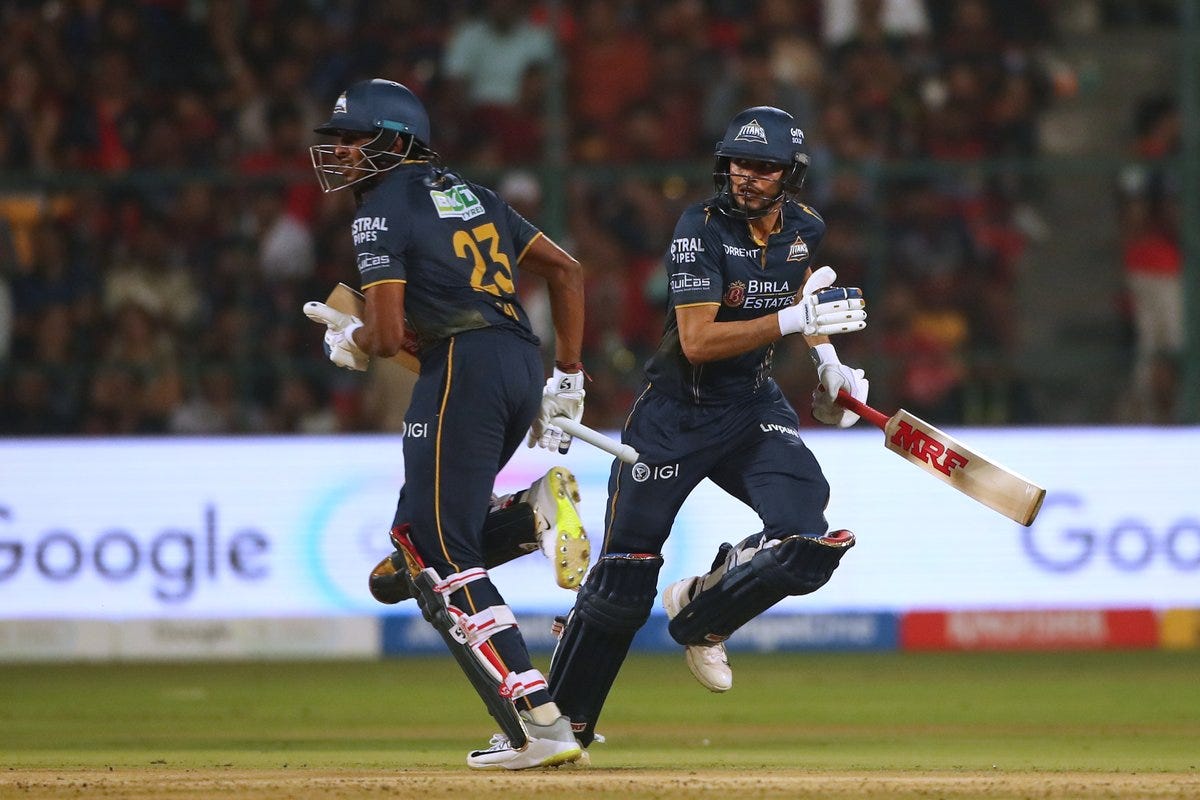
Tonight, the unstoppable force of RCB’s powerplay bowling met the immovable stone of GT’s opening partnership. Shubman Gill & Sai Sudharsan are unique in the IPL; they keep the ball on the ground, and they rarely hit maximums. Since 2025, they’ve scored a combined sixty-six 6s in 43 innings – that’s the fewest amongst opening pairs across the league. In comparison, Jaiswal and Sooryavanshi have hit 84 in 35 innings, Head and Abhishek have hit 77 in 40 innings, and Arya and Prabhsimran have hit 86 in 45 innings.
Both GT openers rarely attempt aerial shots against the standard RCB powerplay delivery in the good and hard length regions. The first phase today was about who would blink first; the hosts with their proven wicket-taking strategy, or the visitors with their proven wicket-preservation strategy. There was a clear winner as GT exited the powerplay with a total of 57/0, and just one maximum scored.
In two games at Chinnaswamy in two seasons, GT have only lost one powerplay wicket. And it’s a counter that other batters have managed to replicate. In particular, CSK’s Ayush Mhatre, DC’s KL Rahul and LSG’s Mitchell Marsh are the only players not to lose their wicket in the powerplay in Bangalore in the last season-and-a-half.
What those batters and GT’s openers have in common is that they are slow starters. They’re not trying to hit the bowler over their head immediately; they’re trying to settle into the game. If we look at their first 10-ball strike rates, it backs up that intuition. Since 2025, Marsh (129.7), Gill (127.1), Sudharsan (128.4), & Rahul (118.6) have some of the least impressive numbers. Comparatively, Sooryavanshi (187.1), Arya (161.2), & Abhishek (158.1) are aiming for the fences immediately.
T20 cricketing logic dictates that going slow in the powerplay is a terrible strategy. So, why is it baffling the best home bowling unit in the league? Unlike most other teams, GT have two openers that are willing to wait out the storm. They will just ignore the dangerous balls, and provoke the bowlers into increasingly riskier deliveries to tempt an edge.
Despite this foil, RCB didn’t actually err drastically. They rarely got their lengths wrong, and there was just one full ball in the powerplay. If anything, they actually adapted to the batters well; they went on a good length rather than short-of-a-good length to Sudharsan because the GT opener plays on the back foot.
However, they did end up providing too much width on the offside – especially to the left-handed Sudharsan who faced 35 of the 48 balls in the first 8 overs. He scored 59 runs in that time, with more than half (52%) scored via cuts through the third man region. The GT batters’ reticence meant that RCB had to play with their stock strategy to induce a mishit, but Sudharsan was in fine form and picked the bad balls perfectly.
While the GT game plan worked today – the openers put up 128 runs in 76 balls – it is not necessarily an indictment on RCB’s bowling strategy. The hard lengths work against the best batters of the modern era, and those are the players that RCB will likely face in the knockout games. However, it does point to a tactical rigidity to their plan A; it’s not a problem against a weak team like GT, but – as they saw against RR in Guwahati earlier this year – a lack of plan B is a weakness that the best teams can exploit.
Data from Cricmetric & the IPL Match Centre.
✍️ Written by Aarush Adil Khan.
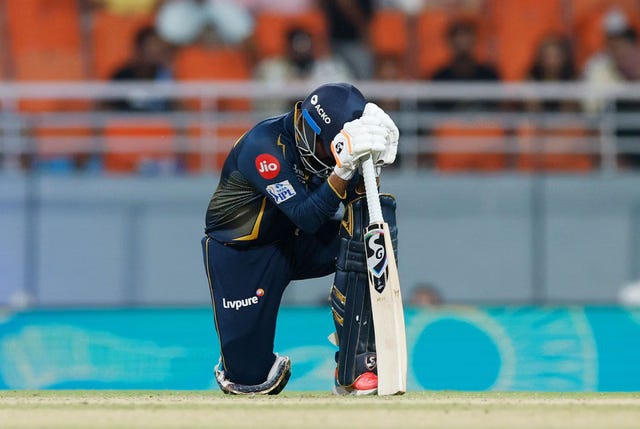
GT’s openers gave them a perfect start. Halfway through the 16th over when Sudharsan got out, the visitors were perfectly placed at 160/2. A 220+ score was well in sight, but in the end they only crossed the 200-run mark because injuries to both Rasikh Dar and Krunal Pandya gifted them an 18-run 20th over.
The problem lies squarely at the feet of their middle order, who could only score 24 (16) before that final over. In fact, GT’s middle order – batters 4 through 7 – has been one of their biggest problems since the last Mega Auction. Last year, they averaged just 54 (33) a game as a four-man unit – that number has dropped to 47 (34) in 2026.
In 2025, their top 3 batters had career years that covered up everyone else’s failures. Today’s centurion, Sudharsan, scored 759 runs at an average of 54. Fellow opener Gill scored 650 runs at an average of 50. Jos Buttler scored 538 runs at an average of almost 60.
Sudharsan won the orange cap, Gill came in 4th, and Buttler ranked 10th. Shahrukh Khan – GT’s next highest scorer who is still on the team – scored 179 runs and finished as the 59th highest scorer in the IPL.
On average, GT’s top three scored 130 runs in 83 balls per game in 2025. However, they’ve dropped back down to Earth, and score “just” 111 runs in 73 balls a game in 2026. Still great numbers, but lagging behind the best teams in the post-Sooryavanshi IPL era.
More importantly, by taking up fewer balls faced in an innings, GT’s top order are leaving their middle order in a conundrum. They could either embrace the modern philosophy of high intent regardless of consequences, or they could try to preserve wickets.
They seem to have chosen the latter – on average the middle order’s wickets lost has dropped from last year (2.26 to 2) despite facing 10 more balls a game. As a result, they are scoring fewer runs, at a slower pace than in 2025. This is evident when we look at each batter’s individual numbers.
Washington Sundar’s strike rate since 2025 was 166.25, while his first 10-ball SR was 162. This year, that overall SR has dropped to 147, and his first 10-ball SR has dropped to 160. Meanwhile, Shahrukh’s 2025 SR was 179 and his 10-ball SR was 162. In 2026, those numbers dropped to 140 and 150 respectively.
However, by far their biggest offender has been Rahul Tewatia. His 2025 SR was 167.79, and his 10-ball SR was 147.4 – those numbers have dropped to 116.7 and 119.5 respectively in 2026. More egregiously, he can’t even keep his wicket in this more conservative middle order. Sundar (29) and Shahrukh (24) still have good averages, but Tewatia’s (14.8) has fallen off a cliff.
GT’s management finally dropped him for tonight’s game against RCB, and brought in Jason Holder. The West Indian made a positive impact, scoring 23 off 10, and bowling 3.5 overs for 35 runs. He might prove to be an inspired change, but GT are going to need more from their other batters if they are going to make it to the playoffs this year.
Data from ESPNcricinfo.
✍️ Written by Tarutr Malhotra, who runs Best of Cricket.
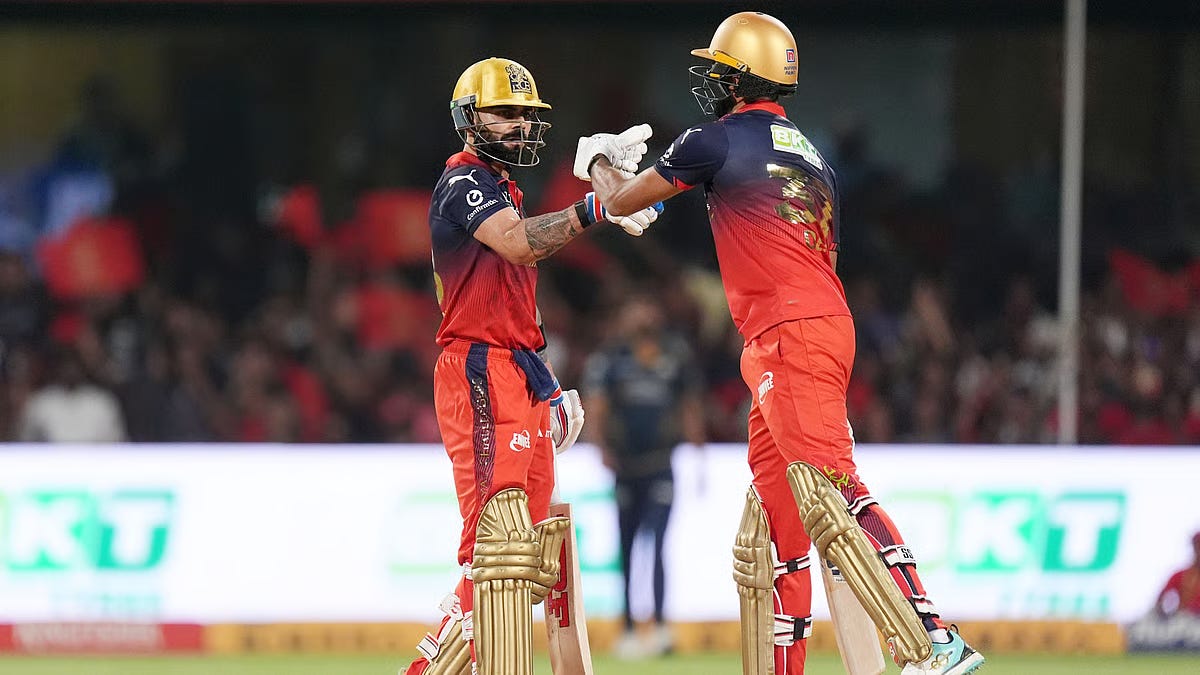
Today’s run chase was a case of deja vu for the defending champions. They had to chase a slightly-higher-than-200-run target, saw a British opener get out early, got a huge boost from a Virat Kohli-Devdutt Padikkal (DDP) partnership, and closed the game out in style.
The game looks identical to their chase versus SRH on Matchday 1. Kohli & DDP scored 136 runs off a 206 total today, compared to 133 runs off a 203 total v SRH. When DDP got out to end the partnership – as he did on both occasions – RCB needed 93 runs at an 8.2 RPO v SRH and 65 runs at a 9.1 RPO tonight.
Slightly higher run rate required, but fewer runs and with 5 established batters to go. Easy work for the defending champions who average more than 10 RPO across all phases in 2026, and 11.86 RPO at the death.
And yet – tonight’s chase was relatively laboured. It took the RCB middle order 36 balls to score 65 runs (180 SR or 10.83 RPO) versus 42 balls to score 93 runs v SRH (221 SR or 13.29 RPO). Why was tonight’s run chase slower than their average death overs RPO when they already had a template on how to close out games like this?
There are two major differences between the chases, and by analysing them together, the answer becomes clearer. The first is that Kohli got out tonight, whereas he saw off the SRH chase himself. The second is the Rajat Patidar got out cheaply tonight (8 off 5) versus finishing the game off on Matchday 1 (31 off 12).
The next question is obvious; was Patidar’s wicket related to Kohli’s wicket? The RCB skipper only played one ball in their short partnership against GT, but his numbers before tonight are revealing. Patidar’s strike rate in the 2026 IPL before tonight was 213 – when he bats with Kohli that number jumped to 244, and without Kohli it tanked to 196. With every other RCB batter that he’s faced at least 10 balls alongside, he has scored at a sub-200 SR.
The one exception? Venkatesh Iyer, who Patidar shared 14 balls with at the end of a tough innings against RR. That game provides an insight into Patidar’s batting. He has averaged an entry point closer to the 10th over this season, but against RR he came in with RCB struggling at 58/3 in 4.5 overs.
The team captain played against type, consolidating the innings as wickets fell regularly on the other end as RCB’s finishers couldn’t handle the pressure of having to construct an innings. By the start of the 15th over, Patidar had scored 27 (26), RCB were at 125/7, and Iyer was brought in as an emergency impact player.
Alongside the last recognisable batter – who also happens to be a reliable anchor-type – the RCB skipper could stretch his wings. He dutifully scored 36 off 14, including four 6s to help RCB post a respectable – if losing – total. That partnership with Iyer included four 6s, the second highest number of maximums he has scored alongside anyone in 2026 – behind only Kohli.
Ten of Patidar’s twenty-three 6s this season – the second highest in the IPL – have come alongside Kohli. His balls per 6 with the RCB opener is 3.9, compared to a season average of 4.9. These numbers – a clear sign of Patidar’s aggression and intent at the crease – drop drastically alongside Tim David (6.5), Jitesh Sharma (11 before tonight), and the other finishers who he hasn’t scored a maximum alongside yet.
This is where things go from hard numbers to a little bit of speculation. I don’t think Patidar trusts his finishers. It feels like he needs to handhold them, which is leading to this tension between anchoring and run scoring, and has gotten him out to sloppy shots in the last two games. This could be a short-sighted take off a small sample size, but his improvements alongside Kohli are hard to deny.
RCB’s batting unit is elite – they didn’t even need Romario Shepherd despite a mini-collapse at the back end of their chase – but it is still dependent on a 37-year old, semi-retired Kohli to hold it all together. Alongside batters whose raw numbers make him look like a dinosaur, the RCB veteran’s value lies in the confidence he instills in them. His partners can accelerate knowing that he will be there to clean up any mess.
Data from our new database.
✍️ Written by Pri Gulati, who runs Thoughts from Third Man. You can follow her on X.
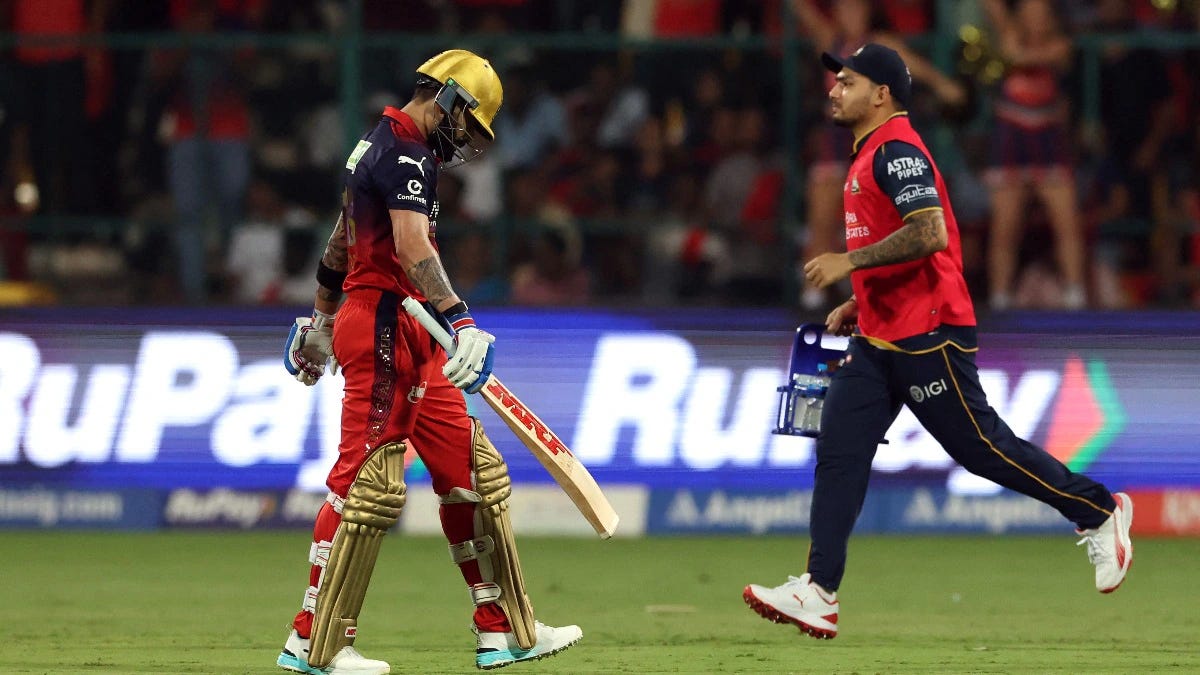
Kohli was in excellent touch tonight, in total command, and had built an authoritative 100+ run partnership with DDP. Both players crossed the half-century mark, and it could have been anyone’s night to accelerate. DDP’s 20-ball 50 had set him up as the aggressor, but by the time GT’s Holder returned in the 14th over, Kohli had taken over.
And then, seemingly out of nowhere, came a jarring hit wicket. It wasn’t a particularly dangerous ball. On the off-stump, ready to be hit. Holder had tried a similar slower short-length delivery in the 6th over – a 124.1 KPH delivery that came into the batter’s body, which was easily read and pulled over midwicket for 4.
When the West Indian returned in the 14th over, his deliveries were fuller and quicker. After a single towards the pads and wide off the legside, Holder fed Kohli two deliveries in the 130 range (129.1, 133.3) that were put away beautifully. The first was smashed into the stands, the second lofted over long off just past the ropes. Everything seemed accessible, in his arc or through the legside.
Then came the fifth ball of the over. Adrenaline pumping, crowd wild. The delivery invited the same instinct. Kohli was ready to smash this one over the boundary as well, but it was not the same ball. The same short length, but the pace drops 10 kph to 123,2, and crucially, the line is outside off. Instead of a pull close to his body, Kohli must fetch this from the 4th stump corridor. Instead of a clean punch, he catches the inside edge and sends it swinging into his stumps.
His last three dismissals have been in the same outside off corridor. Standard-paced (132-135) deliveries in a line that has become a problem for the orange cap holder. DC’s Lungi Ngidi, MI’s Hardik Pandya, and LSG’s Avesh Khan have all taken wickets by making Kohli play away from his body, forcing a split-second decision about whether the ball is close enough to control the stroke or a reach.
Holder’s wicket followed the same pattern, but he stripped the pace. To Kohli, in attack mode after two boundaries, it was ripe for punishment. His swing was just a tad too quick for it.
It’s got to be a frustrating trap for a man who so loves to drive down the covers. Time and again, bowlers have taken one of his most productive scoring areas and turned it into a battlefield where the slightest variation could blow up a picture-perfect innings. Too full, and it freezes him. Without pace, the ball is a temptation. The margin of error becomes slim.
Today, Holder took hold of Kohli’s intent to dominate and pushed it just over the edge into another fourth-stump mishap. A glorious 81 (44) knock, that was just accelerating, ended in frustration for the veteran opener and his legion of fans.
Data from the IPL Match Centre.