

RCB beat MI by 18 runs, but only because RCB’s Romario Shepherd tried his best to make the game competitive in the last over when MI needed 44 runs to win.
But, what happened beyond the headlines?
-
🐌 Virat Kohli’s trouble with mid-innings acceleration.
-
🔫 How MI are misusing their most potent bowling weapon.
-
🚅 How RCB’s spinners played with their pace to take down MI’s batters.
✍️ Written by Tarutr Malhotra & Tanvi Bhaskar.
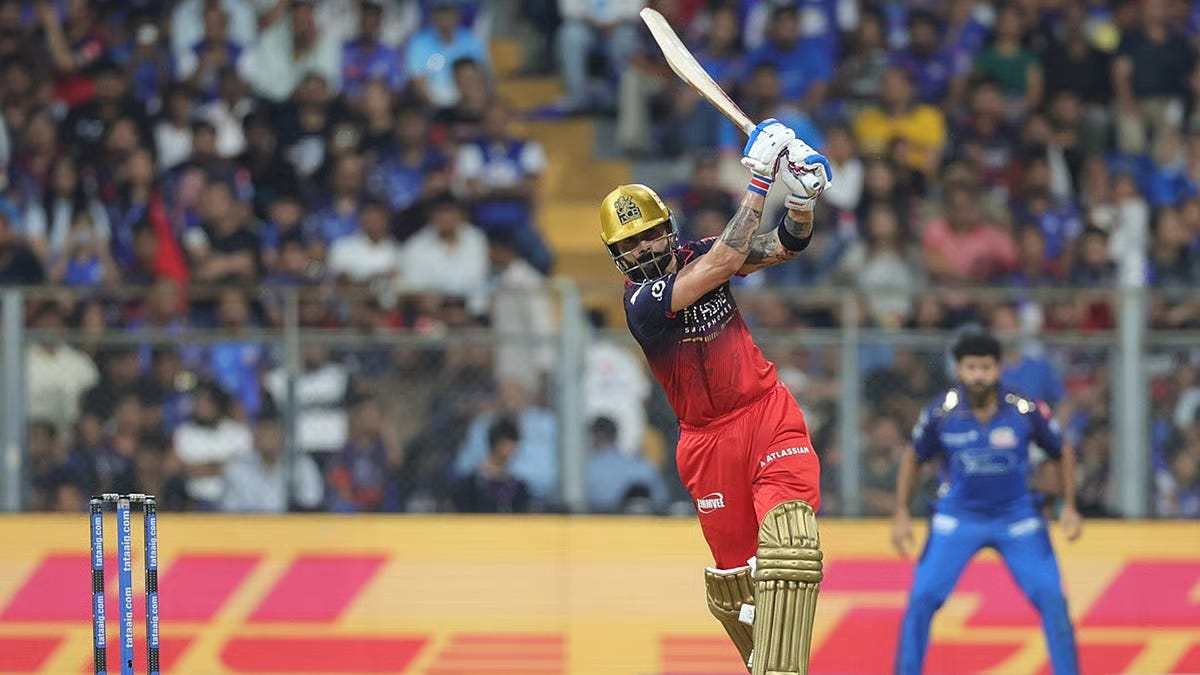
Virat Kohli and Phil Salt put together RCB’s single biggest opening wicket stand at the Wankhede in 19 years tonight. They scored 120 (65) to give the visitors a head start that proved too much for the MI batters to match.
However, their individual numbers drive home a point that many RCB fans may be sick of at this point; Kohli seems prone to these occasional lapses in intent. A couple of times a season, he seems more like the flailing pre-2023 anchor than the accelerated post-2024 opener who’s led RCB to so much success.
Kohli scored 38 off 29 in that opening stand – 31.7% of the partnership’s runs in 45% of the balls – with an equally abysmal record after Salt got out. He scored 12 off 9 – against the likes of Mayank Markande & Shardul Thakur – before holing out off a full toss against Hardik Pandya.
What makes this more confusing is that we saw the most aggressive version of Kohli to start this game. He raced to 18 of his first 10 balls (a 180 SR rate), tonking both Trent Boult and Jasprit Bumrah for boundaries in the first 4 overs. He recorded just 3 dots in the first 4 overs, including a 7 (4) return versus Bumrah.
When Salt scored 22 runs off a loose Mitch Santner over in the 5th, RCB were in cruise control. They could even afford to play out a second Bumrah powerplay over for just 6 runs, and maintain a run rate of nearly 12 RPO. That should’ve been the start of a middle overs acceleration against a weak MI fifth bowling option – Markande and Thakur went for 72 runs in their 4 overs – but Kohli just…retreated.
Even as Salt accelerated – the Englishman’s middle overs strike rate jumped to 221 – Kohli slowed down. Between the 5th and 12th overs, the King scored just 19 runs off 19 balls. The onset of spin with the fields spread out became a barrier for Kohli. His boundary run percentage dropped from 64% in the powerplay, to just 29% in the middle overs. He scored as many boundaries in the first 4 overs (two 4s, one 6) as he did in the next 10.4 overs (three 4s).
After scoring 23 off 15 versus Boult and Bumrah, Kohli only picked up 13 off 11 versus the spinners (Salt scored 44 off 14 against them). Santner, turning the ball away, naturally cut off Kohli’s preferred scoring zones through the off side, while Markande’s leg-spin required him to take on shots against the spin to find boundaries. Instead of taking those risks, Kohli opted for percentage cricket, which meant fewer boundary attempts.
Kohli’s inefficient innings was covered up by Salt, but it had an effect. Salt got out trying to smack a wide yorker against Thakur because RCB hadn’t scored a boundary in 7 balls – 5 of which had been faced by Kohli.
The RCB opener had started the season well, scoring 129 runs at a 179 strike rate in the first three games. Tonight, he looked all set to replicate that form, but got bogged down by bowlers he should be feasting on. Despite his good play this year – especially against SRH – this has been a standard problem for the King.
While he starts his innings strong post-2024 (at a 158 SR in his first 10 balls), it slows down rapidly (146 SR in balls 11-20, and 133 SR in balls 21-30). Usually, he makes up for this middle overs slowdown by accelerating as RCB approach the death (163 SR in his 31-40 ball range).
However, tonight, Kohli couldn’t accelerate again. In his 31-40 ball range, he scored just 11 runs off 8 balls at an SR of 138 before mistiming a shot from a Pandya full toss to long on. It was at least the third such freebie he had mishit in the middle overs.
On the night, RCB’s other batters – especially Salt and Rajat Patidar (53 off 20!) – made up for Kohli’s malfunctioning innings. However, on another night – perhaps one where Rohit Sharma doesn’t hobble off the pitch – RCB could pay dearly for Kohli’s misplacement of intent in the middle overs.
Data from our new database.
✍️ Written by Tarutr Malhotra, who runs Best of Cricket.

As expected, Jasprit Bumrah was MI’s best bowler tonight despite not picking up any wickets. He slowed the powerplay bleeding after Mitch Santner’s 22-run 5th over, and his overall economy of 8.75 RPO was far below the 12 RPO that MI conceded as a bowling unit tonight.
However, his usage tonight continued a particularly odd way of utilising the most dangerous bowler in the world. MI see him as a defensive option rather than an offensive one. Karan Jain mentioned this in his column last week about the most intriguing tactical choices in the IPL, but it’s worth looking at the tactic within the context of the RCB game.
Tonight, Bumrah bowled 4 overs – the 4th, the 6th, the 17th & the 19th. This makes sense superficially. MI gave their best bowler two overs in the powerplay and two overs at the death. However, the powerplay overs in particular reflect MI’s odd use of Bumrah – they play him in the last three overs when they need to punch back against a rough start, rather than in the first three overs when he can build pressure against new-to-the-crease batters.
The broadcast had an interesting stat about Bumrah’s usage; across his IPL career, MI have given him nearly twice as many 4-6 overs (63.9%) than 1-3 overs (36.1%) in the powerplay. Ironically, his best play seems to come in the first three overs versus the second three. In overs 1-3, his economy is 5.7 and he takes a wicket every 24.4 balls. In overs 4-6, his economy drops to 7.3 and he takes a wicket every 34.9 balls.
However, those are career long stats. What about since 2025, when the current iteration of this MI team was put together? His most bowled overs across all phases are over 5 (6 times) and over 6 (5 times). His worst performing over in the last season and a bit? Over 5 – where he concedes an economy of 9 RPO.
I’m just an armchair critic though. Maybe MI have some insider knowledge that I can’t fathom. You know who else has insider knowledge of Bumrah’s play, and a star-studded cast of bowlers to put around him? India.
Since the start of 2025, Bumrah’s most bowled overs for India are the 2nd and 4th – 12 times each in 25 T20Is. His best over across all phases for India in the period? Over 2 – where he concedes an economy of just 5.42 RPO. We all know Bumrah can defend the ball well, but India use that defence to create pressure on the opponent rather than to relieve pressure on themselves.
These differing strategies played out in MI’s usage of Bumrah tonight. He was given the 4th over (after MI conceded 33 runs in the first 3 overs) and the 6th over (after Santner conceded 22 in the 5th). On both occasions, Bumrah was called upon to stem the flow of runs rather than to create a wicket-taking threat.
Apart from one sliced 4 by Virat Kohli, neither of RCB’s openers even tried to hit him during those two powerplay overs – and they didn’t need to. RCB scored 8 RPO in Bumrah’s overs, and still ended the first phase with a run rate of nearly 12 RPO.
This points to a larger flaw in MI’s usage of Bumrah; he’s their firefighter instead of their fire starter. They throw him the ball when they need to quickly stem the flow of runs. It explains why he gets so many single-over spells, when his bowling style clearly lends itself to sustained pressure over multiple overs.
The underlying numbers show how baffling this decision is; when Bumrah has bowled a single-over spell for MI since 2025, he concedes an economy of 7.27 RPO, takes a wicket every 44 balls, and concedes 53.3 runs for every wicket. When he has bowled two-over spells, he concedes an economy of 6.63 RPO, takes a wicket every 13.4 balls, and concedes just 14.8 runs per wicket.
Last week, when RCB lost to RR, we talked about how they struggle in the middle overs if they lose 3 wickets in the powerplay. In Bumrah and Trent Boult, MI had two elite powerplay pacers that could play off each other to exploit that advantage, with Hardik Pandya available to fill in any gaps.
Instead, MI decided to stick with Bumrah as a last resort rather than a first option. India have won two T20I World Cups in three years with Bumrah as the tip of the spear. It seems baffling that the IPL team who discovered his talents don’t use him in a similar manner.
Data from our new database & the Jio broadcast.
✍️ Written by Tarun Pratap, who runs The Rank Turner. Follow him on X.

In a game where 462 runs were scored and MI’s spinners conceded 83 runs in 6 overs, RCB’s spinners found a way to fight back. Krunal Pandya finished with a 26-1 return in his 4 overs, while Suyash Sharma conceded 47 runs but took two wickets in his first over to break MI’s chase.
After 4 overs of predictable pace, Rohit Sharma and Ryan Rickleton had the hosts cruising at 48/0. RCB then introduced Pandya in the 5th over – the ex-MI all-rounder who had won multiple IPLs with the Wankhede side. He immediately stemmed the tide, conceding just 21 runs in his first three-over spell.
After running at 12 RPO in the first 4 overs of the innings, MI’s chase was restricted to 7.4 RPO in the next 5 overs. While Pandya didn’t pick up a wicket in the spell, his pressure did create the conditions for Suyash’s double wicket introduction in the 8th over.
Pandya’s success was built on constant and consistent variation in lines and lengths, but also smart use of space. Against the LHB Ryan Rickleton – who was terrorising RCB’s bowlers – Krunal sped the ball up. One of his first deliveries to the South African was clocked at 111.5 KPH, in the same over where he bowled a 92.6 KPH ball to the right-handed Rohit. The thinking was simple; speeding the ball up took it away from the LHB’s hitting arc quicker. The strategy worked. Rickleton scored just 3 (4) against Pandya, while he scored 34 (18) against everyone else.
Against the RHBs, he bowled slower deliveries that forced them to generate the pace in their shots against his SLA deliveries. He went as slow as 79.6 KPH against Suryakumar Yadav at one point, and it worked wonders. The India captain scored just 12 off 9 versus Pandya, while he scored 21 (13) against everyone else.
Pandya also modified his deliveries as he saw how the batters adapted. In the 7th over, SKY paddled a 100 KPH ball aimed at leg stump over to fine leg for a boundary (one of only two Krunal would concede all night). In the 13th over, when Pandya came back for his fourth over, he bowled the same delivery against SKY but looped it in at 82.9 KPH. The MI batter had nowhere to go and no pace to play with, and hit the ball straight to the fielder at deep backward square leg.
Similarly, against his brother Hardik, Krunal learned from the mistakes of his peers. The MI captain struggled against faster balls throughout his tenure in the middle, failing to hit a single ball over 99 KPH to the ropes. Krunal duly bowled all but one of his deliveries to Hardik at more than 109 KPH. The MI star scored just 3 (5) against his brother, while putting away 37 (17) against everyone else.
On the other hand, Suyash decided to play with fire instead. When he was brought on in the 8th over, he had the benefit of Pandya’s run pressure to build upon. He knew that Rickleton would have to take him on after MI had scored just 24 runs in the previous 3 overs. Suyash bowled a googly outside off stump that bent away from the LHB, and got a top edge.
4 balls later, Suyash bowled another googly to Tilak Varma on the leg stump, which the MI batter spooned to short fine leg. Both wicket-taking balls were in the 86-88 KPH range, which forced both LHBs to try and generate their own power while under ever-increasing run pressure.
While Suyash was relatively poor against MI’s right-handers – conceding 38 off 17 balls – but had done his job. Pandya created the pressure with his disciplined bowling, and Suyash was able to exploit that pressure against his favoured matchup. With those two wickets and Rohit’s enforced retirement, MI’s chase was in tatters by the time the spinners got done with their spell in the 14th over.
Data from the IPL Match Centre.