
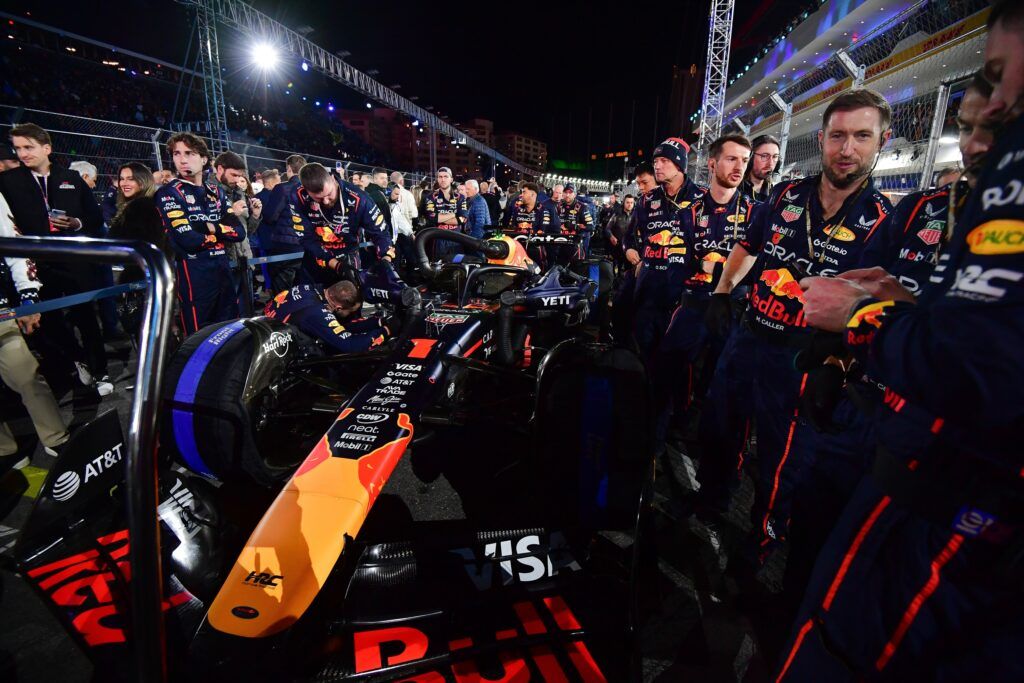
The countdown to Formula One’s 2026 reset is quietly picking up pace, and Red Bull already finds itself under a bright spotlight. For the Austrian outfit, as the team is preparing for a future without Honda, a partner that helped deliver multiple championships and some of the most dominant seasons in modern F1.
Red Bull has spent the past few years at the front of the grid by setting the standard with Max Verstappen and a car that often looked a step ahead of others. Now, early rumors about Red Bull’s 2026 challenger, the RB22, are starting to surface, offering an intriguing look at how the Milton Keynes team is approaching the biggest technical revamp ever.
A New Era for Red Bull With the RB22
Red Bull Racing has never been afraid of bold ideas. Since joining F1 in 2005, the team has built its success on its strong leadership and a willingness to trust its instincts. That approach delivered multiple championships with Sebastian Vettel and later turned Verstappen into a dominant force who too is a world champion.
The RB22 will be the first car Red Bull designs for the 2026 regulations, and it arrives at a turning point when F1 is moving away from ground effect cars to something where active aerodynamics will play a larger role while engines shift toward 50% electrification and fully sustainable fuels.
According to a report from an Italian publication, Red Bull is expected to switch to a double pushrod suspension layout on the RB22, both at the front and rear, and if that proves accurate, it marks a clear departure from the team’s long-running pullrod front suspension philosophy.
During the ground effect era from 2022 to 2025, Red Bull’s suspension layout offered aerodynamic advantages that suited its overall concept. With those rules now gone, mechanical consistency and handling will become more critical. A pushrod setup is generally more straightforward and can be easier to integrate with new packaging demands, especially with a fresh power unit design.
Ferrari is also rumored to be heading in a similar direction with its own 2026 car, which suggests that teams may be aligning early on what matters most under the new rules, rather than chasing extreme concepts and risk falling behind.
Red Bull Powertrains and the Ford Gamble
The biggest question surrounding the RB22 is not its suspension, but its engine, as from the next season onwards, Red Bull will produce its own power units in partnership with Ford. This marks the first time the team has taken on such a responsibility.
The partnership with Ford was announced in early 2023, confirming the end of Honda’s involvement with Red Bull. Honda will instead join Aston Martin as a factory supplier after closing a successful chapter that brought multiple titles to Milton Keynes.
Red Bull Racing and Racing Bulls are both set to appear at a Ford launch event in Detroit in January, shortly before pre-season testing begins in Barcelona. They will be one of the first public appearances where the Austrian giant presents its post-Honda future.
Inside the paddock, there is no shortage of rumors as Mercedes is widely believed to be well advanced in its 2026 engine development while other manufacturers have faced challenges. The FIA even introduced a support scheme known as the Additional Development and Upgrade Opportunities (ADUO) to help struggling teams catch up.
Former team principal Christian Horner had acknowledged the scale of the task before his departure and warned that instant success would be unrealistic; his successor, Laurent Mekies, also echoed a similar sentiment.
The Milton Keynes outfit knows that the RB22 will not be a guaranteed title contender for next year, but instead is positioning 2026 as the start of a long-term project built on patience. The rumored suspension changes and new engine program indicate that the team is willing to reset its entire situation to achieve success again.