
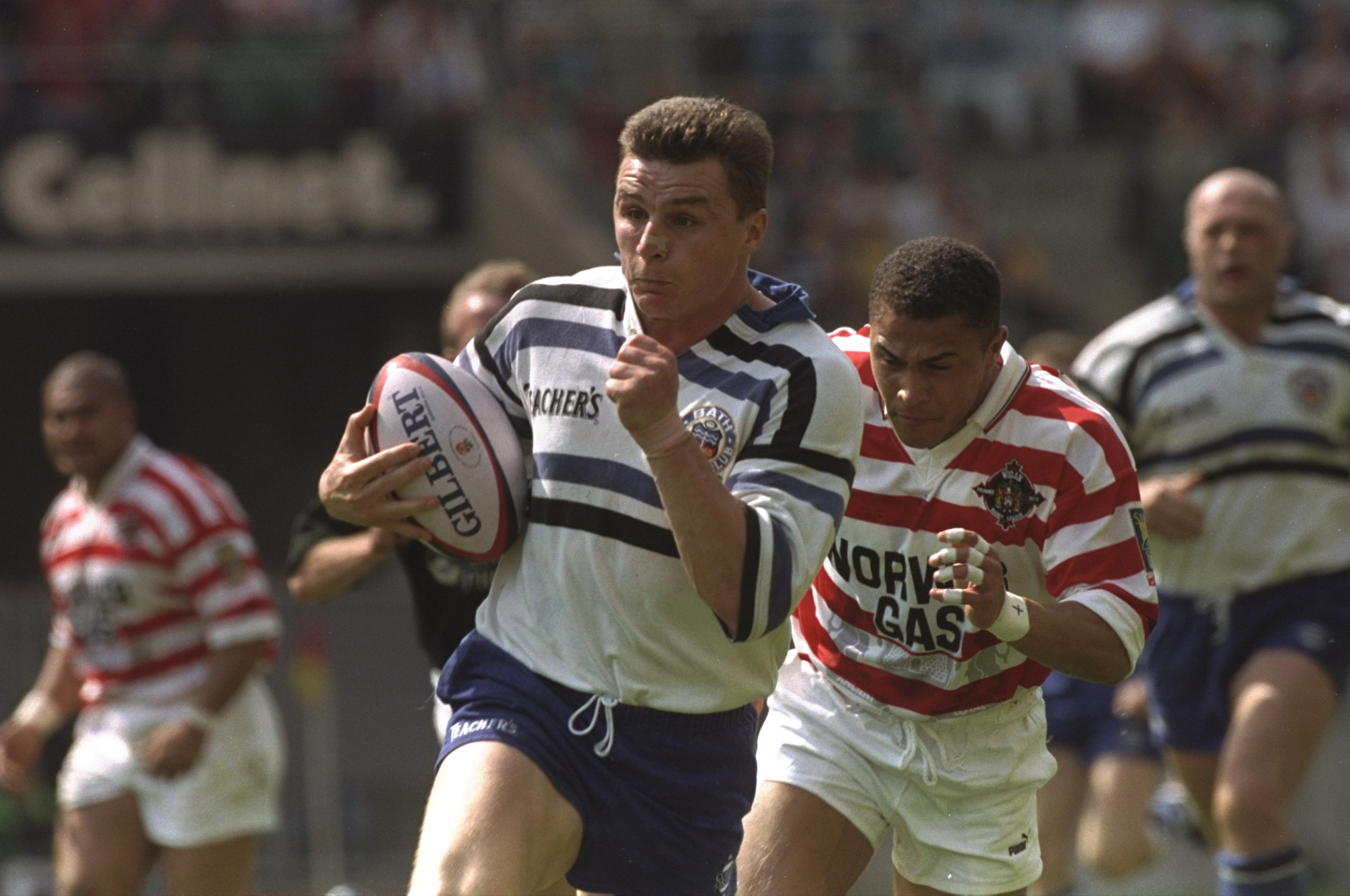
In May 1996, Bath met Wigan in a two-legged showdown between the reigning champions of rugby’s rival codes.
It’s been described as the “Great Schism”.
In August 1895, at the George Hotel in Huddersfield, a group of clubs from northern England looking for a way remunerate their working-class players met to discuss breaking away from the Rugby Football Union. It was the birth of rugby league.
For the next century, the two codes existed in separate, parallel worlds, the stars at the top levels of the 13-player game getting paid to play, while their counterparts in union remained (officially, at least) resolutely amateur. Union players who chose to ‘defect’ to the professional version of the sport were well aware they’d be forever banished from the code in which they’d made their names.
That all changed in 1995, almost 100 years to the day after that fateful meeting in West Yorkshire. Concerned about the prospect of losing its players to league – or even mooted breakaway tournaments – the International Rugby Football Board (now World Rugby) made the game-changing decision to make union “open”. Players would now be allowed to turn professional for the first time, in the biggest shake-up to hit rugby in a century.
Twickenham hosted the union leg on a Saturday afternoon in late May 1996 (Mike Hewitt/Allsport via Getty Images)
The Clash
For a rugby league agent named Alan McColm, the IRFB’s ruling represented an opportunity. He’d spotted the potential in a match-up between the best sides in league and union, and made contact with a group of Bath players to discuss a possible contest with league giants Wigan.
The plan was eventually escalated to Bath executive Danny Sacco and Wigan marketing director David Bradshaw, who both pushed ahead with the scheme despite opposition from the men in suits who ran the respective codes.
This so-called “Clash of the Codes” would be played over two games in May 1996, and broadcast on Sky Sports.
The league leg would be hosted at Maine Road, then the home of Manchester City, while the ‘return’ union fixture would take place two-and-a-half weeks later at Twickenham. (The RFU had originally been reluctant to sanction the game being played at the home of English rugby, but – when Cardiff Arms Park started sniffing around the potentially lucrative fixture – allowed the game to kick off at HQ.)
At the time, Wigan and Bath were both at the peak of their powers. This all-conquering Wigan side had won seven consecutive league titles and eight back-to-back Challenge Cups. Boasting a line-up of legends including Jason Robinson, Martin Offiah, Shaun Edwards, Henry Paul, Andy Farrell and Va’aiga Tuigamala, it’s still regarded as one of the greatest of all time.
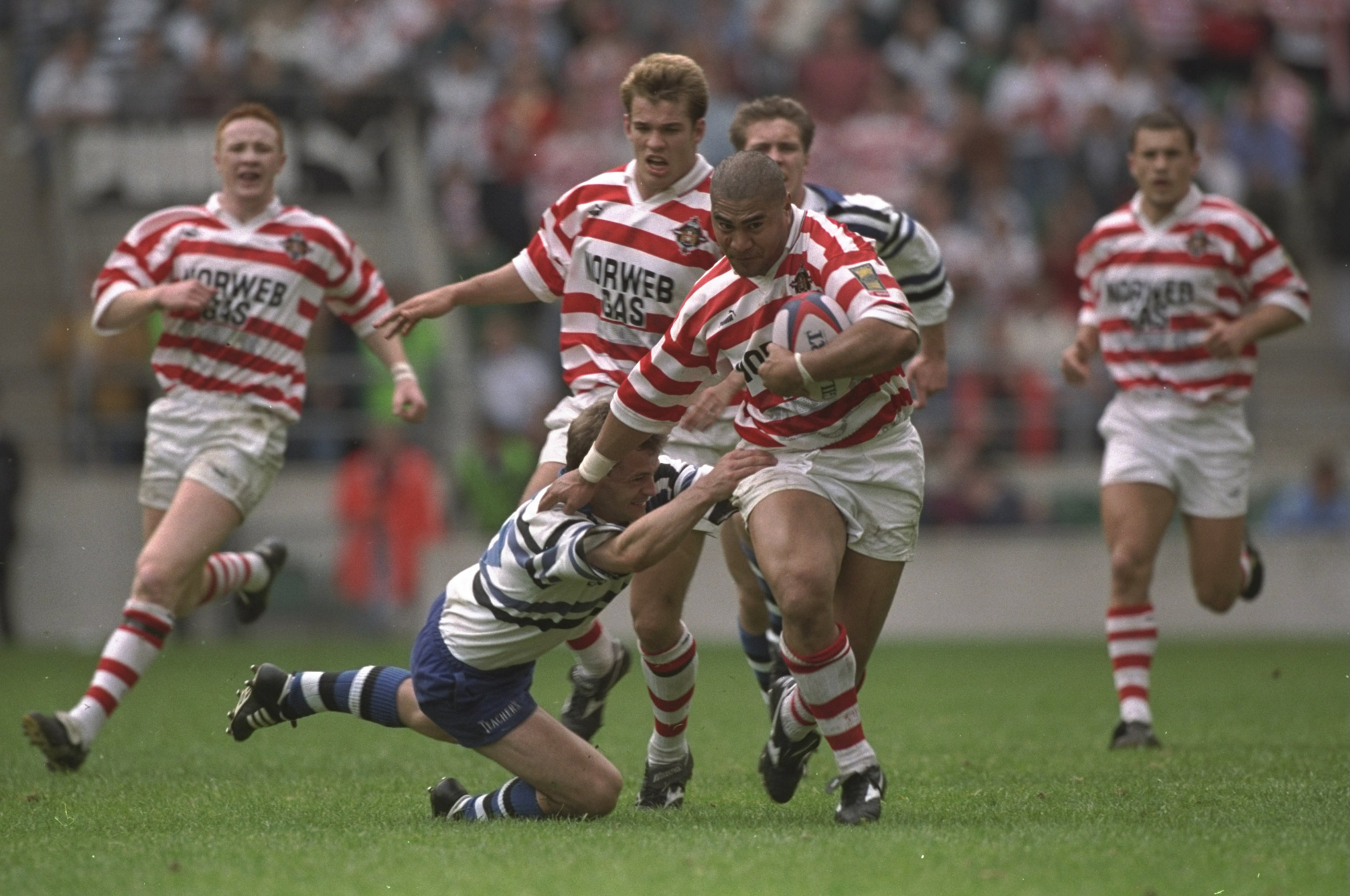
Wigan’s “pace and power” was a factor in both matches (Mike Hewitt/Allsport via Getty Images)
Bath, meanwhile, had won six league titles and 10 Pilkington Cups since 1984, and had plenty of international players of their own. This was a clash of the titans as much as a Clash of the Codes.
“I was absolutely staggered when it was suggested because there had been so much enmity between the two codes over the years,” Brian Ashton, who was Bath head coach at the time, recalled in the Telegraph.
“Maybe it was a class thing, potentially. Obviously rugby league had broken away from rugby union, so some rugby union diehards, I don’t know if they saw them as the enemy but they certainly weren’t mates, that’s for sure. I wasn’t quite sure what was going to happen.”
Rugby World Clash of the Codes
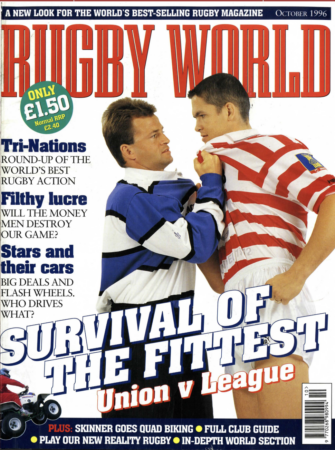
Jon Callard and Andy Farrell on the cover of Rugby World (Rugby World)
In the lead up to the series, Rugby World brought the world of rugby league to union with a special cover.
Bath’s Jon Callard joined by Wigan starlet Andy Farrell in a tale of the tape.
The feature broke down both’s physical make-up with the 21-year-old Farrell weighing in at 16st 2lbs with his 46 inch chest.
Farrell also walked us through his weekly diet that included a jacket potato for lunch and Alpen before bed.
A League of their own
The rugby league fixture certainly didn’t go according to plan for Bath, as the midweek fixture turned into a humbling experience for a side that had got into the habit of winning. Wigan took just three minutes to open the scoring, with Offiah touching down six of the team’s 16 tries on the way to an 82-6 victory. Jonathan Callard’s late consolation score reportedly received the biggest cheer of the day.
Not that Bath’s preparation had been ideal. They’d beaten their biggest rivals, Leicester, in the Pilkington Cup the previous weekend to complete a league/cup double, and had subsequently spent several days celebrating the victory via the long-established combo of beers and an open-top bus tour.
So while Wales rugby league coach Clive Griffiths (a cross-code international as a player) had been drafted to run a couple of training sessions for the Bath players in the run up to the match, time was so limited that they predominantly concentrated on learning the laws of the rival code.
But when the game kicked off, Bath’s players had to adapt to more than uncontested scrums and the six-tackle rule. Playing against full-time professional athletes also proved to be a shock to the system, as the union team (who were used to an average ball-in-play time of just 27 minutes) learned some harsh lessons about the superior fitness of their opponents.
“Their pace and power was something we had never seen before,” Bath second row Martin Haag admitted to the Telegraph. “It just really opened our eyes to how far ahead they were and what professionalism meant.”
State of the Union
In between the two matches, Wigan laid down a marker by taking part in union’s then-traditional season-ender, the Middlesex Sevens. Many of the players who’d run amok at Maine Road also came out to play at Twickenham, beating Richmond, Harlequins, Leicester and Wasps on their way to the title.
Some commentators suggested that Wigan might even be too good for their rivals in the second leg, with the Independent’s long-serving rugby league correspondent Dave Hadfield’s match report noting that (h/t Sky Sports): “Few will regard Bath as entirely safe on union territory in 16 days’ time.”
Wigan played a practice match against local union side Orrell, however, it became clear that they wouldn’t be taking anything for granted at Twickenham. The technicalities of rugby union’s scrums, lineouts and kicking game were factors the league stars wouldn’t have time to get used to, especially in an era when set-pieces played a significantly larger role in the game than they do now. There was also the important matter of safety to consider.
“It was difficult to know how to approach [the second game] because the potential for harm at scrums and lineouts against a team that had never actually competed at that level before was quite strong,” explained Bath coach Ashton. “Certainly, after the first couple of scrums, we just eased off, because it was pretty evident that irrespective how powerful and strong their players were, technically they really didn’t know what they were doing at the scrum. Physically that was a real danger area.”
Bath ultimately ran out 44-19 winners, thanks to tries from Adedayo Adebayo (2), Jon Sleightholme, Mike Catt and future England captain Phil de Glanville. But with Bath holding back in the set-piece, it’s perhaps unwise to read too much into the aggregate score, which had Wigan as 101-50 winners across the two legs.
Even so, the union stars admired their league opponents. “Their ability to play off any broken field situation was outstanding in both league and union,” pointed out Bath second row Nigel Redman.
Brave new world
After the final whistle, RFL chief executive Maurice Lindsay stated: “The games this month have highlighted the big differences that exist, but it’s difficult not to imagine that the codes will come closer together over the next five years and that one code will be in existence at the end of that period.”
That merger hasn’t come to pass, of course, though the ties between the two codes have grown over the years. Union, in particular, has benefited from an influx of league talent on both sides of the touchline.
That Wigan side alone featured three players who’ve gone on to make big names for themselves in the 15-men game. Robinson was famously a member of England’s 2003 World Cup-winning team, while Farrell and Edwards have gone on to extremely successful coaching careers in international rugby union.
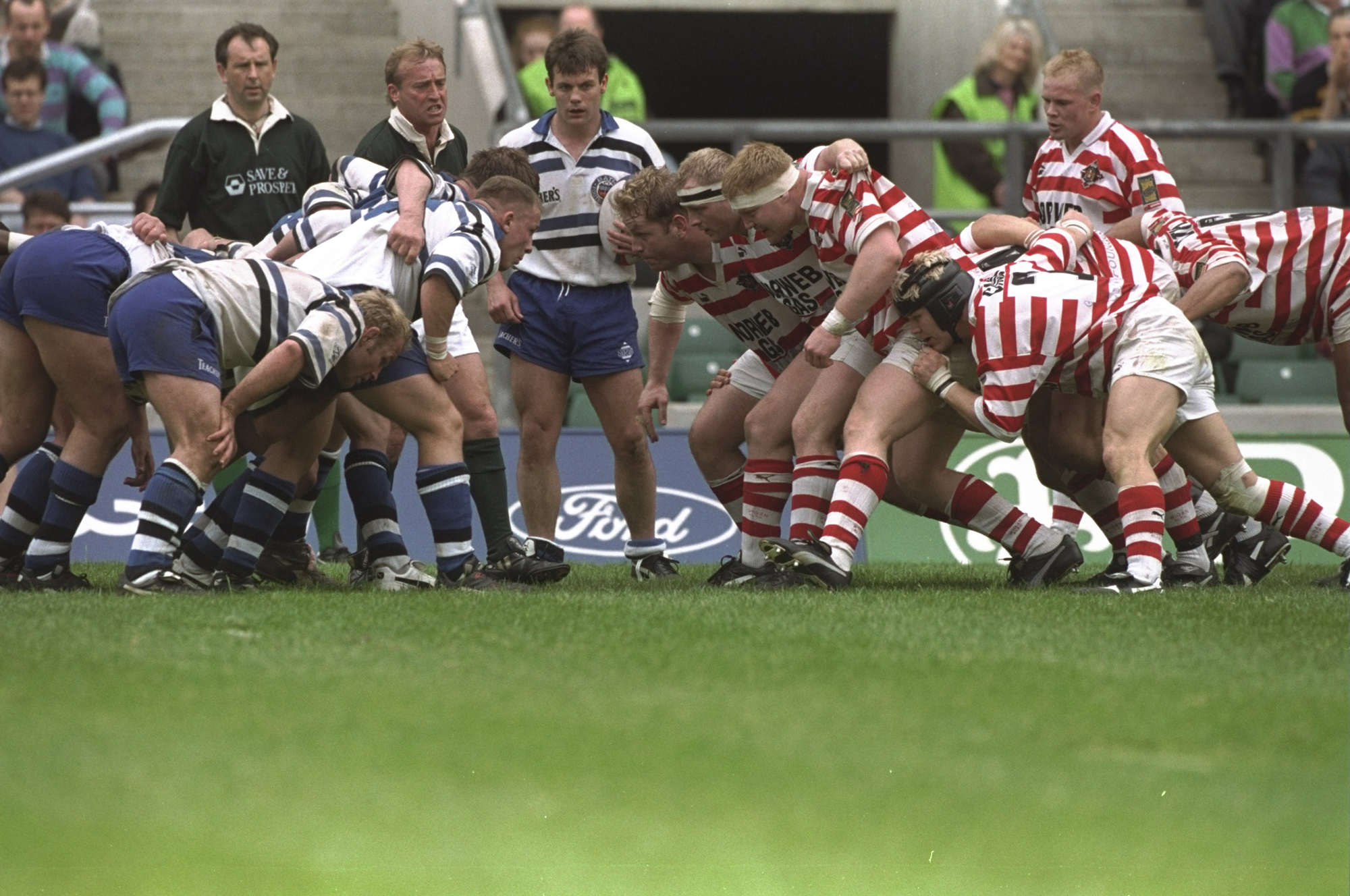
Rugby union’s set-pieces were an undiscovered country for many of Wigan’s stars (Mike Hewitt/Allsport via Getty Images)
With an increasingly packed rugby calendar, it seems unlikely that the reigning Gallagher PREM champions will ever again line-up against the holders of the Super League trophy. Besides, three decades of professionalism later, a Clash of the Codes 2.0 would struggle to carry the air of mystery – and novelty – of its predecessor. Still, the matches remain an interesting oddity from a transitional period in rugby history.
“To have the top rugby league team of their era come to play at Twickenham was a massive deal,” Sleightholme told Sky Sports in 2020. “On reflection, it was a massive surprise the RFU allowed it and I’m glad they did.
“Looking back on it now, I don’t think we realised what an honour it was to be part of that. Growing up as a rugby union player in Yorkshire and on that M62 corridor, I’d always have my leg pulled by some of my mates – but one thing those games did was break down those barriers.”
Download the digital edition of Rugby World straight to your tablet or subscribe to the print edition to get the magazine delivered to your door.