
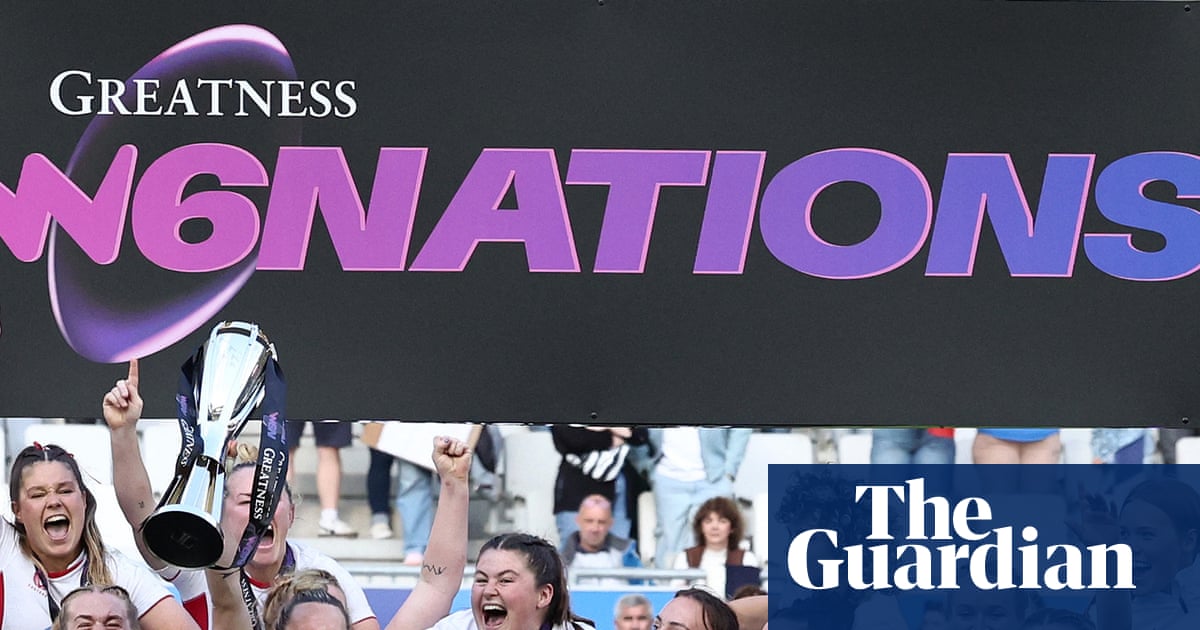
There are a couple of reasons why England’s latest Six Nations grand slam is worthy of glowing appreciation. The first is that consistent excellence should always receive due recognition. And the second is that England had to do far more than simply show up and tick off the kind of routine runaway victory that leaves even their most loyal fans slightly underwhelmed.
A 15-point margin might not instantly suggest a full-blooded contest but France more than fulfilled their part of the bargain. The nagging concern within women’s rugby is that the Red Roses are not being sufficiently challenged. On this occasion no one could level that accusation at the determined hosts who had England’s golden girls pinned back for lengthy periods.
Which, strange to relate, made England’s eighth successive Six Nations crown all the more admirable. This was anything but a serene cruise to yet more tournament glory, particularly in the first and third quarters as France pounded away at the visiting line. Until now it has not been a Six Nations campaign notable for English defensive solidity but they properly had to dig in now.
Even when the spirited French fought their way back to 29-21 with 20 minutes left they could find no way through. Instead the crucial next score came from Jess Breach, who collected her second try wide on the right to snuff out the hosts’ gathering momentum. When the head coach, John Mitchell, talked beforehand about “pulling the trigger” and being “courageous with our skill set” the purposeful midfield running and precise interplay was exactly what he was seeking.
And England, it almost goes without saying, also have the benefit of the lurking match‑winner that is Ellie Kildunne. Twice in the first half the full-back accelerated away, her long-limbed stride leaving everyone else trailing. It was also her well-timed pass that put Breach clear, proof their shooting star can create as well as finish.
For those who shrug their shoulders at England’s 38th straight win – this was their 99th victory in their past 103 matches since 2016 – and wonder aloud why they should keep watching a foregone conclusion, the answer is that quality and quantity are not easy maintained at the highest level.
Men’s tennis had something similar back in Pete Sampras’s day when the American spent 286 consecutive weeks at No 1 and collected the Wimbledon men’s singles title seven times in eight years. Just as it was not the metronomic Sampras’s problem that he became all but unbeatable on grass, it is not England’s fault that they have the resources, the strength in depth, the individual quality and the ruthlessness to keep on winning games of rugby. How many people criticised basketball’s Boston Celtics or LA Lakers for winning too regularly back in the day?
And, besides, that is only one side of this particular equation. Winning the World Cup last year has allowed the women’s game to take a significant leap in terms of attention and support. Subsequently Scotland, Ireland and Italy have all set attendance records this season; sustaining that momentum in the years to come will be the next battle but there are reasons to believe it can be done.
For a start the first British & Irish Lions women’s tour is due to depart for New Zealand next year, another potential step in terms of spreading the gospel. Welcoming a Welsh or Scottish team into Premiership Women’s Rugby might also help, though any dilution of England’s superiority will clearly take a while.
Because no one else has players of the sheer class of Kildunne and the outstanding Meg Jones, the current goal‑kicking accuracy of Zoe Harrison or the forward power that can cope with even this season’s mass withdrawals through injury and pregnancy. There were just six starters in all from the World Cup final against Canada back in the autumn, hence Mitchell’s visible emotion after the trophy lift having claimed what he called “by far the hardest” Six Nations triumph he has been involved in.
In some ways he believes this was an even bigger achievement than winning the World Cup, where an awful lot of things were in the host nation’s favour. England’s captain, Jones, felt the same way. “We’ve faced so much adversity,” she said. “[But] we fronted up and showed what England is about.”
And aside from the flanker Sadia Kabeya’s mild embarrassment at swearing on live television, there was barely a negative to be found in the Bordeaux night air as the team drifted away to celebrate. Mitchell’s refashioned team have unquestionably deserved every drop of their victory champagne.
The final word, though, should probably go to Brian Moore, who is now hanging up his BBC TV summarising hat after many years of pithy, robust analysis. “Don’t underestimate the resolve you need to keep doing what England are doing,” stressed Moore, a men’s grand slam winner himself in 1991, 1992 and 1995. No one will have appreciated the hard-fought nature of this Anglo-French denouement more than him.