
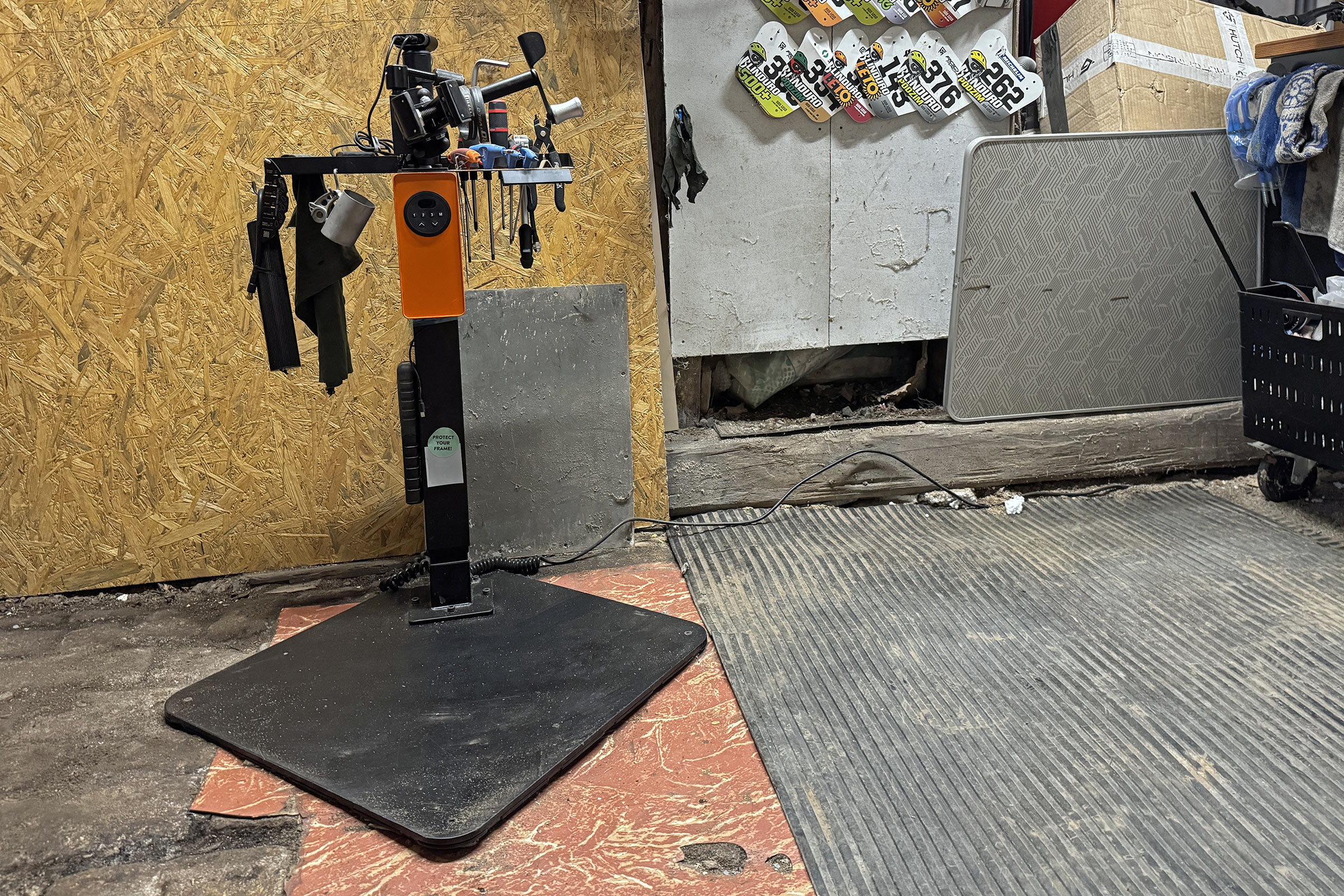
The Remco Bike Lift came into my workshop late last fall, and things haven’t been the same. I’ve since worked on a few bikes outside on a sunny day, plus at some races on my favorite folding workstand. But everything that’s been worked on in my shop in the past half a year has been magically lifted off the ground by this little monster.
I have to preface this review by saying, “Of course, you don’t really need a repair stand that lifts your bike off the ground for you. But, oh man, this is seriously a game-changer!”
Remco Bike Lift electric telescoping bicycle repair stand
The electric Remco Bike Lift is undeniably an extravagance.
Last December, I gave the workstand an Editor’s Choice award in the Tools category for its day-to-day functionality. Yes, it is very expensive. The other tool I awarded at that same time late last year, for changing how I work on bikes, was a $140 / 115€ mini inflator. That one is still expensive for pumping up a tire, but it’s still less than 1/10 of what this robo-stand would cost. You see, the complete Remco Bike Lift setup in my exact configuration with all the trimmings retails for $1402 / 1551€.
But the, albeit still expensive, pricing is quite a bit more complex than that.
Since it uses a modular construction, you only have to buy the parts you need. So if are a bike shop that already has a pro workstand and base (or you are bolting it to the floor), realistic pricing starts around $744/840€. Even home mechanics, who have an existing Feedback, Park, Unior workstand (the list goes on…) with a high-quality clamp head, will likely be able to get out much cheaper than my complete newbie setup.
Heavy-duty eBike-rated, up to 45kg
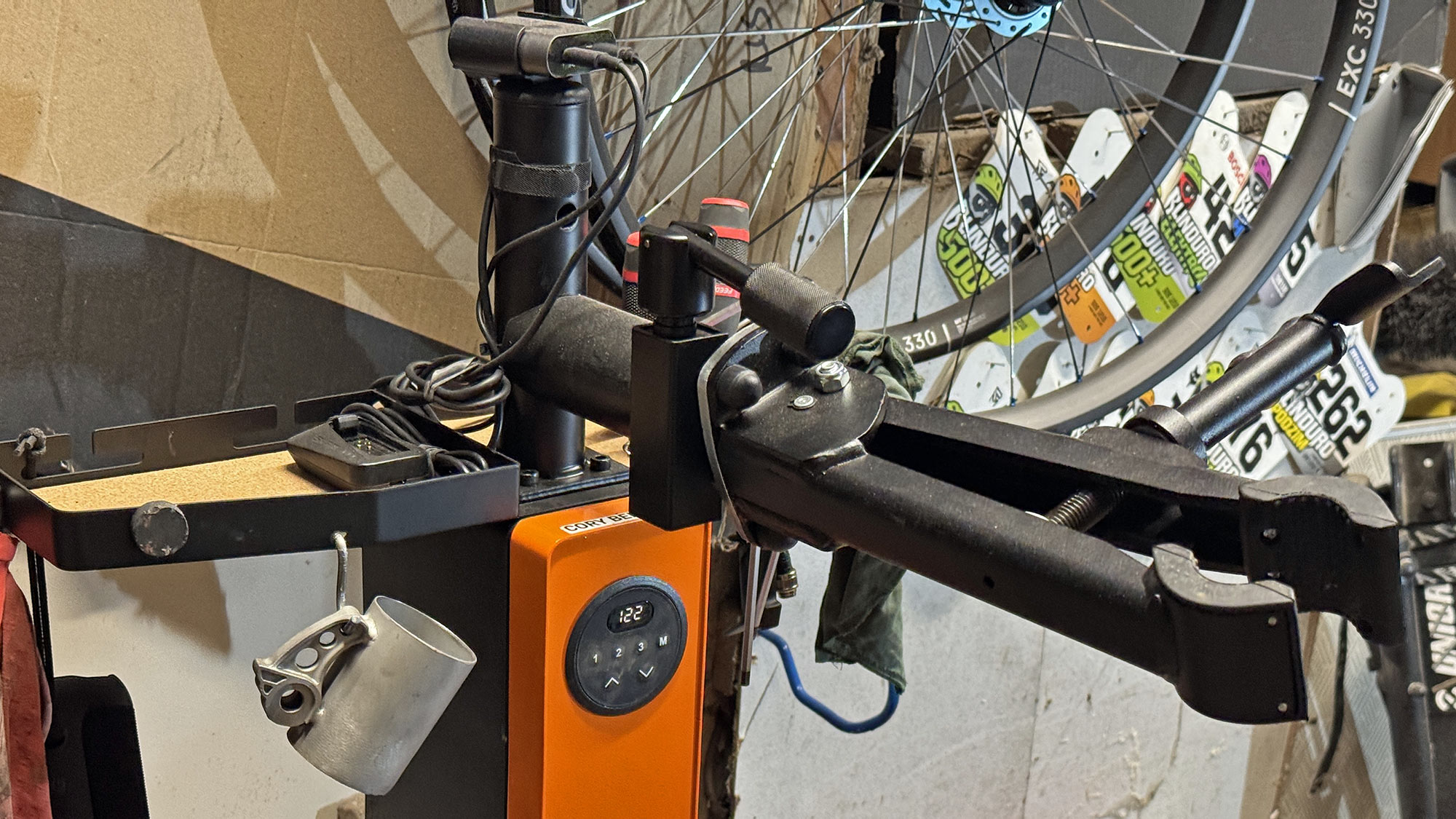
To be fair, I already had a portable stand with a lighter Unior clamp, but opted for the heavy-duty Unior Master Shop Clamp to get the max load rating that the Remco Bike Lift can provide. Topping out at 45kg (100lb), that’s more than enough to pick-up the heaviest ebikes we generally test. Most performance eMTBs we review typically fall in the 20-25kg range.
But it also meant I could safely work on my heavier long-john-style Hagen cargo ebike. And things like the silly, heavy Engwe commuter ebike we’re still running around to get groceries and take out the recyclables four years later than we thought it would survive.
Put simply, this is a heavy-duty telescoping bicycle repair stand with an electric motor inside that lifts everything from your UCI-illegal road bike, up to your gravity-ready full-powered enduro ebike – all at the press of a button. It will essentially lift any type of bike, so you don’t have to.
The heavier the better I say. Or rather, it’s even better with the heavier ones.
Tech Details & My Personal Setup
The Remco Bike Lift debuted about 2.5 years ago as a solution for bike shops working on more and more heavy bikes & ebikes. The concept was simply that the key electric-lifting column couple be swapped in, replacing existing workshop stand setups with relatively minimal cost – keeping existing base and clamp solutions.
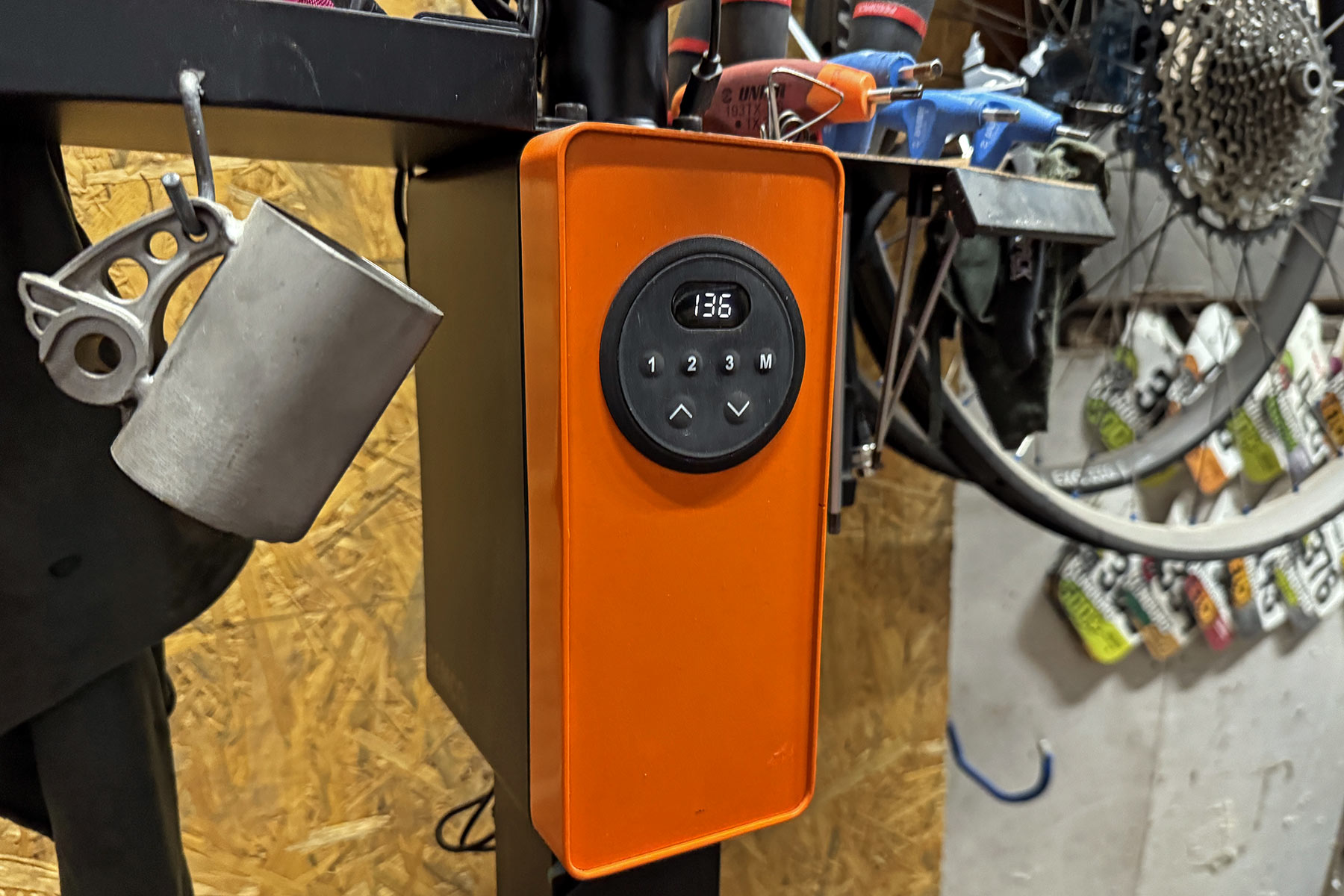
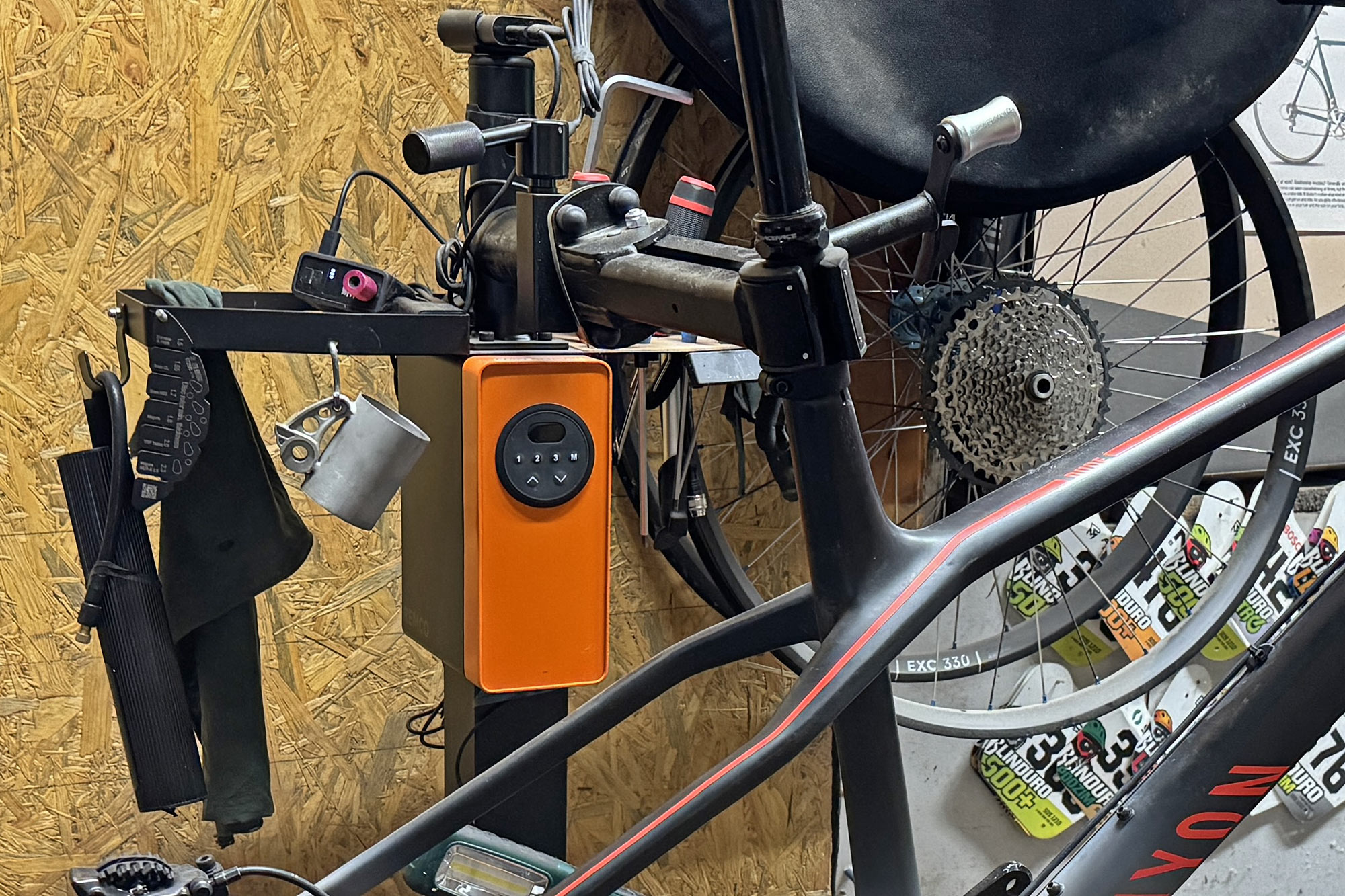
The lift works thanks to a linear actuator inside that extends 65cm (25.6″). That’s generally enough to pick up bikes off the ground by the seatpost at/above the seatpost clamp, and lift them high enough to work at eye level. Position 1 is the bottom and 3 is the top, and you can program 2 anywhere in between, as you prefer. I have 2 set at 16cm below top-out, as that’s my typically ideal height for working on drivetrains and brakes.
According to the official Remco Bike Lift drawings, the lowest working height for the center of the clamp would be 86.6cm (34″) off the ground. But with most mountain bikes and eMTBs featuring sloping geometry and long-travel droppers, I found that to be not quite low enough.
Real dimensions & travel
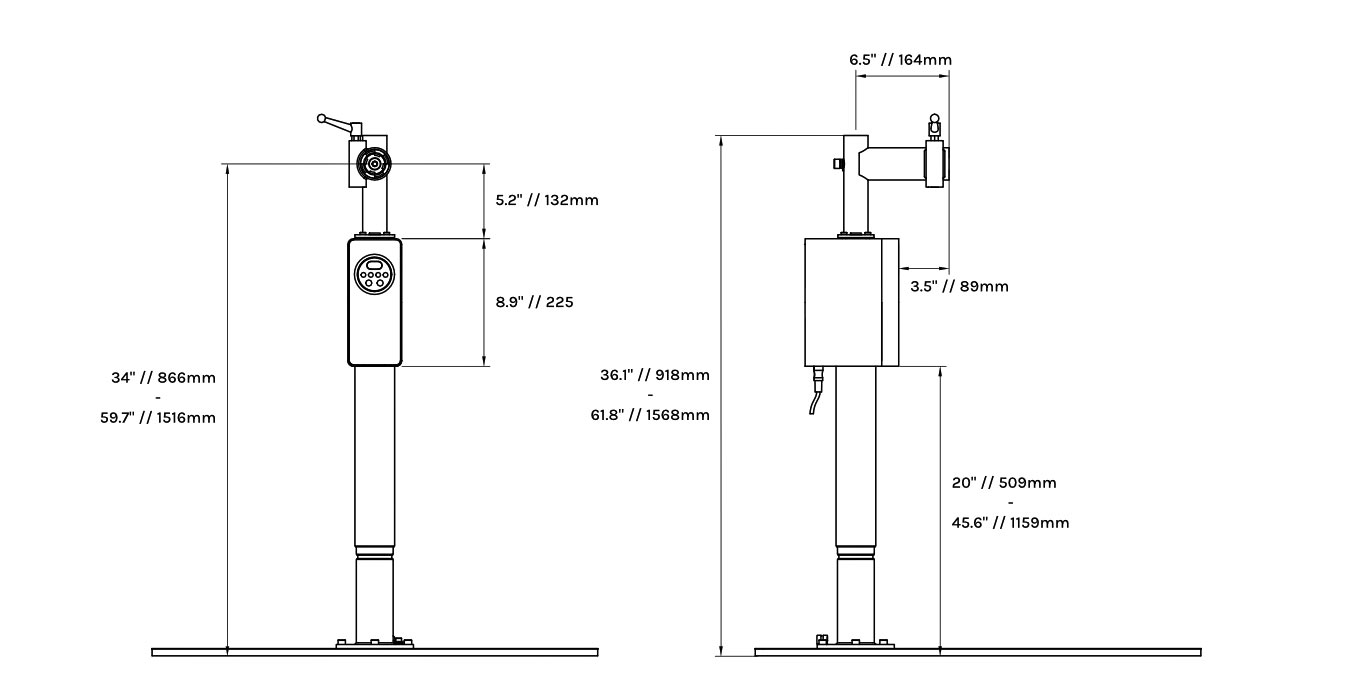
Luckily, a closer look at the official Min & Max heights tells a slightly different story.
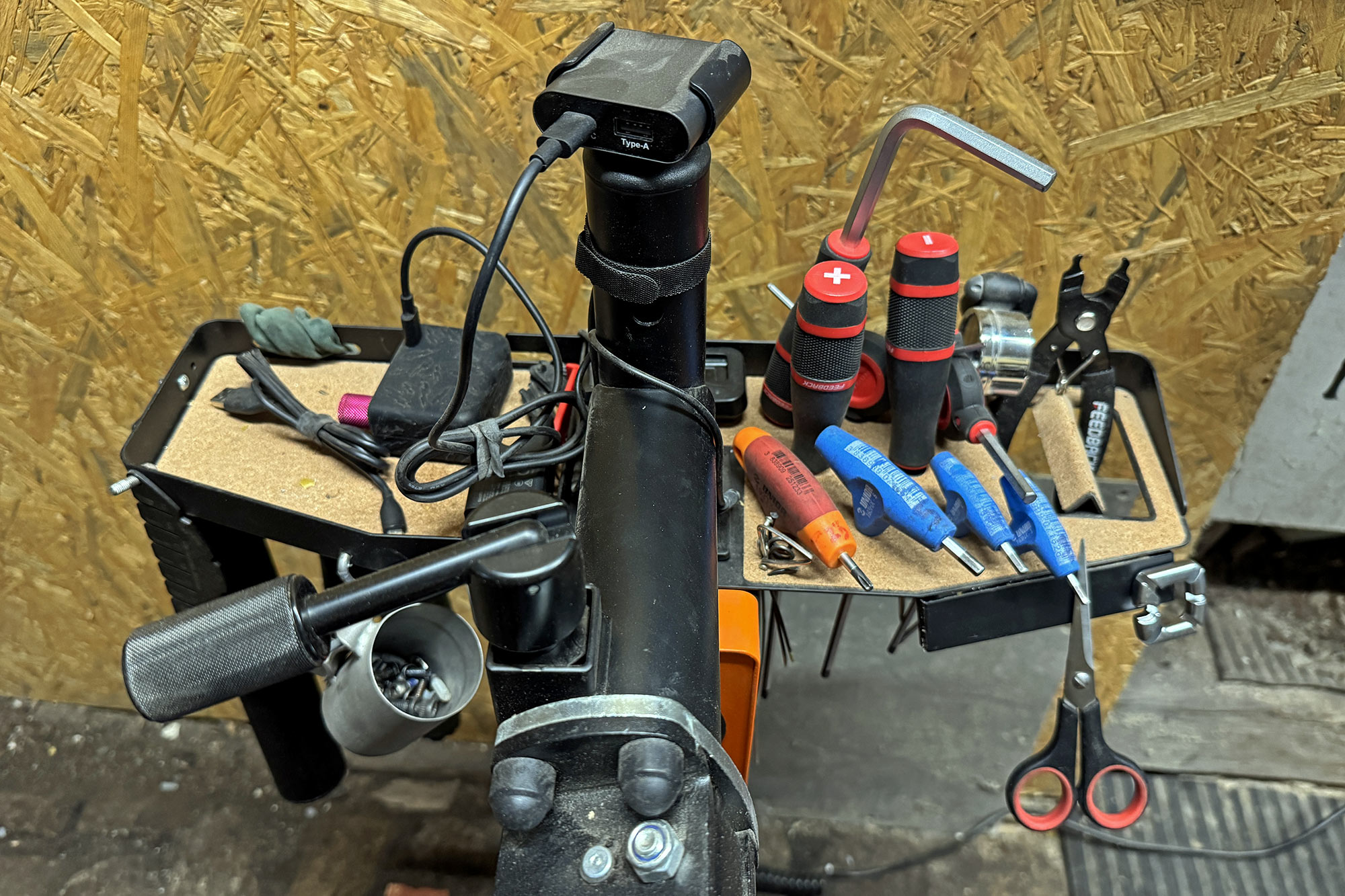
The Chuck Adapter (the small vertical stub that’s attached on top of the orange lift control box) has two mounting positions, and the lower one is 6.5cm down. That’s the one I opted for, giving me a more ideal low position of 80cm off the ground, and still 143.5cm at top out. Ultimately, the display then reads 3cm higher than the top of my clamp. But since it’s just an approximate representation of where the Bike Lift is in its full travel (85.5-149 on screen), it’s still a helpful guide.
Some mechanics will prefer the higher position. And there’s also an optional base extension to make it even higher. But I prefer the low setup.
A bit more detailed pricing breakdown of having everything in one place
Price is a major point here, obviously. (Because this is a big outlay, whether it’s an investment for ease or workability in a pro shop, or just a very serious upgrade for the home mechanic!)
But so is getting your repair & maintenance setup perfectly dialed to improve efficiency, right?
Modular, means only buy what you need and re-use the workstand clamp you have. But it still isn’t cheap. This really is still meant to be a pro bike shop repair stand for everyday mechanics who need to work on heavy ebikes. But as more $15,000+ road, gravel, mountain & high-powered ebikes get sold (or even just the still-expensive $8-9k ones!), it starts to make sense that more people are going to buy fancy repair stands to take some of the ‘work’ out of ‘working’ on your bike, even at home.
Plenty of amateur shade-tree mechanics already buy premium-quality professional tools.
Why not a pro work stand, too? And if you go shopping for a pro-level repair stand, you’ll quickly find that you could easily spend 600-900 dollars or euros on one of those. And you’d still have to lift every bike into it. So why not go all the way!
A close look at my setup
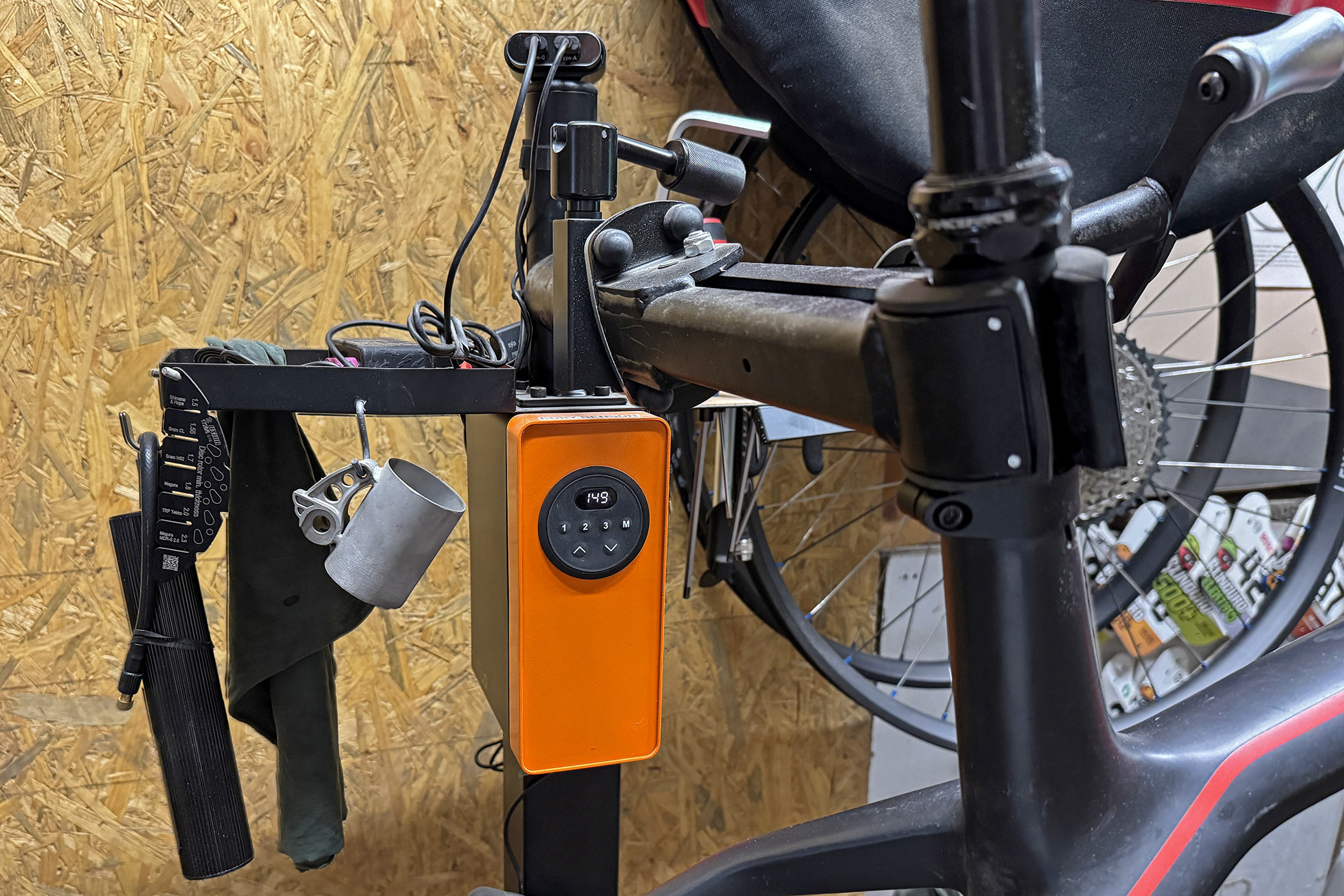
If we break it down, my setup looks like this:
- $744 / 849€ for the Remco Bike Lift itself, includes the attachment for Pro Clamps like this Unior one.
This is the core element that literally does all the heavy lifting. - $209 / 210€ for the Unior Master shop clamp
If you already have a workstand to upgrade, you won’t need this. Plus, there are more affordable clamps available, too. But this one is solid secure, rated for 45kg, and made strong 100% in the EU. - $220 / 302€ for the Base Plate, because a heavy chunk of steel is just worth a lot. But, bolt the stand to the floor of your workshop and save a bunch of cash.
- The $120€ Tool Tray is a must in my eyes; this is what lets you customize the setup for how you work. I drilled out a few tiny holes to mount my commonly-used pick tools, and added some hangers for a small bolts holder, an extra wrench, a rotor checker, and an electric inflator.
- And the $79€ Rapid USB Charger is also a must-have in these days where so many bikes have batteries to keep charged! Remco wants you to mount it low on the side of the controller. But I drilled a hole in the plastic top cap of the Chuck Adapter stub, and it is more easily accessible, and can even pivot side-to-side, as needed.
The negatives (besides price)
One of the only real pain points I’ve experienced with the Remco Bike Lift is that I wished it had a standard outlet to plug in proprietary chargers or a tablet/laptop. The only power output it has on the stand is a non-standard plug for Remco’s own USB changer. I started without the charger, but after a month I realized that I needed it. And it has made all the difference – charging AXS & Di2 batteries, a flashlight for peering inside frames, and mini inflators, so I don’t have to pump up tires manually in the workshop anymore.
Because modern light eMTBs still aren’t that light
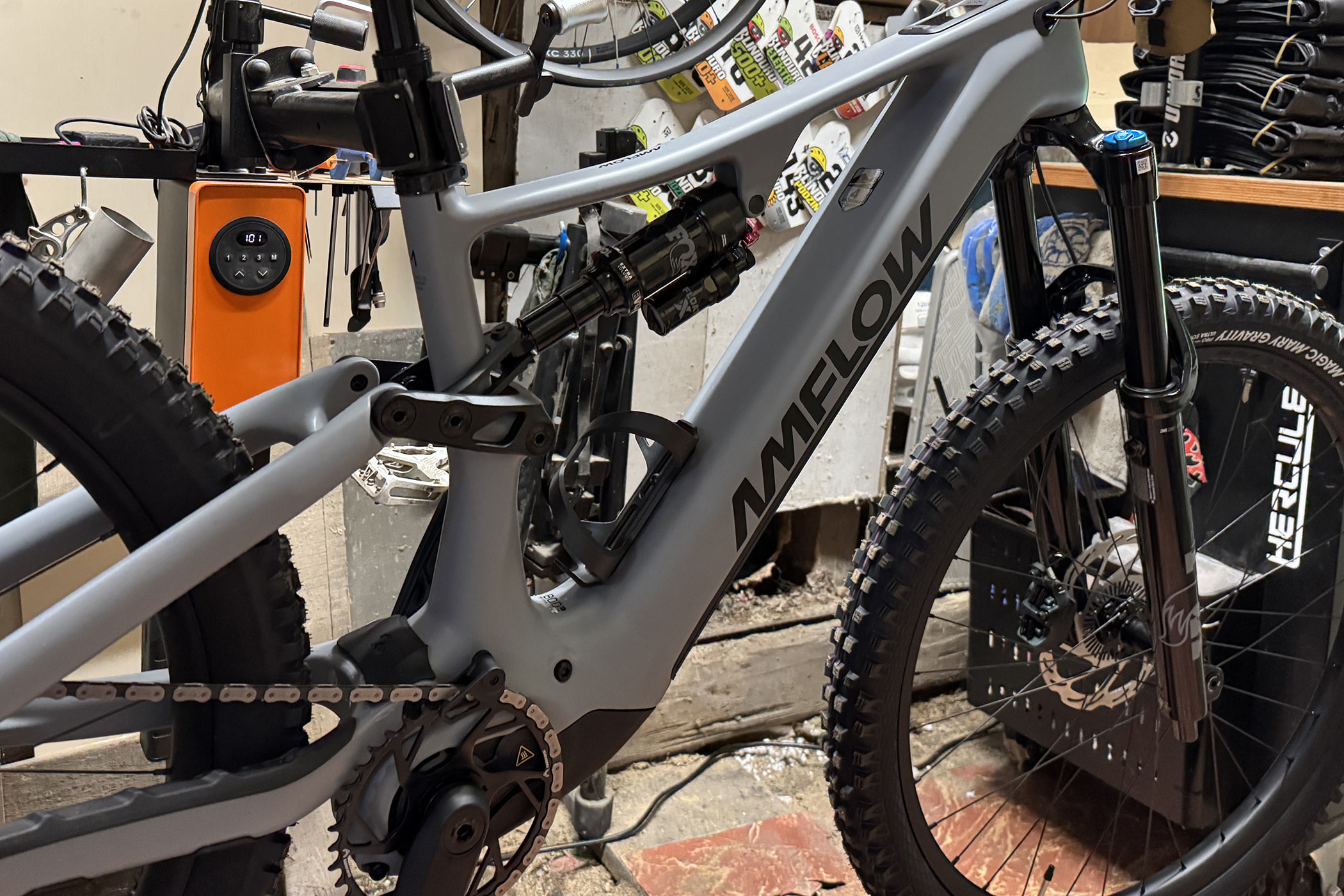
Since last fall, I have been servicing & maintaining dozens of European Bikerumor test bikes on this stand – including cleaning, packing & returning several test bikes at the end of 2025, and then some pretty major winter servicing on all of our long-term and my family’s personal mountain bikes throughout the spring.
Among that, there’ve been, I think, 6 ebikes in that time. None of them exceptionally light weight.
Even top-tier modern trail, all-mountain, and enduro bikes today are often 1-2kg heavier than previous generation. When you start adding wider tires, wider wheels, electronic everything everywhere with extra batteries, and internal frame storage that invariably means all the bikes are equipped with spare tubes, multi-tools, tire repair tools, and maybe even a pump at all times. More modern bikes are more capable and more convenient… just not lighter.
And oh, how glorious it is to have this little orange beauty picking all of those bikes up and putting them back down, over and over. After I first preset my ideal working height, I just roll the bike up to the Remco Lift, clamp its seatpost, hit 2, and walk away. It seems completely silly to me. But it is somehow freeing to not lift heavy bikes of the ground, and spend those maybe ten seconds, finding any specialized tools I might need to get ready.
Or, I just lift the bike up to a nice working height, while I set myself to another task like seating & inflating a new tubeless tire.
And positioning the bike for each task is so much better!
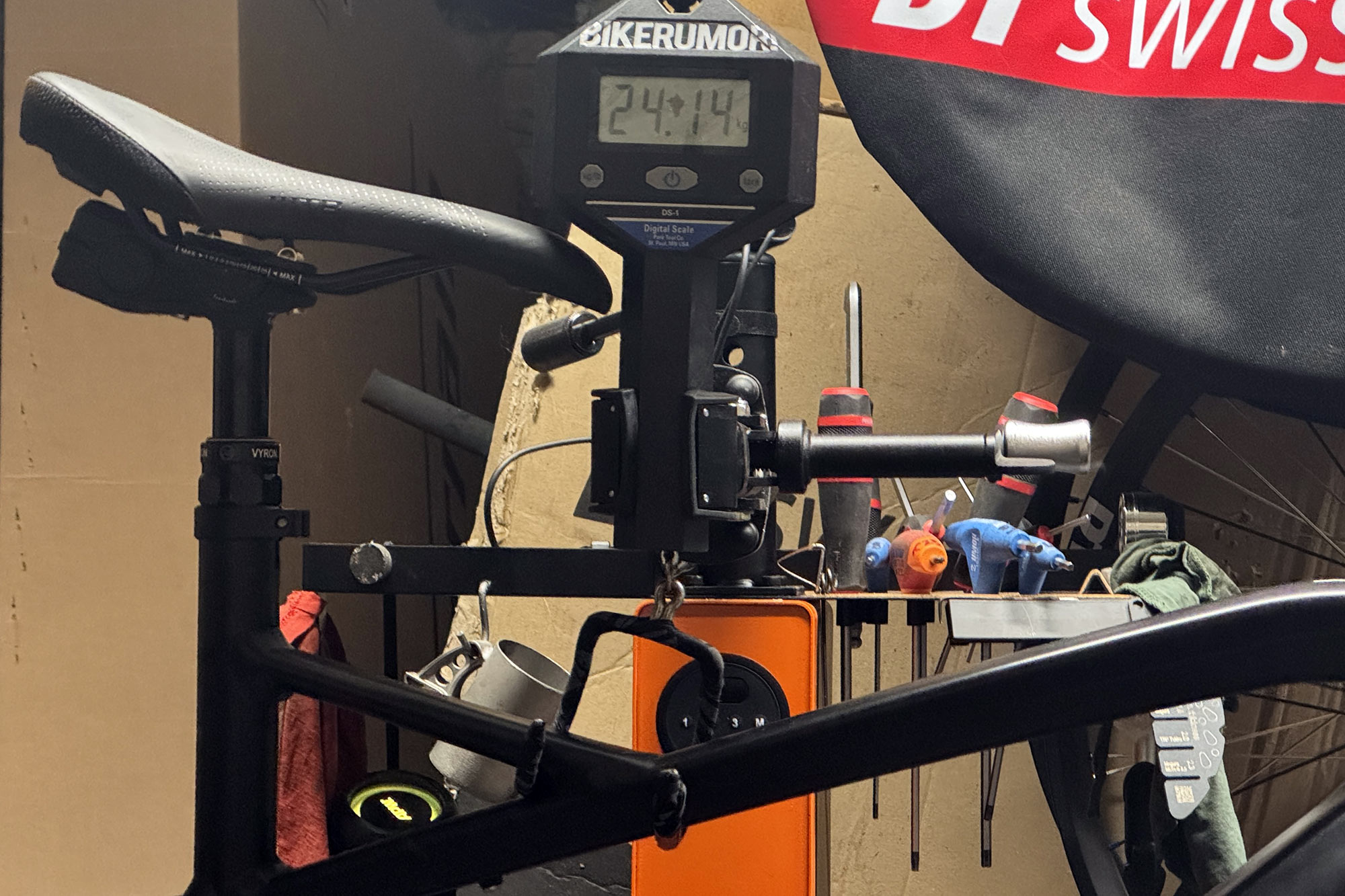
The thing that has most surprised me, is that I now move the bike up and down in the stand maybe 3 or 4 times while I’m working on it.
I never used to do that with a conventional repair stand, even with a regular bike. And especially not a heavier ebike that usually weighs well over 20kg. I would often spin the bike in the stand, but never re-lift it. It just wasn’t worth the extra effort. But now, when I move from adjusting a derailleur, to installing a bottle cage, to adjusting a brake lever clamp, to removing a rear shock, to routing a new internal dropper cable, to simply cleaning and lubing a chain. Each time, I move the bike up or down, maybe just 5 or 10cm to a height that feels perfect.
So now, I’m also more likely to pull up a stool for a task that might take longer, like installing a new chainring or cleaning out a T-type cassette packed with autumn leaves or spring grasses.
Because it is so little effort to move the bike up and down centimeter by centimeter, now I move it much more often. So it is at the perfect height for whatever task is at hand.
Parting thoughts
Yes, it is expensive. So are all the damn bikes these days.
But, the Remco Bike Lift has genuinely changed how I work on bikes.
I didn’t think lifting bikes into a stand was that difficult, until I didn’t have to do it anymore. And I didn’t even mention how much easier (and pain-free) it was to service bikes in those days in the workshop when I couldn’t ride much after a minor shoulder injury. I also hadn’t ever really appreciated how much more comfortable it could be to adjust the bike for each and every different maintenance task at hand.
Yes, the Remco Bike Lift is expensive. But you should totally drool over it, just like you lust over the next, best new road or gravel or mountain bike that we’ll write about this week or next. And if you regularly work a lot on bikes – and it’s within your budget – I can assure that you’ll appreciate this more advanced workstand.
I’m never going back to lifting every bike I work on into the repair stand.