
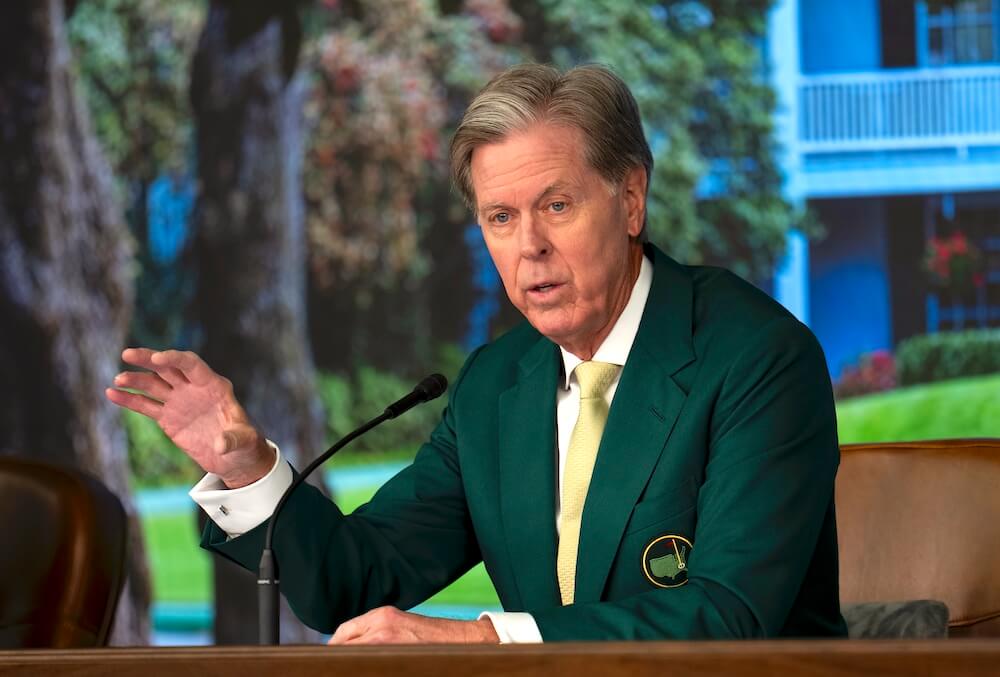
AUGUSTA, GEORGIA | The annual audience with the Masters Tournament chairman always begins with a carefully scripted preamble that covers all the bases. Fred Ridley deftly went from acknowledging the transition to a new competition committee chairman, honoring the passing of Fuzzy Zoeller and Jim Dent, recognizing significant anniversaries, promoting community outreach projects from The Patch to the new TGR Learning Center and congratulating the newly crowned champions of the Augusta National Women’s Amateur and Drive, Chip and Putt National Finals that have become honored appetizers for Masters week.
“Finally …,” Ridley said.
The chairman saved his biggest point for last, and he was prepared to get something off his chest. While the leaders of Augusta National Golf Club would never speak in the harsh tones of the iconic Frank Costanza from “Seinfield,” it felt a little like a kinder, gentler version of the first Festivus list of grievances – “I got a lot of problems with you people, and now you’re gonna hear about it!”
Ridley – a past U.S. Amateur champion, past USGA president and former competition committee chairman at the Masters – made it very clear where Augusta National and the Masters stands when it comes to the announced rollback of the golf ball led by golf’s governing bodies – the USGA and R&A.
His thoughts are presented here in full before comment.

“Finally, I’ve commented for the past several years on the subject of distance,” Ridley said. “We have been consistent in our support of the governing bodies in their effort to regulate the distance elite players are hitting the golf ball. Recognizing that the implementation of the overall distance standard test for golf balls may be delayed to 2030, I want to reemphasize that support and affirm our position as the USGA and R&A represent their collective obligation as custodians of the game.
“I also want to be clear that our position is grounded on much more than protecting the Augusta National golf course. We will continue to make modifications as are necessary to react to driving distances that in some cases exceed 350 yards. Unfortunately, many courses, including some iconic venues, do not have that option.
“Until recent years golf has been a game of imagination, creativity and variety. The game has become much more one-dimensional. As players drive the ball prodigious distances and routinely hit short irons into par-4s and even some par-5s, this issue goes beyond competitive impacts. Increased course lengths result in more time, more cost and more environmental concerns.
“The data that has been shared with all stakeholders makes one thing clear: the impact to the recreational game will be immaterial. All of us in this room and millions of weekend golfers around the world will be hard-pressed to notice the effects of this change, and I do not believe our enjoyment of the game will be affected.
“As for professional golf, we hold firm in our belief that the greats of the game are defined not merely by how far they hit the ball, but their extraordinary skill in all aspects of the game.” – Fred Ridley
“As for professional golf, we hold firm in our belief that the greats of the game are defined not merely by how far they hit the ball, but their extraordinary skill in all aspects of the game. Their ability to shape shots, to take on risk and to execute under pressure is at the heart of championship golf and is best displayed through a full spectrum of shot-making opportunities.
“Regulation of the golf ball is not an attempt to turn back time or stifle progress. It is an effort to preserve the essence of what makes golf the great game that it is.”
Well, there you have it. Ridley would like all the recreational golfers complaining about the ball rollback to understand that what it means to them is “immaterial” and will go unnoticed. The focus should be on trying to contain the elite golfers who keep pushing outside the boundaries of a game whose venues go back more than a century.
He would also like the PGA Tour and PGA of America – two prominent entities whose leaders have expressed skepticism and/or open disdain for the rollback regulations proposed by the governing bodies – to understand where the Masters stands. If the PGA Tour and PGA of America choose not to abide by the rules of golf when the ball changes go into effect, then competitors will almost certainly be playing a golf ball that doesn’t conform to the rules when they show up for three of the four major championships on the calendar.
That’s not what Ridley wants.
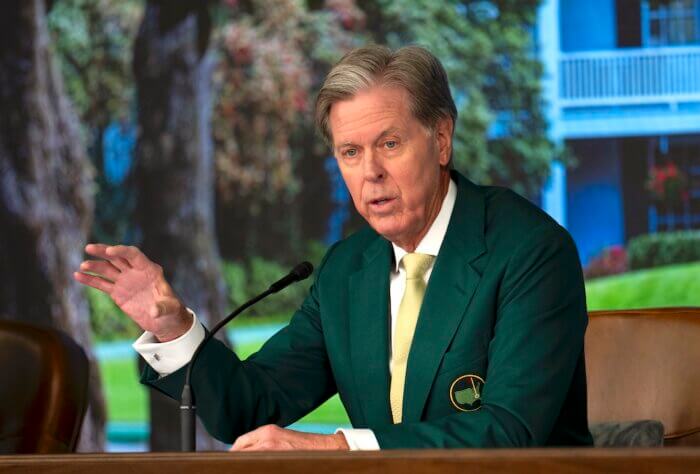
“My feeling on this subject is failure’s not an option,” he said. “I think we need to continue to work together to come to some agreement. Tough issues like this require compromise, and I think there has been some compromise to date. There’s certainly commercial interests that are at play here, and we all know what those are. But at the same time, I think, if we can look at this from the standpoint … it’s not the good old days. That’s not what we’re trying to do.
“What we’re trying to do is to protect the integrity of what makes golf so great. I think I tried to articulate it in my comments, and that’s that it’s more than about just hitting prodigious drives.”
“I’ve said that we can make changes, but there’s not much we can do to make changes to No. 1, unless we tear down the Eisenhower Cabin. And we’re not going to do that.” – Fred Ridley
Prodigious drives, however, have changed the game at the highest level. Ridley spoke to U.S. Amateur runner-up Jackson Herrington, one of six amateurs in this year’s Masters field. Herrington said he hit drives over the fairway bunkers on both the first and fifth holes at Augusta – each one about a 325-yard carry. The first hole happened to be into the wind when he cleared it.
“I’ve said that we can make changes, but there’s not much we can do to make changes to No. 1, unless we tear down the Eisenhower Cabin,” Ridley said. “And we’re not going to do that.
“We’ll make changes when we can, but I think it’s time to really address this issue. It’s been talked about for a long time.”
It has been talked about for a long time and it’s quite possible that the governing bodies’ ball proposals don’t go nearly far enough and may not actually fix what they’re trying to fix. Perhaps a rollback in the size of driver clubheads should be the next step.
Whatever needs to be done, Ridley made it clear that Augusta National and the Masters is on board. It’s up to the others to reach the same conclusion.
© 2026 Global Golf Post LLC