
Cobolli withstands Auger-Aliassime to complete four-set turnaround
Flavio Cobolli def. Felix Auger-Aliassime 4-6, 6-4, 6-4, 6-4
Flavio Cobolli progressed to the Roland Garros semifinals after overturning an opening-set deficit against Felix Auger-Aliassime in a match that gradually shifted from Canadian control to sustained Italian pressure across the final three sets. Auger-Aliassime began with clearer baseline structure, taking the opening set 6-4 by capitalising on late-set opportunities and generating 13 winners compared to Cobolli’s 4, reflecting a more efficient first-strike phase in the early exchanges.
The Canadian’s early dominance was built on controlled service games and extended baseline patterns that forced Cobolli deeper behind the baseline. Although the set remained on serve for long stretches, Auger-Aliassime’s ability to create two set points and convert on the second attempt defined the closing stages, with Cobolli unable to consistently neutralise the depth and pace of the Canadian’s first ball in the opening phase of the match.
The second set marked the first structural shift. Cobolli began to improve his return positioning, taking the ball earlier and targeting Auger-Aliassime’s second serve with greater depth. After initially trailing in exchanges, the Italian broke momentum with a key run of games, turning the set around to 6-4. A crucial element was Cobolli’s response under pressure at 0-40 earlier in the set phase, where he saved three consecutive break points and prevented Auger-Aliassime from consolidating control.
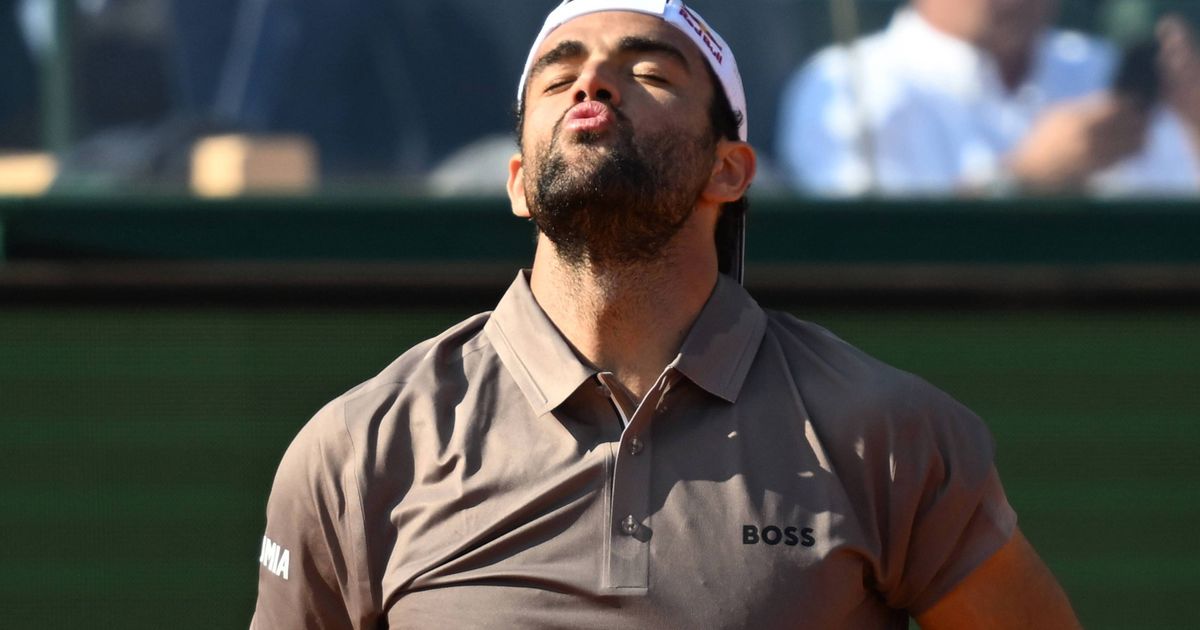
FLAVIO COBOLLI of Italy during the match against Z. Svajda of USA in the fourth round of tennis tournament Roland Garros
From that moment, Cobolli reduced the variability in his service patterns and increased rally tolerance, particularly in neutral baseline exchanges where he began to outlast Auger-Aliassime’s first wave of aggression. The third set followed a similar structure, with Cobolli absorbing early pressure and then forcing longer service games on the Canadian, ultimately securing the set 6-4 and moving ahead two sets to one.
The fourth set consolidated that tactical reversal. Cobolli maintained consistent return depth and repeatedly forced Auger-Aliassime into extended second-serve points, limiting his ability to dictate early. As the Canadian’s service efficiency declined under sustained pressure, Cobolli closed out the set 6-4 without needing a dramatic swing, instead relying on accumulated control across return games and baseline consistency.
The result sends Cobolli into the Roland Garros semifinals, reinforcing his ability to sustain physical and tactical pressure over five-set conditions. His next opponent emerges from a disrupted section of the draw, where seeding gaps have opened following earlier exits.
Arnaldi advances after Berrettini retirement at Roland Garros
Matteo Arnaldi def. Matteo Berrettini 7-5, 5-2 (ret.)
Matteo Arnaldi advanced to the next round of Roland Garros after Matteo Berrettini was forced to retire while trailing 7-5, 5-2, bringing a physically compromised contest to an early conclusion after a fluctuating first two sets defined by momentum swings and physical strain.
The match opened with Berrettini taking immediate control, breaking early to establish a 2-0 lead and extending that advantage to 3-0 through a second break. His early phase was characterised by strong service positioning and rapid scoreboard acceleration, as Arnaldi initially struggled to stabilise his baseline rhythm in the opening exchanges.
However, Arnaldi responded quickly with a break to reduce the deficit, before gradually re-establishing equilibrium through improved return depth and greater consistency in neutral rallies. The Italian continued to close the gap game by game, eventually holding serve to move into a 4-3 lead after recovering from a double-break deficit earlier in the set phase. Berrettini was then forced into extended service games, including a prolonged 9-deuce hold that temporarily restored parity at 4-4.
The set eventually tilted in Arnaldi’s favour as he increased pressure on Berrettini’s second serve and targeted deeper returns into the backhand corner, forcing errors in longer exchanges. Arnaldi secured the opening set 7-5 by breaking at the decisive stage, completing a sustained recovery from 0-3 down and shifting the baseline dynamic of the match.

The second set began with Arnaldi consolidating momentum through a comfortable hold, followed by an early break that placed immediate scoreboard pressure on Berrettini. Although Berrettini briefly re-engaged with a break back to reduce the deficit to 2-1, his physical condition deteriorated shortly after, requiring a medical time-out following that game.
From that point, Arnaldi maintained controlled service games and continued to apply structured return pressure, moving ahead 5-2 as Berrettini’s movement and serve efficiency declined. At that stage, the former Wimbledon finalist was unable to continue, resulting in retirement and confirming Arnaldi’s progression.
The outcome sends Arnaldi forward in the Roland Garros draw under compromised conditions, but with full awareness of the opportunity created by a disrupted section of the bracket.