
Welcome to the 300+ new subs since my last post, and thanks (again) to Jim Courier for the shoutout on air! I owe Jim a carton of beers, or one Honey Deuce at the US Open.
Note: All data courtesy of Courtside Advantage and TennisViz.
This is the more captivating semifinal in my opinion. Zverev has looked largely unperturbed by carrying the weight of favourite, and Mensik feels like a surprise semifinalist, but his resume says otherwise. At just 20 he already owns a Masters 1000 title (Miami 2025) and a stack of top 10 wins.
Their only meeting occurred recently in the altitude clay of Madrid, where Zverev won 6/4 6/7 6/3 in an evening encounter. This match is slated for the daytime slot, but conditions in Paris will be slower given the cooler temps.
At first glance many people tag Jakub Mensik as an heir to the Zverev archetype — rangy, big serve, great backhand, excellent mover, weaker forehand. All that is true, but the differences between them are still important.
-
Both men average around 125mph on serve. Zverev averages a higher percentage of first-serves (73%) but doesn’t look to spot-serve, resulting in fewer aces (avg. 7). Mensik goes for smaller targets, only making 61%, but averages a much healthier 11.7 aces/match.
-
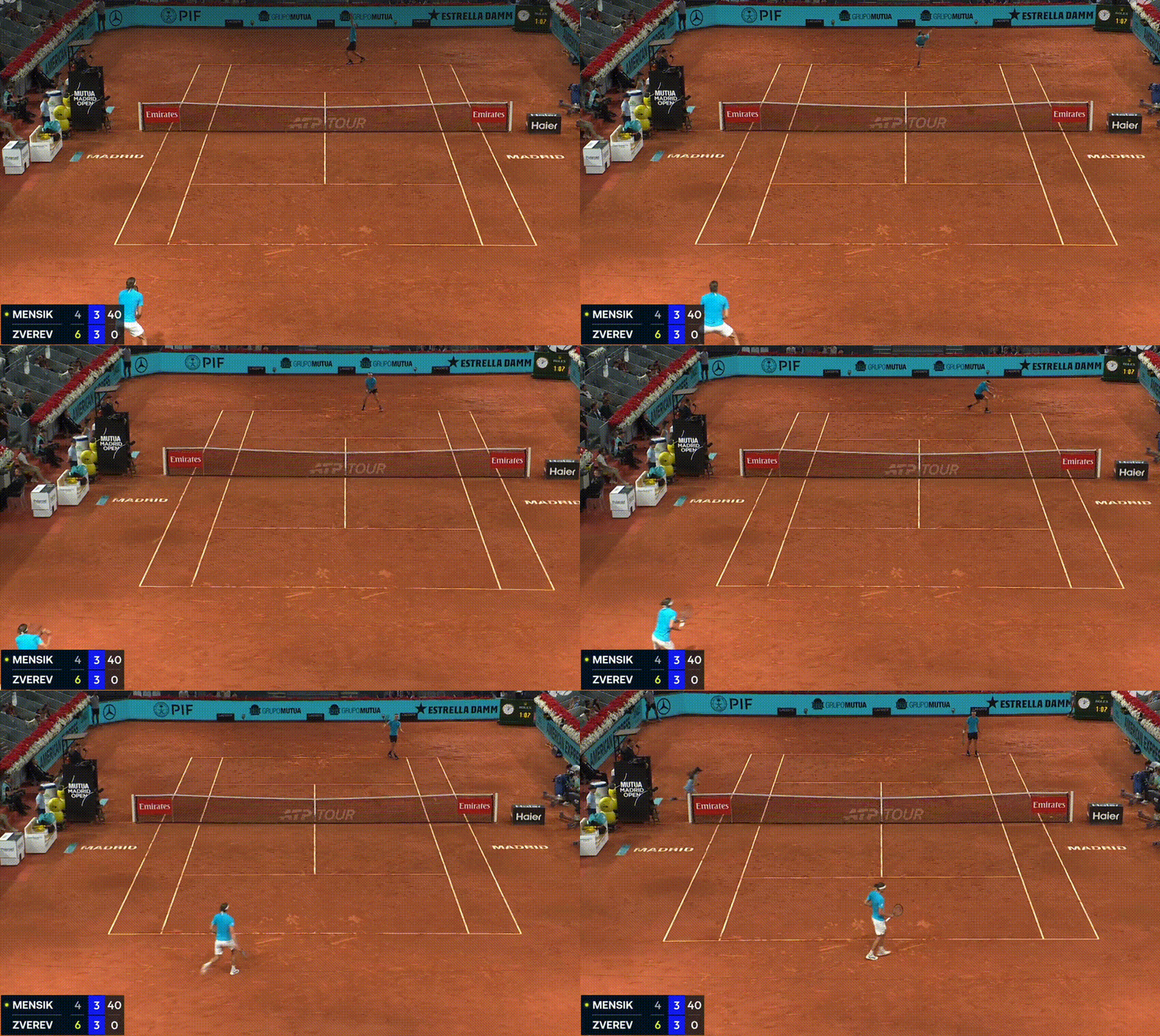
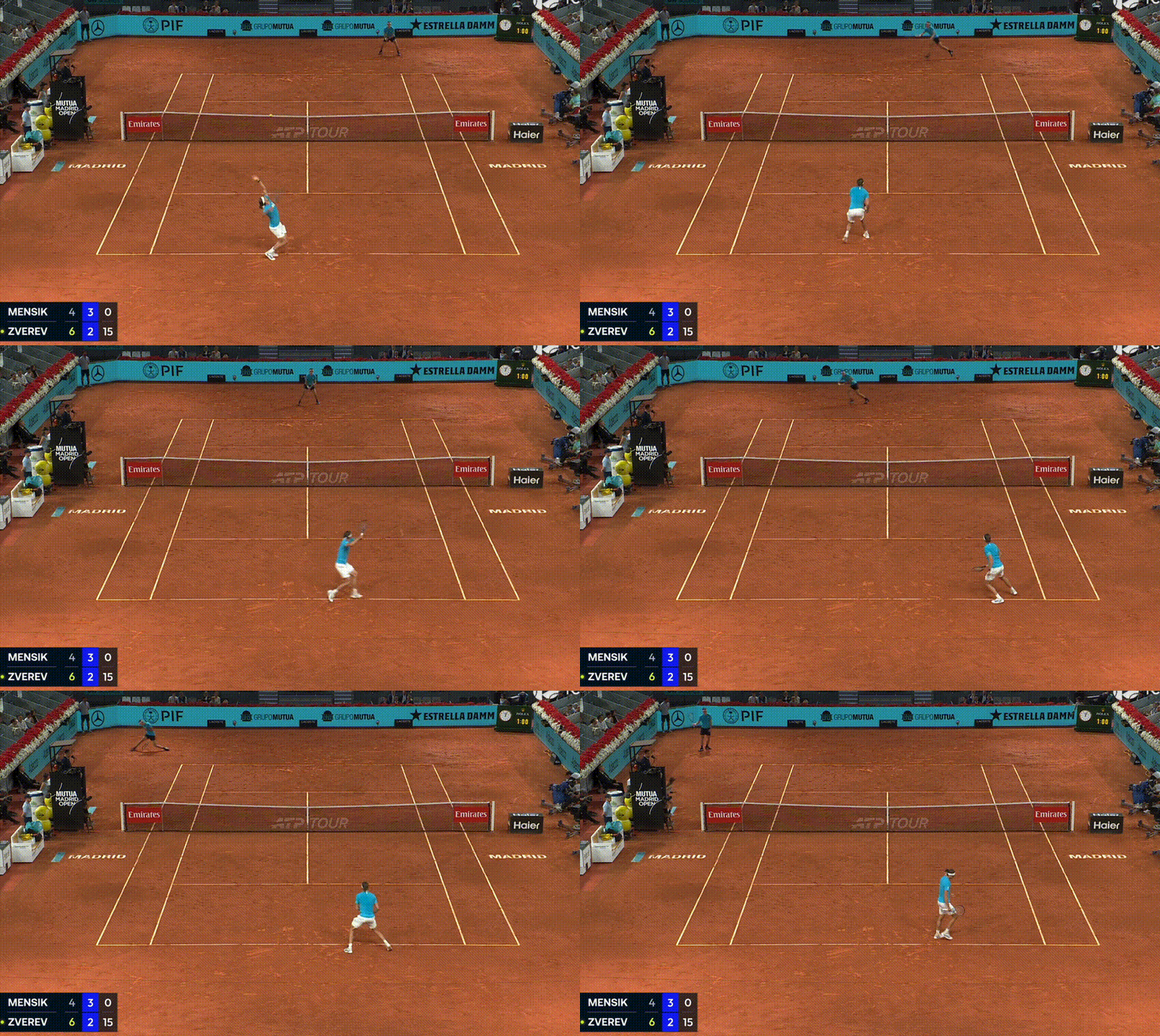
On return, Mensik assumes a more aggressive court position, especially on second serves. He uses the return as a means to attack his opponent while they are still stuck inside the baseline. He’s often using this return +1 inside-out forehand:
Zverev is more content to use all of Chatrier’s real estate, relying on his weight of shot and court coverage to get back to neutral:
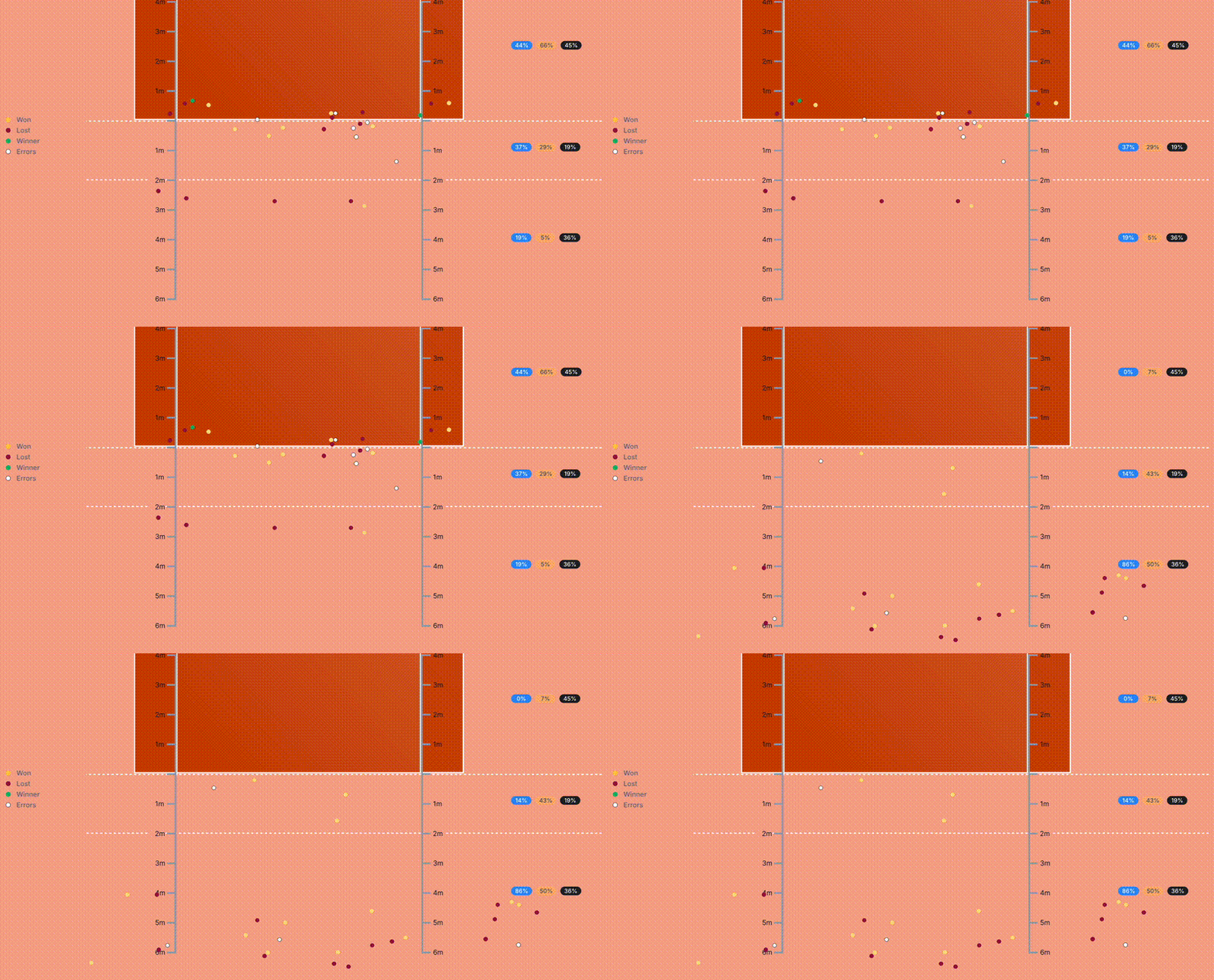
Here are the charts of second-serve return contact points from Madrid. Zverev was almost exclusively returning from the back wall, whereas Mensik was often close to the baseline:
-
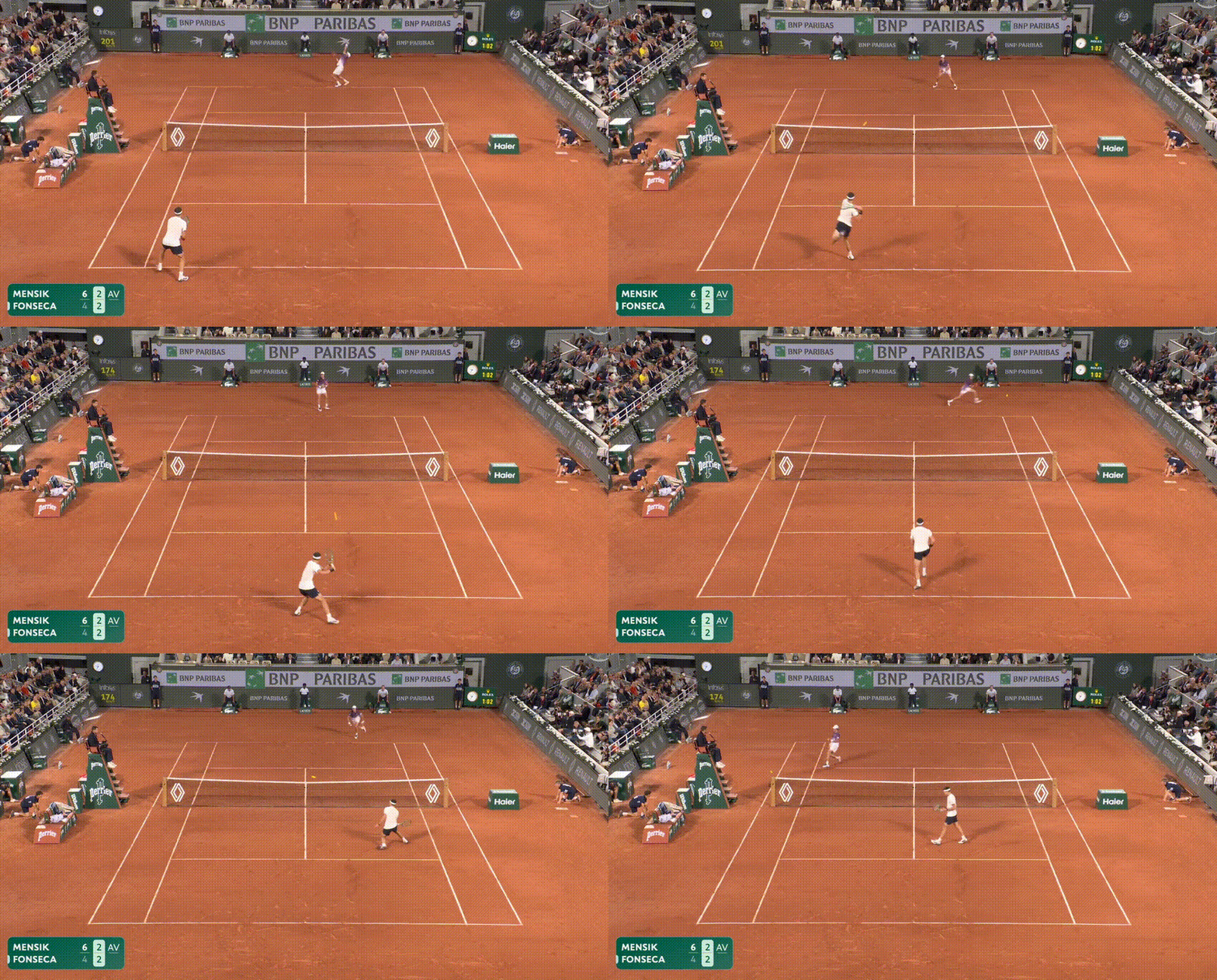
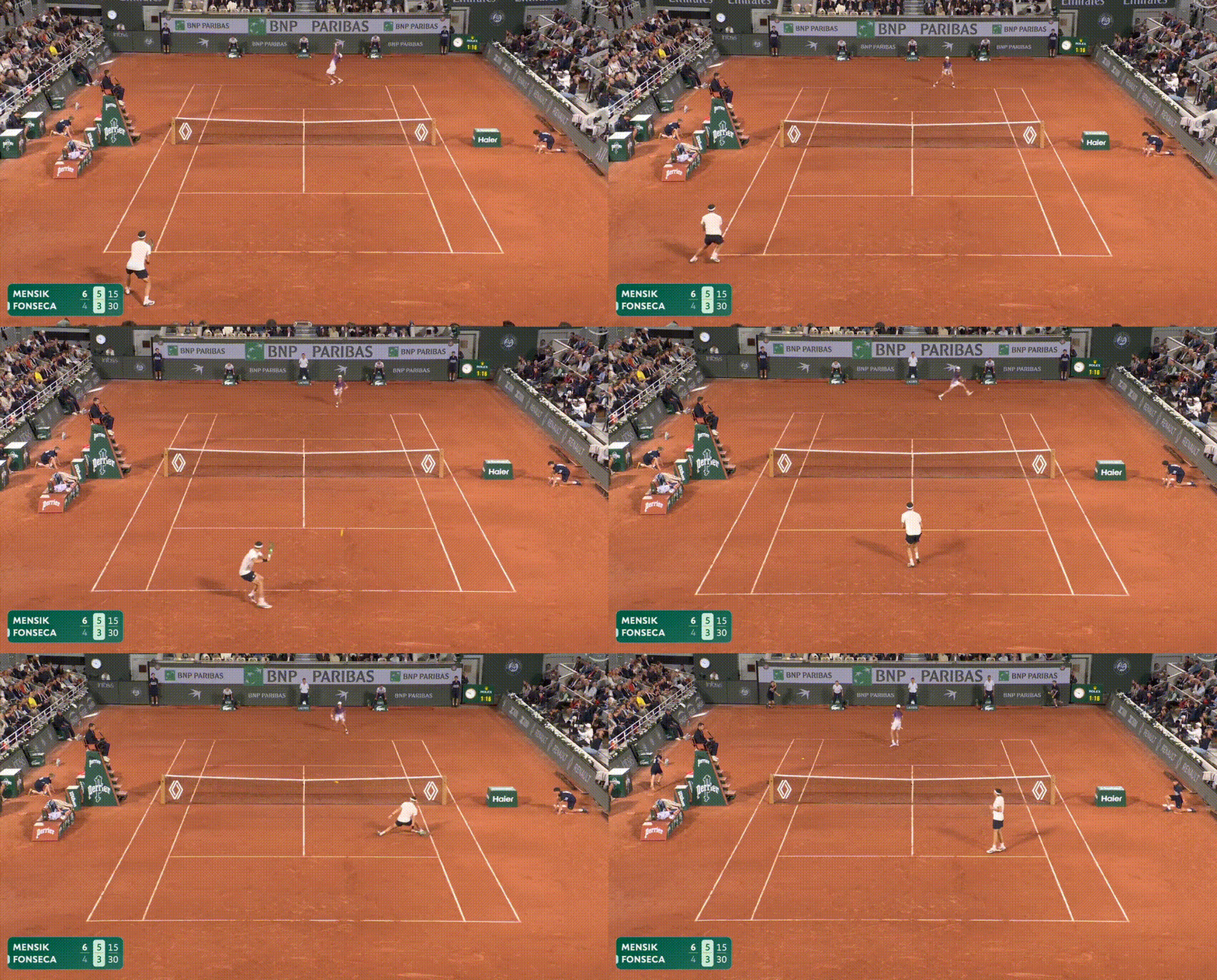
That difference in return location also reflects their appetite for forward movement and net play. While Zverev’s net game has been a slow evolution, Mensik arrived on tour with out-of-the-box feel and court sense in the forecourt:
Both men would back their backhands against anyone, and in 2026 Zverev’s is ranked third on the TennisViz rankings with an 8.14 rating. Mensik’s is a very respectable 20th with a 7.39. They are two of the most pronounced power position backhands on tour:


Given how evenly matched they are on serve and backhand, the forehand may ultimately decide this semifinal.
Zverev’s forehand has long been susceptible to breaking down under pressure, or at least getting passive in big moments. The German has made a concerted effort since last year to increase his aggression on that wing, and his speed and spin stats are among the heavyweights in 2026. When given time Zverev loves to hit his forehand crosscourt with spin. He will look to pull Mensik out of court by breaking the sideline with that shot, rather than try and rush the Czech with more middle strikes:
The big question is: will he commit when the moment arrives?
Mensik is an interesting case. The Czech owns one of the slowest and flattest forehands on tour, and is also below tour average for in-percentage. I’ve highlighted before how Mensik has a “weak stretch” in the hitting arm muscles, given he drops the racquet and starts the swing with an uphill battle, whereas most great forehands time their drop with the uncoiling of their hips:
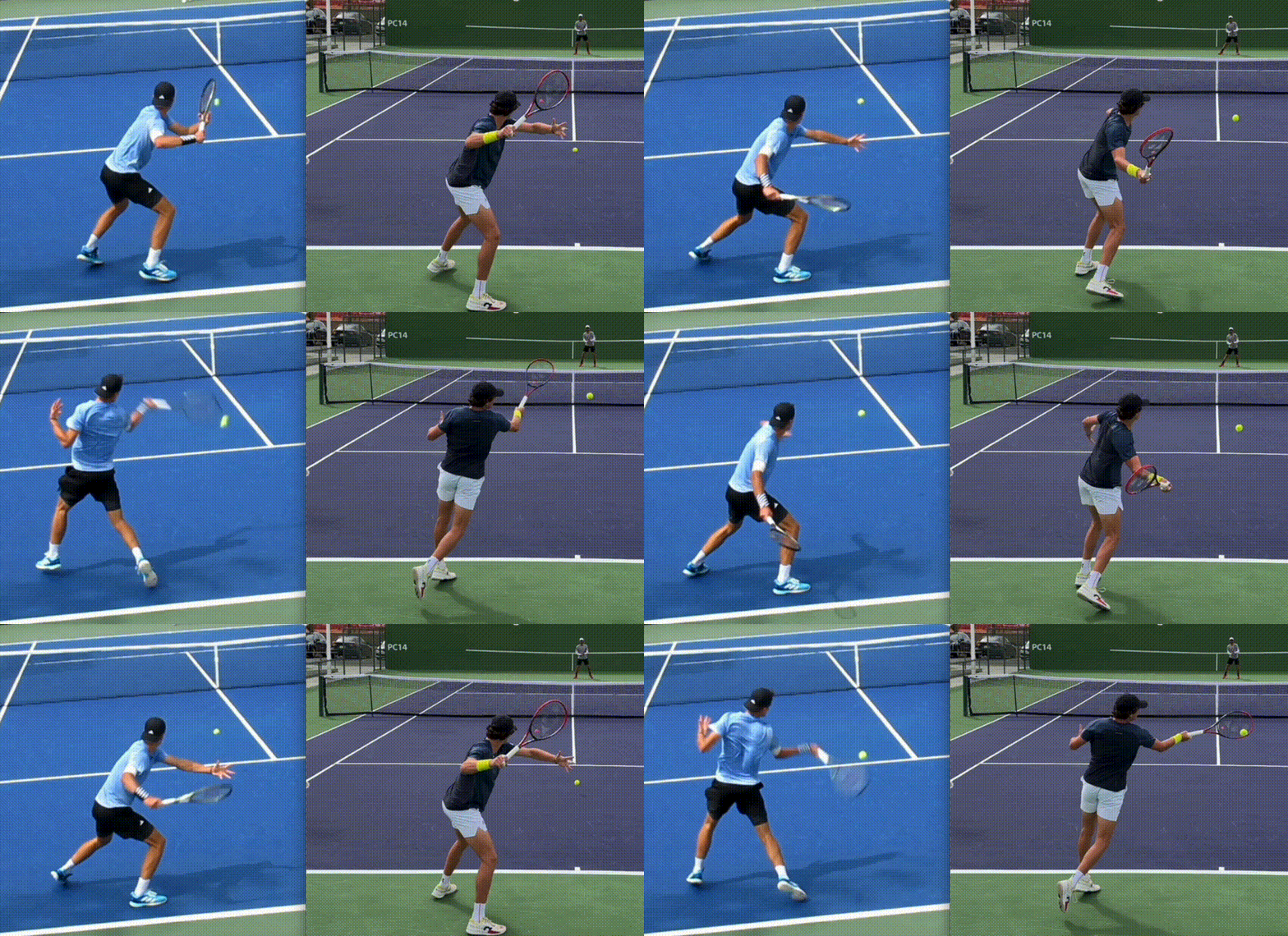
You can often spot evidence of this weaker stretch in the “palm-up” follow through (a lack of long-axis internal rotation of the upper arm) and over-rotated shoulders.


But if there’s an area of relief for Mensik (or any weak stretch forehand), it’s in the inside-out forehand from higher contact points. Here the lack of racquet head speed biases contact on the inside (left-side, from this back perspective) of the ball, with the over rotating shoulders creating a sort of fade to the shot that careens away from opponents:
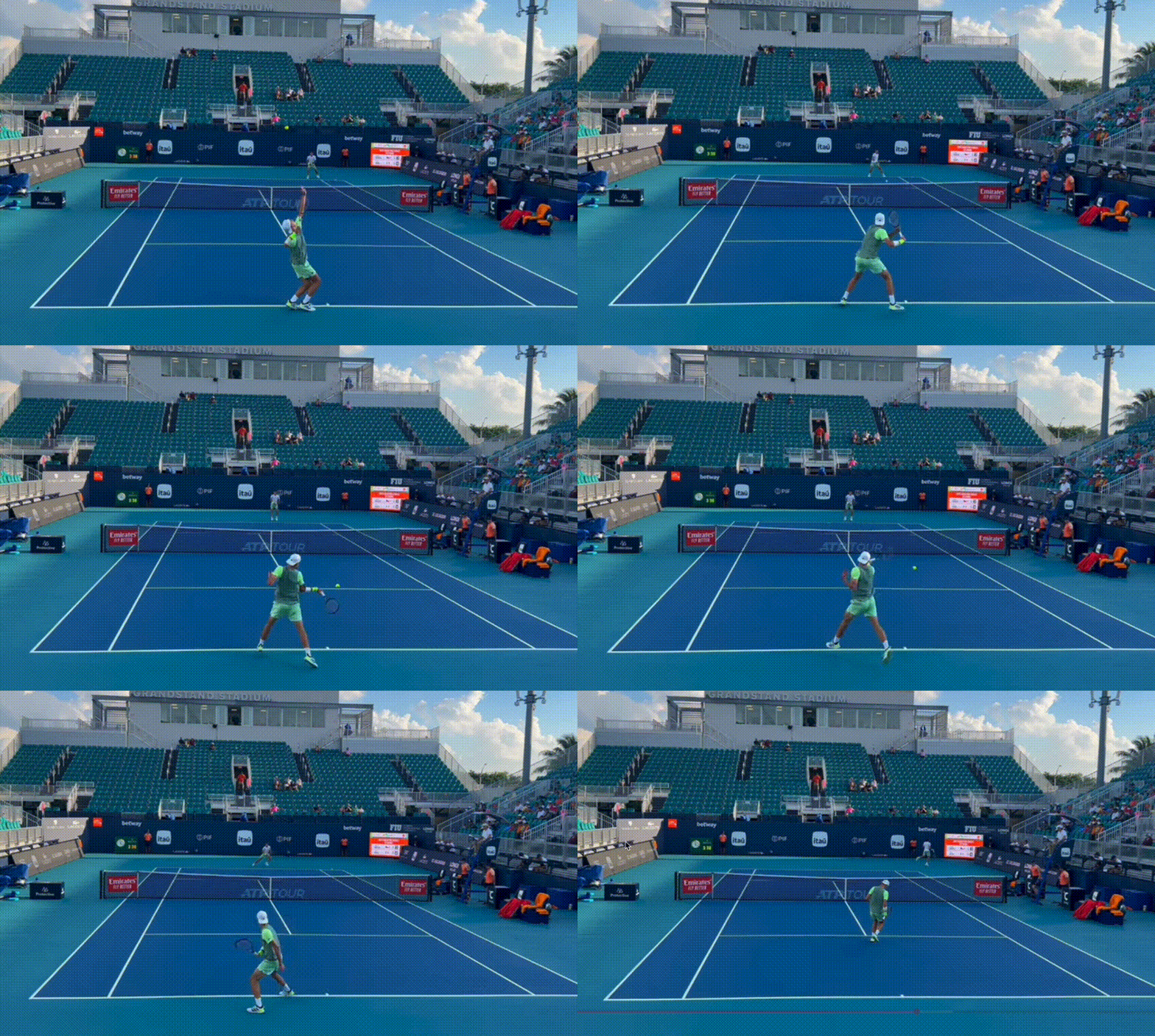
There aren’t many players on tour who favour this shot direction from their forehand +1 as much as Mensik. In fact, only Davidovich Fokina surpasses him in the top 30 (by 1%), with the caveat being that the Spaniard still goes into the deuce court 33% of the time — a good 5% more than Mensik.
Here’s a collection of some of the hardest/heaviest hitters of the forehand with their serve +1 forehand shot directions the last 52-weeks, ranked by how often they play into the deuce court:
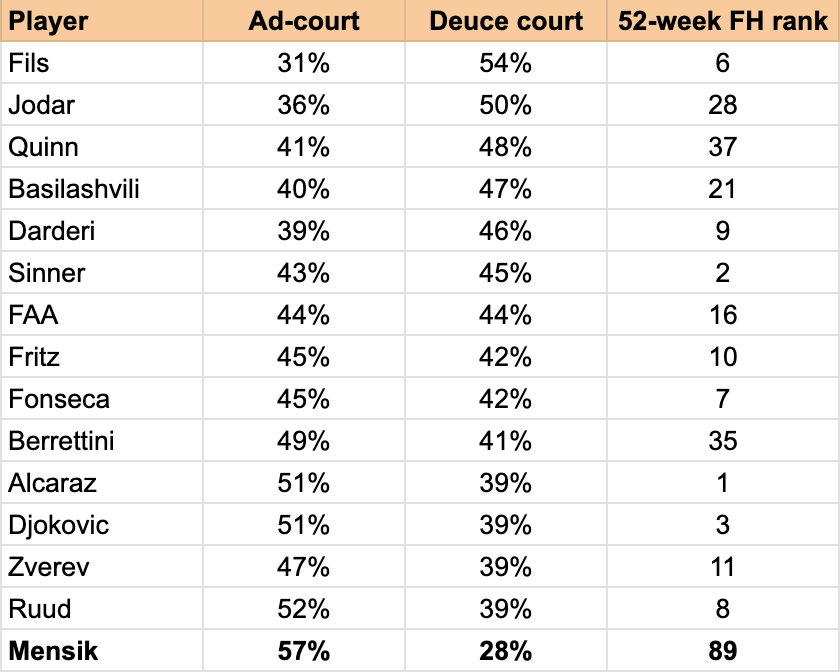
Players with great racquet head speed tend to favour the inside-in/crosscourt forehands on the +1 because they: (a) have the topspin to play over the high part of the net (when playing inside-in) and pull it in on a shorter down-the-line path, or to break the sideline; and (b) can generate the pace or width to make attacking the opponent’s forehand a low-risk/high-reward strategy. It’s unsurprising that Fils — the tour leader in shot speed and spin — is the player happiest to hit his +1 forehand into opponents’ forehands; it’s a high margin play for him in terms of making the shot and hurting the opponent.
Technique dictates tactic.
Strip away the biomechanics and the matchup becomes surprisingly simple. Mensik needs to make it a match of serve +1 and return +1, with the view of finishing at net as often as possible, preferably with more of those sliding angled drop volleys (for pure entertainment reasons). He also needs to use the drop shot to break Zverev’s baseline comfort.
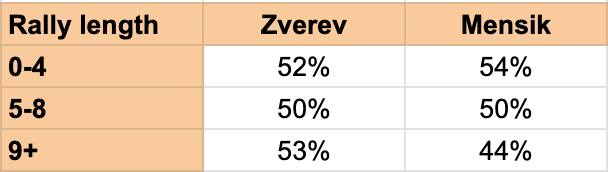
Zverev needs to make it a match of rhythmic neutral baseline exchanges; if the German is at neutral he is ahead in this matchup. He won 57% of baseline rallies in their last encounter, and overall enjoys much more success in longer rallies. A look at their 52-week stats for rally length win-percentage:
Mentally, the psychological burden sits almost entirely on Zverev’s side of the net. So far he’s handled that well, but he’s had two days to mull over this match and will surely be feeling the nerves at this stage of the event. Then on the other side of the net, you could say that Mensik performs his best as an underdog. He nearly pulled out of Miami in 2025 with an injury and only decided to play last minute, and his .500 record against top 10 opposition is only marginally worse than his career ATP record of .612. He clearly relished that status against Fonseca in the quarterfinals, and played with a chip on both shoulders that perfectly balanced his quiet demeanour with a ruthless game plan. He seems to know his game well for just 20 and leans into that disrupting style.
Physically the two days off should mean both have near full tanks, but I wonder if Zverev’s fitness and experience will play a factor down the stretch should this go four or five sets.
I’m leaning Zverev in five. Mensik’s game is built to disrupt, but over five sets disruption is hard work, mentally and physically. Eventually I think Zverev’s greater comfort from neutrality will prevail.
See you in the comments. HC.