
Ed. note: I wasn’t able to make Sea Otter this year. Jasen Thorpe shared his thoughts about the show with me over email.
Disclaimer
Byron couldn’t go to Sea Otter this year. But he made a really smart move in asking Charles Manantan to cover the show for Hugger Enterprises. Then Charles got hit by a car (he’s ok). When Charles reached out to cancel the Otter meeting I had scheduled with him, I jokingly offered to cover the show for them.
The joke became a little serious. A little serious became a negotiation that started with the idea of video booth tours and interviews with exhibitors and concluded with me agreeing to share show trends and other things I found amusing. I also promised to keep in mind that you all, being Hugger readers, don’t need or want the typical media round-up and spec-by-spec coverage of every new product at Otter, and that you’re smart enough to consider the world holistically. Your mileage may vary on that last point. Sorry, and good luck. – Jasen

Panda Podium
Panda Podium was not the most standout story of Otter but they were a story, for sure. Watching from their booth, I saw that most consumers and industry types would walk by without a glance. Or would look and blow by, anyway. Don’t get me wrong, it wasn’t one of those tradeshow ghost-town booths of despair. Plenty of people also stopped to check things out. But it’s the ones who blew by that are important to this story, which is important to the context of the next story.
Joe Whittingham is the founder of Panda Podium. He moved from the UK to China a little over fifteen years ago, abandoning his hobby of tuning JDM vehicles (it’s neither particularly possible nor entirely legal in China, apparently) and picking up bikes and cycling in its place. As he got into cycling and began consuming cycling media, he was struck by how, at least in English-language media, the experiences, brands, and technologies common to him in China were nowhere to be found.
In response to a void in the cycling community and marketplace, and to share his experience with his peers in China and back home in the UK, he started a YouTube channel.
China Cycling
As he became more enmeshed in the local cycling community and began building relationships with local manufacturers, reviewing bikes and products on ChinaCycling, he started to field inquiries from his followers: “Hey, where can I buy that?” And a lot of times, the answer was, “Well, outside of China, I guess you can’t. “That gradually morphed into, “Maybe I can help you with that.” (You can see where this is going…) And, yeah, it eventually led to Joe starting Panda Podium – a website through which consumers can buy Chinese-made bikes and products that have been selected, tested, vetted, and generally approved by Whittingham and his team, including some frames and parts that have been used at a world tour level, raced to world titles, and private-labeled by some very well-regarded brands.
Panda ships directly to consumers globally from China. And, as you can imagine, value for the cost is a part of their model, because of that.
Breaking down how people react to this model is one of the areas where things get interesting. Some people are threatened by the business model. Others are skeptical of the product quality. While another group are freaking stoked. And some are more like, Chinese-made D2C curious, or open to it. And there’s a lot baked into that. Some of it is fair, some of it is racist, some nationalist, some protectionist, some evangelical. You choose. From a US perspective, it’s not so different than what we might have seen with electronics or cars over time. Depending on your age and interests, you may remember when Japanese cars were considered low-quality. We all know how it would sound to say that now. Korean cars, anyone? Hyundai seems to be doing ok these days. And yeah, you can’t not think about Chinese cars now, right?
Direct to Consumer
The reality is that every nation has companies that are capable of producing garbage products. The reality is that China also has serious manufacturing capabilities and can produce amazing technology. So the thing is – how can consumers filter products that are good from bad or great from ok, or whatever? And how do you feel about navigating customer service in this setting? Those are the gaps that Panda aims to bridge through its experience with Chinese manufacturers, its cycling experience, and its growing testing protocols.
As for consumer and industry reactions to it, well… if there’s one thing that became clear at this year’s Otter, it’s that Chinese manufacturers, who have already been making a considerable contribution to the industry as OEM suppliers, are no longer content to stay behind the scenes, and pretending they don’t exist is no longer a viable option.
Shenzhen’s US coming-out party
Speaking of China, generally, and Shenzhen, specifically… Otter 2026 felt like a coming-out party for brands with some serious manufacturing chops. Big booths, lots of bike models, proprietary designs, slick displays, creative ideas, and clean execution were all prominently displayed on the premier exhibition row at Laguna Seca this year.
How about if we start with DJI/Avinox/Amflow?
DJI is a Shenzhen-based manufacturer of cameras, camera stabilization equipment, drones, power packs, solar generators, and more. Their e-bike motor division, Avinox, issued a press release a week before Sea Otter, announcing two new ebike drive systems and commitments from a large number of bike brands to use them. Most noticeable among those brands, at Otter, was DJI’s e-bike division, Amflow, which showcases the Avinox motor technology across a number of models.
Stablead
You would also have been hard-pressed to miss the Otter presence of Stablead. Established just last year, with a presence in Southern California and the involvement of Brian Lopes (you know, former world MTB champion Brian Lopes) and Tom Rogers (Yeah, former world up racer and suspension engineer, Tom Rogers). They showed several complete bike prototypes, including their own frame and suspension system designs, suspension components, drivetrain parts, and more. And while those of you following along closely might be thinking, “Burbank isn’t Shenzhen!” Well, Shenzhen is Shenzhen. Stablead is the bike division of Tilta, a Shenzhen-based manufacturer of cinematography and photography equipment. (Think cages, control systems, car mounts, stabilizers, gimbals…).
Perhaps the most traditional business showing out of Shenzen at Otter would be XDS. I say ‘traditional’ because XDS is already a major manufacturer of bikes for widely known, widely distributed US brands and others. (So, not a camera company, for example). But they’re now moving into the US market in a more meaningful way with their own brand – X-Lab. Their bike lineup includes road, gravel, and e-bikes, many of which feature attention-grabbing specs and/or pricing, and the road bikes are already being used at the World Tour level by Team XDS Astana.
Vertical Integration
From a business perspective, these brands, as well as Panda Podium, will face similar challenges and choices as existing bike brands in terms of how they navigate the market – Through retailers? Consumer direct sales? Both? How do they handle customer service, maintenance, and initial assembly? Stuff like that. But they are also bringing energy, innovation, and a fresh look at things – and they are relatively free of legacy/baggage, but also relatively free of track record.
Time will tell how this plays out for each company and the others that might follow. And it all kind of reminds me of a conversation I had with my son a few weeks back, about how sometimes it might be easier to start a company than to try to get an existing one to change its methods of working or its goals. That said, it feels like the market is right for enough disruption for this to lead to something of an upheaval of the existing bike industry world order – or maybe just lead to some proper merger and acquisition kind of stuff.
Apologies to longtime Hugger readers. That was probably the highest number of non-Sony camera-related words you’ve had to read in a while. Maybe Hugger can convince Sony to get behind this @mobilitylabs.ai concept. Or you can score a sweet eBay deal on a Sony Walkman Solarspeed 10-speed Certified Race Bike Vintage.
Fast(er) Gravel
Ok, ok, let’s talk about gravel history. When gravel first happened, it was basically cyclocross bikes with clincher tires, longer top tubes, longer chainstays, and crappy handling. Sometimes, it had a little more tire clearance. Usually, it had some mounts for racks. It actually had “grinding” in the name. Not floating, not playing, not flying – grinding. Ugh. Why are we so terrible at marketing? Anyway, the idea was, um, imperfect, but still conceptually good enough to be worth further development, and so we got more comfort, more versatility, more adventure, more bike packing, more racing, and more from it. All good stuff. But I can’t think of many times that I’ve seen a gravel bike and thought, “Damn, that thing looks effing fast.”

One noteworthy exception to that lament was the introduction of the Open U.P. I suppose that shouldn’t have come as a surprise, given the Cervelo and BMC pedigree of the Open founders, Gerard Vroomen and Andy Kessler. At the time that the U.P. was launched, they explained the concept: “The U.P. gives you the rider position to go fast (like a road bike) and the tires take care of the terrain.” I don’t think I’ve ever heard a bike description more in line with a company’s DNA. Among other features, it had a cool drop chainstay that enabled clearance for wider tires without needing a wider crankset spacing. U.P. riders could choose between 700c wheels with gravel-appropriate size tires for the time, or 650b wheels with up to 54mm tires.
Winding Detours
Of course, we all know how things have gone in the gravel market regarding tire sizes, so for its next act, Open introduced the WI.DE. (Winding Detours – It’s like they do this on purpose), which featured drop chainstays on both sides, no front derailleur, and could handle tires up to 2.4″ on 650b wheel, or narrower tires on 700c.
The webpage for the WI.DE. proclaimed, “Monster tires, nimble ride, without compromising speed. Fitting the biggest tire into a bike with road geometry is our favorite puzzle!
Anyway, the U.P. was well received, worked as hoped/advertised, and warranted updates and revisions that, in 2025, became the U.P. 2.0 and U.P.P.E.R. 2.0 (The UPPER being a bit lighter than the UP, but otherwise identical). The 2.0 versions of the UP/PER got even faster than the introductory versions, adding an aero fork and frame shaping, and an integrated, decidedly aero bar/stem combination.
Massive Tire Clearance
So, there’s history. And there’s context. And there’s brand, and philosophy, and consistency, and all of it taken together should have prevented me from being surprised, and yet, there I was, standing out in the Open (booth), surprised by the introduction of the WI.DE 2.0 this year, which (right, right…) builds on the original WI.DE. design by adding an aero frame and fork shaping, an integrated, aero bar/stem, and clearance for (wait for it…) 2.6″ tires on 700c wheels. Plus mounts for some really well-made bags.
I mean, I have a Mosaic mountain bike at home with 2.4″ tires and a 110mm travel Fox 34 fork, which I think of as a trail or all-mountain hardtail, and the WI.DE., with 2.6″ tires, makes it look small. Mosaic comparison aside, the WI.DE. 2.0, with big tires and bags, looks like an all-terrain luggage rocket. In that sense, I guess it’s not purely “fast gravel,” but it’s for sure fast gravel packing. And if it saves you 20 watts at 6mph while you’re riding the length of the Colorado Trail, then, you know what? I’m happy for you. But more than that, it just makes me smile that this bike exists. And I’m especially down with the idea of road fit/geometry for a gravel bike.

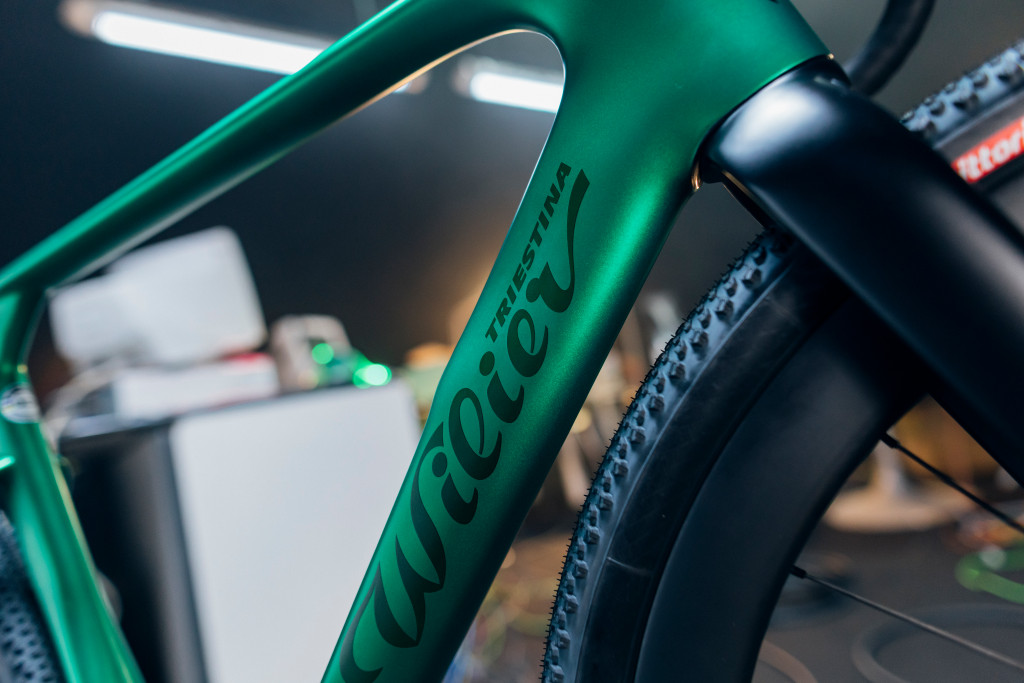
Later in the show, even with all of that Open stuff already in my head, when I visited the Wilier Triestina booth and saw their new gravel bike, the Rave SLR, I thought, “Damn, that thing looks effing fast.” And, full disclaimer: You do you, but to me, the thing that has always been the most fun is fast.
At their booth, the Rave was lined up next to Wilier’s Filante SLR road bike. And you really can’t talk about the Rave without talking about the Filante. Integrated aero bar and stem. Bar shape with a cool s-bend concept that lets the brake hoods sit a little inboard of the drops, without needing to flare the drops (less aerodynamic) or causing a goofy brake lever/hood positioning. Aero fork and headtube shaping.
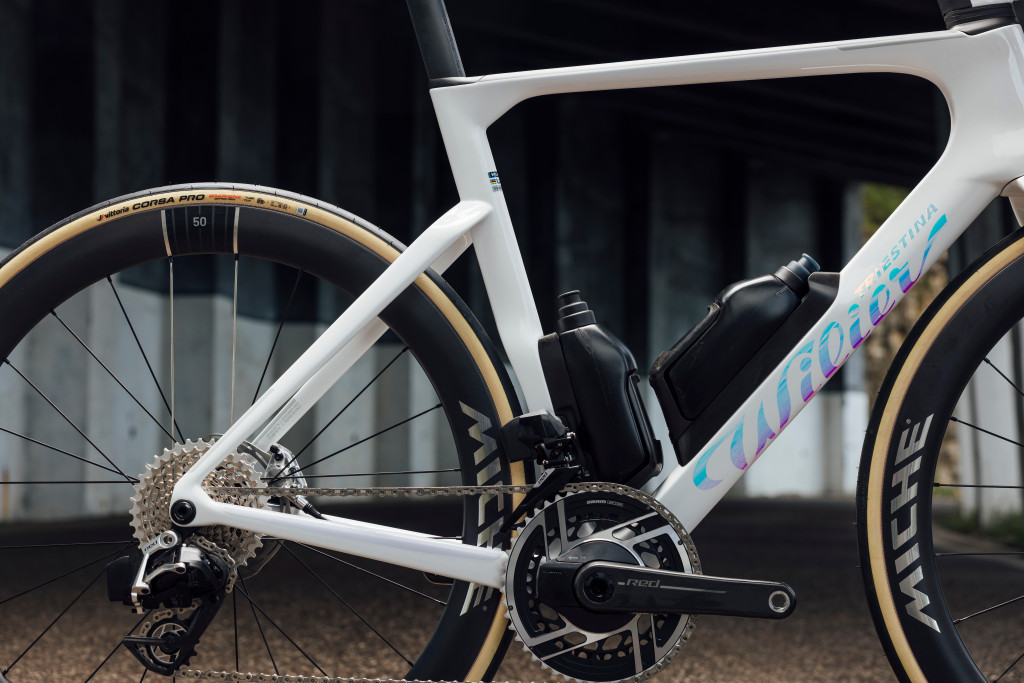
Round steerer with a custom bearing design to still enable internal routing. Aero tube shapes, and rear wheel/tire contour at the seta tube. Custom-made (by Elite) aero water bottles, cages, and mounts that blend seamlessly with the frame, and complement each other, filling the space above the bottom bracket to form a more aero shape that also carries water and fits within UCI regulations. Aero treatments to the seatpost, stays, and hidden seatpost binder… You get the idea.
Aero Shaping
And here’s the thing about the idea: there’s some aero shaping and tech, where you can kind of say, yeah, for sure that’s faster than conventional round, metal stuff. And then there’s aero, which is more subtle and sometimes counterintuitive, and you can only learn it through CFD, wind tunnel testing, and real-world testing. I don’t have a wind tunnel and haven’t ridden this bike. I suspect it will be fast. We’ll find out.
We’ll also find out whether the same holds true for the Rave. Because it’s an aero design, bottles and cages, frame, fork, bar, stem, geometry, really everything is so clearly based on the technology built into the Filante. Just, you know, adapted for appropriately larger tires.
One of the things Wilier has going for it right now is that they have just named a new distributor in the US and, in doing so, have gained the support of a number of experienced industry pros, including Tim Johnson (Yeah, former cyclocross and road pro, Tim Johnson). I mention this mostly because, while we were talking about the bike at Otter, you could see his enthusiasm for it and for the idea that gravel and fast could go together in a way the industry hasn’t fully explored or optimized just yet.
Yeah, apparently 32″ wheels are going to be a thing. There were wheels, tires, suspension components, bikes, and all the stuff in various forms. Not from every manufacturer, or anything like that. But enough so to say that it’s a thing. Time will tell whether it stays a thing or becomes a big thing.
For a while, my dream was that Paris-Roubaix would be won on 32″ wheels and 32mm tires, because I like the 32/32 symmetry, and I love when the bike industry mixes metric and imperial measurements. But now, I find myself hoping that we can just jump ahead to 36″ wheels, second-guess it, and then settle on one-meter wheels. Especially if mountain bike handlebar width keeps increasing, and we can enjoy some sort of 1000mm symmetry as the “ideal” measurement for things, even if only for a moment.
More than any of that, and more than wheel/tire diameter conversations, I was thinking about tire widths, and how road is up into the 30mm+ range, often enough, and gravel is huge now, and mountain bike tire sizes are what they are, and I’m pretty sure the UCI’s 33mm tire test gauge for cyclocross is the most ridiculous tool on the face of the earth right now, even as I hope that remains the speification.
I stopped by Bowhead to check out the adaptive mountain bikes for a while on Otter Saturday. I love the way they’ve developed something totally their own, drawing on bike, e-bike, motorcycle, automotive, and other mechanical engineering nerd categories. The bikes totally capture my imagination, and I can geek out on talking with the Bowhead crew about suspension, steering, handling, and power units.
But this year, I think the coolest thing they had going was their new introduction, the Nano. It’s a super-compact, foldable wheelchair. Its wheels can be set to one of three positions, ranging from maximum mobility to increased stability to total static. And the omnidirectional front wheels are an elegant solution for maneuverability. But those are just the features. The benefit? The chair fits down an airplane aisle. It works in a hotel shower. It basically enables its users to take a bit more control over their mobility, rather than ever getting stuck waiting for or relying on the right support at the right time from an airline, hotel, or transportation service while traveling.
My first job was at a bike shop when I was 12 or 13, building bikes from the box for cash. It started me on a path of working in shops through high school and while racing, before turning toward a career in the industry. One thing that was consistent in all the shop time I logged was the presence of Kool Stop brake shoes as a go-to replacement for most customers and most bikes.
Over the years, the Oregon-based, made-in-USA brand has expanded its offerings – back then, it was caliper and cantilever rim brakes – to include a pretty broad range of disc brake shoes, for a variety of makes/models, and has served as an OEM supplier for some of the more prominent disc brake brands. It made me smile to see their booth at Otter, positioned next to Brembo, and to know that Kool Stop is closing in on their 50th anniversary.

I’ve long lamented the departure of the Calamari food truck from the Sea Otter expo. It’s been gone for years. But, damn, if it didn’t have some of the best, butteriest, most tender calamari I’ve ever had. Since then, I’ve grown fond of the Indian food vendor – they make their naan to order, on-site. But this year, my lunchtime heart was stolen by Benito’s food truck. They only have one thing on the menu – a serving of three quesabirria tacos. Your choice is yes, please, or no, thank you. That’s it. Well, unless you want to add a horchata or a juice.
…
We’re riding townies, adventure, and mountain bikes. Find recommendations on our store page. As Amazon Associates we earn from qualifying purchases.