
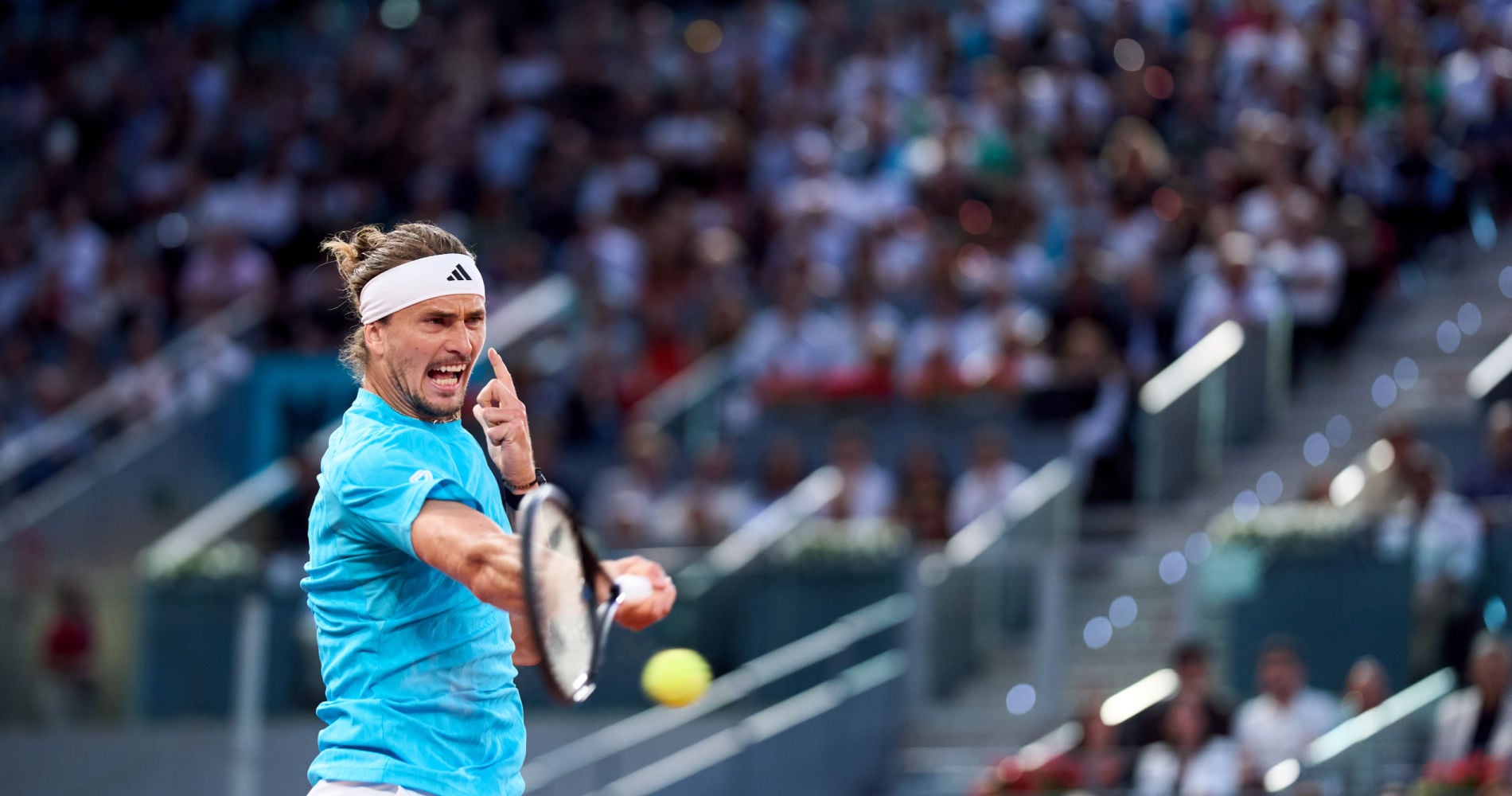
“He’s like a wall.” These are the latest words recorded by Alexander Zverev about Jannik Sinner, clay, and his difficulties to even win a set against him. It was in Monte-Carlo and Sinner had just dismantled him 6-1, 6-4. Zverev added that he felt he didn’t play well for his first tournament on clay in 2026. Two tournaments and more wins later, the German has the same wall in front of him in the 2026 Mutua Madrid Open men’s final.
Sunday’s final will be the fifth consecutive ATP Masters 1000 meeting between the two men, six if you include the 2025 ATP Finals. That has never happened before in the series history. It tells you everything about where these two players sit in the current hierarchy – and everything about what Zverev, number three if the world’s hierarchy, far behind Alcaraz and Sinner, needs to do to escape it.
As far as we know, Jannik Sinner has solved Alexander Zverev. He has won his last 8 matches against the 2024 Roland-Garros finalist, leading 9-4 in their head-to-head. Since the 2024 Cincinnati semifinal, Sinner has won eight consecutive matches against him, five of them at Masters 1000 level. The scorelines are not flattering: 6-1 6-4 in Monte-Carlo this spring. 6-0 6-1 in Paris last autumn. 6-2 6-4 in Indian Wells. These are not close matches lost on fine margins. These are comprehensive defeats.
- 2024 Cincinnati (M1000, SF) — Sinner def. Zverev 7-6(9) 5-7 7-6(4)
- 2025 Australian Open (GS, F) — Sinner def. Zverev 6-3 7-6(4) 6-3
- 2025 Vienna (SF) — Sinner def. Zverev 3-6 6-3 7-5
- 2025 Paris (M1000, SF) — Sinner def. Zverev 6-0 6-1
- 2025 ATP Finals (RR) — Sinner def. Zverev 6-4 6-3
- 2026 Indian Wells (M1000, SF) — Sinner def. Zverev 6-2 6-4
- 2026 Miami (M1000, SF) — Sinner def. Zverev 6-3 7-6(4)
- 2026 Monte-Carlo (M1000, SF) — Sinner def. Zverev 6-1 6-4
Yet there is a match on court (5 pm CET) and Zverev has never made a mystery about his wish to join the elite group composed by Carlos Alcaraz and Jannik Sinner.
Zverev is having a remarkable 2026. He is 26-7 on the season, has reached the final of a Masters 1000 event, and enters Sunday having beaten essentially everyone in his path – at the top level, only Alcaraz and Sinner have consistently beaten him since his shock third-round loss to Arthur Rinderknech in Shanghai. His problem is that his path always seems to end at the same wall.
If there is one number Zverev can build a match plan around, it is his serve quality score of 9.2 this tournament – the highest of any player in the draw, above Sinner’s already-excellent 8.9, and a full 1.3 points above the tour average of 7.9.
Zverev’s serve
That is not a marginal edge. Against most opponents, a serve operating at that level is a match-winner on its own terms. Zverev has served 40 aces this fortnight, held 93% of his service games, and generated enough free points off his first ball to stay largely out of trouble. The blueprint is clear: if the serve stays at 9.2, Zverev has an option to control the match’s rhythm and stay competitive.
The problem is that Sinner’s return quality score of 8.3 – against a tour average of 6.4 – is precisely the instrument designed to neutralise what Zverev does best. Where other returners concede the first-serve point and wait for second-ball opportunities, Sinner pressures both.
The consequences show up in the break point data: Zverev has saved only 50% of the eight break points he has faced this week, and been broken four times in 58 service games. Sinner, by contrast, has saved 78% of his nine break points, conceding just two breaks in 53 service games.
The one number Zverev can hold onto
There is, however, one statistical thread Zverev can legitimately pull. His first-serve percentage across the tournament stands at 72% — significantly higher than Sinner’s 64%. And his conversion score of 77% outperforms Sinner’s 70%. The equation for Zverev is therefore precise: he must sustain his first-serve percentage at or above 70% throughout the match, not merely in bursts. Every time that percentage dips and Sinner gets a second serve to attack, the structural advantage shifts. Sinner has won 64% of second-serve return points so far this fortnight. That is not a statistic — that is a sentence.
It is worth remembering that Zverev has beaten a World No. 1 four times in his career — Djokovic three times, Nadal once. But his last win over a No. 1 came at the 2021 ATP Finals, nearly five years ago. And his record against Sinner since 2024 suggests that whatever tactical solutions he has explored, none have produced the sustained disruption required to break Sinner’s rhythm across three sets on clay.
What Sinner is playing for
Should Sinner win today, the records fall in clusters. He would become the first man in ATP Masters 1000 history to win five consecutive titles in the series – breaking a streak he currently shares with Djokovic, who achieved four consecutive titles three times. He would also become the first man to win the first four Masters 1000 events of a single season, and the first Italian champion in Madrid tournament history.
At 24, he would hold titles at seven of the nine Masters 1000 venues, needing only Rome and Canada to complete the set — a feat achieved only by Djokovic. The numbers accumulating around Sinner are no longer just impressive. They are historically inconvenient for everyone else.