Look, I have a bit of history with the Boston Marathon.
I love the marathons I’ve visited: Chicago, London, New York, Frankfurt, Milan, Berlin, Dubai, Los Angeles, San Francisco, and, yes, Columbus. I just believe that Boston has a unique place in the legacy of our sport.
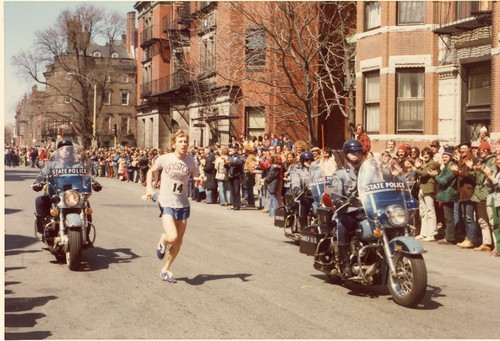
I first read about the Boston Marathon in Runner’s World in 1974. I have loved the race ever since. I qualified for Boston with a 2:48.17 and finally ran the 1986 Boston Marathon, where I believe I ran 3:23:20. I learned to respect the course the hard way. From 1986 until 2018, I visited every year, when I had three stents five days prior, watching in tears as Des Linden took the victory, hoping to visit once again. I covered remotely until 2025, when I returned to this historic race. My visit in 2 26 was wonderful as always, and now, sitting in the Larrenhalle, my small office in our small farmhouse in Wisconsin, I submit my suggestions on the Boston Marathon and its special position in marathon lore:
- Oldest continuous marathon: Fifteen marathoners started the 1897 Marathon, organized by John Graham and the Boston Athletic Association on April 19, 1897. Since then, the Boston Marathon has been held (during WW1, there was a year when the race was held as a relay, and a remote version during the COVID-19 pandemic). The race was inspired by the marathon distance featured in the revival of the Olympics in April 1896 in Athens, Greece.
- The World’s most exclusive marathon. Boston has qualification standards for each five-year group. In 1985, I had to run 2:50 or better. I ran 2:51.28 in 1982 and, in 1984, 2:48:17 at the Summit Marathon in Soquel, CA. It was one of my proudest moments, besides running the 1986 Boston. It is no different now, except that the age groups are quite competitive, with an average qualification standard that has to be exceeded by 4-5 minutes to qualify. One must run their butts off to make the Boston standard. It is a badge of respect to qualify for the Boston Marathon.
Boston Marathon mass finish by Jane Monti for Race Results Weekly - Boston has been part of our social history #1: a historic site for Women’s marathoning! Roberta Gibb was the first woman to finish the Boston Marathon in 1966. In 1967, Kathrine Switzer started the race with her then-boyfriend, only to have her number torn off by Boston Marathon official Jock Semple. Thomas Miller, a hammer thrower, was running with Katherine, body-blocked Jock Semple, and Katherine went on to finish the race. Roberta Gibb became a sculptor after completing a statue of her historic moment, and Katherine Switzer became a champion of women’s sports, helped found the first women’s race series, and continues to comment on the sport to this day. In my files at the Larrnehalle, I have a handwritten letter from Jock Sempte in which he recounts the race and expresses remorse for his actions.
- Boston was part of social history (#2), as it was the first international marathon to accept push-rim wheelchair marathoners. Bob Hall is a member of the Greater Boston Track Club. The late Bill Squires, the wack job coach of the GBTC, was able to get Bob Hall into Boston ONLY if he finished under 3 hours! Bob Hall wheeled 2:58 and went on to a career in building racing wheelchairs. (Bob passed away the week before the 2026 Boston Marathon.
- Boston became a professional race in 1986! John Hancock’s then-CEO, the mercurial David D’Alessandro, changed the marathon’s history with his sponsorship, following the lead of the first professional Boston Marathon race director, Guy Morse. D’Alessandro, aide to the media, said, “For 3 million dollars a year, I own the city of Boston for a day.” That quote was picked up over 7,000 times when he first noted it, in 1985. How do I know about the quote? I was at the aforementioned presser, as Runner’s World special projects manager (thanks, Mike Perlis).
- Boston has the best footwear and apparel sponsorship of any event in the World: adidas. Put together by Adrian Leek and Guy Morse, this sponsorship is the best-known and most widely seen in marathon footwear and apparel deals. Both men understood that the legacy and the iconic brands coming together are part of the culture that makes Boston so iconic. Guy Morse and Adrian Leek changed the subculture of the marathon and marathoning by considering how to make adidas part of marathon culture and subculture. The iconic products, apparel, and footwear are badges of respect among marathoners and runners, and can be seen around the globe. The combination of the BAA logo, the Boston marathon legacy, and the adidas design and approach have created a high standard, so high that most marathons do not come near it.