
Shown on most modern bikes and Peloton screen
Roughly how hard you worked
How hard was the class overall
Calories Burned
Total Energy Burned
—
kcal
Enter your workout details and hit Calculate Calories to see your energy expenditure.
Walk out of any spin class and you’ll see a calorie number on the bike or the app. It feels great when it says you torched 700 calories. But is that number real? Studio displays lean on heart rate and average profiles, which tend to run high. If you’re tracking your workouts for weight loss or fitness, you want a number you can actually trust.
This spin bike calorie calculator uses a dedicated spin-class MET value of 9.0 from the 2024 Adult Compendium of Physical Activities to estimate calories burned, adjusting for your weight, class duration, and either watts or class intensity in metric or imperial units.
Below, I cover calorie ranges by class intensity, what the kJ number on your bike actually means, and why studio calorie counts often read high.
How This Spin Bike Calorie Burn Calculator Works
Most spin calorie calculators online use a crude shortcut: time multiplied by weight multiplied by some fixed “spin factor.” It’s fast, but it treats every spin class as identical and ignores how hard you actually worked. This calculator does better.
The math uses the MET method (Metabolic Equivalent of Task), the same framework researchers and doctors use to measure energy burn. The core formula:
Calories = MET × weight (kg) × duration (hours)
Here’s the key part. The calculator uses a dedicated spin MET value of 9.0, pulled straight from the 2024 Adult Compendium of Physical Activities (Ainsworth et al.). That number is specific to studio cycling classes, which combine high-cadence work, standing climbs, and sprint intervals. A generic “cycling” value would undersell what a real spin class puts you through. Spin works you harder than a steady gym bike session, and the 9.0 MET reflects that.
You can enter your effort two ways:
Watts. If your bike shows power output (most studio bikes do), use it. Most accurate.
Effort level. No watts? Pick your class intensity instead, and the calculator maps it to a Compendium-based estimate that adjusts the MET up or down from the 9.0 baseline.
Spin Class Calories by Intensity and Weight
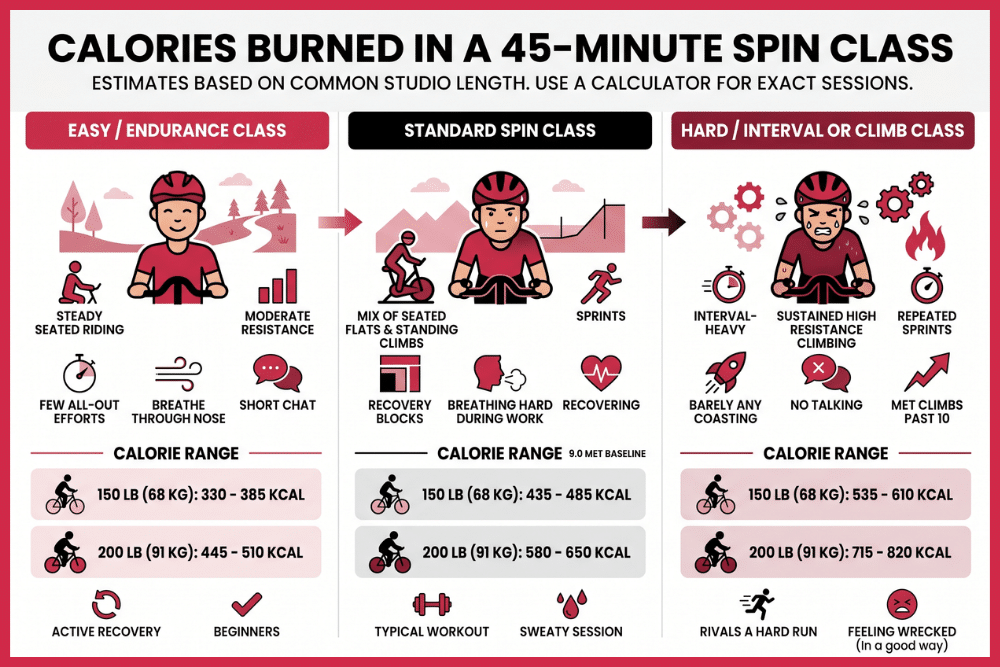
These numbers assume a 45-minute class, the most common studio length. Use the calculator above for your exact session, including watts-based input and different durations.
Easy / Endurance Class
150 lb (68 kg) rider: 330 to 385 kcal in 45 minutes
200 lb (91 kg) rider: 445 to 510 kcal in 45 minutes
This is a recovery-focused or beginner class. Lots of steady seated riding, moderate resistance, and few all-out efforts. You’re working, but you can breathe through your nose and hold a short chat. MET sits around 6.5 to 7.5.
These classes are great for active recovery days or for easing into spinning without hating your first week.
Standard Spin Class
150 lb (68 kg) rider: 435 to 485 kcal in 45 minutes
200 lb (91 kg) rider: 580 to 650 kcal in 45 minutes
This is your typical group class at a gym or studio. A mix of seated flats, standing climbs, a few sprints, and recovery blocks. The 9.0 MET baseline lands right here. You’re breathing hard during the work and recovering during the easy bits.
Most people picturing “a spin class” are picturing this. It’s a solid, sweaty workout that burns real calories in under an hour.
Hard / Interval or Climb Class
150 lb (68 kg) rider: 535 to 610 kcal in 45 minutes
200 lb (91 kg) rider: 715 to 820 kcal in 45 minutes
This is a Tabata-style interval class or a heavy climbing session. Sustained high resistance, repeated sprints, and barely any coasting. Talking is off the table. MET climbs past 10.
I always leave these classes feeling wrecked in the best way. The calorie burn rivals a hard run, packed into 45 minutes, which is why interval-heavy spin is so popular for people short on time.
kJ vs Calories: What Your Spin Bike Display Means
If your studio bike shows a number labeled “kJ” or kilojoules, that’s not a random metric. It’s actually the most honest number on the screen, and here’s why.
A kilojoule measures the actual mechanical work you put into the pedals. Power-equipped spin bikes (like Spinner bikes and most studio setups) measure your output in watts, and kilojoules are just watts added up over time. No guessing, no heart rate estimates, just the real work you did.
Here’s the handy part. There’s a near 1:1 ratio between kilojoules of work and calories burned. So if your bike says you produced 450 kJ, you burned roughly 450 calories. The numbers line up almost exactly.
Why does this work out so cleanly? Your body is only about 20 to 25% efficient at turning food energy into pedal power. The rest is lost as heat. That inefficiency happens to cancel out the unit difference between kilojoules and calories, leaving you with a tidy 1:1 match. It’s a lucky coincidence of physiology and math, but it’s reliable.
So if your bike shows kJ, trust it. It’s closer to the truth than the calorie estimate on most consumer machines.
Why Studio Calorie Numbers Are Often Inflated
The calorie count flashing on the studio screen or your class app is usually a bit high. Not wildly, but enough to matter if you’re tracking for weight loss.
A few reasons why:
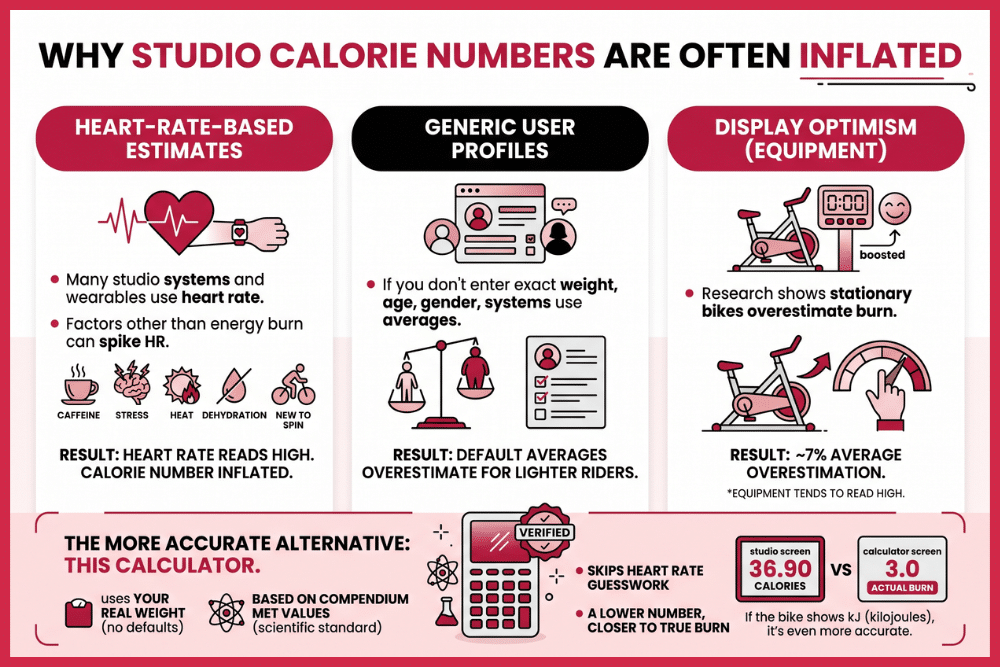
Heart-rate-based estimates. Many studio systems and wearables estimate calories from your heart rate. The problem is that caffeine, stress, heat, dehydration, and simply being new to spin all spike your heart rate without meaning you burned more energy. The number reads high.
Generic profiles. If you didn’t enter your exact weight, age, and gender, the system fills in averages. If you’re lighter than average, those defaults inflate your burn.
Display optimism. Researchers at UC San Francisco found that stationary bikes overestimate calorie burn by around 7% on average. That’s smaller than the elliptical’s 42% (no joke), but it’s still a thumb on the scale.
This calculator skips the heart rate guesswork and uses Compendium MET values with your real weight. The number you get will probably be a little lower than your studio screen, but it’s closer to what you actually burned. And if your bike shows kJ, that’s even more accurate.
Frequently Asked Questions (FAQs) About Spin Bike Calories
Is the SoulCycle calorie count accurate?
Usually a bit high. SoulCycle and similar studios often estimate calories from heart rate and average rider profiles, which tends to inflate the number. If your bike shows watts or kJ, trust that instead. Expect your real burn to land 10 to 20% below the screen number.
Does spinning burn more calories than running?
At matched effort, they’re close. A hard 45-minute spin class burns roughly what a steady 45-minute run does for most people. Spinning wins on being low-impact, so it’s easier on your knees and joints over the long haul.
How many calories does a 45-minute spin class burn?
For most adults, 350 to 800 calories depending on weight and intensity. A 150 lb rider in a standard class burns around 450. A heavier rider in a hard interval class can top 800. Use the calculator above for your exact number.
Is spinning good for weight loss?
Yes, paired with a calorie deficit from your diet. A few classes a week burns serious calories, and the high-intensity intervals keep your metabolism elevated after class through the afterburn effect.