

Shown on most modern bikes and Peloton screen
Roughly how hard you worked
How hard was the class overall
Calories Burned
Total Energy Burned
—
kcal
Enter your workout details and hit Calculate Calories to see your energy expenditure.
The calorie number on your stationary bike’s screen is probably wrong. Built-in displays often overestimate by 20 to 30%. Peloton has been called out by the Wall Street Journal for inflating numbers. Generic online calculators ignore that a recumbent and a spin class burn completely different amounts.
This stationary bike calorie calculator uses MET (Metabolic Equivalent of Task) values from the 2024 Adult Compendium of Physical Activities to estimate energy burned across upright, recumbent, spin class, and HIIT cycling, accepting either watts or effort level for accuracy in metric or imperial units.
Below, I break down calorie ranges by bike type, why watts beats guessing, and how Peloton’s number compares to reality.
How This Stationary Bicycle Calorie Calculator Works
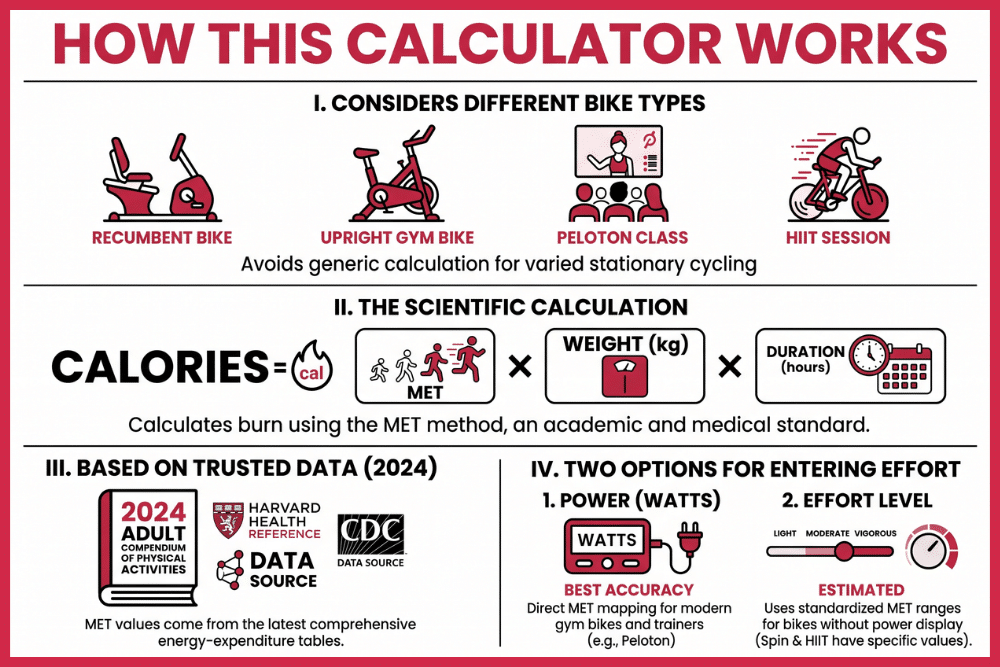
Most online calorie calculators for exercise bikes treat indoor cycling as one generic activity. They ignore that a recumbent bike workout, an upright at the gym, a Peloton class, and a HIIT session all burn very different amounts at the same effort. This one accounts for all four.
The math uses the MET method (Metabolic Equivalent of Task), which is the same framework researchers and doctors use to measure energy burn. The core formula:
Calories = MET × weight (kg) × duration (hours)
The MET values come straight from the 2024 Adult Compendium of Physical Activities (Ainsworth et al.), which has specific entries for indoor cycling at different wattages, plus dedicated codes for spin classes and HIIT cycling. This is the same data from Harvard Health and the CDC reference.
The calculator gives you two ways to enter your effort:
Watts. If your bike shows power output (Peloton, most modern gym bikes, smart trainers), this is the most accurate input. The calculator maps your watts directly to a Compendium MET value.
Effort level. If your bike doesn’t show watts (basic home upright, older gym equipment), pick how hard you worked. The calculator uses standardized effort-to-watts ranges from the Compendium to estimate.
Spin and HIIT have their own dedicated MET values built in.
Calories Burned by Exercise Bike Type
These numbers assume a 30-minute workout at moderate effort (around 100 watts for upright bikes). Use the calculator above for your exact session, including longer durations and harder efforts.
Upright Exercise Bike
150 lb (68 kg) rider: 200 to 240 kcal in 30 minutes
200 lb (91 kg) rider: 270 to 320 kcal in 30 minutes
This is the standard exercise bike at the gym or home. You’re sitting upright, engaging your core to stabilize, and pedaling against resistance. MET sits around 6 to 7 at moderate effort.
If you’re cranking it up to vigorous (150+ watts), expect those numbers to jump 40 to 60%. Push to all-out (250+ watts) and you can easily double them.
Recumbent Bike
150 lb (68 kg) rider: 175 to 215 kcal in 30 minutes
200 lb (91 kg) rider: 240 to 285 kcal in 30 minutes
Recumbents burn about 12% fewer calories than uprights at the same wattage. The reclined position takes your core out of the equation, so less of your body is doing work. The calculator adjusts for this automatically.
That said, recumbents are easier on your back and joints, which means you can ride longer. A 60-minute recumbent session can outburn a 30-minute upright session for most people.
Spin Class / Peloton
150 lb (68 kg) rider: 280 to 320 kcal in 30 minutes
200 lb (91 kg) rider: 370 to 425 kcal in 30 minutes
Spin and Peloton classes use a dedicated MET value of 9.0 from the Compendium because the format combines high cadence work, climbs, sprints, and out-of-saddle efforts. You’re working harder on average than a steady-state upright session.
A 45-minute Peloton class can burn 400 to 600+ calories depending on the class type and your weight.
HIIT Cycling
150 lb (68 kg) rider: 270 to 310 kcal in 30 minutes
200 lb (91 kg) rider: 360 to 415 kcal in 30 minutes
HIIT uses a Compendium MET of 8.8. The intervals are brutal but the recovery periods drag the average down slightly compared to a sustained spin class.
The real win with HIIT is the EPOC effect: your body keeps burning extra calories for hours after the workout ends. Your stationary bike calorie display won’t show this, but it’s real.
Watts vs. Effort: Which Should You Use?
If your bike shows watts, use watts. Always. It’s a direct measurement of the actual mechanical work you’re doing, which means it doesn’t care about your bike’s resistance setting, your fitness level, or how hard you think you’re working. 150 watts is 150 watts.
Effort-based estimation is a fallback. It’s accurate within about 15%, which is fine if your bike doesn’t have a power readout. But if you have the watts data, you’re leaving accuracy on the table by guessing.
Where to find watts on common bikes:
Peloton. The big number on the screen labeled “Output” is your current watts. Average watts shows up at the end of class.
Modern gym bikes (Keiser, Schwinn AC, Stages SC). Watts displayed on the console during the ride. Some require pressing a “stats” button.
Basic home uprights. Most don’t show watts. Use the effort selector instead.
Smart trainers (Wahoo, Tacx, Zwift hubs). Watts are the primary metric, displayed in the connected app.
If you’ve ever wondered why your friend on a Peloton swears they burned 700 calories in 30 minutes when you only saw 350 on your gym bike at the “same” resistance, watts is the reason. Same dial setting can produce very different power outputs.
Why Your Peloton Calorie Number Might Be Wrong
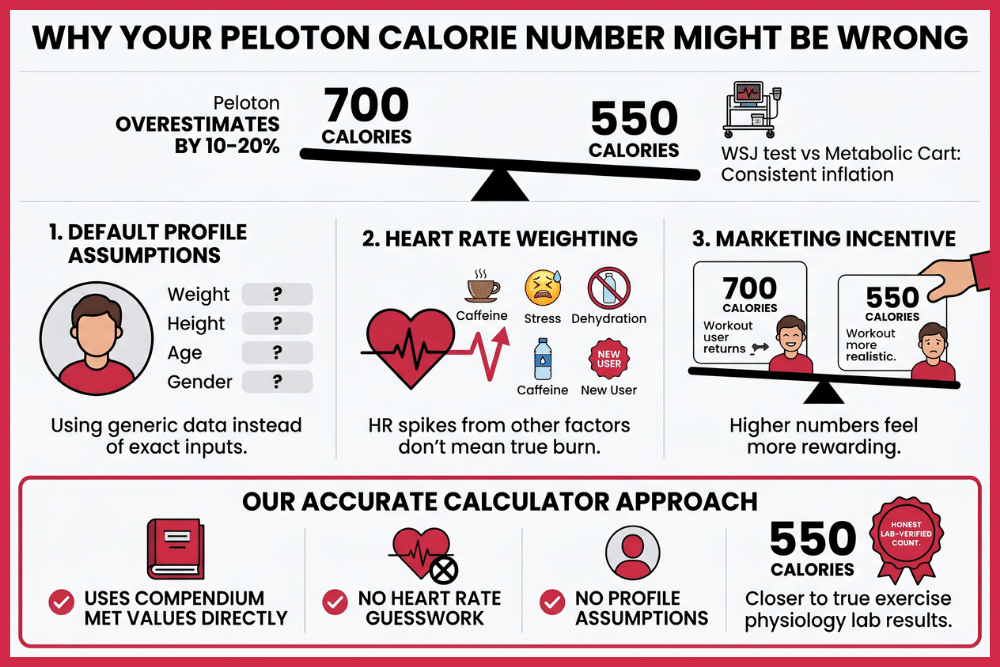
Peloton’s on-screen calorie count tends to overestimate by 10 to 20% compared to research-grade calculations. The Wall Street Journal tested it back in 2021 against a metabolic cart (the gold standard for measuring energy burn) and found consistent inflation across riders.
There are a few reasons for this:
Default profile assumptions. If you didn’t enter your exact weight, height, age, and gender, Peloton fills in averages that probably don’t match you.
Heart rate weighting. Peloton’s Strive Score and calorie estimates lean heavily on heart rate. But heart rate while cycling spikes from caffeine, stress, dehydration, and just being new to a workout – none of which actually mean you’re burning more calories.
Marketing incentive. Higher calorie numbers feel rewarding. Users are more likely to keep coming back to a workout that says they crushed 700 calories than one that says 550. This isn’t a conspiracy, just a soft thumb on the scale that exists across most fitness platforms.
This calculator uses Compendium MET values directly with no heart rate guesswork and no profile assumptions. The number you get is closer to what you’d see in an exercise physiology lab. It might feel lower than your Peloton screen, but it’s more honest.
Common Stationary Bike Calorie Mistakes
Trusting the Bike’s Built-In Display
Most cheap home exercise bikes calculate calories using your weight and a generic formula that ignores your actual effort. Some don’t even ask for your weight. The display number is often off by 30% or more.
If your bike doesn’t show watts and didn’t ask for your weight at setup, treat its calorie readout as motivation, not data. Use this calculator instead with your real weight and effort level.
Ignoring Your Bike Type
A 30-minute recumbent session and a 30-minute spin class burn very different amounts at the same perceived effort. Recumbents recline you and reduce core engagement, so they burn around 12% less.
Spin classes mix high-cadence intervals and climbs, pushing the average MET higher. Always pick the right bike type in the calculator. Don’t lump all indoor cycling together.
Copying Peloton or a Friend’s Numbers
I see this constantly. Someone posts that they burned 800 calories in a 45-minute Peloton class, and everyone assumes they should be hitting that too. Calorie burn scales heavily with body weight. A 220 lb rider burns way more than a 140 lb rider at the same watts. Your number is your number. Comparing to anyone else is almost always misleading.
Not Adjusting for Class Intensity
A beginner endurance ride and a Tabata HIIT class are very different workouts, even if both are 30 minutes. The calculator has a class intensity selector for spin and HIIT for this exact reason. Pick low for endurance or recovery, moderate for a standard class, and high for a race or climb-heavy session.
Frequently Asked Questions (FAQs) About Stationary Bikes
Do you burn more calories on a stationary bike or outside? Outside, usually. Wind resistance, terrain changes, and the energy cost of balance push outdoor calorie burn 10 to 20% higher at the same speed. Stationary bikes win on consistency though. No traffic, no weather, no coasting downhills.
Is weight loss with a stationary bike possible? Yes, but only paired with a calorie deficit from your diet. A 30-minute moderate ride burns 200 to 320 calories for most adults. Five sessions a week is roughly half a pound of fat loss per week if you don’t eat back the calories.
Is a recumbent bike worth it if it burns fewer calories? For most people, yes. The lower burn rate is offset by being able to ride longer without back pain or saddle soreness. A 60-minute recumbent ride often beats a 30-minute upright session in total calories burned.
How long does it take to burn 500 calories on a stationary bike? For a 175 lb rider at moderate effort: about 50 minutes on an upright, 55 minutes on a recumbent, or 35 to 40 minutes in a spin class. Use the calculator above for your exact numbers.