
“NCR has built the competition and marketing engine. CRAA retains much of the elite-player
credibility, at least on the Men’s side. NIRA offers the clearest ‘varsity model’ through NCAA
alignment. USA Rugby owns the national team pathway. The next step is turning those
pieces into one coherent college rugby operating system.” –Anthony “Anton” Forbes-Roberts
What Parts 1 and 2 Established
The first two pieces in this series made a simple argument: U.S. college rugby is leaving real money
on the table.
Part 1 made the financial case. With the 2031 Men’s Rugby World Cup coming to the United States, college rugby should be entering a period of unusual opportunity: more players, more schools, more sponsors, more media attention, and more institutional interest. But fragmentation limits the sport’s ability to capture that value. Instead of one recognizable national college rugby property, the market sees overlapping organizations, disconnected championships, divided calendars, and an unclear value proposition.
That matters because the money is not the point. The point is what the money could do.
A larger commercial platform could fund better events, coaching, player identification, medical and
safety standards, media coverage, data, travel support, and stronger pathways from youth rugby to
college rugby to the national teams. The missed opportunity is not simply revenue. It is reinvestment.
Part 2 made the calendar case. College rugby does not have one product. It has at least two: 15s and
7s. Each needs a clear national championship window and a season structure that fans, sponsors,
players, schools, and media partners can understand. Without that, even good competitions remain
difficult to package. A sport without clear windows struggles to build anticipation. A championship
without a defined place on the calendar struggles to become an event.
But beneath the financial and calendar questions sits a more practical one: What jobs actually need
to be done to run college rugby well? That may be the better question than, “Who should control
college rugby?”
The current system is often framed as a contest between organizations: NCR, CRAA, NIRA, USA
Rugby, and others. But that framing misses the point. College rugby does not need one organization
to win a turf war. It needs the sport’s best capabilities organized into a coherent national operating
model.
Each organization has real strengths. NCR has built the closest thing to a broad national competition engine. CRAA retains important elite-performance credibility, especially among many of the strongest men’s programs. NIRA may offer the cleanest institutional model in the sport through women’s varsity rugby. USA Rugby owns the formal national-team pathway and the connection to the Eagles, Olympics, World Cups, and the broader American rugby ecosystem.
The problem is not that college rugby lacks assets. It is that those assets are trapped in
separate structures.
The Operating Functions College Rugby Needs
A serious college rugby system requires more than a championship bracket. It requires operating
functions that work together. At minimum, those include:
? Performance pathway
? Competition architecture
? Championship production
? Institutional legitimacy
? Participation and growth
? Governance and standards
? Commercial and media platform
The mistake is assuming that the organization with the strongest claim to authority must also be the
organization best suited to perform every function. That is rarely true in sports. Different organizations bring different strengths. The challenge is to identify those strengths, compare them against best practice, and build a model that uses them.
The better question is not who controls college rugby.
The better question is: what jobs need to be done, who is already best at doing each job, and
how can those capabilities be combined?
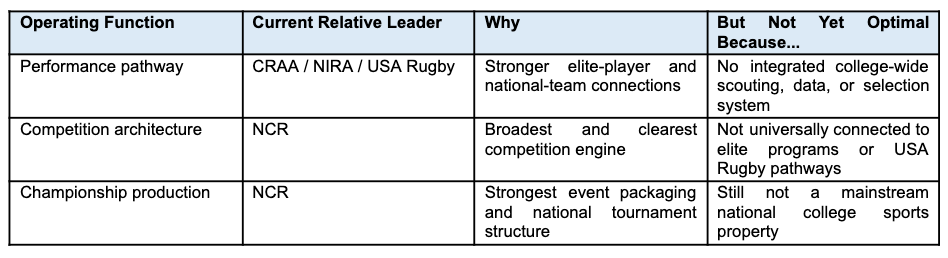
1. Performance Pathway
Best practice: The best college players should be visible, tracked, evaluated, and connected to USA
Rugby age-grade, senior national-team, Olympic, and professional pathways. Selection should not
depend on which organization a player’s school happens to belong to.
Current strength: CRAA and USA Rugby have the strongest relative claims. CRAA is associated
with many top men’s programs. NIRA has a strong concentration of women’s varsity program athletes,although NCR has strength of numbers and national reach. USA Rugby has the formal connection to the national-team pathway for both Men and Women.
Current gap: There is no single college-wide player identification system, shared national data layer,
or universally accepted scouting process across NCR, CRAA, NIRA, varsity programs, club programs,
15s, 7s, men, and women.
Optimal gap: Even where the best players may be concentrated, the broader college ecosystem is
not fully integrated. A best-practice model would connect every college competition to transparent
identification, evaluation, and advancement.
2. Competition Architecture
Best practice: Every team should know where it fits. There should be clear divisions, meaningful
regular seasons, credible rankings, transparent playoff qualification, and championship windows that
are easy to understand. The structure should serve elite and developing teams without forcing them
into the same competitive box.
Current strength: NCR is strongest here. It has built the broadest and most visible competition
architecture, with multiple divisions, national events, and a clearer participation ladder.
Current gap: CRAA has elite credibility but a narrower competition footprint. NIRA has a strong
women’s varsity model but only within its lane. USA Rugby has formal authority but does not operate
the day-to-day college competition ecosystem.
Optimal gap: NCR’s competition machine is significant, but it is not yet universally accepted by the
elite end of the sport or fully connected to USA Rugby’s high-performance pathway. A best-practice
model would combine NCR’s operating scale with broader elite legitimacy and national-team
integration.
3. Championship Production
Best practice: College rugby championships should feel like national sports events. They should
have clear qualification, repeatable dates, strong destinations, recognizable branding, sponsor
inventory, broadcast or streaming coverage, fan experience, and media buildup.
Current strength: NCR is strongest in championship production. It has done the most to turn
competitions into packaged events, particularly across divisions and in 7s.
Current gap: Other championship structures may have strong teams or meaningful titles, but they are not packaged as consistently or broadly. The result is a fragmented championship marketplace where sponsors and fans are asked to understand multiple overlapping claims.
Optimal gap: Even NCR’s strongest events are still not mainstream college sports properties. They
remain largely inside the rugby community. The best-practice standard is not merely a well-run rugby
event. It is a recognizable national college sports property.
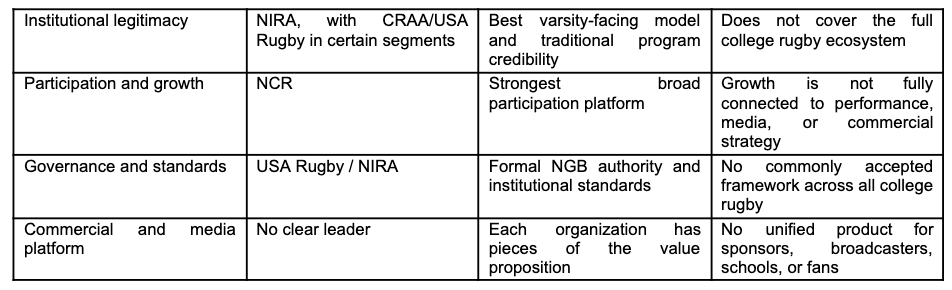
4. Institutional Legitimacy
Best practice: Universities, athletic departments, club sports offices, compliance administrators, risk managers, and student affairs offices should understand the structure. The sport should speak a
language schools recognize: eligibility, safety, governance, insurance, gender equity, conduct,
academic standards, and institutional accountability.
Current strength: NIRA is strongest within its women’s varsity model. CRAA and USA Rugby also
carry legitimacy with certain traditional programs and institutions. NCR has legitimacy with many
clubs, but not necessarily the same institutional recognition across the elite or varsity-facing
landscape.
Current gap: Men’s college rugby remains especially fragmented institutionally. Some teams operate as club sports. Some have quasi-varsity status. Some are deeply connected to alumni. Some are lightly supported by schools. A national structure has to serve all of these realities.
Optimal gap: NIRA may be the cleanest institutional model, but it is not a full-market solution. It does not solve men’s rugby, club rugby, 7s, lower divisions, or the broader college rugby economy. A
best-practice model would take NIRA’s institutional clarity and apply similar discipline across the wider ecosystem.
5. Participation and Growth
Best practice: College rugby should grow players, teams, conferences, coaches, referees, and
sustainable clubs. It should lower barriers to entry while still creating aspirational levels of competition. Growth should connect to retention, safety, coaching education, and long-term development.
Current strength: NCR appears strongest on broad participation. Its model is built around scale,
access, multiple competitive levels, and national participation opportunities.
Current gap: Participation growth is not enough by itself. If growth is disconnected from performance
pathways, institutional standards, media visibility, and commercial strategy, it does not translate into
the full value of the sport.
Optimal gap: NCR may be best positioned to grow participation, but the optimal system would
connect that participation base to elite identification, national storytelling, sponsorship value, and USA Rugby development pathways. Scale should feed the whole system, not sit beside it.
6. Governance and Standards
Best practice: College rugby needs common standards: eligibility, registration, insurance, safety,
discipline, transfers, academic status, match reporting, referee standards, and dispute resolution.
These standards must be trusted by schools and accepted across competitions.
Current strength: USA Rugby has the strongest formal governance claim as the national governing
body. NIRA has strong standards within its institutional varsity structure. NCR and CRAA each have
operating rules for their members.
Current gap: There is no single, broadly accepted college rugby governance framework. Rules differ
by organization. Standards are not always portable. Schools, players, volunteers, and sponsors are
left to navigate complexity.
Optimal gap: Formal authority is not the same as operational execution. USA Rugby may have the
national governing role, but it does not currently provide the full college operating system and has
gaps in youth and adult club levels as well. A best-practice model would separate national standards
from day-to-day competition operations while ensuring both are aligned.
7. Commercial and Media Platform
Best practice: College rugby should be sold as one national story. Sponsors should understand the
season, audience, championships, demographics, media inventory, participation base, and
development pathway. Fans should know what games matter. Players should be visible. Schools
should see value. Media partners should have a product to package.
Current strength: No one fully owns this bucket. NCR may be closest because of its event structure
and participation scale, but CRAA has elite-program credibility, NIRA has institutional value, and USA Rugby has national-team relevance.
Current gap: The commercial story is divided. There is no unified college rugby sales platform, single
championship package, shared media calendar, common data set, or one-stop narrative for sponsors.
Optimal gap: Even the best current commercial efforts are selling pieces of the college rugby market, not the whole market. The optimal model would create one national commercial platform that includes men’s and women’s rugby, 15s and 7s, elite and participation levels, championships, data, content, and pathways.
The Scorecard
Organization Strengths and Limitations
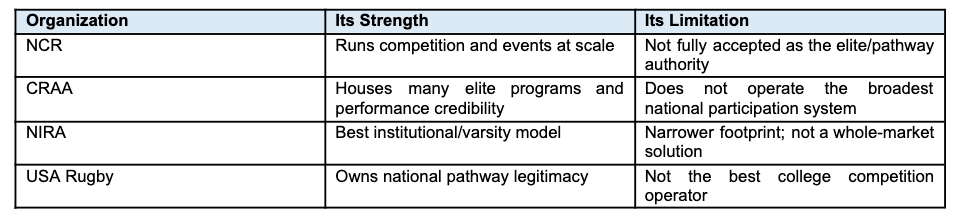
NCR has built the competition engine. CRAA has retained much of the elite-performance credibility.
NIRA has the clearest institutional model. USA Rugby owns the national-team pathway. But no single
organization currently delivers the whole best-practice system.
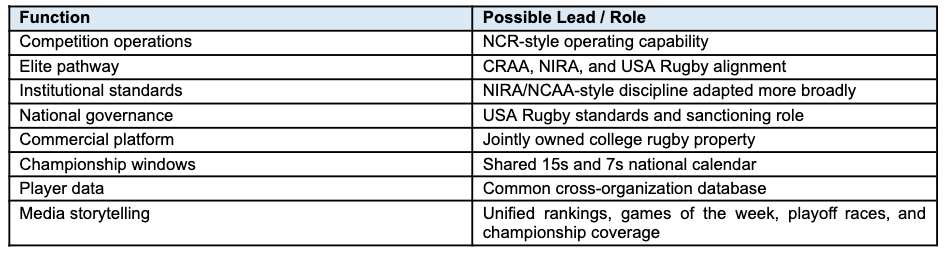
What a Better Model Could Look Like
A better model would not necessarily require every organization to disappear. It could take several
forms: a national college rugby council, a joint operating agreement, a shared championship company, a common eligibility and standards framework, a unified commercial and media platform, a
coordinated 15s and 7s calendar, and a national player identification and data system.
The exact structure matters less than the principle: assign the work to the organizations best equipped to do it, and stop forcing players, schools, sponsors, and fans to navigate the fragmentation.
This would not eliminate disagreement. But it would move disagreement inside a shared model rather
than through competing calendars, competing championships, and competing claims of legitimacy.
The Reinvestment Point
The reason this matters goes back to Part 1. The commercial opportunity is not about extracting
money from college rugby. It is about building a system that can reinvest money into the sport.
A unified operating model could help fund better national championships, travel support, coaching
education, refereeing, medical and safety standards, women’s rugby investment, player identification,
data and rankings, media coverage, development pathways, and support for emerging programs.
That is what is lost when the system remains fragmented. The dollars are not just dollars. They are
the fuel for the sport college rugby says it wants to become.
How to Move Forward
The next chapter of U.S. college rugby should not be determined by which organization can make the
strongest historical, political, or legal claim to authority.
It should be determined by capability.
Who can run competitions? Who can produce championships? Who can identify players? Who can
speak to universities? Who can grow participation? Who can set standards? Who can sell the national
story? Who can connect college rugby to the future of the American game?
The answer is not one organization. At least not today.
The answer is a better operating model that recognizes the strengths already present in the system
and organizes them around the jobs that need to be done.
College rugby has the pieces.
What it does not yet have is the structure to make those pieces work together.
Anthony “Anton” Forbes-Roberts is an NCR Board member and proud CRAA rugby parent/booster at UCLA; past President of Rugby Georgia; past founder, coach, and President of Atlanta Youth Rugby; and coach at USA Rugby South Panther Academy.