

James Breese | Founder, Cricket Matters
All clinical standards and performance work at Cricket Matters are overseen by James Breese — Level 5 Sports Clinical Therapist (LCSP Member No. 9390) and ECB Coach. Our integrated approach holds three perspectives at once — clinical, strength training, and cricket coaching — applied to athlete safety, injury rehabilitation, and performance under load.
If your child is an eleven-to-seventeen-year-old fast bowler with back pain, the conversation has probably already started. Maybe the GP said growing pains. The club physio said muscle strain. The school coach said he needs to rest, ice it, and he’ll be right next week. And maybe he was. For a fortnight. Then it came back.
One seventeen-year-old fast bowler described the pattern like this: it hurt for about three days, settled, then came back the next time he bowled. That recurrence is the cohort’s entry point — what most parents notice from their own observation at home, well before the diagnostic conversation gets specific.
Back pain in a junior fast bowler isn’t one thing. It’s a question with multiple possible answers — and most of those answers don’t show up at first examination.
In our clinical screening at Cricket Matters, we work backwards from that recurrence pattern. Pain that goes away with rest and comes back when bowling resumes is the body telling you something specific. The pain isn’t the diagnosis. It’s the result of a diagnosis you don’t have yet.
This post walks through eleven conditions that can produce back pain in a junior fast bowler — what each one is, what it tends to feel like, and where each one sits on the diagnostic map. The point isn’t to give you a verdict. None of these conditions are diagnosed by reading a webpage. The point is to give you the vocabulary your next conversation needs.
What Most Parents Are Told vs What’s Actually Happening
The published clinical literature on adolescent back pain is reasonably clear on what’s underneath the symptom. Most adolescent low back pain is non-specific — meaning the published research can’t tie it cleanly to a named structural cause — and most of it is self-limiting — meaning it resolves with conservative care over weeks (MacDonald, Stuart & Rodenberg, 2017; Roberts, Calligeros & Tsirikos, 2019).
That’s the picture most GPs are working from. They see thousands of patients a year, the great majority of whom don’t have a bowling action loading a still-developing spine forty deliveries a week.
The cricket-specific evidence sits in a different bracket. In a prospective study of adolescent fast bowlers, Engstrom and Walker (2007) found that 22% developed L4 stress lesions between the ages of 15 and 17, all on the non-bowling-arm side of the spine. Keylock and colleagues (2022), studying adolescent male fast bowlers aged 14-17, reported a baseline lumbar bone stress injury prevalence of 20.5% with an annual incidence of 27.3 injuries per 100 players per year.
The literature on adolescent back pain in general says most cases are benign. The literature on adolescent fast bowlers says one in five will show a lumbar bone stress injury before reaching senior cricket. Both are true at once. The first is the population-level statistic your GP is working from. The second is the cohort-level statistic your child sits in.
Your child is not the average adolescent. They are an adolescent doing something the average adolescent does not do.
That gap is the reason the standard pathway often doesn’t land. The growing-pains framing isn’t wrong because GPs are careless. It’s incomplete because the question they’re answering isn’t the question your child’s bowling action is asking.
One coach made the point cleanly in a public forum on a teenage bowler with persistent back pain — “I doubt very much that it is ‘growing pains.’” The same coach, in the next paragraph, listed the differential that should be ruled out before that label is accepted — “I would hugely recommend you visit your GP to eliminate scoliosis, spondylolisthesis or a stress fracture. The spine is not something you should take for granted.” Name what else it could be. Then ask better questions about which one it is.
The Eleven Conditions, Grouped by Type
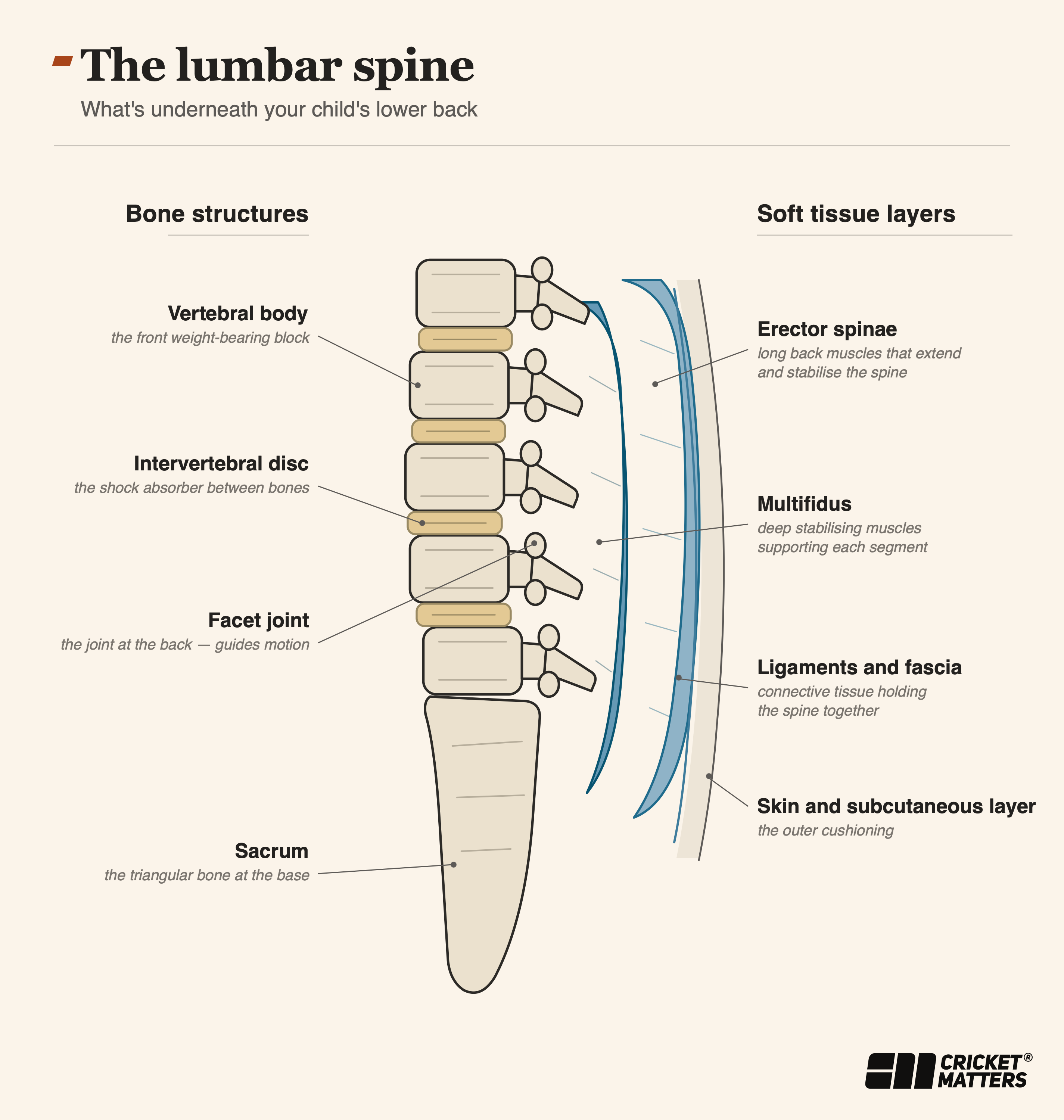
Here’s the differential breadth. We group these into six clinical brackets — not because the brackets are diagnoses themselves, but because they map to different patterns of presentation and different assessment routes.
Bone-Stress Conditions
1. Pars stress reaction or stress fracture (spondylolysis). The condition the cricket literature names most often. The pars interarticularis is a small section of bone at the back of each vertebra. Under repeated bowling-action load — particularly the side-bending plus rotation cricket fast bowlers go through at front-foot contact — the bone can develop a stress reaction (microscopic loading injury, often visible on MRI as bone marrow oedema before any crack appears) and, if loading continues, a stress fracture (a defined break in the bone). Engstrom 2007 and Keylock 2022 both put this at the top of the differential for adolescent fast bowlers. The deep post on pars stress in this cluster covers it in detail.
2. Vertebral apophyseal ring injury. A growth-stage lesion where the cartilaginous ring around the vertebral endplate (which has not yet fully fused to bone in adolescence) is injured under load (Hasler, 2013). Less common than pars stress but recognised in the adolescent-spine literature. Tends to present after a specific high-load delivery or a fall, more than as a gradual recurrence.
3. Rib stress reaction. Cricket-specific. Stress injuries to the ribs in fast bowlers are a recognised pain-localisation differential — pain felt in the back may originate from the rib at the costovertebral joint, where the rib joins the spine. The cricket-specific rib-stress evidence sits in journals outside the current PubMed parser, so we carry this as a clinical-observation differential, not a citation-anchored claim.
Soft-Tissue Conditions
4. Lumbar muscle strain — including quadratus lumborum. The most common acute presentation. The quadratus lumborum, a deep side-of-the-back muscle, is structurally loaded by the bowling action; Engstrom and colleagues (2007) found asymmetric quadratus lumborum hypertrophy on the bowling-arm side in adolescent fast bowlers, which helps explain why one side tends to hurt more than the other. Most muscle strains resolve with two-to-four weeks of relative rest. The diagnostic problem: recurring muscle-strain framing is often the label given to a bone-stress injury underneath.
5. Facet joint irritation. The facet joints sit at the back of the spine and guide rotation. In a bowler whose hip rotation is restricted, the lumbar facets pay for what the hip can’t produce. Inflammation here tends to produce pain on extension and rotation toward the bowling-arm side.
Mechanical Conditions
6. Hip-spine pattern (lumbopelvic-thoracolumbar coupling). Back pain where the cause is in the hip. The bowling action requires hip extension and rotation; if the hip can’t produce those ranges, the lumbar spine has to. Bayne and colleagues (2015), in a prospective cricket-specific study, found that bowlers who developed lower back injuries had on average 5° less hip flexion at front-foot contact (46° vs 51° in uninjured) and 10° more thorax lateral flexion at ball release. Keylock and colleagues (2022b) extended this — thoracolumbar rotation and lumbopelvic rotation between back foot contact and ball release were identified as predictors of lumbar bone mineral density, explaining 65% of the variation in adolescent fast bowlers. The pattern has its own deep post later in this cluster.
7. Mixed-bowling-action mechanical overload. A “mixed action” — front-on with the lower body, side-on with the upper, or some hybrid — produces shoulder counter-rotation across the spine. Senington and colleagues (2018) identified shoulder counter-rotation as a primary mechanism of lumbar load in fast bowlers. Mixed-action overload is often the upstream explanation for why a bowler develops pars stress or muscle strain in the first place.
Postural and Growth-Related Conditions
8. Scheuermann’s disease. A growth-stage condition where the front edge of the vertebrae develops a wedged shape during the adolescent growth spurt, producing a forward curvature of the upper back (Hasler, 2013). Often mild; sometimes painful, particularly under bowling-action extension. More common in boys; typically declares itself between 12 and 16.
9. Postural overload from kit and carriage. Pads, helmet, kit bag, school rucksack carried daily. Cumulative load isn’t the cause of cricket back pain but can be the layer underneath a condition that wouldn’t otherwise have declared itself. The cricket-specific evidence on this in juniors is limited; the general adolescent-spine load literature supports the principle.
Referred Conditions
10. Sacroiliac joint dysfunction. The sacroiliac joint sits between the sacrum (the base of the spine) and the pelvis. Loading patterns at the bowling delivery stride can produce pain that feels like lumbar pain but is generated lower down. Tends to localise to a small spot just to one side of the bottom of the spine.
11. Iliac crest apophysitis. Growth-plate inflammation at the top edge of the pelvis where the abdominal and back muscles attach to bone (Achar & Yamanaka, 2020; Patel & Kinsella, 2017). Pain felt as low back or upper buttock, often just above the pelvis. The cricket-specific apophysitis literature is thin; the general adolescent-athlete evidence base carries the pattern. The deep post on apophysitis versus growing pains covers it in detail.
That’s eleven. Not a complete list — rarer conditions (tumours, infections, congenital malformations) need to be ruled out before any of the eleven above are accepted — but it’s the differential breadth a competent cricket-aware assessment is working through.
Some parents arrive at this list having read about scoliosis or spondylolisthesis. Scoliosis is a structural pattern checked separately — outside the bowling-action differential this post covers. Spondylolisthesis sits downstream of unresolved pars stress (condition #1 above); a deeper post on pars stress injuries in junior cricketers (publishing in this cluster) covers it in detail.
What Each Condition Typically Presents As
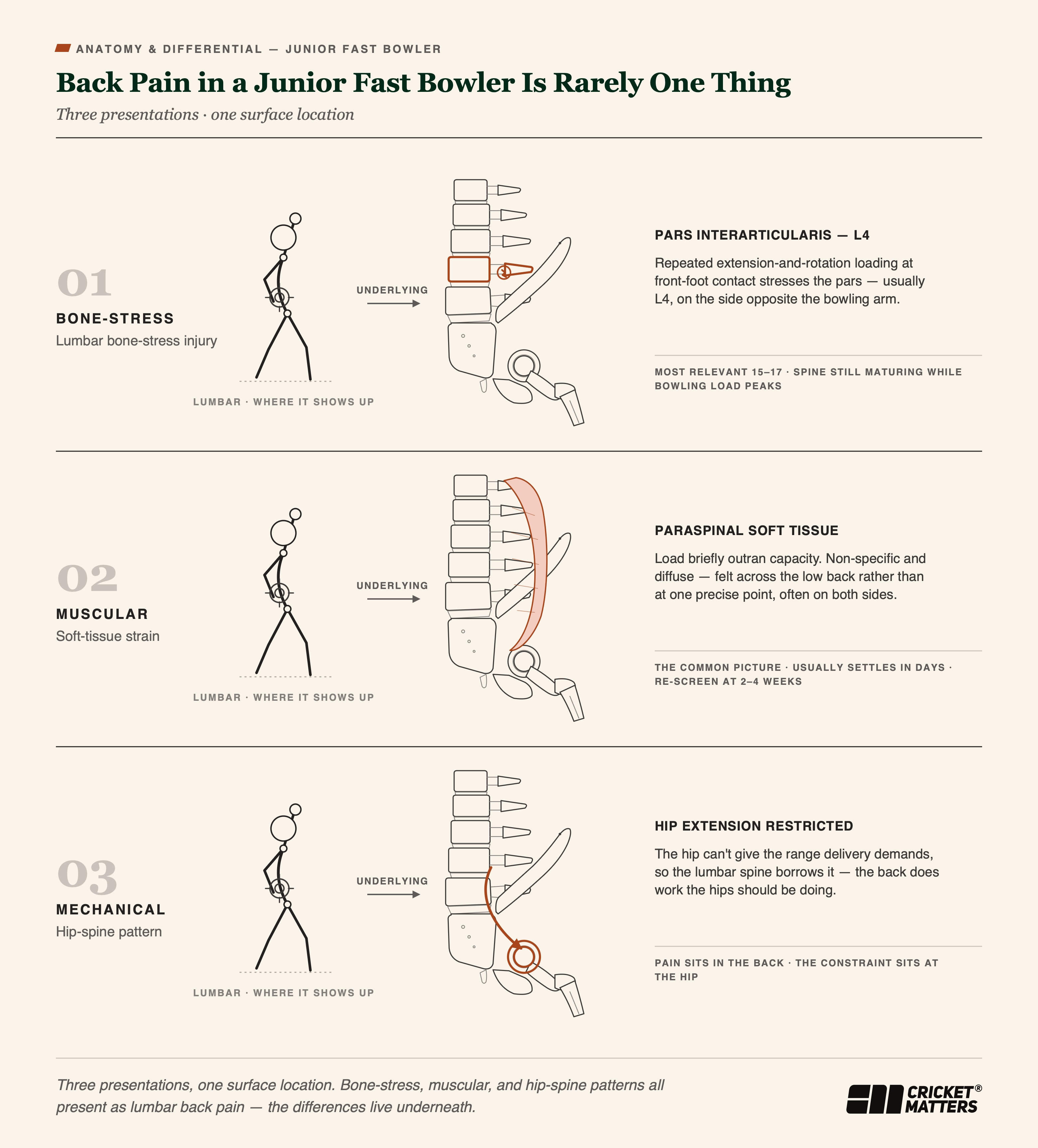
Here’s the same eleven, organised by what each one tends to feel like at the recurrence-pattern stage parents most often present at. None of these descriptions are diagnostic. They’re orientation cues for a conversation with a clinician.
| Condition | Typical recurrence pattern | Provoking movement | Side bias |
|---|---|---|---|
| Pars stress reaction / fracture | Bowling produces pain; rest resolves; bowling brings it back. Often weeks before it stops resolving with rest. | Extension (arching back), rotation toward bowling-arm side | Non-bowling-arm side (Engstrom 2007: 22% of cases on contralateral side) |
| Vertebral ring injury | Single-incident onset more often than gradual recurrence | Flexion (bending forward), often after a high-load delivery | Variable |
| Rib stress | Pain referred through to the back from the costovertebral joint area | Rotation, deep breathing, lying on the affected side | Bowling-arm side typically |
| Lumbar muscle strain | Acute onset; resolves within 2-4 weeks if it’s only muscle | Any direction; localised tenderness on palpation | Often bowling-arm side (quadratus lumborum hypertrophy pattern) |
| Facet joint irritation | Recurrence pattern with extension and rotation | Extension + rotation combined | Toward bowling-arm side |
| Hip-spine pattern | Pain pattern doesn’t resolve with standard physio approaches; the back pain “keeps coming back” | Bowling action mechanically; hip-mobility-loaded positions feel restricted | Often bilateral with one side restricted |
| Mixed-action mechanical overload | Persistent pain pattern correlated with bowling spells; coach has often raised action concerns | Bowling-specific; less symptomatic in non-cricket activity | Often non-bowling-arm side of the spine |
| Scheuermann’s disease | Pain on extension; visible thoracic curvature; pain may be unrelated to bowling specifically | Extension; prolonged sitting also provokes | Thoracic > lumbar typically |
| Postural overload | Diffuse pain; multiple sites; correlates with school-load weeks more than bowling spells | Cumulative across the day rather than acute | Bilateral typically |
| Sacroiliac dysfunction | Pinpoint pain location; often described as “deep” | Single-leg loading; getting in and out of a car; bowling delivery stride | Unilateral; specific localisation |
| Iliac crest apophysitis | Pain just above the pelvis on the side; aggravated by abdominal or back-muscle contraction | Sit-ups, twisting, side-bending | Often bowling-arm side |
No one of these descriptions diagnoses the condition. What they do is tell you whether your conversation with the clinician is missing something.
Back pain in a young fast bowler is rarely growing pains.
A free parent’s guide — what’s actually likely happening, what to look for at home, and what to do about it.
Why the Eleven Get Confused — The Diagnostic Overlap Problem
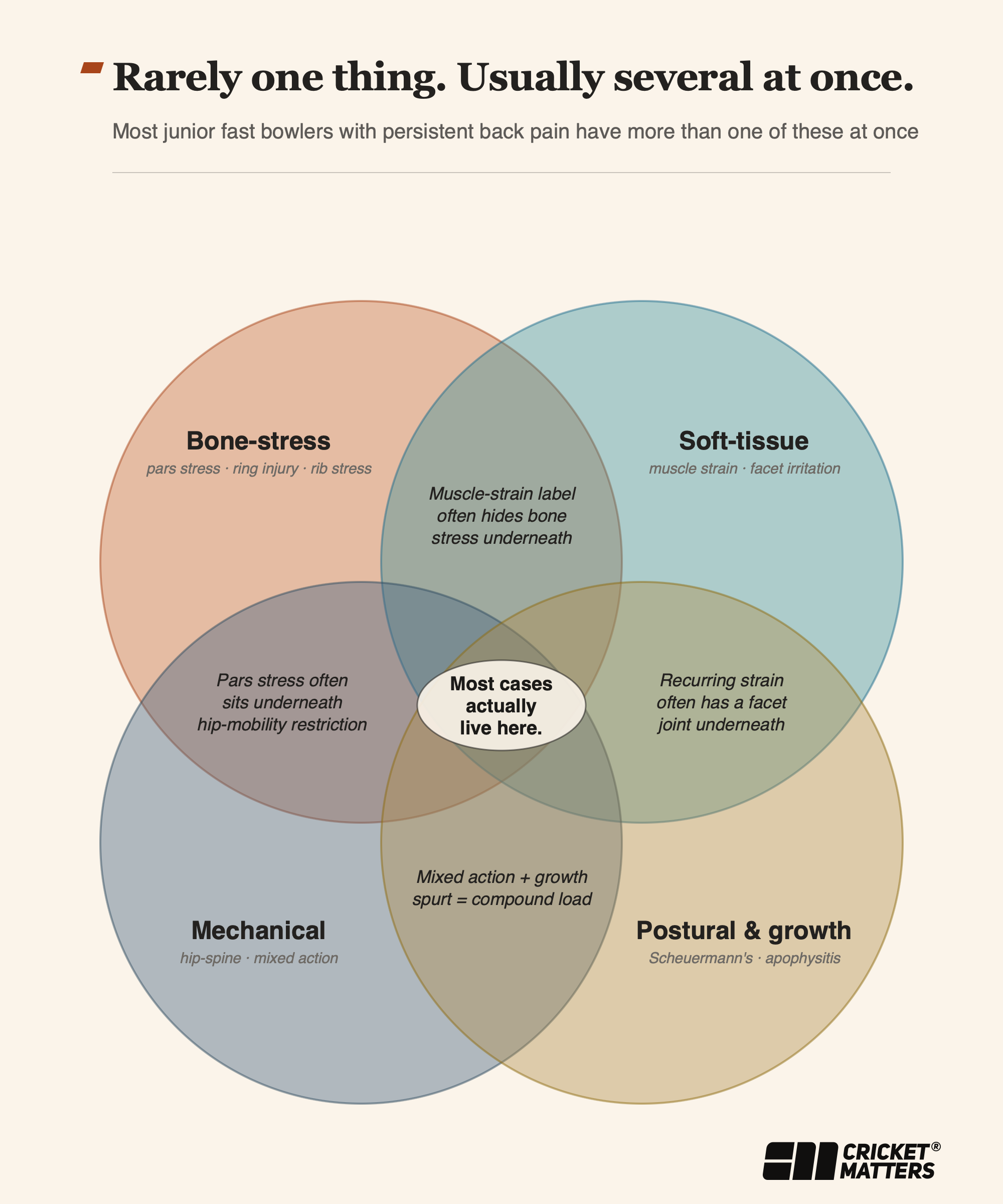
The patterns above don’t sit in clean boxes in real life. A junior bowler with pars stress reaction often also has hip-mobility restrictions (which is partly why the pars is overloaded in the first place). A bowler with a mixed action may also be in the adolescent growth spurt when Scheuermann’s tends to declare itself. A muscle strain that doesn’t resolve in four weeks may have a facet joint underneath that wasn’t picked up at first examination.
This is the central reason the standard pathway misses things. First-examination clinicians work down the most common differential first — muscle strain, generally non-specific, generally rest-and-stretches. That works for the bulk of the population it’s calibrated against. For the cricket fast bowler subpopulation, the differential breadth is wider and the conditions are more likely to overlap.
“Growing pains” isn’t a clinical diagnosis. It’s a category that holds the pain that doesn’t clearly fit anywhere else. Most adolescents do have benign, growth-stage musculoskeletal soreness. That doesn’t tell you whether your specific child does, or whether the label is hiding something more specific underneath. A single examination — particularly one done without a bowling-context question set — often misses what’s actually happening. The pain is too vague at first to differentiate cleanly. By the time it’s vague-but-persistent, the bone or joint that produced it has often been loading the wrong way for months.
What a Proper Assessment Actually Looks At
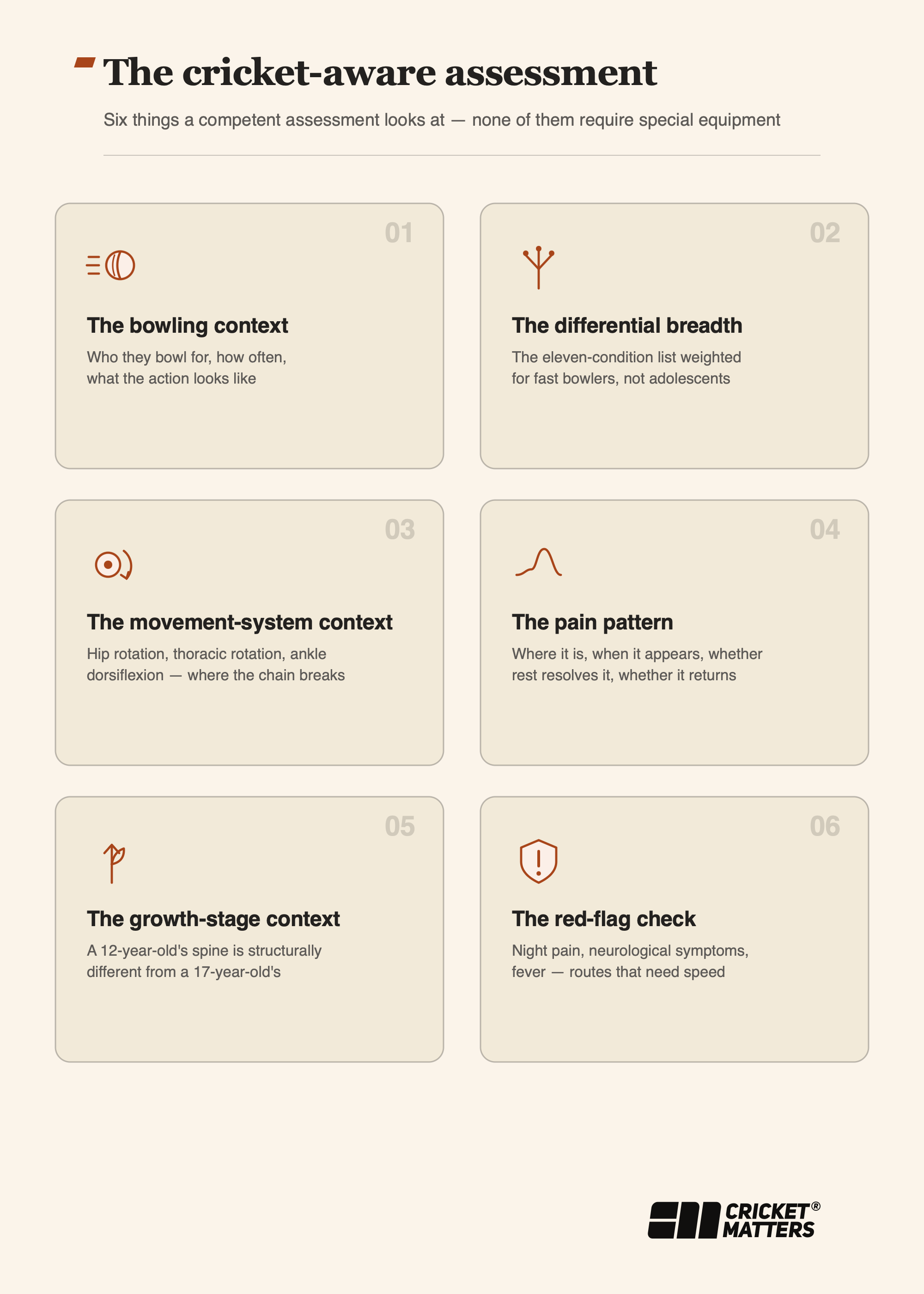
A cricket-aware assessment for back pain in a junior fast bowler does six things the standard pathway doesn’t always carry. None of these require any equipment a competent assessor doesn’t already use. What they require is the question set.
The bowling context. When the pain starts, how the load looks across the week, what teams the bowler is turning out for, how the bowling action sits. A bowler at 15 turning out for school, club and county across one week is in a different population to a bowler at 15 turning out for the school side only. The signal that matters most is how often the bowler is bowling, not the total balls alone — in junior fast bowlers, a higher percentage of days bowled and a shorter in-season break track with bone stress injury more closely than ball counts or workload ratios do (Kountouris and colleagues, 2018).
The differential breadth. A working list of the eleven conditions above, with cricket-specific weighting. Pars stress and the hip-spine pattern sit higher in the cricket-bowler differential than they do in the general adolescent differential.
The movement-system context. Hip rotation. Thoracic rotation. Ankle dorsiflexion. The bowling action requires range at all three; if any of them is restricted, the spine pays for what the rest of the chain can’t manage. The clinical norm range for hip internal rotation is roughly 35-45° in healthy adolescents; in fast bowlers, the asymmetry between the two sides matters more than either absolute number, and the cricket-specific prospective evidence (Dennis and colleagues, 2008) shows the relationship between hip internal rotation and bowling injury isn’t simply linear.
The pain pattern. Where it is. When it appears in the bowling spell. Whether it eases or worsens through the over. Whether rest resolves it. Whether the resolution lasts.
The growth-stage context. A 12-year-old’s spine is structurally different from a 17-year-old’s. Apophyses, growth plates and ring epiphyses are still developing in early-to-mid adolescence and are the structurally weakest links in the chain under load.
The red flag check. Pain at night that wakes the child. Numbness or weakness in a leg. Loss of bowel or bladder control. Fever, unexplained weight loss, persistent pain unrelated to activity. These route immediately to GP or A&E rather than into a movement-system pathway. Most junior bowlers with back pain do not have any of these. The check is there because the small number who do need to route differently and quickly.
Where to Go Next
What to do when your child’s back hurts.
Eleven conditions cricket can produce in a teenage spine. A seven-station home screen. A clear next step for every result.
You now have the eleven-condition vocabulary. Three moves are useful from here.
One — the parent’s guide. The free guide for parents of junior fast bowlers covers the home screen, the red-flag panel and the seven movement stations the clinical assessment is built around. It’s the next step if you want to be the parent who walks into the next appointment with the right questions.
The diagnosis isn’t the end of the season. It’s the start of the path your child can actually take.
Two — the deep posts in this cluster. Pars stress injuries in junior cricketers, apophysitis versus growing pains, and back pain from the hip each go further into a specific condition this hub only summarises. The load-management hub sits alongside this one — when to rest, when to bowl, and the multi-team coordination problem most parents are trying to manage without a brief.
Three — a clarity call. If anything here has produced a question — about your child specifically, or about whether their back pain fits one of the eleven patterns above — a free twenty-minute clarity call is the next move. We don’t diagnose on the call. What we do is look at the bowling context, the pain pattern and the assessment route, and tell you straight whether what your child is presenting with fits the cluster’s typical pathways or warrants something else.
The full pillar guide for the cluster sits at Back Pain in Junior Fast Bowlers — A Parent’s Guide. If you’ve reached this post first, that one is worth reading next.
Parent Questions Answered
Is my child’s back pain serious?
Most adolescent back pain resolves with conservative care over weeks. The published literature is clear on that. The cricket-specific evidence is also clear that one in five adolescent fast bowlers will show a lumbar bone stress injury before reaching senior cricket. Both are true. The question is which group your child is in. Pain that resolves with rest within two-to-four weeks and doesn’t return when bowling resumes is at the reassuring end. Pain that comes back every time bowling resumes — particularly pain in the same spot, on the same side, after the same kind of delivery — is the pattern that warrants a closer look.
Can it really be eleven different things?
The list isn’t a forecast — most junior bowlers with back pain have one of two or three of the conditions, not all eleven. The point of the list is that the first-examination differential is often narrower than the actual range of possibilities. Knowing the breadth helps you and the assessor work through it cleanly.
My GP said growing pains. Should I push back?
Not necessarily, but you can ask better questions. “Growing pains” as a label tends to mean “non-specific musculoskeletal pain that will probably resolve on its own.” That’s often accurate. What it doesn’t rule out is the cricket-specific differential above. A useful question is: “If this comes back after a fortnight of rest, what would you want to look at next?” That gives the GP a route to escalation if the picture changes, without questioning the initial framing. The next post in the cluster on apophysitis versus growing pains goes into the language for this conversation in more detail.
What’s the difference between a stress reaction and a stress fracture?
A stress reaction is the bone responding to load before it has actually broken. Imaging often shows bone marrow swelling (oedema) on MRI without a fracture line. A stress fracture is the same continuum further along — the loading has continued and the bone has developed a defined break. Caught at the reaction stage, the condition is often more responsive to conservative care. The deep post on pars stress injuries covers this in detail.
How long should we wait before pushing for a scan?
If the pain is resolving with rest and not returning when bowling resumes, scans are usually not the first step. If the pain has been recurring for more than six weeks despite reasonable conservative care, or if any red flag signs appear (night pain, neurological symptoms, fever, unexplained weight loss), the conversation about imaging needs to happen earlier. The post on scans in this cluster (publishing in Tier 2) covers what each scan type actually shows.