
Summary
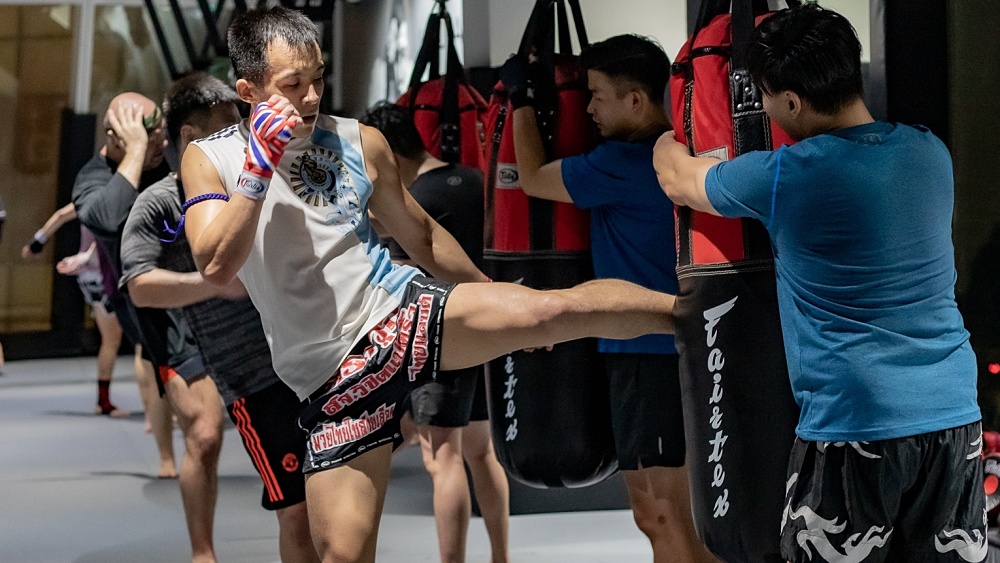
Kicks are the defining weapons of Muay Thai, more powerful than punches, higher scoring in the eyes of judges, and capable of ending a fight at any moment. Unlike boxing, which limits fighters to their hands, Muay Thai opens up the entire body as both a target and a weapon, and the six kicks covered in this article sit at the heart of that system. From the long-range control of the teep to the devastating low kick, the rib-cracking body kick, the highlight-reel head kick, and the deceptive switch and jumping kick variations, each technique serves a distinct purpose in a fighter’s offensive arsenal. This article breaks down how each kick works, where it lands, and what it is designed to achieve — giving you a clear framework for understanding and developing your kicking game. As Muay Thai World Champion and Evolve MMA instructor Chaowalit Jocky Gym puts it, “Kicks win fights. A fighter who can throw all six weapons with power, timing, and purpose is a fighter who controls everything, the distance, the pace, and ultimately the result.” Whether you are new to the art or refining your existing technique, mastering these kicks is non-negotiable.
Key Takeaways
- Kicks score higher than punches in Muay Thai, making them essential to any serious fighter’s game. Judges place significant weight on clean, powerful kicks when scoring a bout, which is why fighters with a strong kicking game so often win decisions that appear close to outside observers.
- The teep is not just an attack; it is a range management tool. Used like a jab in boxing, the teep controls distance, disrupts your opponent’s rhythm, and sets up other techniques, making it one of the most tactically versatile weapons in Muay Thai.
- The low kick targets the leg, not just for damage but for cumulative breakdown. Repeated low kicks erode an opponent’s mobility and balance over the course of a fight, and in many cases can finish a contest by rendering a fighter unable to continue standing effectively.
- Body kicks are most effective when used to break down the guard over multiple rounds. Repeatedly attacking the arms and ribs forces your opponent to make defensive compromises, opening the door to the head kick later in the fight.
- Switch kicks and jumping kicks are deception tools as much as power tools. Their effectiveness depends heavily on timing, footwork, and the ability to disguise your intentions, making them advanced techniques that reward dedicated drilling.
- The shin, not the foot, is the primary striking surface for roundhouse kicks. Muay Thai’s emphasis on the shin over the foot is a key technical distinction from other striking arts, producing far more power and structural integrity on impact.
1) Teep
Also referred to as the push kick, the teep is a long-range stamping kick used to do damage and also keep your opponent at bay. This kick is also a brilliant range finder and can be used to set up other techniques in place of the traditional jab. To perform this kick in the most common way (off the front leg closest to the opponent), shift your weight so that more is carried on the back leg. You’ll notice your front leg then becomes lighter. Raise the knee upwards as if bringing it towards your chest, then stamp forward, leaning backwards slightly and driving the hips towards the target at the same time. The point of impact can vary depending on the objective. The sole of the foot to maintain distance, and the ball of the foot, or sometimes even the heel, for more damaging shots. Typically, the target for this kick is the torso of the opponent, but many fighters also teep to the thighs for a fast and disruptive strike. Less commonly, something of an insult in Muay Thai and definitely not advisable to do to your training partners, you may even see a teep to the face now and again.
2) Low Kick
The low roundhouse kick is one of the most devastating kicks in any martial art due to the incredible amount of power that can be generated into it. You don’t have to look far to see a fight finished within the allotted rounds simply by a series of stunning leg kicks. Aimed at either the inner or outer thigh of the opponent, the low kick effectively sandwiches the meat of the thigh between the attacker’s shinbone and the defender’s femur. To throw any roundhouse kick, the starting motion is both a snapping of the hip and twisting of the lead foot on the tiptoe. The kicking leg is essentially a dead weight, carried round with the force of a baseball bat into the opponent’s leg. Unlike other martial arts, where kicking with the foot is typical, Muay Thai emphasizes the use of the shin. The foot is made up of many small bones, whereas the shin is one solid block swinging towards an opponent. Not only can the low kick be used as an impact weapon, but if used correctly, it can also sweep an opponent completely off their feet, scoring big in a Muay Thai fight.
3) Body Kick
Fired off in the same way as the low kick, the mid-level roundhouse is another fight finisher. Probably the most interesting detail about this kick is the option to either attack the arms or the torso of the opponent. Many fighters aim at the arms specifically over the course of a few rounds to break down the opponent’s guard. After taking repeated damage to the upper arms, it becomes extremely hard to maintain an effective defensive position with the hands held high. Later on in a fight, this allows for an easier attack to the head and an opportunity for the coveted knockout strike. Repeatedly kicking the arm can also render their punches from that side useless.
The target that is usually the first choice option for someone throwing a body kick is the ribs. Landing a full power kick across the ribs is one of Muay Thai’s trademark moves. Repeated kicks against the heavy bag or on the pads, with an emphasis on speed and hip torque, is the fastest route to a fight-ending roundhouse.
4) High Kick
A highlight reel finisher, the high roundhouse is one of the more spectacular shots to witness in a Muay Thai bout. This shot is almost invariably targeted to the head of the opponent. The head kick has the longest path from the floor to the target, so it is essential to set it up correctly by convincing your opponent to lower their guard in some way. Body shots, kicks, and knees all encourage a lower guard and opportunity to land the head kick.
5) Switch Kick
A variation on the roundhouse, a switch kick requires a switching of the stance. For example, if you are right-handed it means your left leg will usually be in front. Once switched, your lead left leg becomes your power leg, ready to attack the right side of the opponents body. Switch kicks are used for a variety of attacks and are best used to mislead and “fake out” an opponent with clever timing, footwork, and speed. When you switch your stance, try not to jump both legs at once (remember leg kicks can knock you over mid jump!). Instead, try to take two quick steps. Step the lead leg back, then the back leg forward quickly to stay grounded and move with speed and proper balance.
6) Jumping Kick
Performed with either a jumping switch or simply straight off the ground, the jumping kick is uncommon but even more impressive than the standard roundhouse kick. By jumping as you kick, you add a great amount of momentum, making jumping kicks some of the strongest techniques you can use. Try jumping upwards as you throw your roundhouse kicks on the heavy bag so that it lands while you are still in the air. This kick is sometimes seen when a fighter catches his opponent’s leg, jumping forward into his opponent as he off-balances him.
Kicks are an essential part of the Muay Thai game. They are harder to learn and harder to pull off well in a fight, but that’s why they score so highly. Many fights often look quite evenly matched to an outside observer, where one competitor is throwing heavy punches and the other heavy kicks. However, as is also often the case, when the decision is announced, the fight goes the way of the kicker. This isn’t always the result of course, but diversifying your attack with these techniques is a must for any serious martial artist.
Frequently Asked Questions About Muay Thai Kicks
Q: Which Muay Thai Kick Should Beginners Learn First?
A: The teep is the best starting point for most beginners. It is the simplest kick mechanically, requires the least flexibility, and teaches the foundational principles of hip drive and balance that apply to every other kick in Muay Thai. More importantly, it is immediately useful — giving you a way to control distance and disrupt your opponent from the very early stages of your training. Once your teep is reliable, the low kick is the natural next step, as it shares the same hip rotation mechanics as the body and high kick.
Q: Why Does Muay Thai Use The Shin Instead Of The Foot For Kicks?
A: The shin is a single, dense bone that delivers significantly more structural integrity and force on impact than the foot, which is made up of many small bones that are vulnerable to fracture when striking hard targets. Using the shin also allows fighters to generate more power through the swing of the entire leg, similar to a baseball bat connecting with a ball. Conditioning the shin through regular bag work gradually hardens the bone and reduces pain on impact — a process that takes time but is fundamental to developing effective Muay Thai kicks.
Q: How Do I Set Up The High Kick Without Getting Countered?
A: The high kick is most effective when your opponent has been conditioned to defend lower. Body kicks, knees to the midsection, and teeps to the torso all draw your opponent’s guard and attention downward over the course of a fight. Once their hands begin to drift lower in anticipation of body attacks, the high kick becomes available. Timing and disguise are equally important — the high kick thrown with the same setup motion as your body kick is far harder to read than one telegraphed by a visible change in posture or height.
Q: What Is The Difference Between A Switch Kick And A Spinning Kick?
A: A switch kick involves a rapid exchange of foot position, stepping the lead foot back and the rear foot forward, to change your power side before delivering a roundhouse kick. It is primarily a deception tool, designed to attack from an unexpected angle with your power leg. A spinning kick, by contrast, involves rotating the body 180 degrees before striking, generating momentum through the spin itself. Both are advanced techniques, but the switch kick is more commonly used in competitive Muay Thai because it is faster and easier to recover from if it misses.
Q: How Important Are Kicks To Winning A Muay Thai Fight On Points?
A: Extremely important. Muay Thai judges score based on the effectiveness and impact of techniques, and clean, powerful kicks consistently score higher than punches in the eyes of most judges. A fighter who controls the fight with well-timed kicks, particularly body kicks and low kicks, will almost always win a decision over a fighter who relies primarily on hand combinations, even if the punch output is higher. Understanding this scoring dynamic is one of the most important pieces of strategic knowledge a competitive Muay Thai fighter can have.
Q: How Long Does It Take To Develop A Powerful Roundhouse Kick?
A: The mechanics of the roundhouse kick can be learned relatively quickly, but developing genuine power requires months of consistent drilling. Hip flexibility, hip rotation speed, and shin conditioning all contribute to a powerful kick, and each takes time to build. Most practitioners find that regular pad work and heavy bag training with a deliberate focus on hip torque and follow-through rather than just speed produces the most significant improvements. Elite-level kicking power, of the kind you see in professional competition, is typically the product of years of dedicated training.
Q: Can Low Kicks Alone Win A Muay Thai Fight?
A: Yes, and it happens regularly at every level of competition. A sustained low kick attack targets the peroneal nerve on the outer thigh — one of the most sensitive points on the body — and repeated impact to this area causes progressive numbness, weakness, and instability in the leg. Fighters who cannot check or avoid low kicks effectively often find themselves unable to stand or move properly by the middle rounds, at which point the referee may stop the contest. Even when a fight goes to a decision, a fighter who has dominated with low kicks will have scored consistently throughout and built a significant points lead.
Q: What Is The Best Way To Practise Kicks Without A Training Partner?
A: The heavy bag is the most effective solo tool for developing kicks. It provides resistance, feedback on power and accuracy, and allows you to drill the same technique repeatedly without fatigue affecting a partner. Shadow drilling, performing the kick in the air with full hip rotation and follow-through, is useful for working on mechanics and flexibility, but should be supplemented with bag work as soon as possible to ensure your technique translates to real impact. If you have access to a kicking shield or a wall-mounted pad, these are also excellent for solo drilling, particularly for the teep and low kick.
You may also like: