
- A potential Hall of Fame pairing at wide receiver: Hines Ward and Antonio Brown played two seasons together, after Ward peaked and before Brown did, but both could end up in Canton within the next decade.
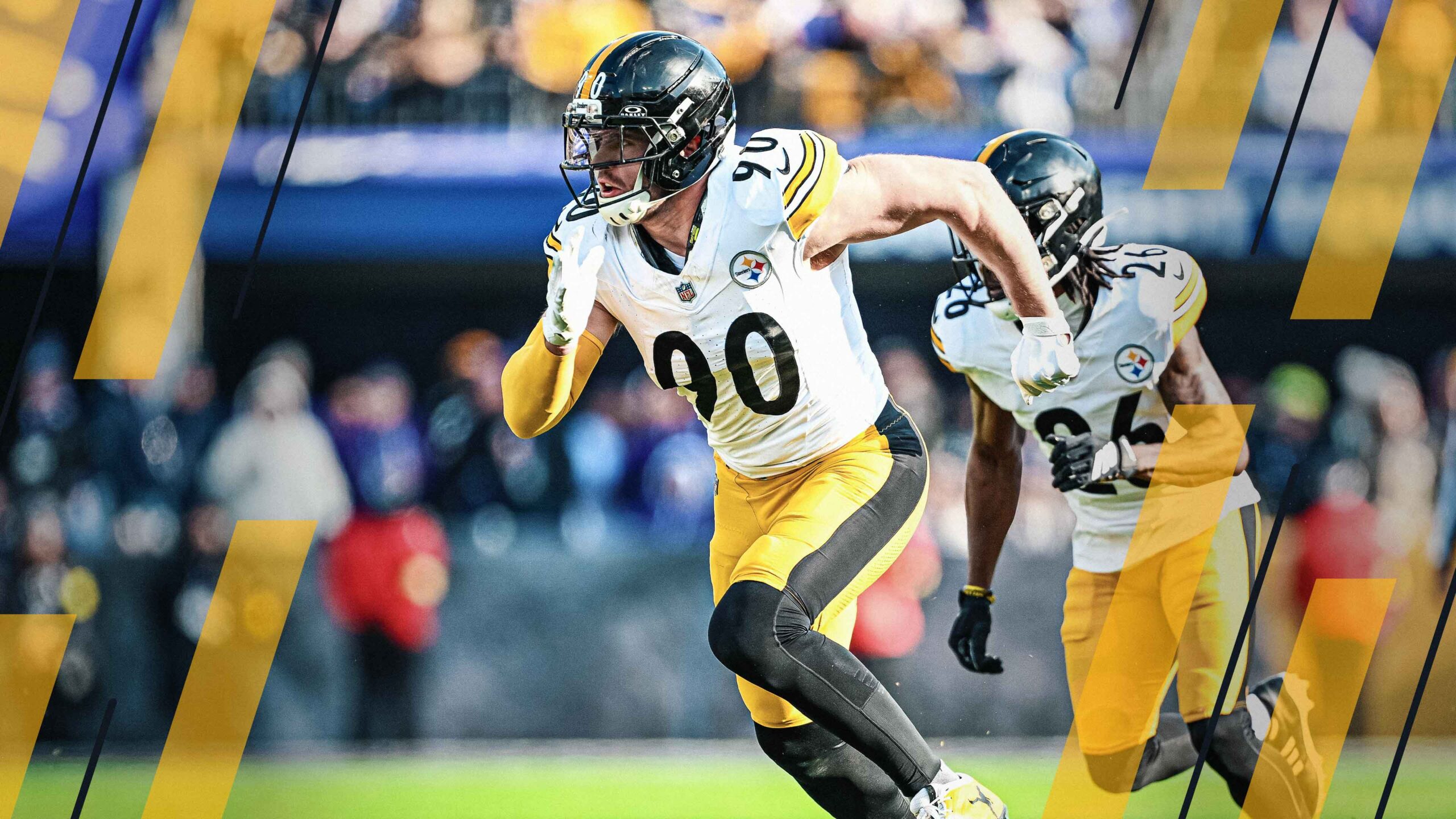
- A similar pairing at outside linebacker: James Harrison and T.J. Watt similarly overlapped for a few games, but both put together a Hall of Fame resume.
- Pittsburgh’s roster continuity simplified many selections: Unlike several franchises, the Steelers retained many of their top performers, resulting in an All-PFF team built around players who spent years producing together.
As part of PFF’s celebration of 20 years of NFL data, we’re building an All-Star team for every franchise, highlighting the best players at each position from the PFF era. This installment turns to the Pittsburgh Steelers.
PFF’s database dates back to the 2006 NFL season, providing a unique lens for evaluating and comparing players across eras. More details on the methodology used to construct these teams are available at the bottom of the page.
Offense
The Steelers’ offense reached its peak in 2015, when it ranked fourth in points scored and third in total yards. Nine of the 12 players on this All-PFF offense were part of that unit, with Super Bowl winners Santonio Holmes and Hines Ward, along with current tight end Pat Freiermuth, serving as the three exceptions.
Pittsburgh has historically done an excellent job of retaining its top players, which made most positions on this roster relatively straightforward. Several franchise greats still missed the cut, however. Hall of Famer Alan Faneca spent most of his prime before the PFF era, leaving the later stages of his career to compete with Ramon Foster at his peak. Hall of Fame running back Jerome Bettis was an even tougher omission, as he retired before the PFF era began.
Defense
Pittsburgh won its only Super Bowl of the PFF era in 2008, but like the offense, fewer than half of the players on this All-PFF defense were part of that roster.
For many franchises, assembling these teams requires combining players who reached their peaks in different eras. The Steelers were somewhat unique in that several of their top defenders overlapped. T.J. Watt and James Harrison rarely shared the field and peaked at different points in their Hall of Fame-caliber careers, but the linebacker group still features players who spent four seasons together. Likewise, all three defensive linemen were teammates from 2016-19.
The secondary produced the toughest decisions on the roster. Hall of Fame safety Troy Polamalu was an obvious choice, as was William Gay after spending a decade in Pittsburgh. At safety, Minkah Fitzpatrick and Ryan Clark both logged more than 5,000 snaps and earned grades above 80.0. While both excelled against the run, Fitzpatrick’s superior coverage play gave him the edge. Cornerback was similarly competitive, with Joe Haden, Steven Nelson, Mike Hilton and Bryant McFadden all earning grades in the 70s across at least 2,000 snaps. Haden’s longevity secured one spot, while Nelson’s higher grade earned him the other.

Methodology
Selections were based on normalized PFF grades adjusted by season. To balance peak performance and longevity, only a player’s five best seasons with a franchise from 2006-25 were considered. Any season with an overall PFF grade below 60.0 was excluded, ensuring that strong years helped a player’s case while weaker seasons were not held against him. Postseason play was included, though all seasons were capped at a 16-game equivalent to maintain consistency across eras. At each position, the player with the highest score under this methodology earned the spot.
Each team consists of 12 offensive and 12 defensive players. Because 11 personnel and nickel defense were the league’s most common alignments over the past two decades, those personnel groupings served as the foundation for every roster. Teams received either a second tight end or a fullback, depending on whether they used more 12- or 21-personnel. Defensively, teams received either a third interior defender or a third linebacker depending on whether they primarily operated from a 3-4 or 4-3 front.
Players who logged significant snaps at multiple positions during their tenure with a franchise were eligible at either spot. In most cases, those players were assigned to the position where they provided the greatest value, though their versatility occasionally influenced the final roster construction.
Unlike some All-Pro teams that group offensive linemen by position type, these rosters were built according to where players actually lined up. If a team’s two best tackles both played exclusively on the left side, only the top left tackle was selected. One of the three wide receivers and one of the five defensive backs was also required to have significant slot experience. In a 4-3 defense, one linebacker needed experience at the Sam linebacker position, while in a 3-4 defense, one defensive tackle needed experience at nose tackle.
When multiple players are listed at the same position, the first name represents the top selection. Players designated as slot wide receiver, slot cornerback, nose tackle or Sam linebacker were selected specifically for those roles rather than as the third-best player within their broader position group.