

New research from New York City-based Transportation Alternatives highlights a persistent pattern in urban cycling: access to protected bike infrastructure is not only linked to how many people ride, but also to who rides.
Across different urban contexts, the study identifies a consistent relationship between protected cycling networks and gender participation. Where protected bike lane coverage is higher, women’s cycling rates rise significantly faster than men’s. Where coverage is limited or fragmented, women’s participation drops more sharply.
“Districts with the most protected bike lane access have more than three times as many women who bike to work as those with the least protected bike lane access,” the report finds.
The relationship is also visible in reverse. “Districts with the most women who bike to work have nearly six times as much protected bike lane access as those with the fewest.”
Even at a broader level, the imbalance remains consistent: “In the average community district, 2.6 times as many men as women bike to work.”
Taken together, the findings suggest that cycling participation is not simply a matter of cultural preference or individual choice, but closely tied to the presence—and completeness—of protected cycling infrastructure.
“Women are significantly more likely to commute by bike when they live in a community district with more miles of protected bike lanes, and significantly less likely to do so when they live in a district with fewer,” the analysis states.
Men also respond to infrastructure availability, but the effect is weaker. “Men, who commute by bike at more than twice the rate as women, are impacted by the presence of a protected bike lane to a lesser degree than women,” the report notes.
Bicycle commuters in New York City
The hidden friction in everyday mobility
To understand why the gap persists, the report shifts focus from cycling rates to the structure of daily travel itself.
“Women are less likely to have access to a vehicle, more likely to trip-chain (i.e. combine commuting with other tasks or errands), and more likely to take trips unserved by current transportation options — the exact types of trips that are easier with a bicycle.”
But the benefits of cycling depend on whether infrastructure supports those trips continuously. In many places, it does not.
“Because the current protected bike lane network touches only 3% of New York City streets and is riddled with gaps and dead ends, women often feel unsafe biking on unprotected streets,” the report explains, adding that “men are 2.6 times more likely than women to bike to work.”
The result is not just a difference in participation, but a difference in access to one of the most flexible and affordable forms of urban transport.
A transportation system with unequal costs
The report argues that this imbalance effectively functions as a hidden cost embedded in mobility systems.
“The bike lane gender gap operates as a transportation ‘pink tax’, requiring women to use more costly or less efficient forms of transportation.”
While cycling is often framed as universally accessible, the findings suggest that access in practice depends on whether infrastructure feels safe enough to use.
“Biking is one of the most affordable and efficient ways to move around New York City — but if women are less likely to ride without access to protected bike lanes, then women and men do not have equal access to biking as a transportation choice.”
Beyond infrastructure: why safety still shapes who rides
The relationship between protected bike lanes and cycling participation is often presented as straightforward: build safer infrastructure, and more people ride. But research and advocacy work in other cities suggests the equation is more complex.
In London, cycling participation remains uneven despite gradual expansion of cycling infrastructure. A report from the London Cycling Campaign notes that “less than one-third of cycling trips in London are made by women,” pointing to a persistent gender gap in cycling uptake.
The organization’s findings emphasize that infrastructure alone does not fully explain participation patterns. Safety is also experienced socially and psychologically, not just physically. Even in areas with cycling investment, perceptions of risk and comfort continue to shape whether people choose to ride.
That campaign called for infrastructure that is “physically safe, accessible, and of the highest quality,” alongside measures addressing what it described as “social safety” for women and underrepresented riders.
Taken together with the findings from Transportation Alternatives, the implication is that infrastructure expansion alone may not be sufficient, but is a crucial first step. Even where protected lanes exist, cycling participation depends on whether routes feel continuous, predictable, and safe enough to become part of everyday travel behaviour.
Elizabeth Adams, Deputy Executive Director for Public Affairs at Transportation Alternatives, frames the issue as structural rather than individual.
“New York City is in an affordability crisis, and riding a bike can be one of the most affordable, efficient forms of transportation. But this road to affordability is not accessible to everyone. Women are uniquely stranded by our incomplete bike network,” Adams said.
She adds that the implications extend beyond transportation alone:
“The bike lane gender gap is real and pervasive, with consequences that are physical, emotional, and economic,” she said. “Every New Yorker should have safe access to a protected bike lane and have the choice to ride a bike. We get there by closing the gaps in our bike lane network.”
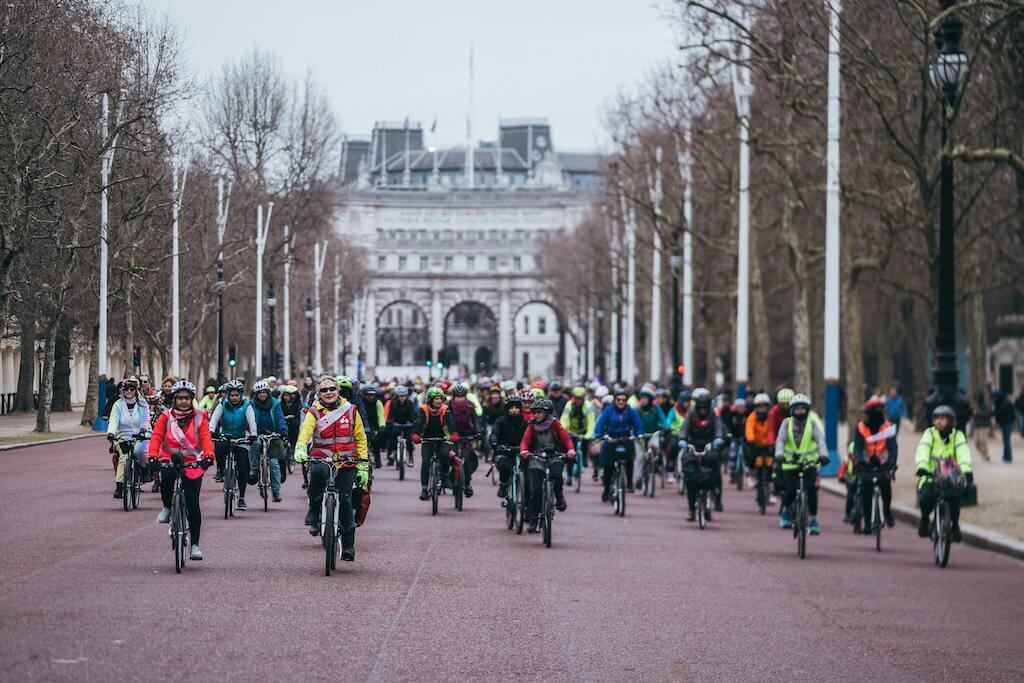
Women’s ride in London (Photo courtesy London Cycling Campaign)
Behaviour follows safety, not the other way around
The researchers behind the analysis argue that cycling uptake is often misinterpreted as cultural preference rather than environmental response.
“The numbers are clear,” said Em Friedenberg, Research Manager at Transportation Alternatives, who led the analysis. “When women have access to protected bike lanes locally, they take advantage of this uniquely convenient and affordable transportation option. When they don’t, they’re stuck.”
She links this directly to everyday mobility patterns.
“Women are more likely to combine commuting with errands and caretaking tasks, and this propensity for ‘trip-chaining’ is well-suited for the customizable nature of bicycling. When the protected bike lane network is incomplete, it is women’s mobility that suffers the most.”
The global question beneath the data
While grounded in the specific urban context in New York City, this pattern described in the Transportation Alternatives research aligns with broader international findings: cycling participation increases when infrastructure is safe, continuous, and predictable—and decreases when it is fragmented.
The deeper implication is not about bicycles themselves, but about access to movement.
In cities with incomplete cycling networks, riding a bike becomes not just a choice, but a conditional one—available in theory, uneven in practice.