
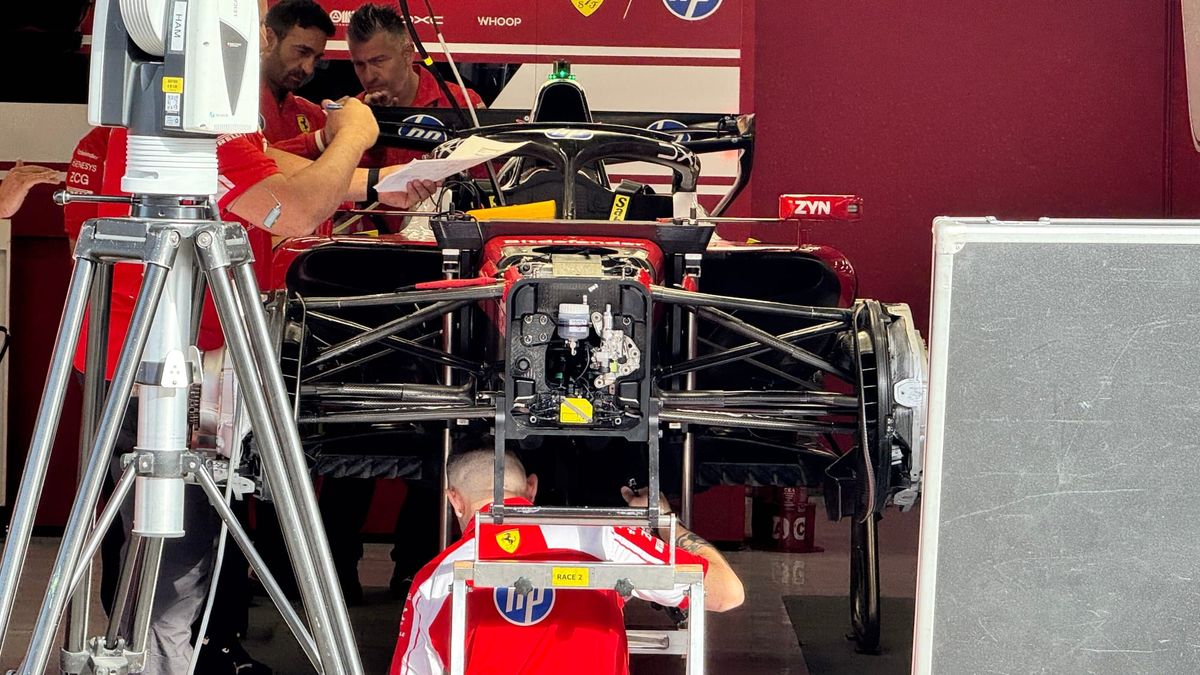
Plenty of column inches have been dedicated to Ferrari’s brake problems both this year and in 2025.
Charles Leclerc was extra vocal about his problems in both Montreal and Monaco, with the result that he’s changing his brake discs from Brembo to Carbon Industrie this weekend.
Lewis Hamilton has used the CI discs since the Japanese Grand Prix weekend. There, Leclerc also tried them but opted to continue with Brembo discs – until now.
It’s not unusual for teams to do this, as although Brembo remains a Ferrari partner and supplies the rest of the braking system, the feel required by the brake discs is very particular for different drivers.
From my past experience, Brembo and CI have fairly different characteristics. In the intervening time, the differences have got smaller, but I can put some numbers on it as an example of how they behave.
In the past, I have had drivers who, like Hamilton and Leclerc, found it difficult to come to terms with these different characteristics. Also, from circuit to circuit, one spec or another can be advantageous.
Whatever the supplier, there is the challenge of the contribution to braking from harvesting energy from the rear axle. Achieving that balance is difficult, especially when you are trying to optimise the battery pack level during a safety car period or after a warm-up lap.
Low-pressure braking episodes will all be managed by front brake pad and disc pressure, generating heat into the disc and pad assembly. However, the regen on the rear axle will manage rear axle retardation, so not generate heat into the disc and pad assembly.
So first of all, here’s what I expect from Brembo…
1 Efficient working temperature around 200Ct o 900C.
2 Higher than that, and the disc and pad wear rate goes out of control and/or you need more cooling, which can be detrimental to overall downforce.
3 Better and more consistent into the first corner, or when cool after a safety car.
4 Better for drivers who are gentle or at least more progressive on the brake pedal.
5 Better for circuits where lower overall braking energy is required, Monaco, Singapore.
Now onto Carbon Industrie…
1 Efficient working temperature around 350C to 1200C.
2 Allows a team to reduce brake cooling without the risk of brake wear getting out of control.
3 Driver needs to make sure they concentrate on getting disc and pad temperature at a reasonable level on out laps and formation laps.
4 Better for drivers who initially jump on the brakes hard.
5 Better for circuits where higher overall braking energy is required, Monza, Montreal.
From my point of view, Brembo should suit Leclerc’s driving style and CI should suit Hamilton’s. I would be looking closely at how they use the brakes coming out of a safety car period and during the warm-up lap before a qualifying lap or on the way to the grid.
What you have under your right or left foot is critical to driver confidence. For the right foot, it’s about the torque delivery, which, with these new regulations, is something to talk about on another day.
For your left foot, it’s about initial brake response and consistency through the braking phase, especially from a slowish lap leading into that critical initial braking episode.