

Americans and their love of cars is a cultural touchstone. But, as it turns out, it’s not true. And least not according to a new study.
The study, published in Transportation Research Part A, suggests that narrative is badly outdated.
Based on a nationwide survey of more than 2,100 Americans, researchers found that nearly one in five urban and suburban residents (18%) express a strong desire to go car-free, with another 40% open to the idea. That’s not a niche. That’s a quiet majority.
As the authors put it, “nearly one in five car-owning adults in the US is interested in living car-free, and an additional 40% are open to it.”
In other words, the barrier isn’t desire—it’s design.
Car-Free, But Not By Choice
The study draws an important distinction between being car-free and being car-less. In the U.S., most households without a car fall into the latter category—people who lack access due to financial constraints, not preference.
That matters, because it has given policymakers the wrong idea about demand. If people without cars are struggling, the assumption goes, then car-free living must be undesirable. But that just isn’t the case.
This research flips that logic. It shows a large, diverse group of people who would choose to live without a car—if the conditions existed to support it.
“Interest in car-free living,” the study notes, “shows little connection to sociodemographic characteristics,” cutting across income levels, regions, and backgrounds.
That’s a direct challenge to the idea that car-free living is only for the young, urban, or affluent.
Park of the Alaskan Way cycling route in Seattle (Seattle Department of Transportation)
The Infrastructure Gap
So why aren’t more people ditching their cars? Because in most of the U.S., it’s still impractical. Anything and everything is designed with the car front and centre to the detriment of pretty much every quality of life indicator.
Decades of car-oriented planning have created a landscape where daily life without a car is difficult, if not impossible. Walkable neighbourhoods are limited, transit is inconsistent, and safe cycling infrastructure is often fragmented or nonexistent.
The study points out that high-quality car-free living is largely confined to a small share of neighbourhoods—often the most expensive ones.
This is where the cycling conversation becomes central.
You don’t get car-free living without viable alternatives, and you don’t get viable alternatives without serious investment in safe, connected bike networks. Cycling isn’t a lifestyle add-on—it’s foundational infrastructure for reducing car dependence. And, with reduced car dependence comes a cargo bike load of benefits from economic to health to environmental.
This Isn’t New
If the idea of such interest in car-free living sounds surprising, it shouldn’t.
More than a decade ago, a survey by the Urban Land Institute found that 52% of Americans would prefer to live in a place where they don’t have to rely on a car frequently. The appetite for less car-dependent lifestyles has been there all along.
What’s changed isn’t the desire. It’s the clarity.
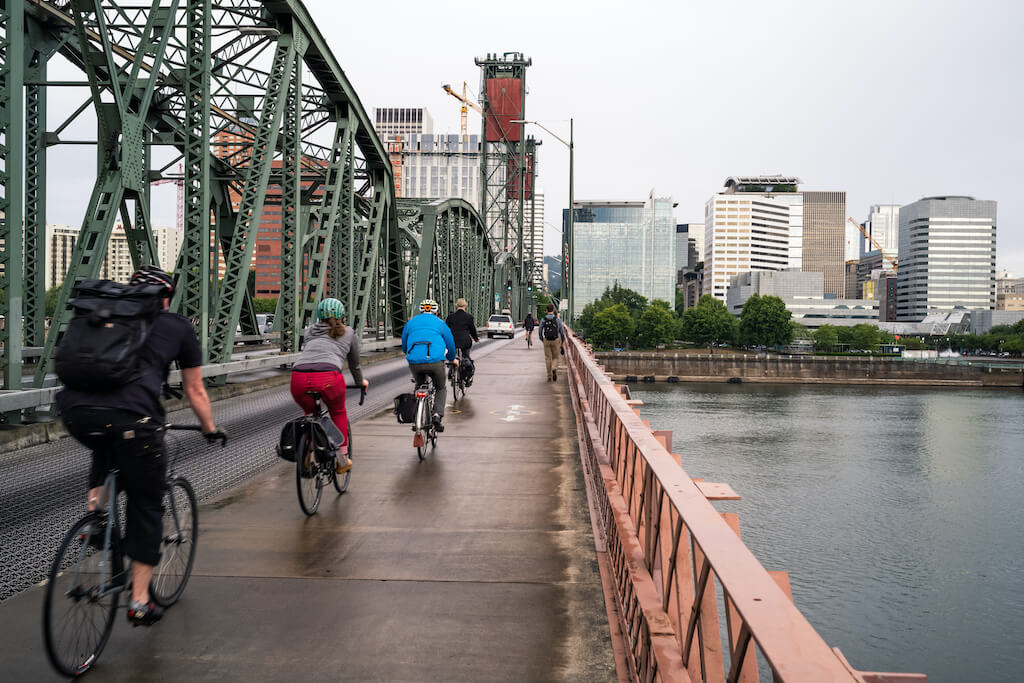
Eastbank Esplanade in Portland, Oregon
Where earlier surveys pointed to a general preference for walkability and reduced driving, newer research is putting sharper edges on that sentiment. It’s no longer just about wanting shorter commutes or nicer neighbourhoods—it’s about a meaningful share of the population actively considering life without owning a car at all.
In that sense, today’s findings don’t represent a shift so much as a confirmation: the demand has been hiding in plain sight.
Build It, and They Will Leave Their Cars
The bottom line is that the demand is already there. We know it, and we see it everywhere a network of safe cycling infrastructure is implemented.
Protected bike lanes. Reliable transit. Walkable streets.
Not as experiments—but as defaults.
Because if nearly 60% of Americans are at least open to living without a car, there is no longer a question that people are ready.