
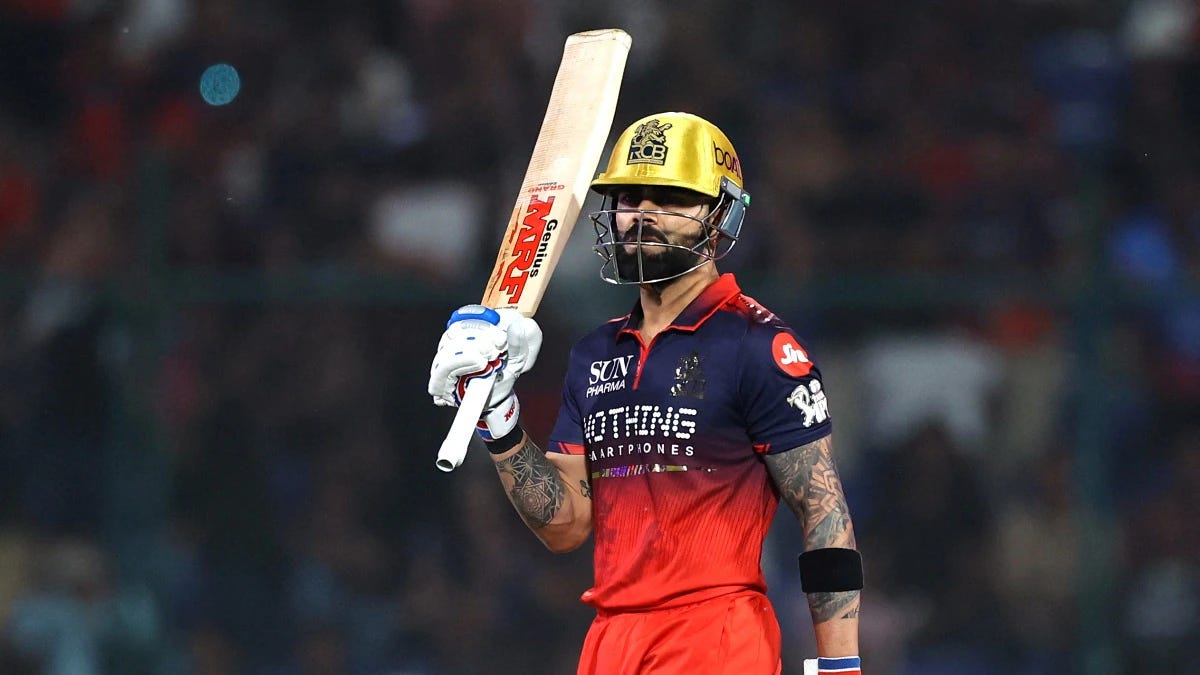
RCB beat KKR by 6 wickets, as the chase master paced the defending champions through a tricky chase with an elegant 105 (60). RCB’s gamble on Jacob Duffy & Venky Iyer provided stability, even if the former conceded 0/48 and the latter didn’t bat.
But, what happened beyond the headlines?
🚨 If you’re an RCB fan, I’d love if you could fill out this 2-minute survey on how you feel about the franchise this year. I plan to create a graphic story of your answers soon! 🚨
✍️ Written by Karan Jain, who runs CricNuance. You can follow him on X.
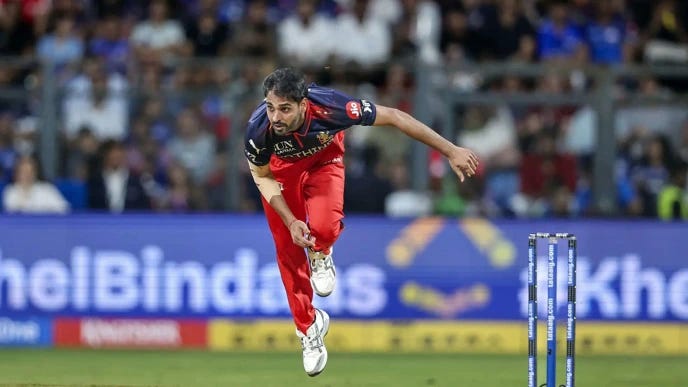
Bhuvneshwar Kumar and Finn Allen have been two of the most in-form players for RCB and KKR this season. Kumar has 21 wickets – and 12 in the powerplay – at a league best bowling average (14) and economy (7). Allen is coming off a 47-ball century, and has struck at 185 in the powerplay in 23 innings in 2026.
Their battle would be an early marker for dominance tonight. However, we didn’t get to see the match-up until the third over – at which point both players had demonstrated what made them so dangerous.
Kumar started proceedings with five consecutive dots to Allen’s partner, Ajinkya Rahane. Kumar bowled conventional full in-swing for the first three deliveries, veering into the stumps from outside off stump. He followed that up with two slower knuckleballs on a length that moved away, utilising the variable bounce of a pitch that had been under rain covers for hours,
These deliveries were bowled right into Kumar’s favoured region in 2026. 94 out of Kumar’s 144 powerplay balls have been bowled outside off before tonight, rarely erring in line. It’s his stock delivery, and has been the source of many of his wickets. Instead of becoming his latest victim, the KKR captain just played the over out for 4 runs off 6 balls.
On the other end, Allen got off to a quick start against Jacob Duffy. He took two deliveries to get used to the slower pitch, with a couple of false shots indicative of his aggressive approach after Rahane’s passivity. By the third delivery, he had figured out the slow pitch and the predictable hard length bowling, and dispatched his Kiwi compatriot for three consecutive boundaries.
Finally, on ball 2.2, we had our match-up.
Kumar’s first ball to Allen was a back-of-the-length knuckleball outside off stump, which Allen predicted and dispatched for 4. At this point, RCB had bowled almost every ball on the same slightly outside off line, and the KKR opener had adapted well. He could wait for the obvious ball, and easily take care of business.
While that was a successful strategy against Duffy, Kumar is a wilier customer. While 65.3% of his deliveries have been in that off-stump channel this season, he’s also been exceptional with his line variation. He’s bowled just 38 powerplay balls at the stumps this season, but taken 4 wickets. Allen was about to become number five.
The next ball was a masterpiece in confusion and deception. Kumar went fuller, on the stumps, and – unlike any of his other on-pace deliveries at that point – got the ball to seam away after swinging in. It was a combination of variations pitched at just the right point to cramp the tall Kiwi, and induce an uncertain swing that edged to the keeper.
Getting Allen early was invaluable. The opener accelerates from a strike rate of 185 in the powerplay to 214 in the middle overs in 2026. His teammates have not been able to replace his powerhitting this season, scoring at just 126.82 in the powerplay without him, and 134.46 in the middle overs.
In a game where KKR ended up 15-20 runs short because they consolidated in the middle overs, and got cramped towards the end, Allen’s powerplay heroics were desperately missed. For one night at least, we have an answer on who’s been better this season.
Data from ESPNcricinfo & Opta.
✍️ Written by Aarush Adil Khan.
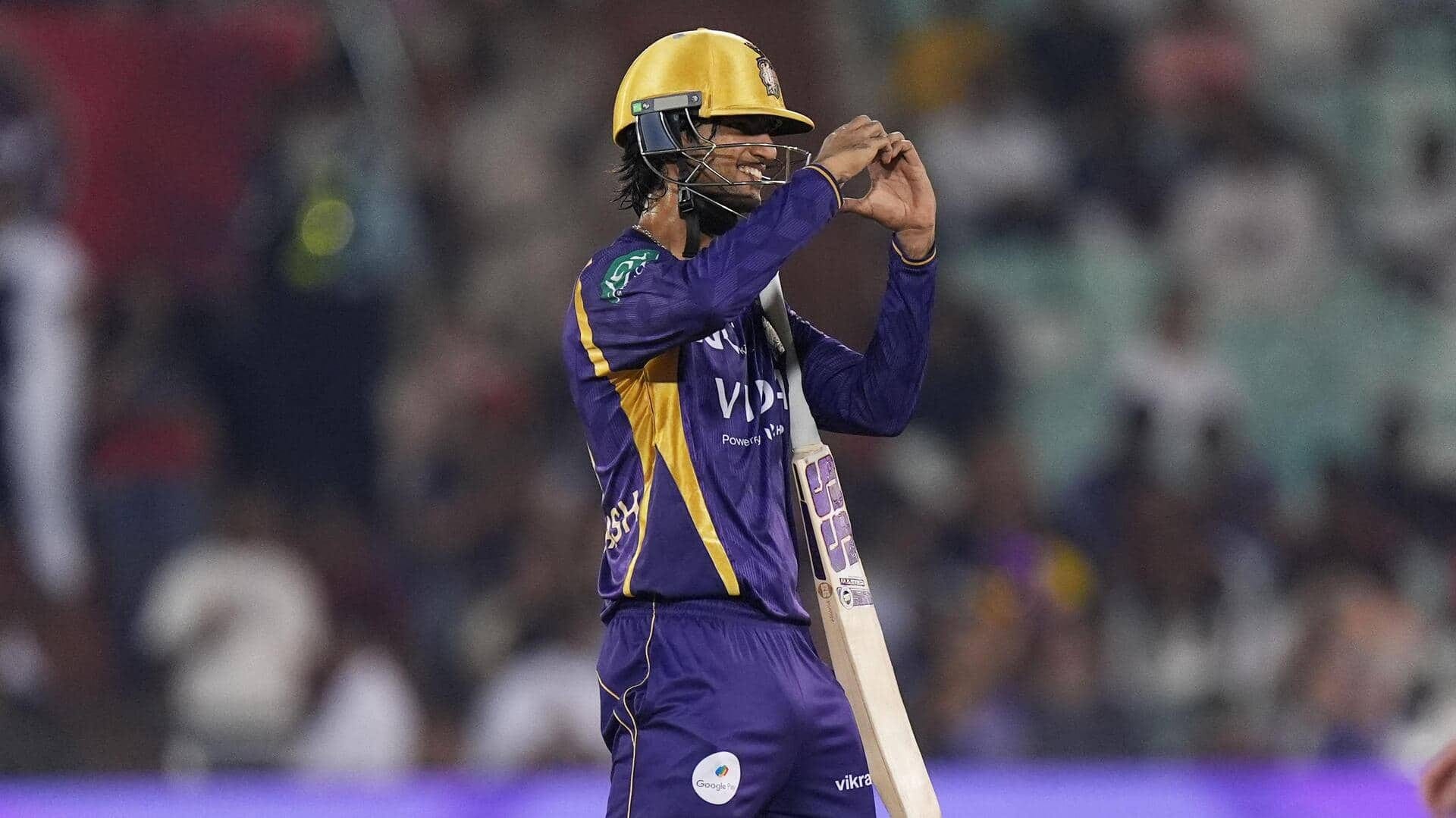
Angkrish Raghuvanshi continued his good form for KKR in the first innings today. He had to come in earlier than usual, but he adapted to the powerplay with an extremely un-powerplay-like strategy; reduce the boundaries, and increase the running.
Before the 21-year old made his way out, Allen & Rahane put together a more traditional powerplay partnership. 23 runs in 15 balls, including five boundaries, 9 dots, and just a single run between the wickets. Raghuvanshi flipped the script after Allen’s wicket; his partnership with Rahane included just four boundaries, 6 dots, & 5 runs between the wicket – and totalled 25 (13) when it was done. Two more runs in two less balls by scoring fewer boundaries in the powerplay.
It was indicative of two strategies that the 21-year old would implement over the course of his 71 (46) innings. One, keep running – he had a dot ball percentage of just 26.08%, and only faced consecutive dots twice in his 17-over stint at the crease. Two, adapt to your partner’s needs.
When Rahane got out in the fifth over, KKR were at 48-2. A good run rate on a competitive pitch, but with wicket pressure starting to pile up against the league’s best powerplay bowlers. In walked Cameron Green, who looked shaky to begin with.
Despite boasting a first 10-ball SR of 148.57 in the powerplay since 2025, Green started tepidly. He had just 3 (6) at the end of the powerplay, and was batting at 16 (18) by the 11th over. So, Raghuvanshi took on the responsibility of run scoring. He scored 27 (18) in overs 7-11, hitting both pace and spin for boundaries to keep the scoreboard ticking along.
The manner of his hitting was particularly impressive. Throughout his innings, he repeatedly attacked short balls on a pitch with unpredictable bounce – scoring 5 boundaries of 9 balls. This isn’t a major surprise since Raghuvanshi has scored nearly 13% of his IPL runs since 2024 via pull shots, at an impressive control rate of 78%.
By soaking up the pressure, he let the nervous Green settle, and reaped the rewards. From the 11th over onwards, the Aussie all-rounder scored 16 runs in 6 balls before Rasikh Dar clattered his stumps. He would end on a more than respectable 32 (34) because Raghuvanshi paved the path for his innings.
Up next was Rinku Singh, KKR’s famous finisher-turned-middle-order-bat. Much like Green, he needed his time to get settled and took just 5 runs off his first 4 balls. Once again, Raghuvanshi took charge by scoring a boundary – and Rinku picked up his cue much faster than Green with a boundary of his own two balls later.
As a duo, they didn’t let any of Kumar’s and Josh Hazlewood’s four death overs go at less than 10 runs – often running furious singles and doubles to keep the runrate up. In all, they ran seven 2s in their 76 (46) partnership. They ran 42 of those runs in just 39 balls, giving them an absurd non-boundary strike rate of 107.69. For context, an NBSR over 70 is considered great.
If you ignore the last ball run out, RCB’s prolific bowlers were only able to take three KKR wickets tonight – their joint lowest total this season. Raghuvanshi thwarted the RCB bowlers by both sticking to his crease doggedly, and helping his teammates do so as well via smart batting and tactics.
Data from ESPNcricinfo, the Jio broadcast & Deepcrease.
✍️ Written by Raunak Thakur, who runs Dead Pitch’s Society. Follow him on X.

Common logic dictates that you don’t fix what isn’t broken. RCB returned to the top of the table with an expected win against the 8th-placed KKR, but only after they tried to experiment with their line-up. In came Duffy, and out went Romario Shepherd (with a couple of other related changes).
On the face of it, the gamble didn’t go well. Duffy conceded 32 runs in two powerplay overs, and ended with figures of 48-0. That’s an economy of 12 in an innings where KKR only scored at 9.6 runs per over.
The Kiwi bowler was unsure of his lengths on the tricky Raipur pitch, but his very presence fixed a season-long problem for RCB. With Duffy assigned as a designated powerplay and middle overs specialist, RCB could play two powerplay overs each of Kumar & Hoff without surrendering the momentum of the swinging ball.
While he had a bad outing tonight, Duffy is an elite bowler. He took wickets at an average of 15.1 and an economy of 7.47 in 2025, and he’s backed up his reputation with important performances in his debut IPL season. 22-3 against SRH, including four-in-a-row at the top of the innings, have led multiple games where he’s either squeezed the opposition or taken key wickets.
Most importantly, he’s a better system bowler than Shepherd. Duffy’s role in this unit is clear, and it frees up Kumar & Hoff to take on multiple overs in both the powerplay and the death – phases in which KKR went at below par tonight. Bowling out Duffy was always a reasonable option despite his expensive start, because he’s a specialist bowler that knows how to fight back.
On the other hand, Shepherd has been utilised as a floundering backup. He’s never bowled out his quota for RCB, and has always been a stop gap option when RCB feel like they have no one else they can call upon. The West Indian is already a sub-par bowler, chosen for his all-rounder qualities, but 2026 has been particularly bad. He’s taken just 6 wickets, at an economy of 11.9 and an average of 39.7.
More worryingly, Shepherd’s “all-rounder” tag has also come under scrutiny. Unlike his bowling credentials, his batting reputation is well-earned. He’s scored at 271.4 and 291.7 in the last two IPL seasons, proving to be the finisher that Kohli & co. needed at the top of the order to go all guns blazing.
However, this season he is batting at 125.8 across 7 innings, and more often than not increasing the burden on his teammates. Last time out against MI, he struggled to 4 (11) at the death as RCB needed Rasikh & Kumar (10 off 4 combined) to save the game. Which brings us to the second advantage of dropping Shepherd; the batting changes.
Venkatesh Iyer has played just two games this season, both times as an emergency impact sub. However, the ex-KKR man is more than capable of filling the middle overs-gap that RCB have in the batting order.
His capability to bat anywhere in the order makes him the perfect floating option, giving the batting lineup far more diversity compared to Shepherd’s rigid finisher-only role. He has the capability to be an anchor when needed, averaging 34.5 with a strike rate of 144.2 – and striking at 174 at the death this year – and is the perfect glue on days when RCB’s batting order threatens yet another collapse.
On the night, Duffy’s overs were extremely expensive and Iyer wasn’t even needed with the bat. However, their very presence in the squad meant a stability across roles and a comfort with backups that has been missing from RCB’s season.
They’ve swapped an ill-equipped all-rounder for two specialists. It’s a risk, but one that didn’t even need the use of an impact sub tonight despite neither specialist playing to their potential. For the first time all season, RCB’s middle overs and middle order didn’t look weak.
Data from ESPNcricinfo & Cricmetric.
✍️ Written by Tarun Pratap, who runs The Rank Turner. Follow him on X.
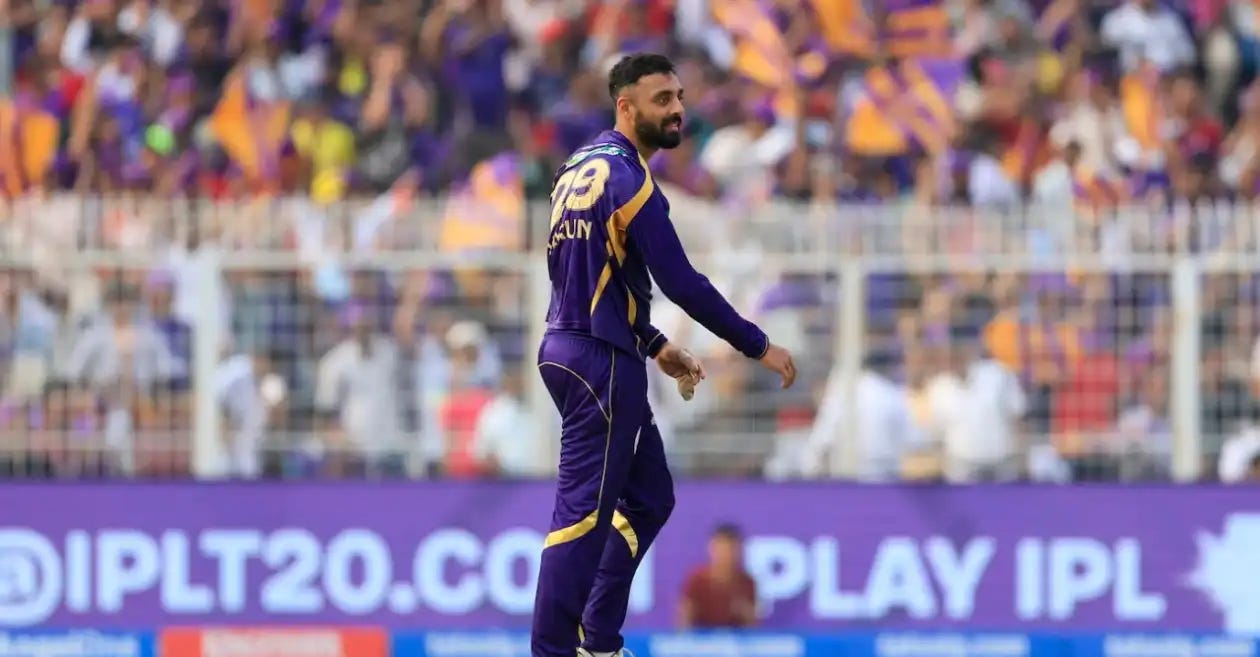
RCB made 91/2 in the middle overs tonight, with the second wicket falling on the last ball of the phase. Kohli, who was on his way to a throwback century, made 49 (35) between overs 7-16 when he has traditionally slowed down in the IPL. This is all very odd against the best middle overs bowling unit in the IPL.
Since the 2023 IPL, KKR have taken more wickets (173) in the middle overs than any other team at the best economy (8.39). Their success has been built on the back of their spin duo; Sunil Narine controls the scoring rate, and Varun Chakravarthy takes the wickets.
Since 2023, the Indian mystery spinner has taken 51 IPL wickets in the phase at an economy of 7.62. No one has taken more, while the West Indian is the only top 10-wicket taker who goes at a better economy (40 wickets at 6.89). The problem is that KKR were missing Chakravarty tonight, and have lost a couple of their other middle overs threats from the last few years; Harshit Rana is also injured, while Andre Russell retired in 2025.
In his absence, Narine continued to perform. He conceded just 21-1 in 3 middle overs, but he had no help on the other end. Anukul Roy, Green & Vaibhav Arora went for 66-0 in their combined 6 overs. It’s not just one bad night; Green goes at 10 RPO in the middle overs this year, while Arora goes at 13.
Their one bright spot is Kartik Tyagi – who picked up 32-3 tonight but has only taken 4 middle overs wickets all season. Without sustained pressure in the middle overs, Kohli was able to easily keep the defending champions run rate up. In the end, they didn’t even need a sustained death overs acceleration, as they only needed 36 runs off the last 24 balls.
KKR’s inability to create pressure across any phase of the game – they also lost powerplay specialist Mitch Starc in the 2025 Mega Auction – cost them the game, and will probably cost them the season. Their bowling template is still built around a defensive spinner and a wicket-taking one in the middle overs, backed by fast bowlers at the start and the death.
However, they no longer have the personnel to adequately execute that plan. KKR have taken 35 middle overs wickets this season, at a league best economy of 7.85. However, Chakravarty has taken 9 of those scalps himself, and with the mystery spinner injured, KKR’s problems were exposed tonight.
Data from Cricmetric.
✍️ Written by Pri Gulati, who runs Thoughts from Third Man. You can follow her on X.
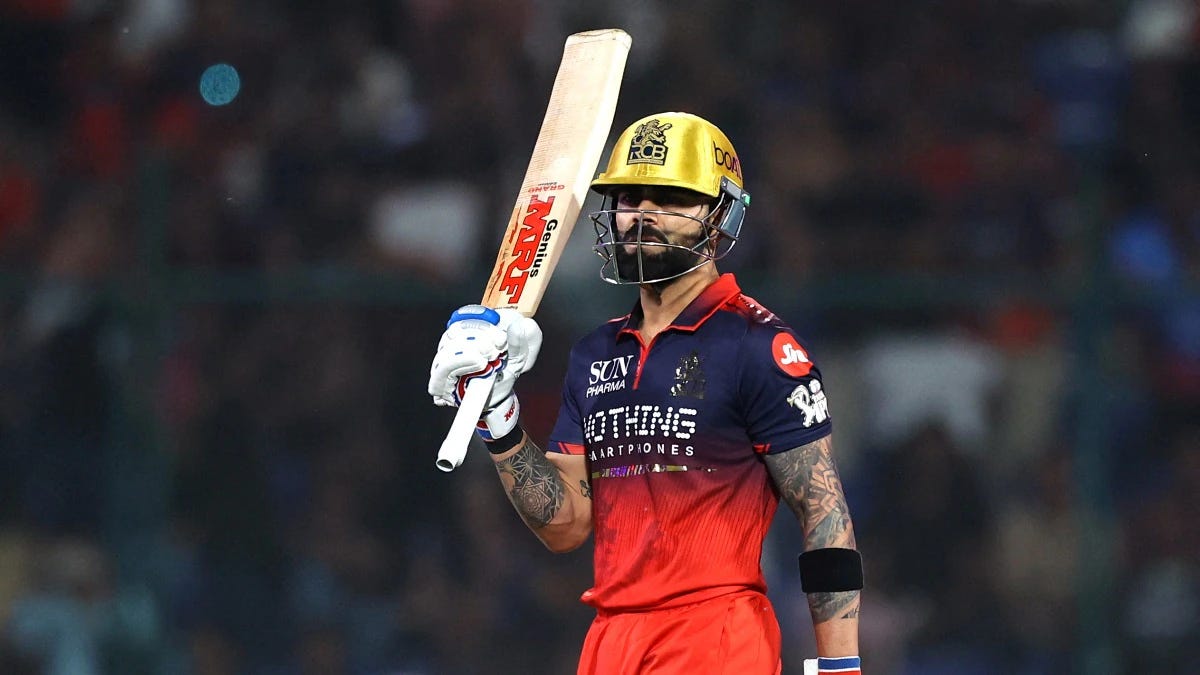
Kohli on the chase is a sight to behold, but the version on display tonight was different. His century on the back of two ducks was a masterclass in innings construction; but more importantly, was a masterclass in guiding his partners on the other end while shouldering the scoring burden himself.
The innings began with a familiar script. Tonight, Arora was the powerplay bowler-du-jour. In the 2nd over, Kohli joyfully devoured him for four 4s every time he mildly erred on line or length. By the end of the powerplay, the RCB opener was 30 (14), and a classic innings was on the horizon: the early momentum, the middle-over control, and the acceleration in the death.
But then KKR tightened their lengths and took the pace off. Narine, Green, and Roy worked in tandem to deny boundary access. The ball held on the surface, and scoring options dried up. Instead of stalling, Kohli rewrote his strategy and got busy. He replaced boundary release with running pressure.
Kohli’s usual T20 method often relies on a balance: singles to keep the board moving, periodic boundaries to prevent stagnation. Now that boundary flow was not consistently available, the innings had to become accumulation-heavy without losing steam.
Between the 7th and 12th overs, Kohli hit just one boundary but took nine 2s. Almost all of these chances were created through angle manipulation and immediate calls. He focused the ball into pockets at deep midwicket and square leg where he knew there would be time to run. He backed away from Green’s cramping line to open up space. Against Narine, he straight-swept for singles.
The partnership with Devdutt Padikkal was instrumental. While Kohli was manipulating scoring opportunities through running, DDP held up the other end via a classic T20 innings. He waited for bowlers to err, and scored well-shaped boundaries. Short balls from Tyagi and Roy were cut and pulled for 4s. He cashed in on those chances, but also ran singles with Kohli when there were none.
DDP departed trying to slap a boundary to a ball that just didn’t have the height, and brief cameos from Rajat Patidar and Tim David threatened another RCB collapse. Kohli was forced to shift gears once more.
The 14th over gave him a release. Arora missed his yorker and Kohli’s vintage snappy wrist work claimed a 4 at long-off. Late boundaries to deliveries from Roy and Tyagi cashed in on the innings construction done prior. Roy dropped short and was pulled. Tyagi landed right in the slot, and Kohli’s wrists did the rest. By the time he reached the 90s, the win and the century were within reach. The manipulation, the 2s, the ugly angles, & the flicked wrists had all been building to this.
A single to bring Jitesh on strike brought up Kohli’s ninth hundred. On display was not a batter at his most effortless. Rather, it was a chase forced to bend to his whim. He rewired it on the back of sweaty 2s, and returned the defending champions’ glow of invincibility after multiple games that questioned their credentials.