
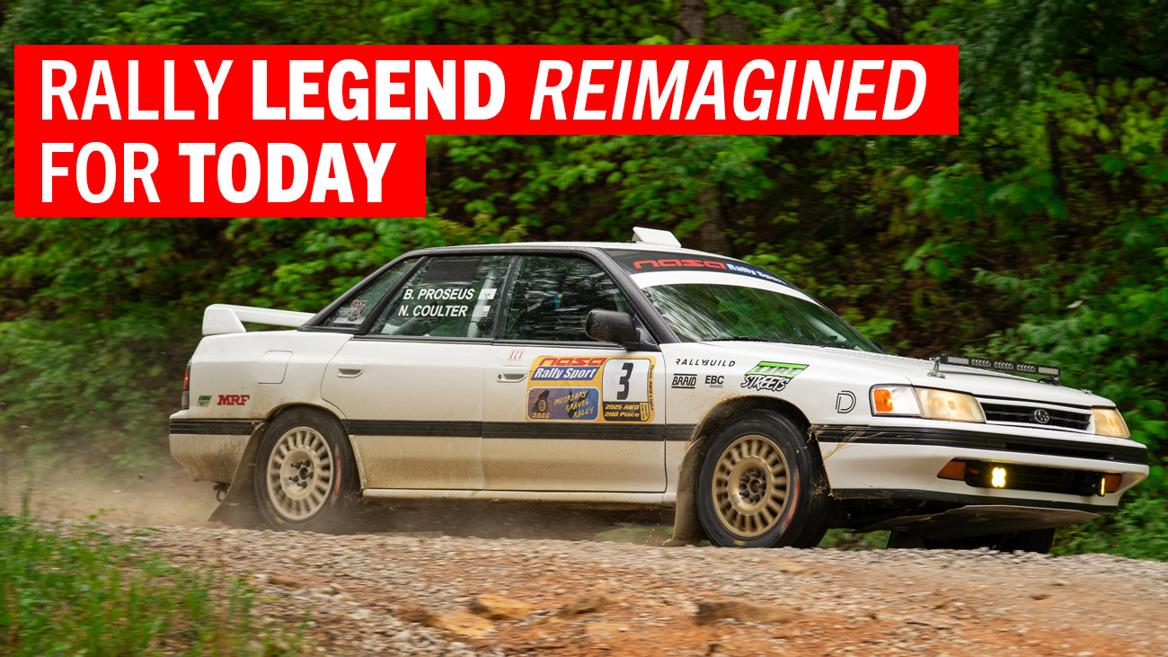
Nostalgia can hit hard when you see a first-generation Subaru Legacy. It’s the car rally legend Colin McRae drove to his first WRC win in 1993.
And just as it started a champion’s career, the Legacy is the platform Nathan Coulter used to springboard from fan to competitor to four-time class winner, including overall in April’s McCreary Gravel Rally, a NASA Rally Sport event based in Stearns, Kentucky.
Humble Beginnings
Photo courtesy Nathan Coulter.
Nathan started out in rally after becoming “obsessed” with the sport, watching videos on YouTube and reading through NASA Rally Sport’s Rally University pages on its website. He decided to get his feet wet in rallycross, but that only further fanned the flames of his burning desire to go rally.
So he bought a prepped car, this one, a 1990 Subaru Legacy, with just two rallies on it. His first rally? The 2019 Rally in the 100 Acre Wood.
Nathan’s debut didn’t go as planned, though, as he completed just one stage of 16. “I put the car into a tree,” he recalls. “That brought my confidence down. It took several years to build up my speed and my confidence.”
Nathan didn’t let the setback deter him. He kept at it. Two rallies later, he finished his first one. In his next rally, he podiumed in his class. Four years later, at the 2024 Boone Forest Rally, he scored his first class win.
Durability First
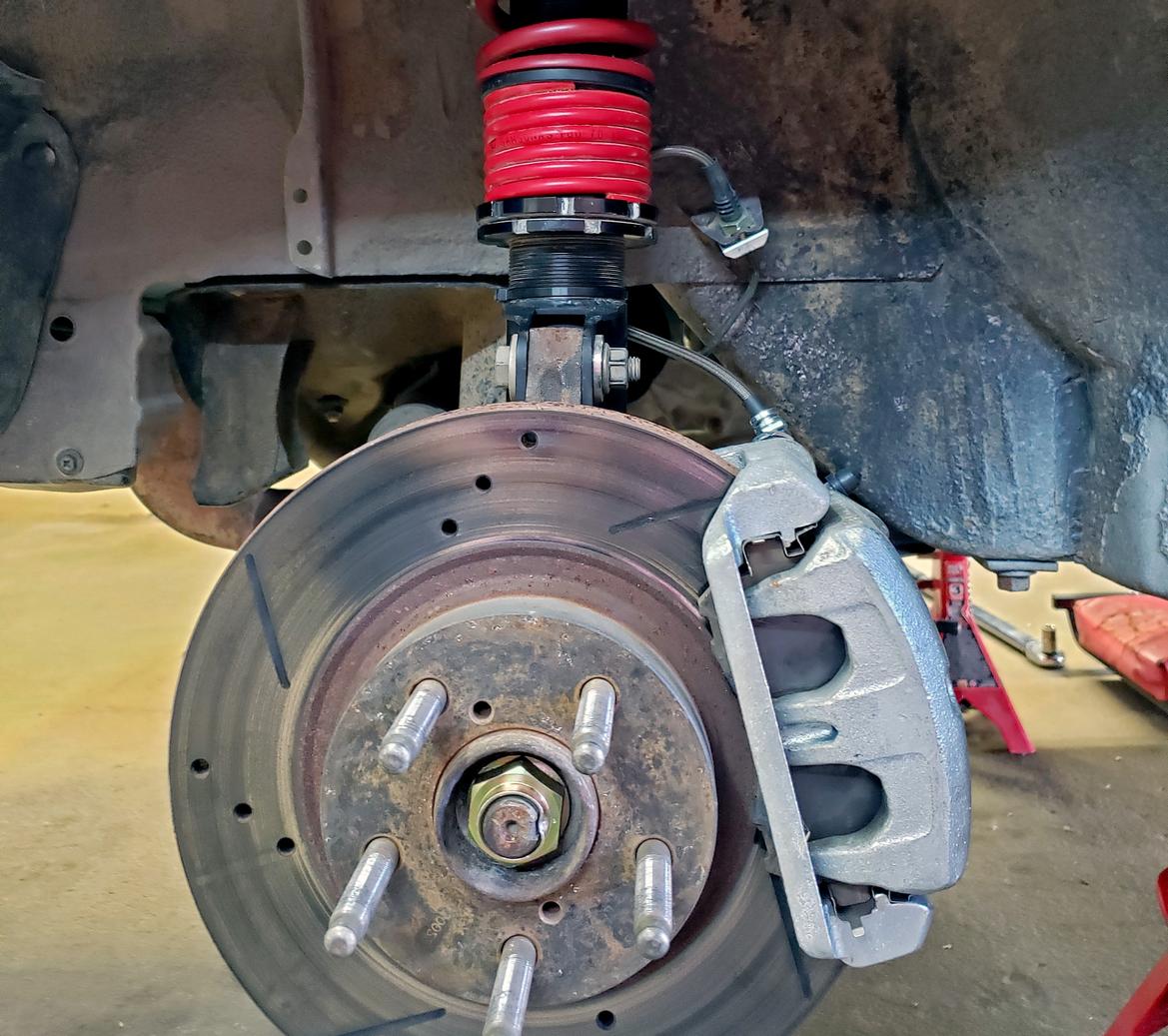
Photo courtesy Nathan Coulter.
The Legacy came with all the rally basics, including safety equipment–cage, logbook, skidplate, some spare wheels and tires. It had a rally suspension already installed, albeit a budget one.
That suspension eventually entered into Nathan’s crosshairs. He upgraded to an inverted, single-adjustable setup from Samsonas Motorsport at the beginning of 2021. “That made a huge difference,” Nathan says. “The car was more planted, and I was able to push harder through the turns and over terrain.”
However, rally is as much about survival as it is speed. Nathan broke stuff–and found new stuff to break.
The car had 280,000 miles on it before it was turned into a race car, so he also worked to eliminate fail points: fresh bushings, a new shifter and the like.
He runs a lot of stock components from a first-gen Impreza, though. Nathan says that many of the components found on the Impreza transfer over to the Legacy.
Impreza parts can be easier to find, he explains. The first-gen Legacy lasted five years, ending its run in 1994. The first-gen Impreza went seven years, with the last models coming in 2001, making it seven years newer, too.
The Impreza also has far more aftermarket support. If something breaks at a rally, he now has 10-plus years of parts at his disposal.
The only aftermarket parts are the dampers and the rear lateral arms to adjust toe. No STI suspension arms in other places, though–aluminum tends to fracture instead of bend, he says, so he sticks to the steel ones.
If you do break something, he explains, the OEM replacements are often less expensive than the alternative scenarios. “The stock stuff works,” Nathan insists. “It’s cheap and acts as the mechanical fuse in the system. It’s much better to replace a $30 control arm than the whole subframe.”
Back to the Samsonas Motorsport dampers: They also helped with durability. “Stronger body–better valving, too–than the previous ones on the car,” he explains. “The dampers have camber inserts, so the alignment locks into place. The alignment doesn’t move–even when hitting big bumps or jumping the car. I had problems with that on the previous suspension.”
He still runs the Impreza 2.5 RS two-piston, cast-iron front brake calipers that the previous owner installed. He then swapped in 2.5 RS one-piston, cast-iron calipers in the rear, too.
“It’s a reliability thing,” he explains. “Guys lose rear brakes with the aluminum two-pots because the gravel wears through the two fluid channels on the outside of them. I’m not going to chance it for an incremental increase in brake performance.
“I just have good pads on 2.5 RS calipers, good rotors and good fluid,” he continues. “When we stepped up to a higher-temp pad, that compound was not offered for the Legacy.”
To increase durability, he also runs HDPE panels to protect the floor pan and rear suspension. Rear wheel scrapers keep the dirt and rocks out of the barrels of the wheels and the brakes.
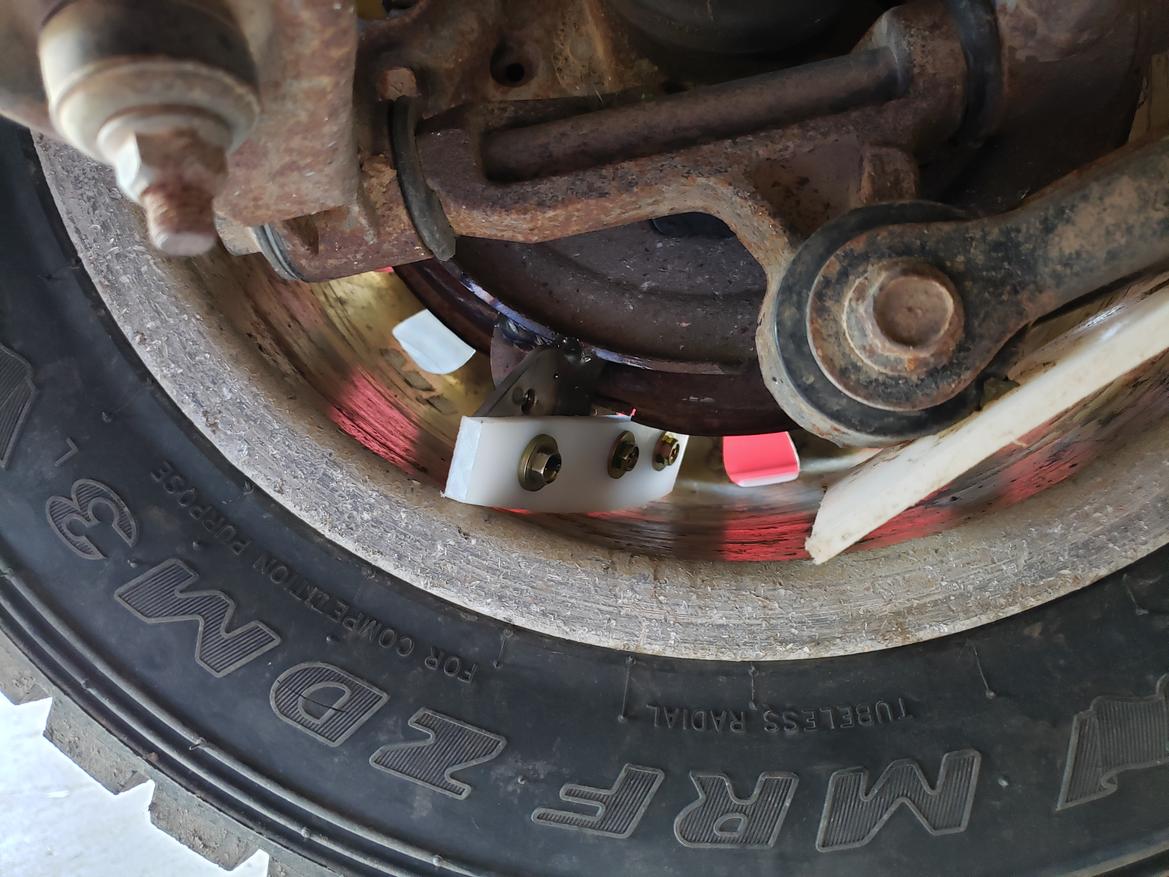
A wheel scraper keeps dirt and debris out of the barrel of the wheel and a UHMW protector on the bottom of the trailing arm protects the lower bushing mount on the upright. Photo courtesy Nathan Coulter.
Speed Next
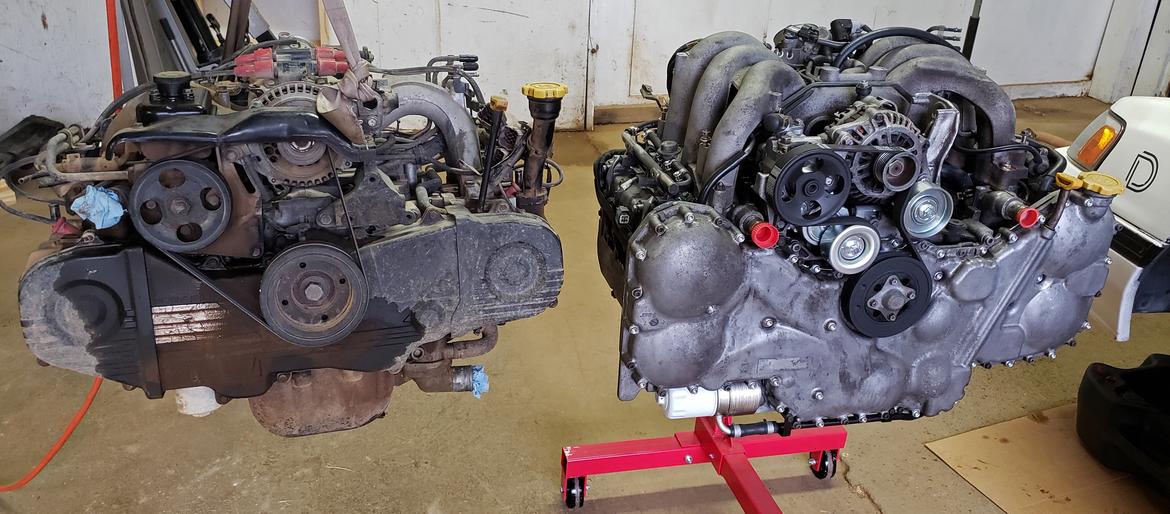
Photo courtesy Nathan Coulter.
Once his equipment started to regularly withstand the rigors of rally, Nathan then went for pure speed. That came later in 2021 when he was still running a 2.2-liter EJ22E. Subaru rated the naturally aspirated engine at a meek 110 horsepower.
“I was flat-footing the engine just about everywhere,” he recalls. “It was pretty gutless but basically indestructible. It was a good engine to start with, but it was time for more power.”
Nathan weighed his options. Rules for his class dictated a naturally aspirated engine. He could have opted for the 2.5-liter EJ25 used by so many in motorsport. Instead, he went with the 3.0-liter, flat-six EZ30D. For the U.S. market, it only came in the 2001-’04 Outback.
“The 2.5 is known for being a bit more finicky,” Nathan explains. “I could get into the EZ30 for a little more money than the 2.5. The Mk I is a bit easier to swap than the later Mk II, especially for my chassis. The Mk II uses CAN bus, so it’s a lot more complicated.
“So I went with the earlier version,” he continues. “It’s a little less power. It comes with single-port exhaust instead of multiport exhaust. It has a variable intake manifold runner, but not VVT like the later version. But to me, Mk I was worth it. It also seemed like the cheaper and more reliable way to go.”
The new engine nearly doubled the power, upping it to 212 factory-rated horses. Nathan then upgraded to the clutch and flywheel found in the turbocharged 2005 Legacy.
He kept the stock five-speed transmission. That was a mistake. That transmission couldn’t handle it, as Nathan slowly came to the conclusion after three years of struggling with failures.
“I broke second gear at one rally in 2023,” Nathan says. “Bearing problems in ’24 and ’25. Broke first in ’25. Had the transmission out three times in 2025.”
So he went with the six-speed manual transmission and matching diffs from a 2004 Impreza WRX STi. This gave him the DCCD (Driver Controlled Center Differential) that adjusts torque distribution between front and rear plus and an R180 limited-slip differential. “So it went from a 30-year-old drivetrain to a 20-year-old one,” Nathan quips. “So much more powerful.”
What’s Next: The Pride and Pitfalls of Rallying an Older Platform
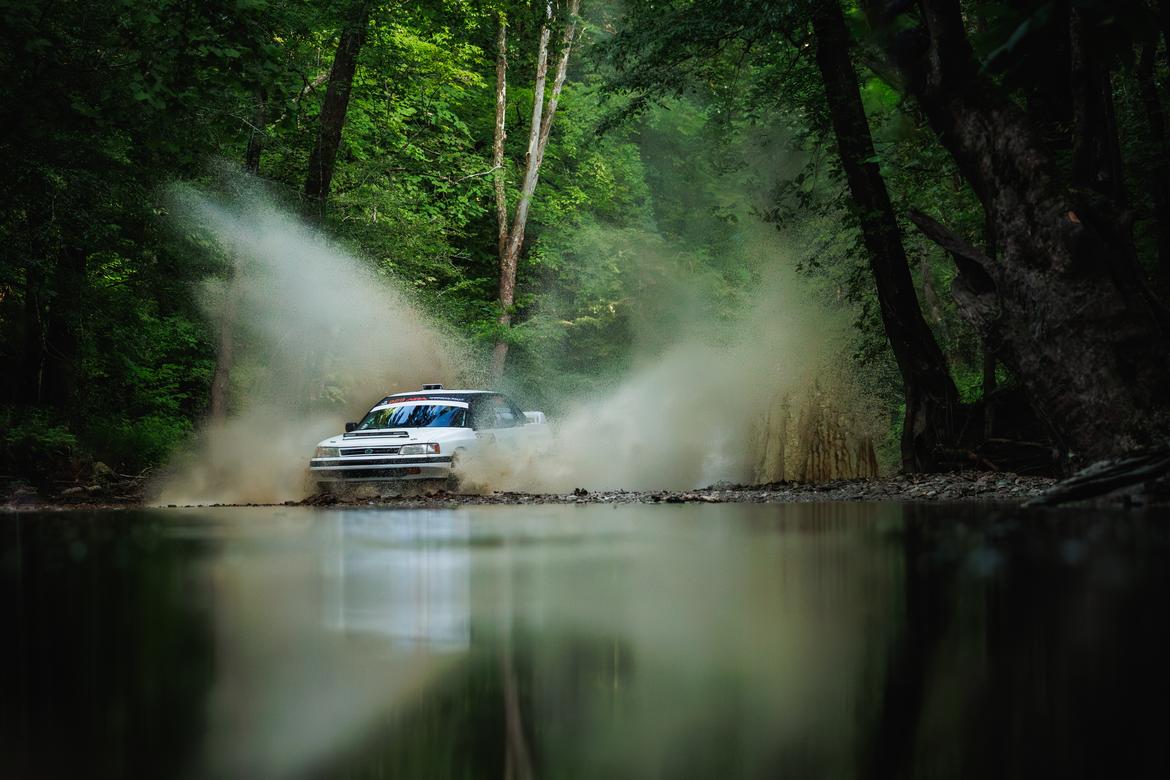
Photo courtesy Trevor Lyden/Nathan Coulter.
It’s amazing how much of a difference 10 years makes. However, Father Time continues to tick. There’s no escaping it. Nathan’s car is 36 years old. While little remains from that era, the body panels still come from 1990. And there’s the rub with Nathan’s race car.
He’s been stockpiling body parts when he can. Subaru still offers some components, but that doesn’t mean they’re well suited for rally.
“The clips that hold the corner lights, they always break,” Nathan says. “I could get those from Subaru, but at any moment those could dry up, because they’re probably just new-old stock. I’ve bought a 3D printer and started 3D printing them … although I’m still trying to get the print just right to where they’re strong enough to run on the car.”
Nathan recognizes there will be a time he’ll have to move on to another platform, but he’s not done yet. He still feels he can squeeze more speed out of the car, but it’ll require him to engineer more solutions.
“The car still can go through lightweighting,” Nathan says. “I’ve got full doors front and rear, full glass all around.”
Nathan plans to start by creating a mold off a spare hood to make a carbon-fiber one. “I’ve never worked with composites before,” he admits. “It’ll be a learning experience.”
It’s going to take a different kind of fearlessness to make his Legacy even faster, one that’s as unshaking in the shop as it is on the stages.
“There are very few [first-generation] Legacies competing in the U.S.,” Nathan says. “A couple of years ago, it was four. Now it’s just two. It’s getting pretty rare. It’s still cool Colin McRae drove one and my car is basically a one of one. It’s the only H6-, six-speed-swapped Legacy stage rally car in North America.”