
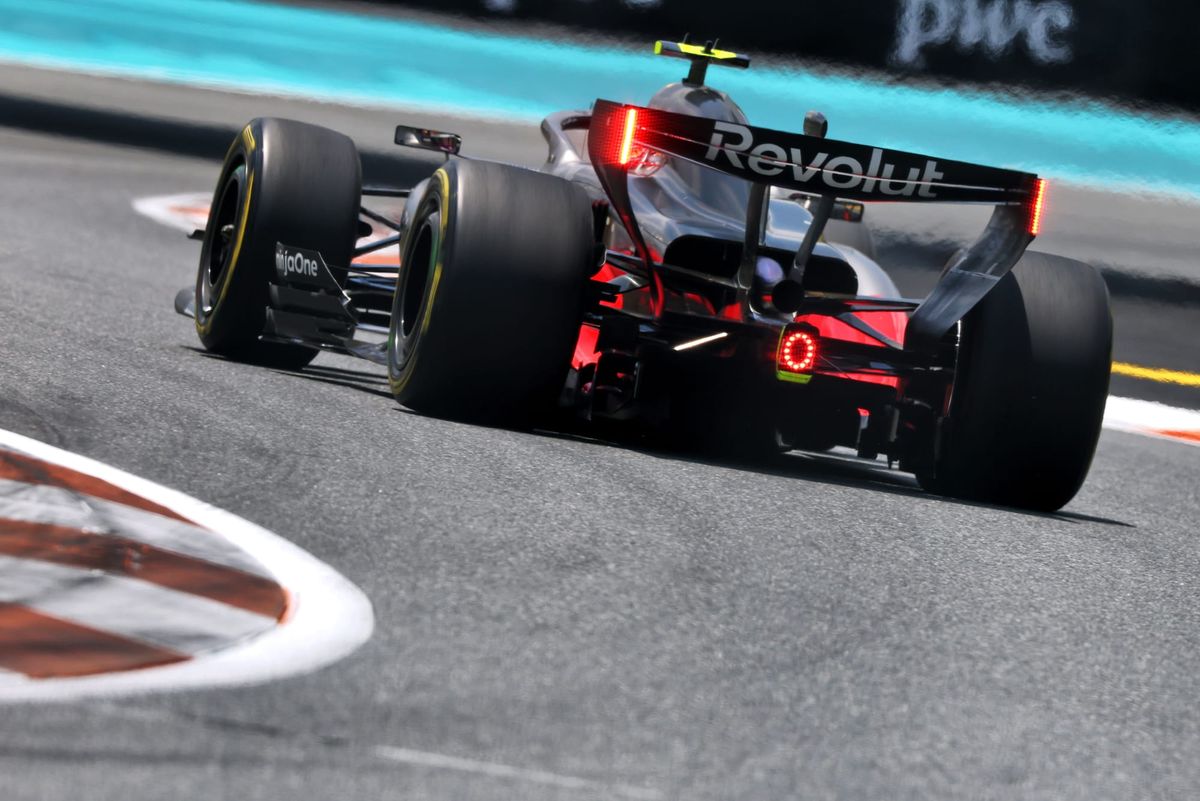
The focus on Formula 1’s rules revolution for 2026 has been almost entirely on the move to bigger batteries – and more particularly the consequences that have come with it.
But amid the frenzied discord over energy starved cars, super clipping, the qualifying spectacle and now a planned shift away from the 50/50 split between combustion power and electrical energy, it has been all too easy to overlook an equally significant change that has been embraced and is actually here to stay.
We are talking about the switch to advanced sustainable fuels, which was as big a foundational pillar for the 2026 rules shift as the bigger batteries.
The new chapter for fuel not only strengthened F1’s green credentials and put it at the front of a technology race that could impact the wider automotive world longer term, but it has also opened the door for ‘old-school’ engines to come back to grand prix racing in the next rule change.
Sustainable fuel is the tool by which V8 engines can return from 2031 at the latest because – with burning fossil fuels no longer required to make V8s possible – F1 is less boxed into a corner when it comes to the type of power unit it needs.
So why has such a positive aspect of F1’s 2026 rules package remained under the radar for many so far?
The bad news about good news
Part of the answer comes from the famous saying that good news doesn’t sell.
That sustainable fuels have so far not been a major talking point in F1 tells us that the new technology has just hit the ground running.
Normally only negative topics tend to get a lot of airtime in terms of paddock gossip. Anything that is working as planned doesn’t grab the attention as much.
So, despite a step-change in technology that could have triggered plenty of drama and controversy, it is a success story that has passed without fanfare. Instead it is the more troublesome electrical element that has triggered the debate, with barely any conversation and zero complaints about the performance and nature of the fuel.
But that also means that while everyone’s attention has been on the role that energy management plays in lap time, the contribution that fuel makes – and how much that fuel has changed for 2026 – has perhaps not been fully acknowledged.
As BP’s motorsport fluids technology lead Luc Jolly explains, the amount of energy the battery has available is super dependent on the output of the internal combustion engine – which itself depends an awful lot on the quality of the fuel.
So, there is a direct line that can be traced between a better fuel and more energy in the batteries.
“It’s still the primary energy source of the car,” Jolly told The Race. “We talk about the 50/50ish electric versus combustion aspect, and all of the energy management topics.
“But all of that energy is still coming from the fuel. So, number one, the primary role of the fuel hasn’t changed.”
For BP, which this year became the exclusive technology partner of Audi but has a long history of involvement in F1 after working with teams including Williams and Renault, the components involved in this year’s fuel are very different from the past – but the technical demands are identical.
“What’s super important is optimising a precise fuel blend,” he said. “Everyone will have their own completely bespoke fuel blend. So, from that point of view, in terms of the power numbers you produce, it’s very reliant on the fuel and the efficiency.
“It’s how much energy that’s in the fuel do you actually make use of? It’s super critical.
“And then, of course, you’ve got this advanced sustainable element. And with that, it’s the performance versus sustainability balance, and there’s decisions you need to make in trade-offs.”
Finding Audi’s appetite
Beyond the advanced sustainable requirements for the new fuels this year there is another intriguing element that has required some rethinking.
The fuel flow limit of the past, which was volumetric, has been replaced with a calorific one. The limit for 2026 is 3000 Mega Joules per hour, which means a different approach compared to the 100kg per hour ceiling of the past.
For Jolly, all new chemicals and an all-new mindset for F1 meant tapping into some experiences BP had in the outside world – and plotting an agreed path with Audi.
“It was quite a long and involved process,” he said. “When we started, obviously the Audi engine was at very early stages of development and, at that point, we’re trying out a lot of different things and we’re maybe not sticking rigidly to things. We’re just exploring elements like: what does the Audi power unit like?
“It sounds a strange way to explain it, but what is its appetite? What componentry does it like?
“In those early stages, we wanted to get a picture of what the Audi power unit in the early phase likes. And then once we started building that picture, and we’re building our models about what sort of blends might work, in parallel, we’re doing the component research piece.
“So knowing the Audi engine likes a certain component, it was then how can we access it from a sustainable source? Is it something we can source? Are we going to have to do something in-house and quite special here to create the final blend?
“We built that picture over time and it was a moving target as well, because the Audi power unit doesn’t stand still. It’s continually evolving. So we were shooting for a moving target as well.
“There was all of that going on at the same time. That is why it took three years to get from point A to now really.”
New challenges, same target
From BP’s perspective, the biggest challenge of getting rolling with F1’s sustainable fuel was not creating the product itself – it was in understanding what the product should be.
Jolly added: “We still need maximum performance and efficiency on the technical side, but that’s not where the biggest change was.
“I would say, for this regulation set, for the fuels. It’s been more about understanding where the challenges are. So it is, how do we do that, whilst meeting this sustainable requirement?”
While fuel companies do not want to give away any of the secrets of the ingredients that make up the sustainable fuels, Jolly explains that there are restrictions in terms of what is allowed.
“Obviously we can’t tell you exactly how we’ve done it, but what I can say is we have to use raw materials which fit within specific categories,” he said.
“So it could be biomass. It could be from municipal waste. Or it could be something called a renewable fuel of the non-biogenic origin, RFNBO, which is basically what people understand as an e-fuel.
“That is where you’ve got your carbon from somewhere, you’ve got your hydrogen from a green source and you have a process to create a hydrocarbon.
“Those are the three main categories, and what I can say is we continue to explore options.”
Speaking last year, Shell’s principal scientist for motorsports, Valeria Loreti, told The Race that all types of waste products were in the mix.
“We can use, for example, residues from the paper or wood industry, we can use residues from crops and agricultural waste, we can use municipal waste, we can even use recycled plastics,” she said.
“The important thing is that we need to measure the energy that is used to process the molecules we want out of the feedstocks. So there will be a calculation about the carbon intensity of the process from the feedstock manufacturing the molecules we want until blending.
“The FIA has set a limit that the new race fuel needs to save 65% or more greenhouse gas in comparison to a basic standard reference fossil fuel.”
Jolly is clear on one thing in particular. Fuel may not have been a focal point right now to a majority of fans, but the role it is playing in ultimate performance is as big as it ever was.
“It is as critical as ever from a performance point of view,” he said. “But you’ve just got this other angle of having more restrictions about how you create that fuel and that having to be done in a certain way.”